Edison Motors Offering All-Mechanical Trucks, At Least To Start

We’ve been following Canadian startup Edison Motors for some time now, but their latest offering caught us a bit off guard — their BDE series truck will be offered first without the electric hybrid drive that first piqued our interest. They make a good case for why in the video below, in which the production prototype tows around a junked Nikola semi as a sort of memento mori of what Edison does not want to end up as.

Now, make no mistake: Edison Motors is going to be selling the series-hybrid version of these big rigs eventually. That truck will have a Scania diesel rated at 500 kW driving electric motors rated at a combined 1800 kW peak power — that’s 2400 ponies. Along with the diesel generator those ponies will be driven by a big o’l battery, but none of that is in the truck in the video. It’s the same cab, and the same frame, but in order to get some revenue in while jumping regulatory hurdles and working the kinks out of the hybrid drive, they put a conventional Cummins diesel and 16-speed transmission in the “Big D” as the truck is known.

The business case makes sense: they don’t want to have their single new product hit a snag, possibly require a recall, and fall into bankruptcy the way the electric truck company Nikola did. The conventional drivetrain also lets them prove their engineering prowess to companies that might like the idea of a Made-in-Canada truck, but be nervous about new technology from a new company.

If you want to know more about the whole diesel-electric scheme, we covered that last year. Edison also has plans to offer its hybrid drive technology for smaller trucks in kit form, which is perhaps the most exciting part from a hacker perceptive.

Continue reading “Edison Motors Offering All-Mechanical Trucks, At Least To Start” →
One Man’s Perfect Retro-Style Monitor Takes All Inputs

Perfection is an inherently subjective measure, in that one must choose the criteria against which to measure. A perfect circle is an absolutely rubbish octagon, for example. So when you see that [RetroBuiltGames] declares that he has built “the perfect multi-input display for retro gaming and vintage computing” — dubbed the “PixelVision AV1000 MKII”— keep in mind that he means the perfect display for his use case. That’s who he’s building it for, after all! The degree to which you find his product perfect is going to depend by-and-large how similar his use case is to yours. In that sense detailed explanations in the design/build video embedded below may be more valuable than the STEP files and PCBs in the GitHub link above– that way if your use case isn’t identical, you can perhaps learn something on the journey to build your own perfect monitor.

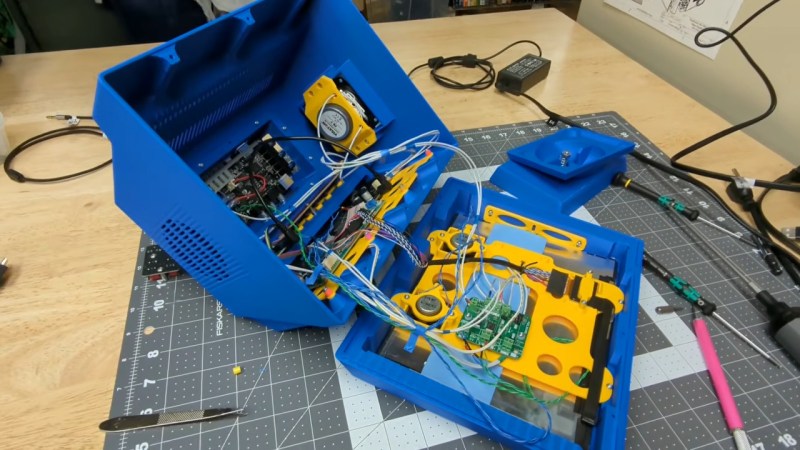
For [RetroBuiltGames] the aesthetic was obviously a big part of it– he’s inspired by the Amiga 1000’s monitor, and a tiny tilting Sony CRT TV.  He was obviously looking for many inputs, as given by the title, and he has an unusually high interest in pixel density for a retro enthusiast. Hence a 9.7″ 2K iPad display forms the basis of the project. The multi-input aspect is provided by a retrotink clone whose PCB lives in a bulge on the back of the unit that could easily house an SBC if you wanted an all-in-one emulation station– it already has a couple of decent speakers mounted in the sides.

Another big piece of the puzzle we don’t see enough of in such projects is Design For Manufacturing– the manufacturing method of choice being FDM 3D printing. The whole assembly was designed in chunks that can be easily printed  with the most visible surface flat on the bed – and if assembly proved difficult, than the parts were redesigned. His explanations aren’t a full DFM course by any means, but it’s good to see these things considered. If you need more detail on that front, we’ve featured plenty of such guides before.

We’re particularly taken by the conceit of creating his own packaging for the unit, and going to the effort of filming an unboxing video for a product he made himself. It’s just a bit of silly fun. We’ve seen boxes before, but generally speaking that sort of thing is saved for when a project becomes a product.

Continue reading “One Man’s Perfect Retro-Style Monitor Takes All Inputs” →

Laser Layers For (Almost) Isotropicly Strong Prints

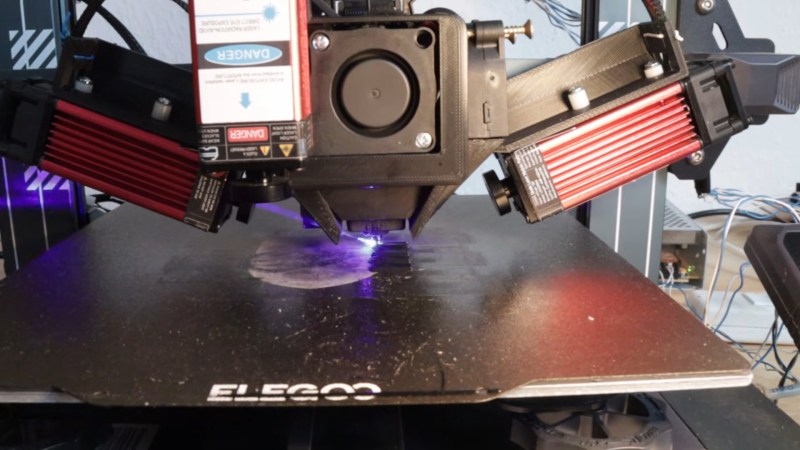
If there’s one defining factor about 3D printing you have to account for when you’re making a design, it’s probably layer adhesion. Sure, there are a lot of factors to consider, but having the z-axis of your part dramatically weaker than x- and y- is a pretty big deal in a whole lot of applications. [I Changed a thing] changed a thing to fix that — namely, he changed his 3D printer by strapping a couple of lasers to it. That’s the kind of hack we like to see!

What the lasers are doing is a very simple idea: they’re pre-melting the last-laid-down-layer just under the nozzle so that molten plastic is meeting molten plastic to create a much stronger joint than you get when you extrude onto an already-cold layer. The second layer keeps the hotspot warmer longer, which also helps the bond. The resulting parts are not purely isotropic, but he’s getting breaking strain along the z-axis of ABS that’s up to 94% of what he’s measuring in the x direction, while PLA still rates at 77.9%. That’s compared to 60% and 41%, for un-lasered samples, respectively. If you watch the video, you’ll get all the details for the printing process and can see more test data.

These lasers look like a game-changer, but their mass might slow down the fast coreXY printers that are so popular these days. If you don’t want to slow down, remember that changing your layer patterns can boost a print’s strength on its own.

Thanks to [Josh Pensel] for the tip!

Continue reading “Laser Layers For (Almost) Isotropicly Strong Prints” →

R-Selecting Tiny Probes To Shotgun Into Saturn’s Rings

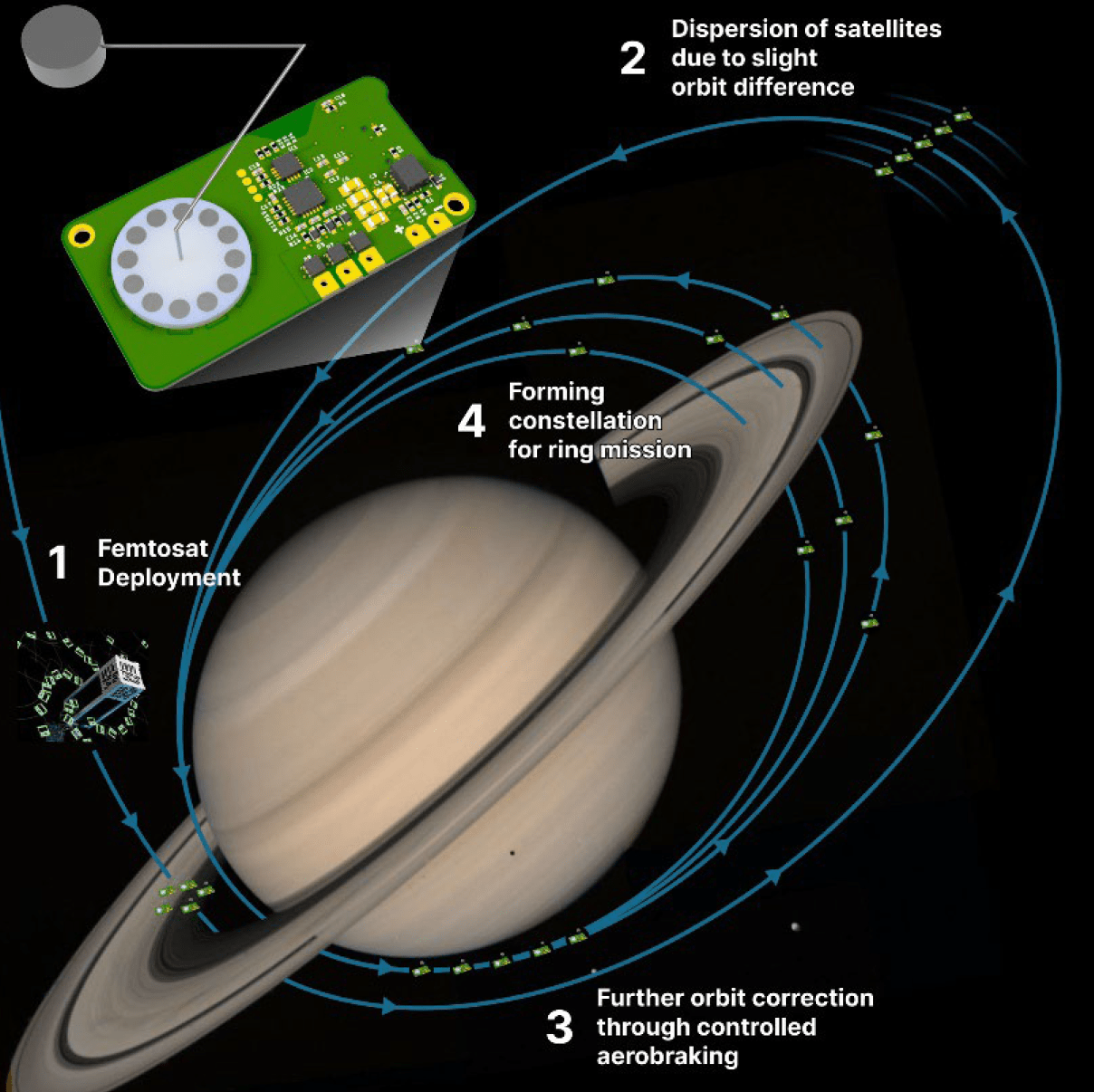
In ecology, there used to be a concept — now largely unfashionable — that species could be described as r- or K-selected, depending on how they treat their offspring. An elephant that has one calf every few years and devotes immense resources to them is adopting a K-selection strategy — much as NASA traditionally has to its flagship probes, like Cassini. A sea turtle who leaves hundreds of eggs in a clutch on the beach and leaves without saying “good luck”, content in the knowledge that one of them will probably make it to adulthood is engaging in an r-selected strategy, and it’s this strategy that [Dr. Michael Rubenstein] is proposing for a next-generation mission to Saturn as part of NASA’s Innovative Advanced Concepts Program for 2026. Entitled “Actively Steerable Femtosat Constellations for In-situ Exploration of Saturn’s Rings, Atmosphere, and Magnetosphere”

The concept is pretty simple: the rings are a horrifying mess of dust, debris, and ice bits of all sizes that represent almost certain death for a spacecraft. By launching 10,000 femtosatellites, those odds of almost certain death become an almost certainty that one or more will make it through with precious data. In the immortal words of Lord Farquhar, “Some of you may die, but that is a sacrifice I am willing to make.” With Cassini, NASA would never consider such a sacrifice. With itty-bity femtosatellites, it starts to make sense. We’ve been saying for years that the future of space is tiny, but these sacrificial probes would make even modern cubesats and picosatellites look big.

Thanks to [Richard HT] for the tip! His tip was to a podcast featuring [Dr. Rubenstein] with [Fraser Cain], which we’ve embedded below. It has a lot more details than NASA’s official blurb page.

Continue reading “R-Selecting Tiny Probes To Shotgun Into Saturn’s Rings” →

Machine Learning COFFIES “Hears” Sunspots Before We Can See Them

In this age of neural net “AI”, even the most skeptical of Butlerians have to agree that these machine learning models can be very, very good at pattern recognition if nothing else. NASA is on the same page, and to take advantage of that pattern recognition, they’ve built a machine learning module called COFFIES, which stands for Consequence Of Fields and Flows in the Interior and Exterior of the Sun, because at NASA everything is an acronym, or at least a backronym. Like most such names, this one is at least vaguely descriptive: the model is trying to predict what’s going on in the material flows and magnetic fields deep within our local star, and using those inferences is able to predict active regions– that’s sunspots to us chickens — up to 12 hours before they visibly form.

Continue reading “Machine Learning COFFIES “Hears” Sunspots Before We Can See Them” →

Scanning For Lifesigns With ESP32 And Raspberry Pi

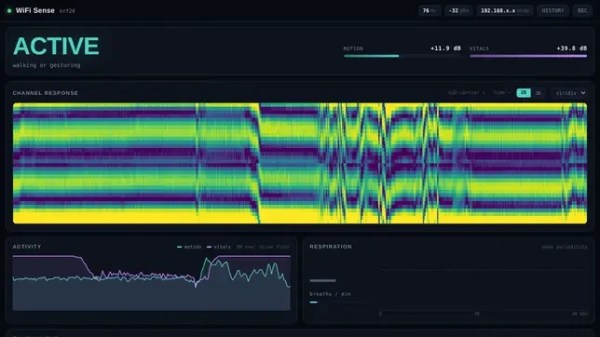
It’s a sci-fi trope that you can ‘scan for life signs’ and detect if there are humans — or suspiciously human-shaped aliens — present, but in real life it’s harder than that. [The Masked Bear]’s wifisense-pi project isn’t really scanning for signs of life, either, unless you happen to consider breathing a sign of life. Even then, it’s not detecting breathing per se, but the subtle motion that goes with it: it’s a very sensitive motion detector that relies on the fact that we fleshy bags of goo disturb WiFi signals with our presence, and motion alters those disturbances.

The device uses an ESP32-S3 to measure the radio channel 100 times per second, while a Raspberry Pi 4 provides the signal processing muscle. It can detect the slightest motions, and even determine the presence of a perfectly still human by their breathing, though you can hide your presence for as long as you can hold your breath.

A single sensor, no matter how sensitive, cannot give position information, and while multiple humans will distort WiFi more than a single one, [The Masked Bear] reports you cannot reliably extract that signal. So this project answers the question: “are there humans in this room?” Or, even more likely, “are there any large breathing animals in this room?” We can’t imagine a 50 kg Mastiff looking any different to this sensor than an equivalent mass of quivering human flesh.

Before you dismiss this as just another motion sensor, keep in mind that it is sniffing the signals already present on the 2.4 GHz band, and, like the WiFi signals themselves, it can work through walls. So we think it’s pretty nifty.

Of course, there are many other ways to detect humans, from machine-learning cameras to millimeter-wave sensors to a simple PIR. This isn’t the first project we’ve seen that uses WiFi like this. It isn’t even the first with an ESP32, but it’s an interesting implementation worth checking out.

ESP32 Music Sequencer Is Clearly Nailing The Y2K Aesthetic

Do you remember back when electronics came in clear cases? Back around the turn of the millennium, when translucency was chic. [3DSage] sure does, which is why he went to great lengths to make a clear case for his Clear Retro Music Sequencer.

The sequencer itself is based around an ESP32-S3 module with a built-in display, and a rotary encoder that handles most of the input. Most, because there’s a second button and a stylophone-like array of brass rods on one edge of the custom PCB he made with his fiber laser that can also handle note input. Other notable features include a phono jack with built-in switching so the tunes come out automatically from headphones or the internal speaker, and a AAA battery-lookalike. It’s a small detail, but that 666 mWh 3.7 V lithium cell is the demon’s meow for this project, seeing as it gives the convenience of a modern battery without compromising that Y2K look — remember you can see the battery through the translucent case.

About that translucent case: it’s 3D printed out of PETG, with settings similar to those we’ve reported on before: hot, slow, and don’t cross the streams! Which is to say every layer must line up with the one above. Oh, use filament fresh out of the drier of you live somewhere as humid as [3DSage]. The result is not totally see-through, but an application of clear enamel fills in the surface well enough to read through, giving the vintage look [3DSage] was after. To complete that Y2K feel, he turns the device into a slap bracelet, because why not? For those of you who missed due to the aforementioned federal prison arc, slap-on wristbands were all the rage amongst the kids back in those days.

The wristband is a length of measuring tape at its core, the springy steel having been cold-worked to hold the radius of [3DSage]’s wrist in its relaxed state, encapsulated in clear gorilla tape for comfort. We probably don’t have to tell you that getting slapped with a raw tape measure isn’t the nicest. For the actual operation of the sequencer, check out the video embedded below — the first 9 minutes cover the build, while the rest shows off the product.

Of course you don’t need an ESP32 for this kind of music maker– you can do it with a C64, or even discrete parts and rope-core memory. 

Continue reading “ESP32 Music Sequencer Is Clearly Nailing The Y2K Aesthetic” →