Piano Escapement Migrates To Drum Kit

For as popular as the piano is in music studios, homes, and schools, it almost defies logic. Compared to a guitar, harmonica, or drum set, pianos are incredibly complex machines that can have somewhere on the order of 8,000 moving parts in a case that can easily weigh hundreds of pounds and which often responds quite poorly to seasonal changes in temperature and humidity. But for putting up with all of these downsides, musicians are rewarded with an instrument that uniquely responds to touch, style, and emotion. A big reason for that is that mechanical complexity, and [Super Valid Designs] is attempting to bring that design to a drum set.

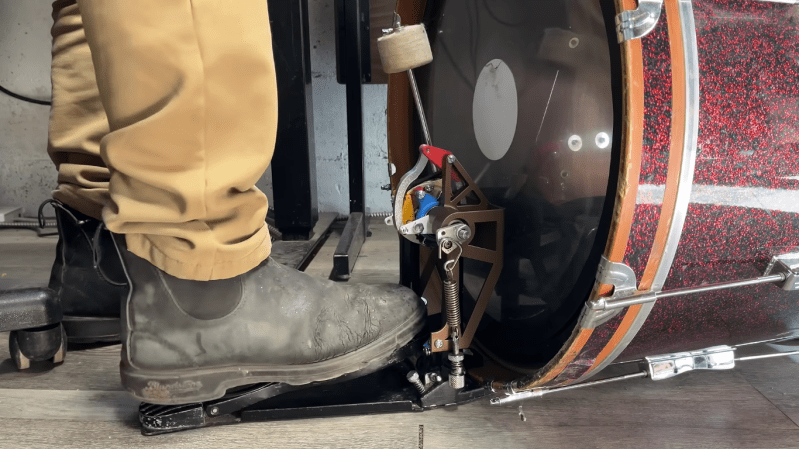
Compared to the complex machinery that connects the movement of a piano’s key to its hammer striking a string, a kick drum pedal is much simpler. It can only bounce off of the drum or get “buried” where the beater remains pressed up against the drum after hitting it. [Super Valid Designs] wanted something with a bit more finesse and control, so he first 3D printed a mechanism that throws the beater towards the drum head and then disconnects it mechanically from the pedal, so that it rebounds even if the pedal stays depressed. The next steps were more difficult, which involved making sure the mechanism reset itself in a repeatable way, without making too much noise of its own. This involved trying out a few different ideas and printing a massive amount of subtly different linkages, but in the end he’s left with a machine that nearly replicates all of the parts of a piano’s escapement,

The end goal of this project wasn’t simply to reproduce piano mechanisms on a drum set, though. [Super Valid Designs] hopes to make a kick drum that’s much smaller than those found in traditional kits, and since smaller drums respond poorly when the beater remains on or near the drum after striking it, a mechanism like this will dramatically improve the performance of the smaller drum and help reduce the requirement for perfect technique. And, maybe in 50 years or so, these types of escapements will take over the drumming world just like the piano escapement took over keyboards after its invention in the 1700s. Some simpler piano actions have been built before, but the complexity seems to be a requirement for all of the tasks they need to do whether its for a piano or a drum.
Continue reading “Piano Escapement Migrates To Drum Kit”

2026 Frikkin Lasers Challenge: Super-Simple Laser Precision For Your Stargazing

Perhaps the hardest thing for amateur astronomers just starting out is finding the things you want to look at. Prolific maker [mircemk] has submitted a quick-and-easy star-hopper device that will help guide your binoculars with laser-like precision using things you likely already have on hand: a smartphone, a mounting plate, and a green laser pointer.

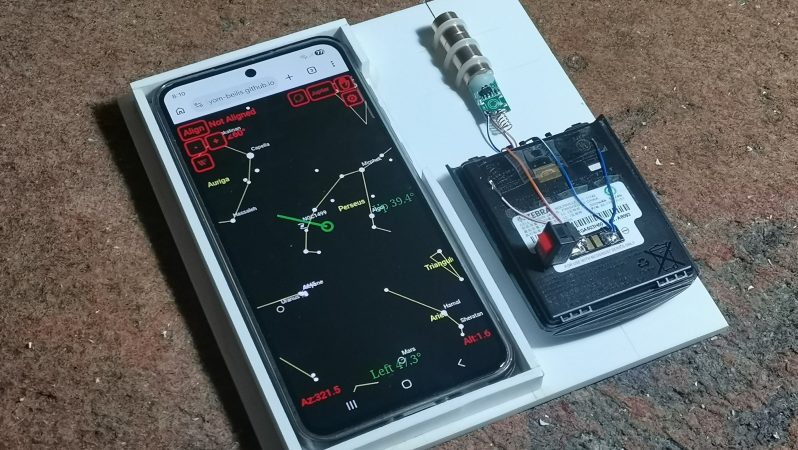
The smartphone is running AstroHopper, an astronomy app that uses GPS and inertial navigation to know exactly where your phone is pointing, and offer an image of the sky on the screen. There are many others of this ilk, and there’s no reason [mircemk]’s trick won’t work with your favorite. The trick is decidedly simple: the smartphone is mounted to a flat plate, in line with a green laser pointer. Careful placement aligns the axis of the phone and the laser, and the mounting plate is set up to fit a tripod.

Using it is simple: with a labelled view of the sky displayed on the screen, one lines up the phone/laser combo with the desired object, and activates the laser pointer. [micremk] has wired in an on-off switch for this purpose and a large external battery, rather than relying on the stock pushbutton. Since the axis of the laser pointer and the phone are aligned, a green line launches out into the heavens for you to follow with your binoculars. Once you locate that green dot, you can turn off the laser. Yes, the computer has helped you find the object, but your muscles are doing the slewing and that will make it much more likely you start to learn the sky yourself rather than relying on electronic magic.

This is probably the simplest hack we’ve yet seen in the Frikkin’ Lasers Challenge, and yet also one of the most practical. If you enjoy playing with radiation that’s spontaneously emitted, there’s still time to get your entry together — the contest runs until July 23, 2026.

Continue reading “2026 Frikkin Lasers Challenge: Super-Simple Laser Precision For Your Stargazing”

Hackaday Europe 2026 – Building A Retro PC From Scratch

If you’re big into retrocomputing, you probably spend a lot of time chasing parts and machines on online classifieds or through local swap meets. But what if there was a different way to build a classic retro PC? What if you could put one together from bare chips, from the ground up?

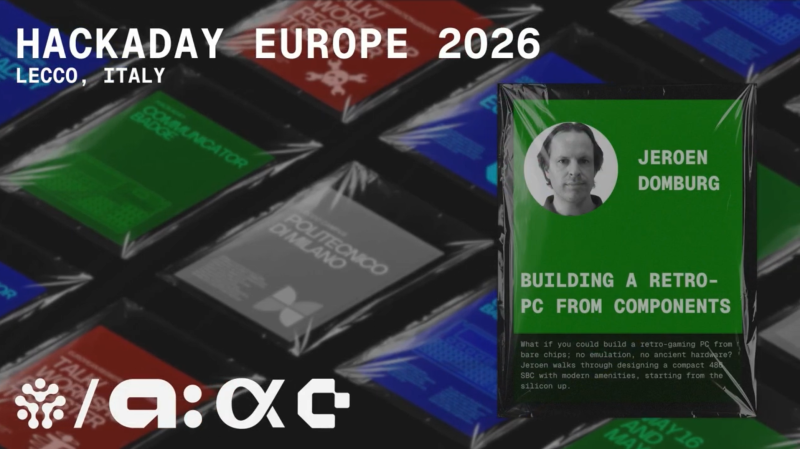
[Jeroen Domburg] is no stranger to the pages of Hackaday. You might know him by his alias, [sprite_tm], under which he’s shared many projects, from miniaturizing old hardware to unearthing the secrets of undocumented commercial hardware. Now, he’s turning his considerable skills to figuring out how to build a retro PC in today’s world, and came to Hackaday Europe 2026 to show us all how it’s done.

Continue reading “Hackaday Europe 2026 – Building A Retro PC From Scratch”

Mechanical TV, Without The Benefit Of New Parts

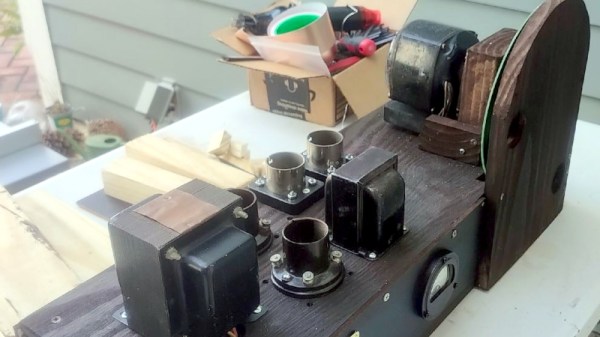
There are many experimenters who have had a go at a mechanical television, and though there are a few challenges, it’s a relatively straightforward project in 2026. A hundred years ago though it was still beyond the cutting edge of technology, and that’s where [Paul Kocyla] is placing his build. It’s a mechanical TV system, using only parts that would have been available in the 1920s. The project isn’t finished yet, but we suggest following along for some fascinating insights into developments in early electronics.

As it stands he has a wooden chassis, a period power supply and amplifier, a synchronous motor, and of course the Nipkow disk that makes it all possible. The electronics aren’t quite finished, and he’s yet to source a neon lamp. This last party may be particularly tricky, as there were specific flat-plate neon lamps made for this application. It’s interesting to find that the motor would synchronize to the grid frequency and would need to be restarted a few times for the frame to be in the right place.

His last posting contains a particularly interesting nugget of information for anyone using tubes. The amplifier carries a 120 Hz hum, something difficult to trace. The culprit is the early tubes with directly heated cathodes formed from the heaters themselves; they had such a low thermal mass that they would “blink” at 120 Hz if fed with AC. A set of period copper oxide rectifiers solve this by feeding DC to the heaters. There’s a YouTube series to follow, and we’ve placed the most recent one in which he fixes the power supply, below the break.

Back in January, we marked the hundredth anniversary of mechanical TV’s invention. Meanwhile, some of us have been known to experiment in this direction too.

Continue reading “Mechanical TV, Without The Benefit Of New Parts”

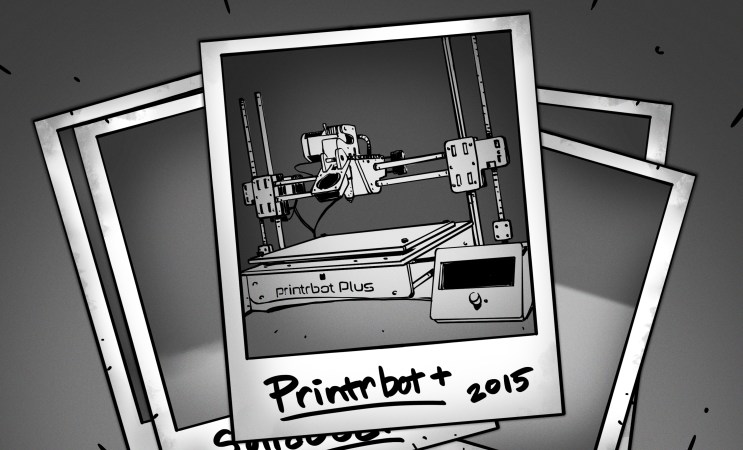
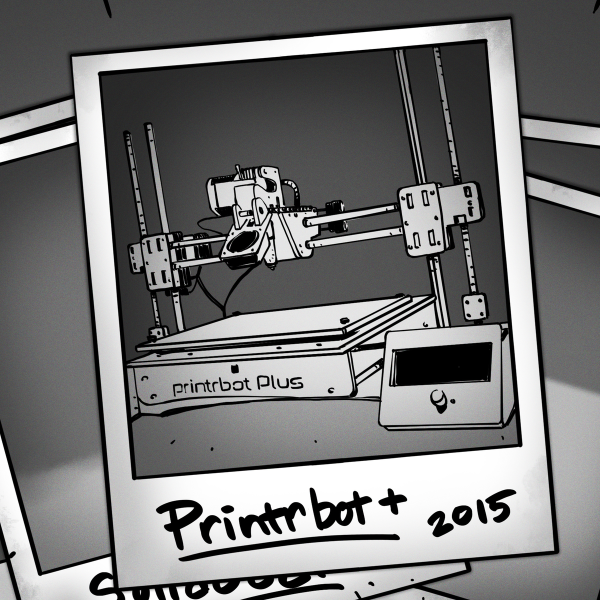
The Teenage Angst Of 3D Printing: Solidoodle, Printrbot, And Bridges

Bridges are a part of our constructed landscape that we take for granted. And bridges by themselves aren’t especially important. What is important is that bridges let you get from one place to another. Technology is often the same. We get from point A to point B through some bridge technology that, probably, most normal people never even notice.

Years ago, point A was commercial 3D printing. Industry had stereolithography, selective laser sintering, fused deposition modeling, and other rapid-prototyping technologies. These were not toys. They were expensive industrial systems used by companies that needed prototypes badly enough to pay serious money for them.

Fast Forward to Today

Today, you can go to a big box store and buy a 3D printer for well under $1,000, and often far less. Modern machines are almost plug-and-play and tend to do all the hard parts for you. That’s point B. How we got between points is a story of hackers who had a dream, and many Hackaday readers lived through it and even played a part in that bridging.

For a long time, RepRap was synonymous with hobby-level 3D printing. The project, started by [Adrian Bowyer] at the University of Bath in 2005, was built around a powerful idea: a machine that could print many of its own parts, thereby helping make more machines. RepRap Darwin reached its early self-replicating milestones in 2008, and the movement produced a thicket of descendants, variants, and arguments about rods, belts, bearings, extruders, firmware, and what “self-replicating” really meant. Of course, the machine could only print some of the parts you needed, but it was still impressive how much of a printer you could make with one printer.

Without RepRap, the desktop 3D printer boom would have looked very different. It created a common pool of ideas: Cartesian frames, printed brackets, hobbed bolts, heated beds, RAMPS boards, Marlin firmware, and a whole common vocabulary. It also created the expectation that a 3D printer was something you could understand, modify, repair, and improve. That expectation would not survive everywhere, but it defined the early culture.

Continue reading “The Teenage Angst Of 3D Printing: Solidoodle, Printrbot, And Bridges”

HamsterOS Crams Complete Graphical Desktop Onto 1.44 MB Floppy

It’s not every day that there’s a new OS in the works for 386 and 486-era hardware, but [John Swiderski] let us know he working hard to bring HamsterOS to retrocomputing enthusiasts everywhere.

HamsterOS targets a November 2026 release.

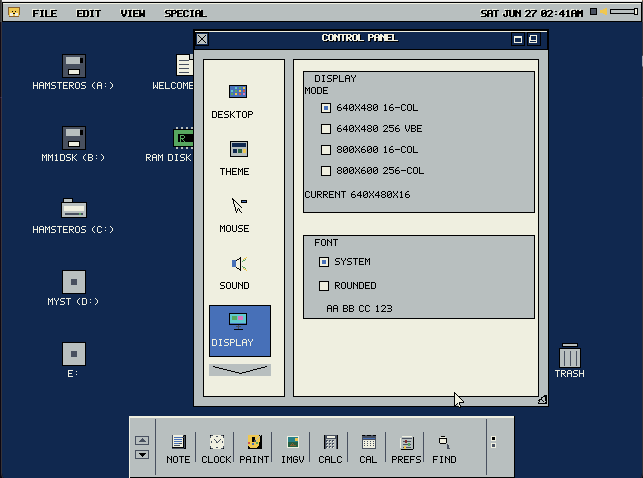
HamsterOS is a tiny but full-featured multitasking 32-bit graphical operating system that fits on a single 1.44 MB floppy disk. It’s designed as a floppy-first OS, but can easily be installed to a hard drive and includes a suite of native applications. There’s even DOS support!

The list of features is impressive, many of which are targeted at making life a little easier for those working with vintage hardware. One example we like is the CMOS crash counter, which automatically forces the system into a basic VGA safe mode after three consecutive failed boot attempts.

Speaking of making vintage computing a little easier to handle, [John] also released HamsterWeazle, a free GUI front-end for Greaseweazle, the open-source USB device that makes interfacing to old floppy drives easy. If you’re finding yourself intrigued by software like HamsterOS but wondering how you’d write to a 1.44 MB floppy without already having some old hardware up and running, Greaseweazle over USB — and HamsterWeazle to make it much more user-friendly — is one way you’d do it.

We recently featured GentleOS, a charming and streamlined graphical OS aimed at vintage hardware that makes a point of showing what’s possible when new ideas meet old hardware. If you have a retrocomputing project you want to show off, custom OS or otherwise, let us know on our tips line!

It’s Linux, On A Sega Megadrive

If you were in the market for a games console in 1990, the chances are that the object of your desire was either a Super Nintendo with its 16-bit 6502 derivative, or the Sega Megadrive, sold as the Genesis in North America, with its Motorola 68000. Both machines featured impressive graphics and sound for their time, but they remain firmly in the 16-bit era. Which makes it a surprise to see LinuxMD. It’s Linux, for the Sega Megadrive, with the latest mainline kernel.

The Motorola 68000 series of chips was the first porting target for Linux, and is still maintained in 2026. This build runs from an SD card  in a modern Megadrive storage peripheral, and is reported to run on the original hardware. The lowly 68000 in the Sega doesn’t have a memory management unit required for the full Linux experience, so what’s really running here is a kernel compiled with the -nommu option. That in itself is a feat, on this architecture. On it you get smolutils, a cut down coreutils, and that seems to be it.

We like this project, for pushing both console and kernel to the limit, even though we see that maybe it’s not the most practical Linux machine. Meanwhile though, this isn’t the only UNIX-like OS for this console.


Image: Evan-Amos, Public domain.