A musical cyberdeck

Musical Cyberdeck Is Part Synth, Part MIDI Controller, And All Cool

When a new project type starts to get a lot of exposure, it’s typically not long before we see people forking the basic concept and striking out in a new direction. It happened with POV displays, it happened with Nixie clocks, and now, it seems to be happening with cyberdecks. And that’s something we can get behind, especially with cyberdecks built to suit a specialized task, like this musical cyberdeck/synth.

Like many musicians, [Benjamin Caccia] felt like he needed a tool to help while performing with his band “Big Time Kill.” He mainly needed to trigger track playbacks on the fly, but also wanted something to act as a mega-effects pedal and standalone synth. And while most of that could be done with an iPad, it wouldn’t look as cool as a cyberdeck. The build centers around a Raspberry Pi 4 and a 7″ LCD display. Those sit on top of a 25-key USB MIDI keyboard and a small mixer. Alongside the keyboard is a USB keypad, which has custom mappings to allow fast access to buried menu functions in the cyberdeck’s Patchbox OS. Everythign was tied together on a 3D-printed frame; the video below shows it in action, and that it sounds as good as it looks.

We think [Benjamin]’s cyberdeck came out great. Need to see some other specialized cyberdecks? Why not take a look at this battle-ready cyberdeck, one that aims to be distraction-free, or a cyberdeck for patrolling the radioactive wastelands.

Continue reading “Musical Cyberdeck Is Part Synth, Part MIDI Controller, And All Cool”

Drill press modded with a treadmill motor, speed controller, lights, and a tachometer.

Drill Press Runs Faster On A Treadmill Motor

Are you tired of the same old video style from your favorite content creators? We can’t say that we were, exactly. But nevertheless, we appreciate this creative departure from [Eric Strebel]’s regular fare as he soups up his drill press with an old treadmill motor and a few extra features.

First off, that commentator in the video is right — 2.6 horsepower is a crazy amount for a drill press. Fortunately, [Eric] also added a variable speed controller and a digital tachometer to keep things in check. As an added bonus, he no longer has to get under the hood and mess with the belts.

We like what [Eric] brings to the drill press motor mod, which is already well-documented on YouTube. We love the re-use of an office chair bracket as a new motor mount. It’s probably our favorite bit aside from the 2-color forward/reverse switch plate idea: print it in whatever letter color you want with proud lettering, paint the whole thing black, and sand off the letters so the color shows. Check it out after the break.

There are many ways to make your own drill press, and one of the easiest is to mount a hand drill.

Did you miss the Industrial Design Hack Chat with [Eric]? It’s okay, you can read the transcript over on IO.

Continue reading “Drill Press Runs Faster On A Treadmill Motor”

Breadboard containing speech synthesis chip

RPi Python Library Has Retro Chiptunes And Speech Covered

The classic SP0256-AL2 speech chip has featured a few times on these pages, and if you’ve not seen the actual part before, you almost certainly have heard the resulting audio output. The latest Python library from prolific retrocomputing enthusiast [Nick Bild] brings the joy of the old chip to the Raspberry Pi platform, with an added extra trick; support for the venerable AY-3-8910 sound generator as well.

The SP0256-AL2 chip generates vaguely recognisable speech using the allophone system. Allophones are kind of like small chunks of speech audio which when reproduced sequentially, result in intelligible phonemes that form the basis of speech. The chip requires an external device to feed it the allophones at a regular rate, which is the job of his Gi-Pi library.

This speech synthesis technology is based on Linear-predictive coding, which is used to implement a human vocal tract model. This is the same coding method utilized by the first generation of GSM digital mobile phones, implementing a system known as Full-Rate. Both an LPC encoder and an LPC decoder are present on the handset. The LPC encoder takes audio in from the user, breaks it into the tiny constituent parts of speech, and then simply sends a code representing the audio block, but not the actual audio. Obviously there are a few more parameters sent as well to adjust the model at the receiving side. The actual decoding side is therefore not all that dissimilar to what the AY-3-8910 and related devices are doing, except you the user have to create the list of audio blocks up-front and feed the chip at the rate it demands.

Continue reading “RPi Python Library Has Retro Chiptunes And Speech Covered”

Historical Hackers: The Hacker Of Cragside, Circa 1870

Imagine visiting a home that was off the grid, using hydroelectric power to run lights, a dishwasher, a vacuum cleaner, and a washing machine. There’s a system for watering the plants and an intercom between rooms. Not really a big deal, right? This is the twenty first century, after all.

Armstrong with a 7 inch gun of his design
Image of Armstrong and his 7-inch gun from an 1887 edition of Illustrated London News

But then imagine you’ve exited your time machine to find this house not in the present day, but in the year 1870. Suddenly things become quite a bit more impressive, and it is all thanks to a British electrical hacker named William Armstrong who built a house known as Cragside. Even if you’ve never been to Northumberland, Cragside might look familiar. It’s appeared in several TV shows, but — perhaps most notably — played the part of Lockwood Manor in the movie Jurassic World: Fallen Kingdom.

Armstrong was a lawyer by training but dabbled in science including hydraulics and electricity — a hot topic in the early 1800s. He finally abandoned his law practice to form W. G. Armstrong and Company, known for producing Armstrong guns, which were breech-loading artillery pieces ranging from 2.5 inch bores up to 7 inches. By 1859, he was knighted and became the principal supplier of armaments to both the Army and the Navy.

Continue reading “Historical Hackers: The Hacker Of Cragside, Circa 1870”

2021 Hackaday Remoticon: Call For Proposals

The Hackaday Remoticon is happening this November 19th and 20th and the whole Internet is invited. This time around we’re packing the weekend with talks about all the hardware, software, special skills, and inspiration that gets poured into the world of electronic stuff.

Send in your talk proposal now! I know, Call for Proposals sounds so official, but it’s really just a matter of giving us a summary of what the talk will cover, and an in-depth description where you make your case on why the talk is relevant to the people who will be watching it.

We go out of our way with all of our Hackaday conferences to get first-time speakers up on stage (or I suppose in front of a webcam in this case). Whether it’s your first time or your fortieth, the substance of the talk is what matters the most — we want to see what you’ve been doing at your workbench and in your lab so please give us a window into that part of your life.

Like many of you, we desperately wanted to get back to an in-person Hackaday Superconference this year. We waited until now to make the call in hopes that maybe a smaller live conference would be possible, but at this point, even if we could pull off the weekend safely, it’s hard to imagine people would have the relaxing good time that Supercon has come to be known for. On the plus side, holding a virtual event like Remoticon means more of the Hackaday community gets to join in on the action. To shake things up for 2021, we’re pivoting away from workshops to make room for more talks and adding some excellent new ways for you to participate that we’ll be sharing more about very soon.

But to pull it off we need a slate of engineers, hackers, and geeks who want to share what they’re passionate about with a captive audience of like-minded individuals. Think you’re up to the challenge? Submit your ideas and let’s build something amazing. Or if you’d rather just kick back and watch, reach out to your favorite hacker and encourage them to speak. The one huge upside of a virtual conference is that it breaks down the time and treasure barriers of travelling to Pasadena to participate, and having this event accessible to a much wider range of people is something we can all get behind.

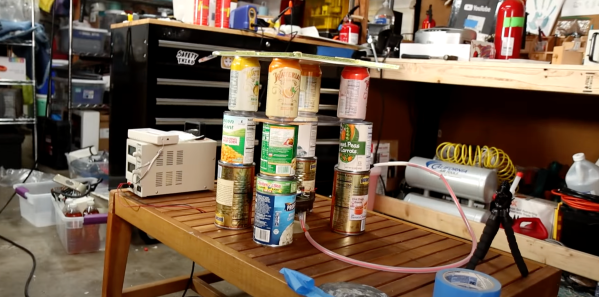
a very slapdash x-ray machine on a table

Building An X-Ray Machine

While we typically encourage hackers to make their own tools or machines when practical, x-ray machines don’t usually make that list. Despite the risk of radiation, [William Osman] has done just that and built a homemade x-ray machine. After receiving an eye-watering medical bill, [William] resolves to make his own x-ray machine in the hopes of avoiding future bills. Thanks to his insurance, the total owed was smaller but still ridiculous to those who live in single-payer health care countries, but it got William thinking. What if he could make an x-ray machine to do cheap x-rays?

Armed with a cheap high voltage DC power supply he acquired from an online auction house, he started to power up his x-ray vacuum tube. A smaller power supply energizes the cathode and forms an electron beam. Then the high voltage (30-150kv) is applied as a tube voltage, accelerating the electrons into x-rays. Safety measures are taken somewhat haphazardly with Geiger counters and lead sheets. With a finger bone cast in ballistic shell [William] made his first x-ray with a long exposure on a DSLR. The next items to go in the x-ray “chamber” were a phone and a hand. The results were actually pretty decent and you can clearly see the bones.

We’ve seen homemade X-Ray machines here at Hackaday before, but not one that is constructed perhaps so haphazardly — his approach makes this obvious: don’t try this at home. Video after the break.

Continue reading “Building An X-Ray Machine”

Teardown: Impassa SCW9057G-433 Alarm System

This series of monthly teardowns was started in early 2018 as an experiment, and since you fine folks keep reading them, I keep making them. But in truth, finding a new and interesting gadget every month can sometimes be a chore. Which is why I’m always so thankful when a reader actually sends something in that they’d like to see taken apart, as it absolves me from having to make the decision myself. Of course it also means I can’t be blamed if you don’t like it, so keep that in mind as well.

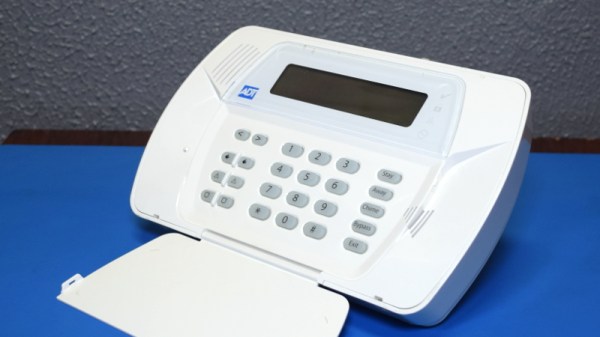
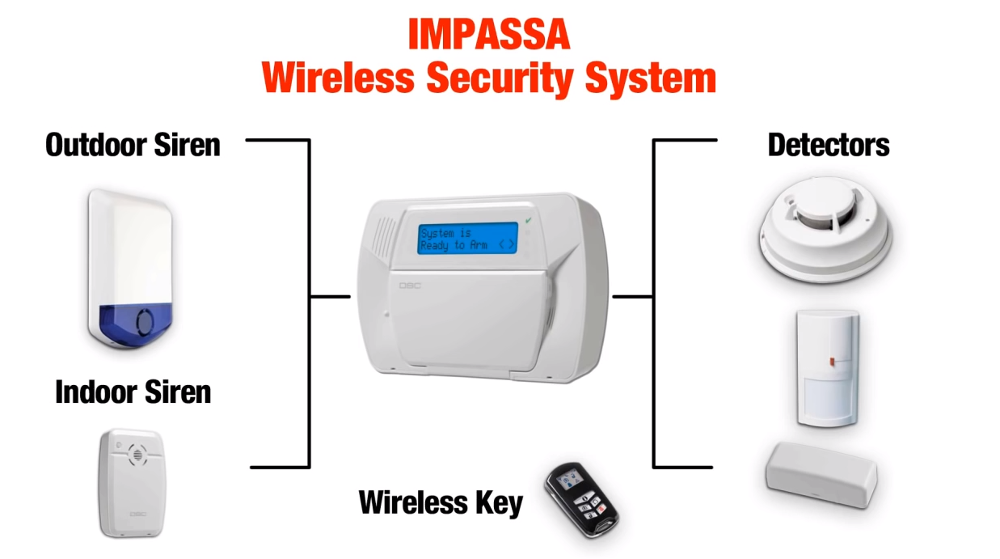
Coming our way from the tropical paradise of Eastern Pennsylvania, this month’s subject is an ADT branded Impassa SCW9057G-433 alarm system that was apparently pulled off the wall when our kind patron was moving house. As you might have guessed from the model number, this unit uses 433 MHz to communicate with various sensors and devices throughout the home, and also includes a 3G cellular connection that allows it to contact the alarm monitoring service even if the phone line has been cut.

Diagram of Impassa home security setup
The alarm can connect to a wide array of 433 MHz devices.

From how many of these are on eBay, and the research I’ve done on some home alarm system forums, it appears that you can actually pick one of these up on the second-hand market and spin your own whole-house alarm system without going through a monitoring company like ADT. The extensive documentation from Impassa covers how to wire and configure the device, and as long as the system isn’t locked when you get it, it seems like wiping the configuration and starting from scratch isn’t a problem.

If it’s possible to put together your own homebrew alarm system with one of these units at the core, then it seems the least we can do is take it apart and see what kind of potentially modifiable goodies are waiting under that shiny plastic exterior.

Continue reading “Teardown: Impassa SCW9057G-433 Alarm System”