Is That An ESP32 On Your Wrist?

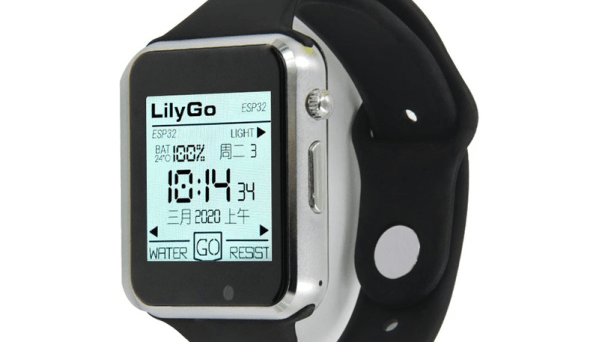
What could you do with a dual-core 240 MHz ESP32 that supports Arduino-style programming, with 16 MB of flash, 8 MB of PSRAM, and 520 k of RAM? Oh, let’s throw in a touchscreen, an accelerometer, Wifi, and Bluetooth. Besides that, it fits on your wrist and can show the time? That’s the proposition behind Lilygo T Watch 2020. If it sounds like a smartwatch, it is. At around $25 –and you can snag the hardware from a few different places — it is not only cheaper than the latest flagship smartwatch, but it is also infinitely more hackable.

OK, so the screen is only 1.54″, but then again, it is a watch. If Arduino isn’t your thing, you can use anything else that supports the ESP32 like Micropython or even Scratch. There are variants that have LoRA and GPS, at slightly higher prices. You can also find ones with heart rate monitors and other features.
Continue reading “Is That An ESP32 On Your Wrist?”

Spherical Quadruped Arduino Robot

[Greg06] started learning electronics the same way most of us did: buy a few kits, read a few tutorials, and try your hardest to put a few things together. Sound familiar? After a while, you noticed your skills started increasing, and your comfort level with different projects improved as well. Eventually, you try your hand at making your own custom projects and publishing your own tutorials.

Few are lucky to have a first-project as elaborate as [Greg06’s] quadruped robot. We don’t know about you, but for some of us, we were satisfied with blinking two LEDs instead of just one.

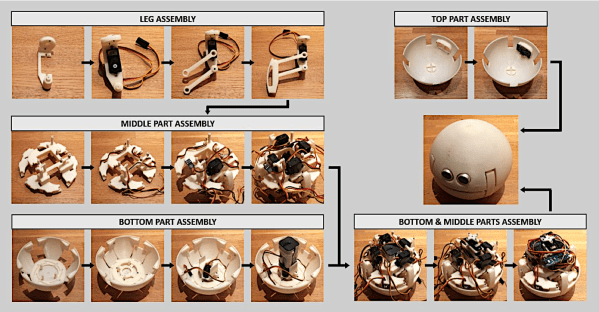
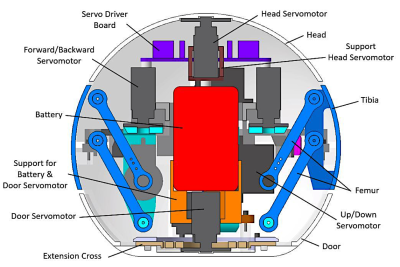
[Greg06’s] robot has a quadruped based, housed within a 3D printed spherical body. The legs are retractable and are actuated by tiny servo motors inside the body. [Greg06] even included an ultrasonic distance sensor for the obstacle avoidance mechanism. Honestly, if it weren’t for the ultrasonic distance sensor protruding from the spherical body, you might think that the entire robot was just a little Wiffle ball. This reminds us of another design we’ve seen before.

If that weren’t enough, the spherical head can rotate, widening the range of the ultrasonic distance sensor and obstacle avoidance mechanism. This is accomplished by attaching another servo motor to the head.

Pretty neat design if you ask us. Definitely one of the coolest quadrupeds we’ve seen.

3D Printed Switch Uses Paperclip

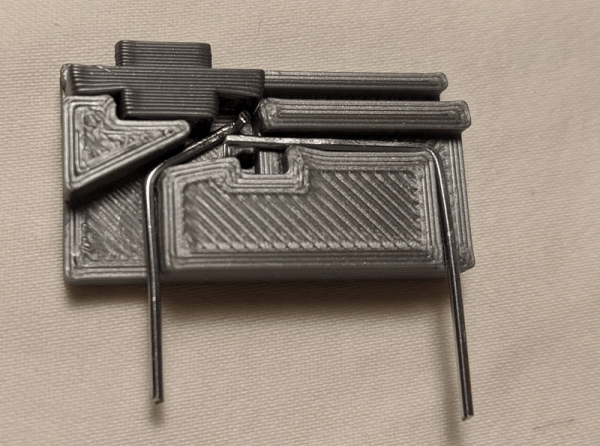
We live in a time when all manner of electronic components are practically a mouse click away. Still, we like to see people creating their own components. Maybe a stock part won’t fit or isn’t immediately available. Or maybe you just want to build it yourself, we get that. [Aptimex] shows off a design for a 3D printed slide switch that uses a paperclip for the contact material.

Of course, it had better be a metal paperclip and we’d make sure the shiny metal was pretty conductive. Of course, you could probably use thick wire to get the same effect. It sounds like [Aptimex] was inspired by an earlier Hackaday.io project that created a few different kinds of switches using similar techniques.

Continue reading “3D Printed Switch Uses Paperclip”

Brass And Nickel Work Together In This Magnetostrictive Earphone

When you go by a handle like [Simplifier], you’ve made a mission statement about your projects: that you’ll take complex processes and boil them down to their essence. So tackling the rebuilding of the humble speaker, a device he himself admits is “both simplified and optimized already,” would seem a bit off-topic. But as it turns out, the principle of magnetostriction can make the lowly speaker even simpler.

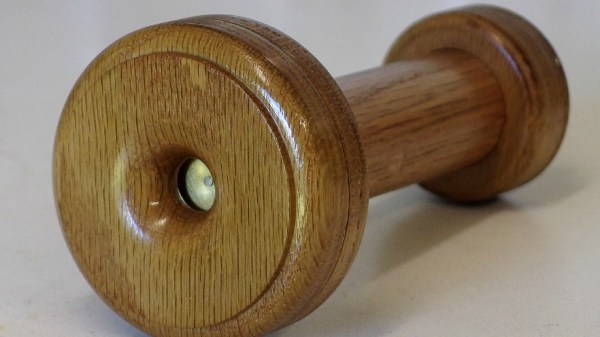
Most of us are familiar with the operation of a speaker. A powerful magnet sits at the center of a coil of wire, which is attached to a thin diaphragm. Current passing through the coil builds a magnetic field that moves the diaphragm, creating sound waves. Magnetostriction, on the other hand, is the phenomenon whereby ferromagnetic materials change shape in a magnetic field. To take advantage of this, [Simplifier] wound a coil of fine copper wire around a paper form, through which a nickel TIG electrode welding filler rod is passed. The nickel rod is anchored on one end and fixed to a thin brass disc on the other. Passing a current through the coil causes the rod to change length, vibrating the disc to make sound. Give it a listen in the video below; it sounds pretty good, and we love the old-time look of the turned oak handpiece and brass accouterments.

You may recall [Simplifier]’s recent attempt at a carbon rod microphone; while that worked well enough, it was unable to drive this earphone directly. If you need to understand a little more about magnetostriction, [Ben Krasnow] explained its use in anti-theft tags a couple of years back.

Continue reading “Brass And Nickel Work Together In This Magnetostrictive Earphone”

Building A Custom Camera Mic

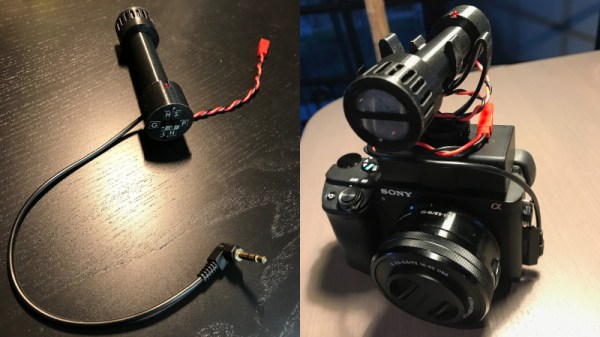
Most consumer-grade cameras these days come with adequate microphones built in. However, as with all hardware made down to a price point, there’s room for improvement. [M. Ploegmakers] decided to whip up a better microphone setup for his Sony A6300, with the Dumbbell Mic as the result.

The microphone is based around an electret condensor element, which provides good performance at a remarkably low price. This is then integrated with a preamp circuit to bring the audio up to the appropriate level for the camera to record along with the video. Switches on board set the gain level, as well as changing the mic to operate with or without phantom power, where available.  The electronics is wrapped up in a 3D-printed enclosure, designed to mount on top of the camera for use out in the field.

It took some experimentation, but now [M. Ploegmakers] has a custom mic rig that records straight into the camera, avoiding the need to splice audio and video back together in post. If your camera lacks an audio input, you might have to do a little more work to hack one in, though!

Stealing RAM For A Microcontroller From A TFT Display

PC users with long memories will recall the days when the one-megabyte barrier was  a significant problem, and the various tricks of extended and expanded memory used to mitigate it. One of them was to install a driver that mapped surplus graphics card memory as system memory when the display was in DOS text mode, and it was this that was brought to mind when we read about [Frank D]’s microcontroller implementation of Conway’s Game Of Life.

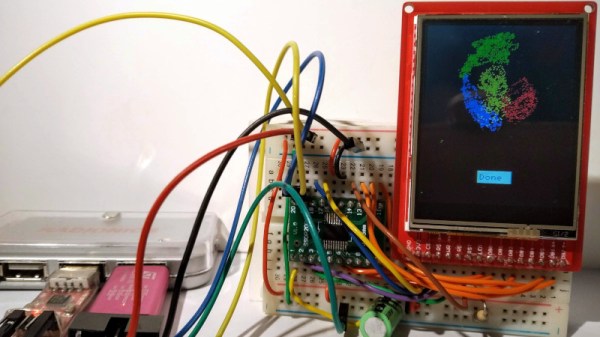
The components were those he had to hand; an STM32F030F4P6 and an RM68130 176 × 220 TFT board. The STM is not the most powerful of chips, with only 16 kB of Flash and 4 kB of RAM. The display has enough on-board memory to support 18 bits of colour information, but when it is running in eight-colour mode it only uses three of them. The 15 bits that remain are thus available to be used for other purposes, and though the arcane format in which they are read required some understanding they could be used to provide a very useful extra 38720 bytes of RAM for the microcontroller just as once happened with those DOS PC graphics cards of old. Interestingly, the same technique should work with other similar displays.

Though this isn’t a new technique by any means we can’t recall seeing it used in a microcontroller project such as this one before. We’ve brought you many Games of Life though, as well as marking John Conway’s passing earlier this year.

Continue reading “Stealing RAM For A Microcontroller From A TFT Display”

Linux Fu: Alternative Shells

On Unix — the progenitor of Linux — there was /bin/sh. It was simple, by comparison to today’s shells, but it allowed you to enter commands and — most importantly — execute lists of commands. In fact, it was a simple programming language that could make decisions, loop, and do other things to allow you to write scripts that were more than just a list of programs to run. However, it wasn’t always the easiest thing to use, so in true Unix fashion, people started writing new shells. In this post, I want to point out a few shells other than the ubiquitous bash, which is one of the successors to the old sh program.

Since the 7th Edition of Unix, sh was actually the Bourne shell, named after its author, Stephen Bourne. It replaced the older Thompson shell written in 1971. That shell had some resemblance to a modern shell, but wasn’t really set up for scripting. It did have the standard syntax for redirection and piping, though. The PWB shell was also an early contender to replace Thompson, but all of those shells have pretty much disappeared.

You probably use bash and, honestly, you’ll probably continue to use bash after reading this post. But there are a few alternatives and for some people, they are worth considering. Also, there are a few special-purpose shells you may very well encounter even if your primary shell is bash.

Continue reading “Linux Fu: Alternative Shells”