An AI Chatbot For The Apocalypse

You don’t have to be a full-on “prepper” to at least occasionally wonder what would happen if civilization collapsed. One thing you probably couldn’t do is go on the Internet and ask your favorite AI how to purify water, repel zombies, or treat a burn, all of which may be highly relevant depending on your situation. Now, with Survival LLM, you have a chance.

The  LLM is pretty much the stock chatbot, but it is trained on survival topics, and it runs locally. Naturally, you need the Internet to set it up, so you’d want to do that now before everything hits the fan. The training set uses medical references, survival manuals, FEMA and CDC documents, and nearly a million Wikipedia articles. It includes the survival references in a library and links to them when answering, too.

The installer is small, but it assesses your system and loads a model based on what you have. If you have less than 32 GB of RAM, you’ll get the IBM Granite 4.2 8B model, which was able to correctly answer 14 of 22 test questions. Other models do better, including the NVIDIA Nemotron 3.5 Super model, which got 21 correct, but requires at least 128 GB of memory.

Now, somehow you have to power your computer, but that’s a separate problem. At least there will be plenty of GPUs to scavenge from abandoned data centers. We’ve seen prepper digital libraries before. More than one, in fact.
Magnetic Lock Opens By Magic

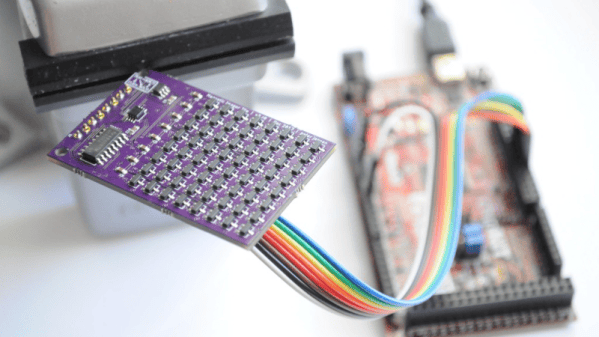
Over on IEEE Spectrum, [Stephen Cass] has a project that would probably have seemed like a magic a few centuries ago. Imagine a box that uses a magnetic device to holds a locking bolt, requiring a magnet to disengage it. The only problem is that any strong magnet can open the box. [Stephen], instead, used an array of 64 Hall-effect sensors developed by [Peter Jansen] to look for a specific magnetic gesture.

Inside is a Teensy that can read the 8×8 grid of sensors. A magnetic stylus allows you to draw an unlock pattern. The system lets you train the gesture you want. There are a few problems. The sensor covers a small area, so it is hard to reliably produce the gesture. Putting an obvious mark on the box is a dead giveaway, so [Stephen] put a Celtic knotwork pattern on the box and uses part of it as a reference.

The other problem is that if you run out of battery, the box is locked forever. Well, at least until you apply mechanical force and break the box open. Wireless charging would be an option, but we might favor a small jack that would allow you to plug in an external battery.

This is a clever use of the sensor. However, we might have preferred a mechanical solution that didn’t require batteries. Or, perhaps, you could use a few normally open and normally closed reed switches to make a kind of magnetic combination lock. It would still need a battery, but it wouldn’t draw current until you connected the switches. Both methods also have drawbacks, of course. Like most things, you just get to pick the drawbacks you can live with.

You can see a video of the magnetic imaging tile from [Peter] below. We really want a setup like this for our secret door. We also wonder whether switchable magnets could provide a battery-free solution.

Continue reading “Magnetic Lock Opens By Magic” →

2026 Retrocomputing Challenge: Custom RISC-V Processor For Retro System

Although once little more than an academic endeavor, the RISC-V architecture is slowly supplanting applications that would have normally gone to ARM. Even a few microcontrollers have chips running this open-source instruction set now, and we expect it to grow in the future since it doesn’t require the licensing of an ARM or x86 chip. [M_Jagadeesh97] is getting ahead of the curve with this retro gaming system built on a custom-designed RISC-V system.

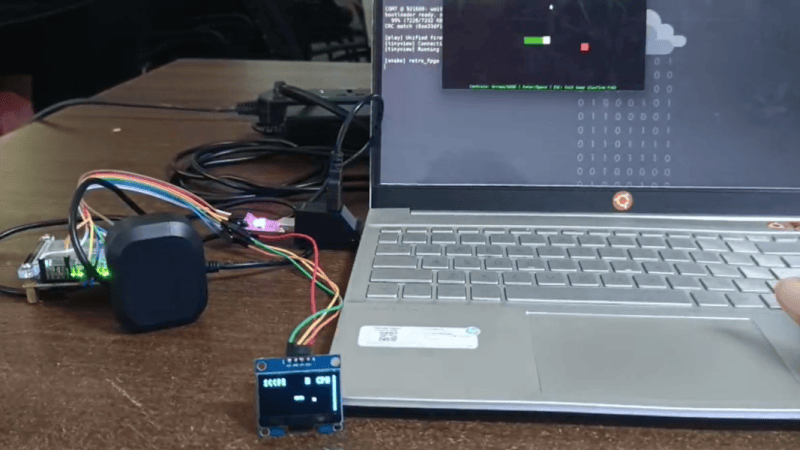
Most of us, presumably including [M_Jagadeesh97], don’t have access to chip fabrication tools, but what we can get is any of various FPGAs. This RISC-V CPU is built on a Terasic DE0-Nano board with 32 MB of RAM available to it, and boots to a launcher with 32 games available. There are a few limitations with this low-power system which was largely solved by limiting the display to 64×32, which lets it maintain the same aspect ratio as the original DOOM as well as the same aspect ratio for many of the older games, while still maintaining 45 FPS.

The project writeup goes deep into the design of a system like this, from the bare metal, the CPU design, the timing of the video signals, and how to implement a Wolfenstein-like raycaster. After adding a small display it looks to be fairly portable as well and is an excellent demonstration of how powerful inexpensive boards like this  FPGA can be with the proper amount of effort.

Battery Prototype Uses Superextensive Quantum Effects To Charge Faster

Although the term ‘quantum battery’ is a bit of a vague term, the cell that [Kieran Hymas] et al. demonstrate in a recent paper does seem to suggest that it uses quantum effects to charge faster than would otherwise be possible, with this rate increasing faster than its volume, meaning at a superextensive rate.

The general idea behind a quantum battery is that these somehow use a quantum effect to store and release energy faster than would be possible using classical physics. First proposed in 2013, the initial Dicke model saw its theoretical quantum advantage shot down by 2020, leading to the search for alternative models.

We have previously seen claims of a quantum advantage in batteries based on the Sachdev-Ye-Kitaev model, such as by [Davide Rossini] et al., but this new paper may be the first prototype cell demonstrating a reproducible effect.

In the here demonstrated cell a microcavity is created with strong light-matter coupling, allowing for both energy storage and discharging, with the illuminated particles super-absorbing the light with what the researchers claim to be due to these particles cooperating using a quantum mechanism. Effectively scaling up the cell would thus scale up the charge- and discharge rate faster than in a conventional chemical cell.

Whether this demonstration can be replicated and expanded upon remains to be seen, naturally. The stored energy in this experiment was very small and the storage time only very brief, so for now it serves primarily as an interesting experimental result for researchers to dig through.

Hacking The Modern Tamagotchi With UART

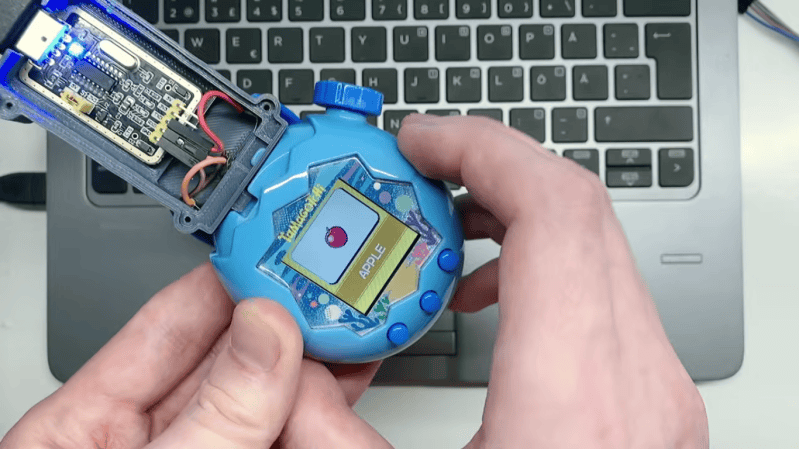
Although not technically the first virtual pet, the Tamagotchi handhelds certainly popularized the idea and made it a worldwide phenomenon. In the late 90s it was hard to go out in public and not see them dangling from backpacks and belt loops. They turned out to be more than a passing fad, too. There have been Tamagotchis in various forms since then, and one of the latest, the Tamagotchi Paradise, is uniquely hackable thanks to this custom UART interface.

The build starts with a simple and inexpensive CH340G UART adapter with a built-in USB interface. A custom 3D printed enclosure is used to house the adapter and also help to expose the interface to the Tamagotchi. This is done by wiring three pins to nickel strips, which are threaded through slits in the case and looped back around to create a pogo-style adapter for the Tamagotchi’s custom dock. Normally this would be used to link to other Tamagotchis, but in this case the USB-to-UART adapter mimics it, allowing for all kinds of in-game shenanigans. The project’s creator [Squalius] shows it off by connecting it directly to a browser tool in Google Chrome.

Not only that, but this can also be used to modify the software running on the handheld entirely, with the video showing demos playing not only Super Mario but also DOOM (of course). This isn’t too surprising given that these games are built with modern 32-bit ARM microcontrollers. For the 90s purists, though, it probably won’t surprise anyone to know that these devices have been the subject of various hacks almost since they came out.

Continue reading “Hacking The Modern Tamagotchi With UART” →

Does Running An E-Paper Display At 30 FPS Destroy It?

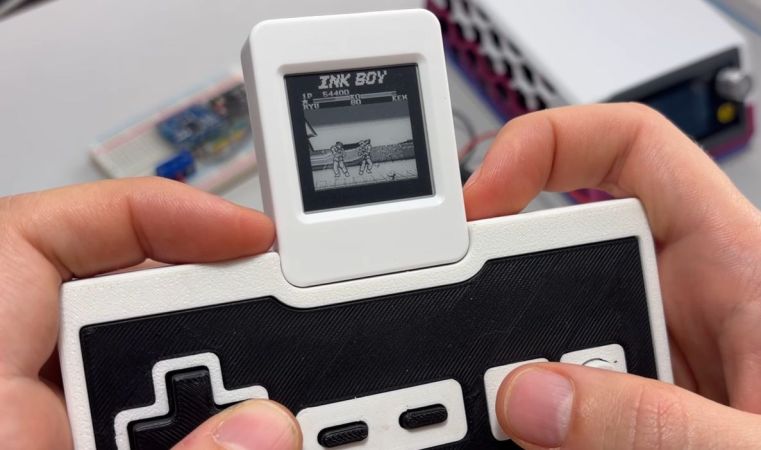
Although e-paper displays are famous for being low-power and lasting essentially forever if not damaged physically, the recent push to drive even cheaper e-paper displays at a framerate like 30 FPS for a decent monochrome gaming experience does raise a few questions. The first being what this does to the power usage of these displays, and the second whether this will wear out the display in short order. To investigate this, [Bo Made It] set up a few experiments.

Subject of this test was a Waveshare ESP32-S3-ePaper board, which had previously been demonstrated running a Game Boy emulator at 30 FPS. With this software running, the board consumed on average about 115 mA, which would run down the device’s 400 mAh battery in about 3.5 hours. From here key was to isolate the power consumption of the display itself, with the system minus the display updates consuming about 90 mA.

Running the frame calculations for the greyscale mode without rendering to the screen pushed that up to 107.6 mA, with even in the 30 FPS greyscale mode the display thus only consuming about 7.4 mA, which is vanishingly small. Clearly the low-power claims of e-paper remain intact even at higher framerates.

As for lifespan, one datasheet gives the typical lifespan as one million updates. This would translate to about 9.3 hours at 30 FPS, though that assumes a full display refresh. Since a smart driver only updates changed pixels, obviously this will be longer, but the question is how much longer, and what will degradation look like?

After running 2.16 million frames of a custom endurance test featuring repeating patterns, some ghosting was apparent, but repeated refreshing made this go away again. This means that so far no permanent damage has been detected within the no doubt conservative limit provided by e-paper manufacturers.

It should be noted that Waveshare itself also recommends against running such high-FPS applications on their device, meaning that this is definitely one big longevity experiment. If actual damage occurs, this means that obviously this won’t be covered under any warranty.

Check out our original coverage of this fast-e-paper hack.

Continue reading “Does Running An E-Paper Display At 30 FPS Destroy It?” →

C64 Keycaps For Everybody

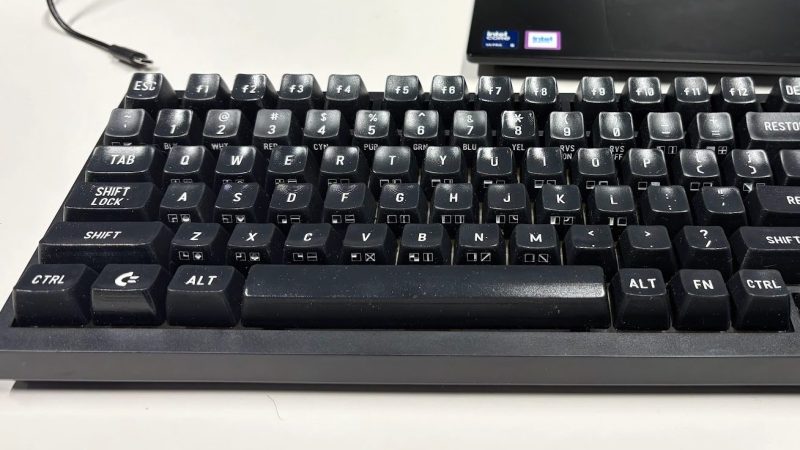
If you’ve got an MX-style keyboard and want some retro charm, you might like a recent project from [Levente Szabadkai]. It’s a set of C64-style keycaps that you can print yourself at home!

The project started as an attempt to produce a set of C64 keycaps for an Ajazz 75% keyboard layout, but [Levente] kept pushing until it developed into a universal set. The keys have C64 legends, plain legends, or blank, and work for ANSI boards from 60% to full size. There are a few ways they can be printed. — you can do two-color printing with an FDM machine, or you can print the caps alone and fill the legends with paint, either in FDM or resin.

As a part of this work, [Levente] had to obviously create the glyphs to print upon all the keycaps. He thus decided to release that as the C64 keyboard font, in fact. It’s available in TTF and OTF formats, and you can preview the font in your browser, if so desired. It includes the function key labels, the 63 PETSCII graphic font legends, and various symbols, punctuation, and selected accented letters, too.

We’ve seen lots of vintage C64 parts recreated from scratch. It’s been at the point for a while where you can build a new machine with what’s available off the shelf. They said Amiga would never die, but it’s the earlier Commodore that really lives on today…