LED Jewelry Makes Neat Use Of Brass

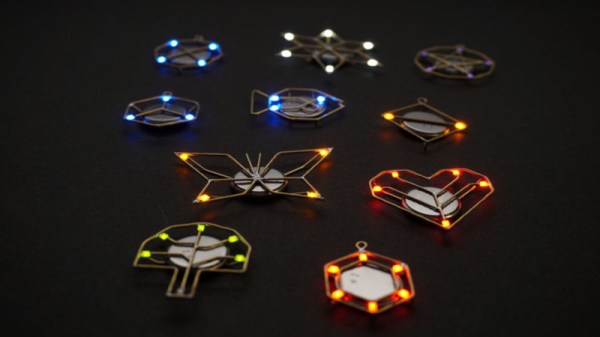
Wearable electronics can be both fun and fashionable. However, there are certain challenges involved in neatly integrating electronic components in a way that is both functional and comfortable for the wearer. In this vein, [Jiri Praus] has managed to create some glowing earrings that are remarkably simple to boot.
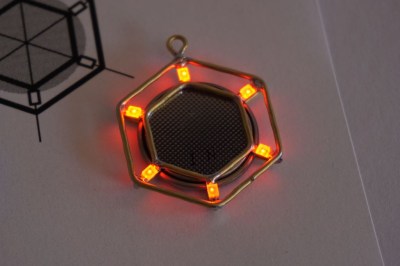
The body of the earring also acts as the conductor and battery holder, all in one.

The earrings start out with brass rod, bent with pliers and soldered at the ends. By following a paper template, it’s possible to get neat and accurate bends by hand, which is necessary to make a matching pair. Through careful design, the brass rods are soldered to the LEDs, and more rod is then used to create an integrated holder for a coin cell battery, which powers the lights.

Thanks to [Jiri]’s smart designs — which we’ve featured before in the form of a blooming wireframe tulip — no wires are needed. The brass rods which make up the body of the jewelry also act as the conductors to pass current to the LEDs. The internal resistance of the coin cell battery also eliminates the need for an in-line resistor. In combination, this serves to create a simple and attractive finished product that should shine for several hours.

We’ve seen other LED earring designs before, too. There are plenty of ways to experiment with glowing jewelry, and if you’ve done something novel, be sure to let us know.
Video Doorbell Focuses On Quality, Aesthetic

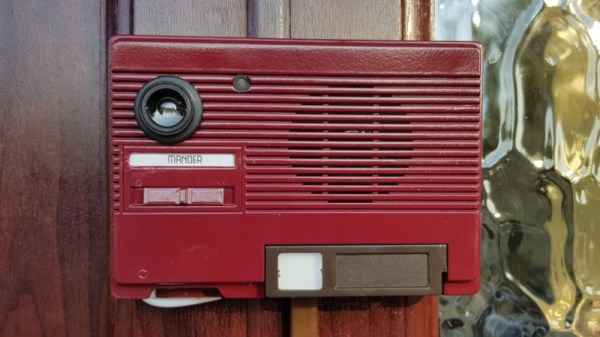
One of the most popular futurist tropes of the 20th century was the video intercom. Once this technology was ready, it would clearly become a mainstay of modern living overnight. Our lived reality is however somewhat different. For [MisterM], that simply wouldn’t do, so he set about producing a retro-themed video doorbell that is sure to be the envy of the neighbourhood.

Not one to settle for second best, [MisterM] wanted to focus on quality in video and sound. A Microsoft LifeCam 3000HD handles video and audio capture, with a Raspberry Pi 3B+ providing plenty of grunt to run the show. The Pimoroni pHAT BEAT add-on provides audio output. It’s all integrated into a 1980s vintage intercom, which is painted a deep shade of maroon for an extra classy look. Further parts are integrated into a classic Sony tape deck, with LEDs shining out from under the cassette door for added visual appeal.

The doorbell works by making calls to Google Duo, which allows the user to answer the door from anywhere in the house, or indeed – anywhere with an Internet connection! [MisterM] reports this has already proved useful for communicating with couriers delivering packages to the house. There’s also a standard wireless doorbell and chime integrated into the unit which alerts those within the house in the usual way.

It’s a project that is both highly functional and looks particularly swish. Integrating new brains into old-school enclosures is a great way to give your project a cool look. These aircraft surplus clocks are a great example. Video after the break.

Continue reading “Video Doorbell Focuses On Quality, Aesthetic”

A Customizable Open Source Mechanical Numpad

Mechanical keyboards with reduced key counts are all the rage these days, but while those streamlined input devices might look cool on your desk, there are times when the traditional number pad or navigation keys are quite handy. Rather than just going without, [Mattia Dal Ben] decided to put together his own mechanical auxiliary input device for when the main board just isn’t cutting it.

[Mattia] is calling his creation the YamPAD, which stands for Yet Another Mechanical numPAD. One of the major goals for the project is to produce a design that’s easy for others to replicate and customize. His PCB has a socket designed to fit an Arduino Pro Micro, which combined with the QMK firmware, offers a wide array of configuration options. All that’s left is to add in the Cherry MX switches and some 1N4148 diodes.

But if you want to take things a little further, [Mattia] has that covered as well. The PCB design has provisions for RGB LED back-lighting should you find yourself in need of crunching some numbers in the dark. There’s even a spot for a 0.91″ OLED display if you really want to take things to the next level.

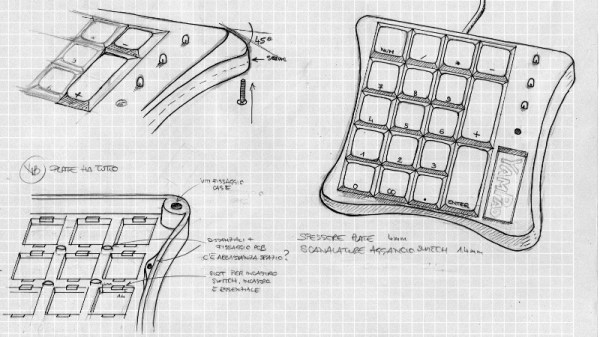
As of right now, the YamPAD is just a bare PCB, but [Mattia] is planning to design a 3D printed enclosure for it soon. The sketches he’s done so far depict a printed case which we think bears more than a passing resemblance to a Wii Fit Balance Board, but of course being a fully open source project, you’ll be free to design your own case based on the PCB’s dimensions. It would be interesting to see what other kind of customization the community might come up with once the design is finalized.

If you like the idea of the YamPAD, you might also want to check out the kbord we covered back in 2017. If you want to see the full keyboard done in this DIY open hardware style, there are already some choice entries into the field.

This Week In Security: Backdoors In Cisco Switches, PGP Spoofing In Emails, Git Ransomware

Some switches in Cisco’s 9000 series are susceptible to a remote vulnerability, numbered CVE-2019-1804 . It’s a bit odd to call it a vulnerability, actually, because the software is operating as intended. Cisco shipped out these switches with the same private key hardcoded in software for all root SSH logins. Anyone with the key can log in as root on any of these switches.

Cisco makes a strange claim in their advisory, that this is only exploitable over IPv6. This seems very odd, as there is nothing about SSH or the key authentication process that is IPv6 specific. This suggests that there is possibly another blunder, that they accidentally left the SSH port open to the world on IPv6. Another possibility is that they are assuming that all these switches are safely behind NAT routers, and therefore inaccessible through IPv4. One of the advantages/disadvantages of IPv6 is that there is no NAT, and all the network devices are accessible from the outside network. (Accessible in the sense that a route exists. Firewalling is still possible, of course.)

It’s staggering how many devices, even high end commercial devices, are shipped with unintentional yet effective backdoors, just like this one. Continue reading “This Week In Security: Backdoors In Cisco Switches, PGP Spoofing In Emails, Git Ransomware”

IoT For Agriculture Hack Chat With Akiba

Join us Wednesday at 5:00 PM Pacific time for the IoT and Agriculture Hack Chat with Akiba!

Note the different time than our usual Hack Chat slot! Akiba willi be joining us from Japan.

No matter what your feelings are about the current state of the world, you can’t escape the fact that 7.7 billion humans need to be fed every day. That means a lot of crops to grow and harvest and a lot of animals to take care of and bring to market. And like anything else, technology can make that job easier and more productive.

join-hack-chatTo test concepts at the interface between technology and agriculture, Akiba has developed HackerFarm, a combination of homestead, hackerspace, and small farm in Japan. It’s a place where hackers with agriculture-related projects can come to test ideas and collaborate with other people trying to solve the problems of a hungry world by experimenting on an approachable scale with open-source technology.

Our Hack Chats are live community events in the Hackaday.io Hack Chat group messaging. This week we’ll be sitting down on Wednesday, May 15 at 5:00 PM Pacific time. If time zones have got you down, we have a handy time zone converter.

Click that speech bubble to the right, and you’ll be taken directly to the Hack Chat group on Hackaday.io. You don’t have to wait until Wednesday; join whenever you want and you can see what the community is talking about.

Custom Storage Boxes, From Cardboard And 3D Printed Bits

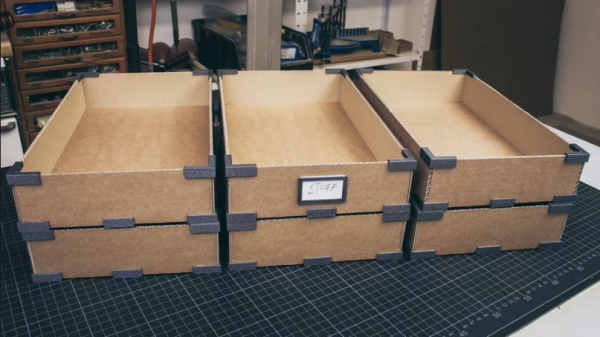
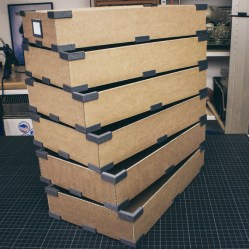
It’s not that storage boxes and organizers are hard to find. No, the problem this project set out to solve was more nuanced than that. The real trouble [theguymasamato] had was that his storage options — wide shelves and deep drawers — weren’t well suited to storing a lot of small and light objects. The result was a lot of wasted space and poor organization. To make matters worse, his big drawers had oddball dimensions, meaning that store bought organizers weren’t a good fit either.

To solve these problems, [theguymasamato] decided to design his own stackable boxes to store small and light objects far more efficiently than before. The design also allows the boxes to be made in a variety of sizes without changing any of the 3D printed parts. Carefully measured and cut cardboard is critical, but that’s nothing a utility knife and ruler can’t solve. The only other requirements are a few simple plastic parts, and some glue. He can fit six of these inside a single one of his drawers with enough room to access and handle them, but without wasting space.

Cardboard is really versatile stuff. Not only has it been behind some amazingly complex devices such as this tiny working plotter, but we’ve seen it form major components in the remarkably ambitious cardboard CNC.

Automate The Freight: Shipping Containers Sorted By Robot Stevedores

Towering behemoths are prowling the docks of Auckland, New Zealand, in a neverending shuffle of shipping containers, stacking and unstacking them like so many out-sized LEGO bricks. And they’re doing it all without human guidance.
It’s hard to overstate the impact containerized cargo has had on the modern world. The ability to load and unload ships laden with containers of standardized sizes rapidly with cranes, and then being able to plunk those boxes down onto a truck chassis or railcar carrier for land transportation has been a boon to the world’s economy, and it’s one of the main reasons we can order electronic doo-dads from China and have them show up at our doors essentially for free. At least eventually.
As with anything, solving one problem often creates other problems, and containerization is no different. The advantages of being able to load and unload one container rather than separately handling the dozen or more pallets that can fit inside it are obvious. But what then does one do with a dozen enormous containers? Or hundreds of them?
That’s where these giant self-driving cranes come in, and as we’ll see in this installment of “Automate the Freight”, these autonomous stevedores are helping ports milk as much value as possible out of containerization.

Continue reading “Automate The Freight: Shipping Containers Sorted By Robot Stevedores”