Mike's robot dog

Mike’s Robot Dog Is A First Step In The Right Direction

Humans can traverse pretty much any terrain thanks to their legs and fast-acting balancing system. So if you want a robot which should have equal flexibility, legs are a good way to go, this confirmed by all the achievements of Boston Dynamics’ robots. It was therefore natural for [Mike Rigsby] to model his robot dog after Boston Dynamics’ dog-like robot, SpotMini.

The build log on his Hackaday.io page makes for interesting reading. For example, he started out with the legs oriented like SpotMini but found that when trying to stand, the front legs worked fine but the rear ones slid or the dog shifted rearward or both happened. His solution was to take a cue from his 1990s Sony robot dog, Aibo, by reversing the orientation of the rear legs. He then upgraded his servo motors to ones with double the torque and increased the strength of the legs’ structure. In the first video below, you can see that his dog now lifts itself up to a standing position perfectly.

So far, to give it more of a dog-like personality he’s mounted Google’s AIY Vision Kit which changes a light’s color based on the degree to which a person is smiling, though we think a wagging tail would work well too. The possibilities are endless but one step at a time. See the second video below for a demonstration of the use of the Vision Kit.

Continue reading “Mike’s Robot Dog Is A First Step In The Right Direction”

Sophie Wilson: ARM And How Making Things Simpler Made Them Faster & More Efficient

Sophie Wilson is one of the leading lights of modern CPU design. In the 1980s, she and colleague Steve Furber designed the ARM architecture, a new approach to CPU design that made mobile computing possible. They did this by realizing that you could do more, and quicker, with less. If you’ve use a Raspberry Pi, or any of the myriad of embedded devices that run on ARM chips, you’ve enjoyed the fruits of their labor.

It all began for Sophie Wilson with an electric lighter and a slot machine (or fruit machine, as they are called in the UK) in 1978. An aspiring thief had figured out that if you sparked an electric lighter next to the machine, the resulting wideband electromagnetic pulse could trigger the payout circuit. Electronics designer Hermann Hauser had been tasked with fixing the problem, and he turned to Wilson, a student working at his company.

Wilson quickly figured that if you added a small wideband radio receiver to detect the pulse, you could suppress the false payout, foiling the thief. Impressed with this innovation, Hauser challenged Wilson to build a computer over the summer holidays, based in part on a design for an automated cow feeder that Wilson had created at university. Wilson created this prototype computer that looked more like a hand-wired calculator than a modern computer, but the design became the basis for the Acorn System 1, the first computer that Hauser’s new company Acorn Computers launched in 1979. Continue reading “Sophie Wilson: ARM And How Making Things Simpler Made Them Faster & More Efficient”

We Couldn’t Resist This CNC Batik Bot

Batik is an ancient form of dyeing textiles in which hot wax is applied to a piece of cloth in some design. When the cloth is submerged in a dye bath, the parts covered with wax resist the pigment. After dyeing, the wax is either boiled or scraped away to reveal the design.

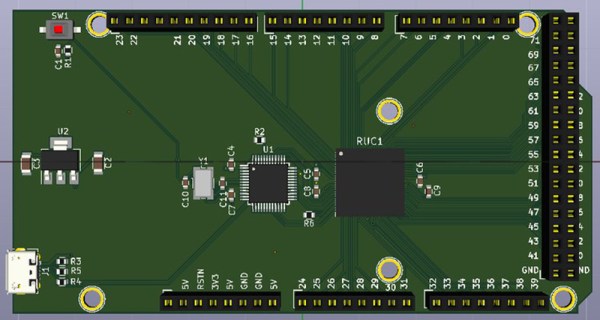
[Eugenia Morpurgo] has created a portable, open-source batik bot that rolls along the floor and draws with wax, CNC-style, on a potentially infinite expanse of cloth. The hardware should be familiar: an Arduino Mega and a RAMPS 1.4 board driving NEMA 17 steppers up and down extruded aluminium.

Traditionally, batik wax is applied with a canting, a pen-like object that holds a small amount of hot wax and distributes it through a small opening. The batik bot’s pen combines parts from an electric canting tool with the thermistor, heater block, and heater cartridge from an E3D V6 hot end. [Eugenia] built the Z-axis from scrap and re-used the mechanical endstops from an old plotter. Check out the GitHub for step-by-step instructions with a ton of clear pictures and the project’s site for even more pictures and information. Oh, and don’t resist the chance to see it in action after the break.

We love a good art bot around here, even if the work disappears with the tide.

Continue reading “We Couldn’t Resist This CNC Batik Bot”

How To Build Anything Out Of Aluminum Extrusion And 3D Printed Brackets

The real power of 3D printing is in infinite customization of parts. This becomes especially powerful when you combine 3D printing with existing materials. I have been developing a few simple tricks to make generic fasteners and printed connectors a perfect match for aluminum extrusion, via a novel twist or two on top of techniques you may already know.

Work long enough with 3D printers, and our ideas inevitably grow beyond our print volume. Depending on the nature of the project, it may be possible to divide into pieces then glue them together. But usually a larger project also places higher structural demands ill-suited to plastic.

Those of us lucky enough to have nice workshops can turn to woodworking, welding, or metal machining for larger projects. Whether you have that option or not, aluminum extrusion beams provide the structure we need to go bigger and to do it quickly. And as an added bonus, 3D printing can make using aluminum extrusion easier and cheaper.

Continue reading “How To Build Anything Out Of Aluminum Extrusion And 3D Printed Brackets”

Alexa, Attack Intruders

If our doom at the hands of our robot overlords is coming, I for one welcome the chance to get a preview of how they might go about it. That’s the idea behind Project Icarus, an Alexa-enabled face-tracking Nerf turret. Designed by [Nick Engmann],  this impressive (or terrifying) project is built around a Nerf Vulcan, a foam dart firing machine gun mounted on a panning turret that is hidden behind a drop-down cabinet door. This is connected to a Pi Zero equipped with a Pi camera. The Zero is running OpenCV and Google Firebase, which connects it with Amazon’s Alexa service.

It works like this: you say “Alexa, open Project Icarus”. Through the Alexa skill that [Nick] created, this connects to the Pi and starts the system. If you then say “Alexa, activate alpha”, it triggers a relay to open the cabinet and the Nerf gun starts panning around, while the camera mounted on the top of it searches for faces. The command “Alexa, activate beta” triggers the Nerf to open fire.

Continue reading “Alexa, Attack Intruders”

Is That A Tweet On Your Belt Buckle Or Are You Just Happy To See Me?

What a time to be alive! The range of things you never knew you needed but absolutely must have expands at a breakneck pace, such that it’s now possible to pick up a belt buckle with an embedded LED matrix to scroll messages. We have no idea what the use case for something like this is, but some people will buy anything.

One such person was a friend of [Brian Moreau], who doubled down after being gifted the glowing bauble by turning it into a WiFi enabled Tweet-scrolling belt buckle. It appears to be a just for fun project, and to be honest one would need a heck of a belt for the buckle after his mods. He added an ESP8266 to take care of monitoring his Twitter account and driving the display on the belt buckle, a non-trivial task given that the thing is programmed with only two buttons that scroll through characters to compose a message. The microcontroller might have fit inside the original buckle or only added a little to its bulk, but [Brian] decided to replace the two coin cells powering it with an external 6-volt battery pack. That required a buck converter to power the ESP, so the whole thing ended up being thrown in a case and acting more like a neat display than a flashy fashion statement.

We’d bet some tradeoffs could be made to reduce the bulk and get that buckle back where it belongs, though. Once it does, maybe it’ll be part of a complete LED-laden ensemble, from head to toe.

Harmony Hub Hacked And Patched

When we say “hack” here we most often mean either modifying something to do something different or building something out of parts. But as we build more Internet-connected things, it is worthwhile to think about the other kind of hack where people gain unauthorized access to a system. For example, you wouldn’t think a remote control would be a big deal for hackers. But the Logitech Harmony Hub connects to the Internet and runs Linux. What’s more is it can control smart devices like door locks and thermostats, so hacking it could cause problems. FireEye’s Mandian Red Team set out to hack the Harmony and found it had a lot of huge security problems.

The remote didn’t check Logitech’s SSL certificate for validity. It didn’t have a secure update process. There were developer tools (an SSH server) left inactive in the production firmware and — surprisingly — the root password was blank! The team shared their findings with Logitech before publishing the report and the latest patch from the company fixes these problems. But it is instructive to think about how your Raspberry Pi project would fare under the same scrutiny.

In fact, that’s the most interesting part of the story is the blow-by-blow description of the attack. We won’t spoil the details, but the approach was to feed the device a fake update package that turned on a dormant ssh server. Although they started by trying to solder wires to a serial port, that wasn’t productive and the final attack didn’t require any of that.

We’ve looked at some ways to harden Linux systems like the Raspberry Pi before, but honestly, it is an ongoing battle. We’ve seen plenty of devices with cybersecurity holes in them — some not found by good guy hackers first.