Truly Terrible Dimensioned Drawings

I’m in the planning stages of a side project for Hackaday right now. It’s nothing too impressive, but this is a project that will involve a lot of electromechanical parts. This project is going to need a lot of panel mount 1/8″ jacks and sockets, vertical mount DIN 5 connectors, pots, switches, and other carefully crafted bits of metal. Mouser and Digikey are great for nearly every other type of electrical component, but when it comes to these sorts of electromechanical components, your best move is usually to look at AliExpress or DealExtreme, finding something close to what you need, and buying a few hundred. Is this the best move for a manufacturable product? No, but we’re only building a few hundred of these things.

I have been browsing my usual Internet haunts in the search for the right bits of stamped brass and injection molded plastic for this project, and have come to a remarkable conclusion. Engineers, apparently, have no idea how to dimension drawings. Drafting has been a core competency for engineers from the dawn of time until AutoCAD was invented, and now we’re finally reaping the reward: It’s now rare to find a usable dimensioned drawing on the Internet.

This post is going to be half rant, half explanation of what is wrong with a few of the dimensioned drawings I’ve found recently. Consider this an example of what not to do.  There is no reason for the state of engineering drawing to be this bad.
Continue reading “Truly Terrible Dimensioned Drawings”

ADSL Robustness Verified By Running Over Wet String

A core part of the hacker mentality is the desire to test limits: trying out ideas to see if something interesting, informative, and/or entertaining comes out of it. Some employees of Andrews & Arnold (a UK network provider) applied this mentality towards connecting their ADSL test equipment to some unlikely materials. The verdict of experiment: yes, ADSL works over wet string.

ADSL itself is something of an ingenious hack, carrying data over decades-old telephone wires designed only for voice. ADSL accomplished this in part through robust error correction measures keeping the bytes flowing through lines that were not originally designed for ADSL frequencies. The flow of bytes may slow over bad lines, but they will keep moving.

How bad? In this case, a pair of strings dampened with salty water. But there are limits: the same type of string dampened with just plain water was not enough to carry ADSL.

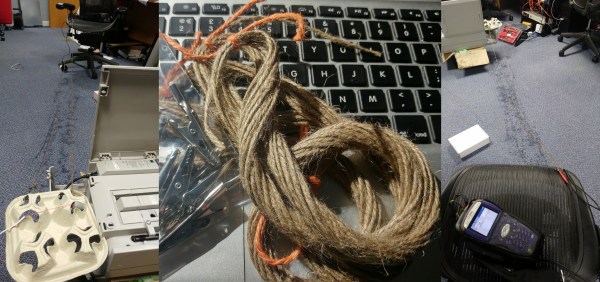
The pictures of the test setup also spoke volumes. They ran the wet string across a space that looked much like every hacker workspace, salt water dripping on the industrial carpet. Experimenting and learning right where you are, using what you have on hand, are hallmarks of hacker resourcefulness. Fancy laboratory not required.

Thanks to [chris] and [Spencer] for the tips.

CNC’d MacBook Breathes Easy

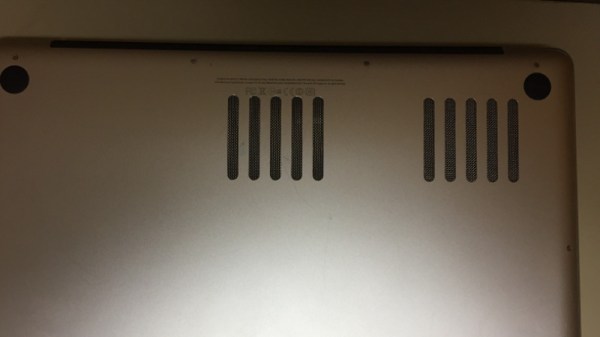
Sick of his 2011 Macbook kicking its fans into overdrive every time the temperatures started to climb, [Arthur] decided to go with the nuclear option and cut some ventilation holes into the bottom of the machine’s aluminum case. But it just so happens that he had the patience and proper tools for the job, and the final result looks good enough that you might wonder why Apple didn’t do this to begin with.

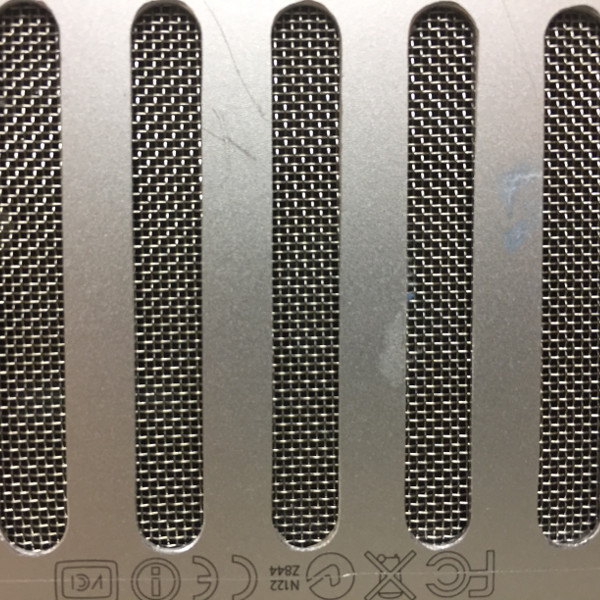
After disassembling the machine, [Arthur] used double-sided tape and a block of scrap wood to secure the Macbook’s case to the CNC, and cut out some very slick looking vents over where the internal CPU cooler sits. With the addition of some fine mesh he found on McMaster-Carr, foreign objects (and fingers) are prevented from getting into the Mac and messing up all that Cupertino engineering.

[Arthur] tells us that the internal temperature of his Macbook would hit as high as 102 °C (~215 °F) under load before his modification, which certainly doesn’t sound like something we’d want sitting in our laps. With the addition of his vents however, he’s now seeing an idle temperature of 45 °C to 60 °C, and a max of 82 °C.

In the end, [Arthur] is happy with the results of his modification, but he’d change a few things if he was to do it again. He’s somewhat concerned about the fact that the mesh he used for the grill isn’t non-conductive (he’s using shims of card stock internally to make sure it doesn’t touch anything inside), and he’d prefer the peace of mind of having used epoxy to secure it all together rather than super-glue. That said, it works and hasn’t fallen apart yet; basically the hallmarks of a successful hack.

It’s worth noting that [Arthur] is not the first person to struggle with the Macbook’s propensity for cooking itself alive. A few years back we covered another user who added vents to their Macbook, but not before they were forced to reflow the whole board because some of the solder joints gave up in the heat.

Building A Drone That (Almost) Follows You Home

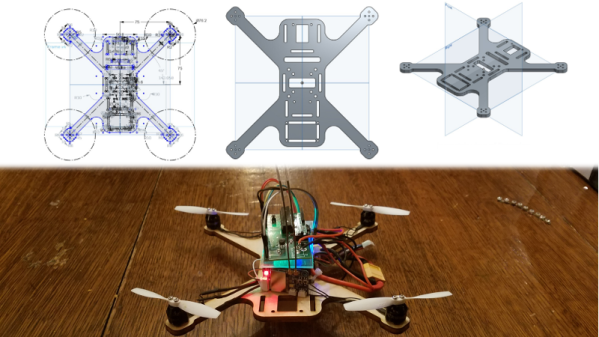
There’s a great deal of research happening around the topic of autonomous vehicles of all creeds and colours. [Ryan] decided this was an interesting field, and took on an autonomous drone as his final project at Cornell University.

The main idea was to create a drone that could autonomously follow a target which provided GPS data for the drone to follow. [Ryan] planned to implement this by having a smartphone provide GPS coordinates to the drone over WiFi, allowing the drone to track the user.

As this was  a university project, he had to take a very carefully considered approach to the build. Given likely constraints on both money and time, he identified that the crux of the project was to develop the autonomous part of the drone, not the drone itself. Thus, off-the-shelf parts were selected to swiftly put together a drone platform that would serve as a test bed for his autonomous brain.

The write up is in-depth and shares all the gritty details of getting the various subsystems of the drone talking together. He also shares issues that were faced with altitude control – without any sensors to determine altitude, it wasn’t possible to keep the drone at a level height. This unfortunately complicated things and meant that he didn’t get to complete the drone’s following algorithm. Such roadblocks are highly common in time-limited university projects, though their educational value cannot be overstated. Overall, while the project may not have met its final goals, it was obviously an excellent learning experience, and one which has taught him plenty about working with drones and the related electronics.

For another take on autonomous flight, check out this high-speed AI racing drone.

Will Hack For Espresso

[Avidan Ross] has an unyielding passion for coffee. Brewing a proper espresso is more than measuring fluid ounces, and to that end, his office’s current espresso machine was not making the cut. What’s a maker to do but enlist his skills to brew some high-tech coffee.

For a proper espresso, the mass of the grounds and the brewed output need to be precisely measured. So, the office La Marzocco GS3 has been transformed into a closed-loop espresso machine with a Particle Photon and an Acaia Lunar waterproof scale at its heart.

Continue reading “Will Hack For Espresso”

Color Changing Clock Uses PCB Digits

There’s an old saying, that you should do everything at least twice. Once to learn how to do it, and then a second time to do it right. Perhaps [Zweben] would agree, since he wasn’t satisfied with his first Neopixel clock and proceeded to build another one. One lesson learned: soldering 180 tiny solder joints isn’t much fun. This time, [Zweben] set out to make a printed circuit board and redesign the clock to make it easier to assemble.

The clock uses multiple copies of a single circuit board. The board holds Neopixel strips in a 7-segment arrangement. Each board can also hold all of the electronics needed to drive the clock. Only the first board gets the microcontroller and other circuits.

Continue reading “Color Changing Clock Uses PCB Digits”

Guitar Game Plays With Enhanced Realism

There’s a lot more to learning how to play the guitar than just playing the right notes at the right time and in the right order. To produce any sound at all requires learning how to do completely different things with your hands simultaneously, unless maybe you’re a direct descendant of Eddie Van Halen and thus born to do hammer ons. There’s a bunch of other stuff that comes with the territory, like stringing the thing, tuning it, and storing it properly, all of which can be frustrating and discouraging to new players. Add in the calluses, and it’s no wonder people like Guitar Hero so much.

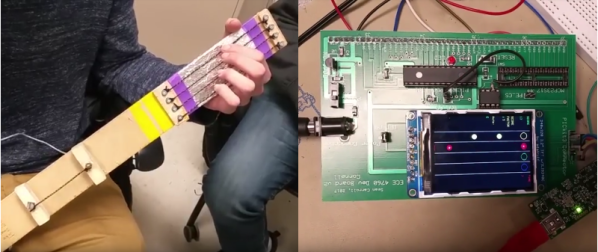
[Jake] and [Jonah] have found a way to bridge the gap between pushing candy colored buttons and developing fireproof calluses and enough grip strength to crush a tin can. For their final project in [Bruce Land]’s embedded microcontroller design class, they made a guitar video game and a controller that’s much closer to the experience of actually playing a guitar. Whether you’re learning to play for real or just want to have fun, the game is a good introduction to the coordination required to make more than just noise.

Continue reading “Guitar Game Plays With Enhanced Realism”