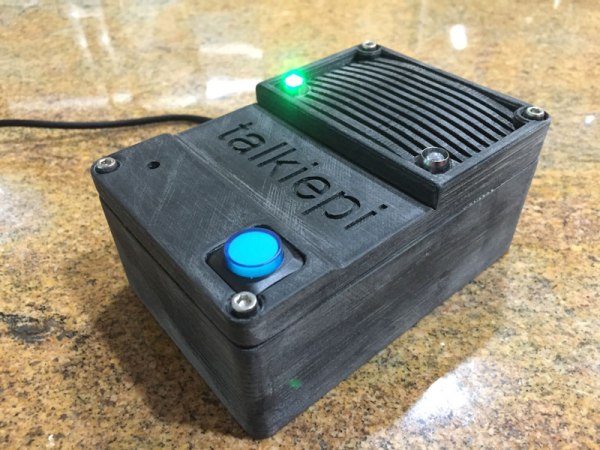
Raspberry Pi Walkie Talkie Mumbles To Friends

His kids wanted walkie talkies, so [Daniel Chote] built one. The TalkiePi is a neat project built around a Raspberry Pi running Mumble, the open-source voice chat system that his kids can share with their siblings and friends.

It’s easy enough to choose the Raspberry Pi, and Mumble is pretty well known. But what’s the easiest way you can think of to add microphone and speakers to the RPi? We applaud [Daniel’s] choice to equip it with the guts of a USB speakerphone. Mumble lets you choose voice activation or keyboard input — in this case an added button makes it push-to-talk, as you would expect in a traditional walkie talkie.

He put all of this into a nicely designed 3D case with a few LEDs, so it is easy to tell that it is ready to transmit. [Daniel] isn’t quite finished yet, though: he’s now working on a new version that is portable, battery powered and uses a Raspberry Pi Zero for the ultimate walkie talkie. We can’t wait to see someone take this to the extreme and include a cellular-modem. But then again, anywhere you can get on WiFi this rig should work, it’s not relegated to a single LAN, and that already far outperforms walkie talkies of yore.
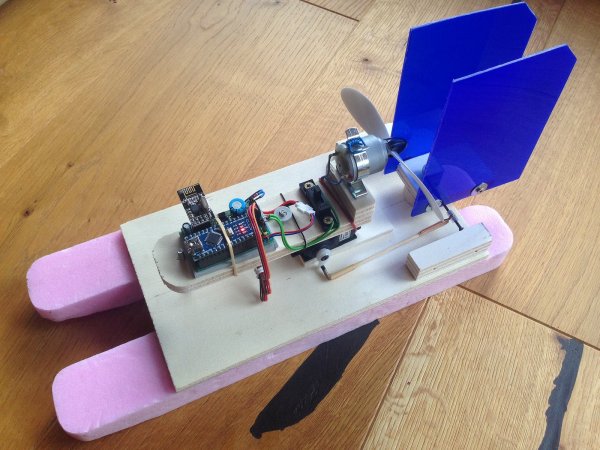

Cheap Toy Airboat Gets A Cheap R/C Upgrade

[Markus Gritsch] and his son had a fun Sunday putting together a little toy airboat from a kit. They fired it up and it occurred to [Markus] that it was pretty lame. It went forward and sometimes sideward when a stray current influenced its trajectory, but it had no will of its own.

The boat was extracted from water before it could wander off and find itself lost forever. [Markus] did a mental inventory of his hacker bench and decided this was a quickly rectified design shortcoming. He applied a cheap knock-off arduino, equally cheap nRF24L01+ chip of dubious parentage, and their equivalent hobby servo to the problem.

Some quick coding later, assisted by prior work from other RC enthusiasts, the little boat was significantly upgraded. Now the boat could be brought back to shore using any R/C controller that supported the, “Bayang,” protocol. He wouldn’t have to face the future in which he’d have to explain to his son that the boat, like treacherous helium balloons, was just gone. Video after the break.

Continue reading “Cheap Toy Airboat Gets A Cheap R/C Upgrade”

Hackaday Prize Entry: Adblock For TV

Contact, the 1985 book by Carl Sagan, was significantly better than the movie. Five people went through the wormhole, three machines were made (in Russia, Wyoming, and a third on Hokkaido), Erbium did something, and the novelization provided much better worldbuilding. One of the more interesting characters in the book was H.R. Haddon, the megalomaniacal business man, made his first million designing a chip that would block advertisements on TV. The book strongly suggests this commercial-blocking chip was a purely analog device, a concept that would have been an amazing abuse of NTSC produced by a damn fine engineer.

Now, even though cord cutting is commonplace and streaming is taking over, there’s still commercials on Hulu. In a few months, I’ll have to pay $5 a month to watch Star Trek with commercials. There is obviously a market for ‘adblock for TV’, and that’s what [PixJuan] is doing for his Hackaday Prize entry.

[Juan]’s device is a basically an HDMI switch with a remote that’s pressed every time the ads start to show on a broadcast. This switch will change the input of the HDMI switch from a cable box to a Raspberry Pi and play a short video clip or something else that isn’t selling you crap. When the Raspi is done, the switch goes back over to the original input.

With a bit of computation in this adblock-for-TV device, there are a few more options for ad detection. The Raspberry Pi could build a database of when ads play and for how long, depending on the channel. This is a great project that has a lot of potential to use some interesting techniques like computer vision and machine learning for the goal of removing commercials before they start.

Wooing A Lady Into Persisting With Persistence… Of Vision

As the story goes, years ago [Matt Evans] was wooing the beautiful and talented [Jen]. There were many suitors vying for her hand; he would have to set himself apart. The trouble was, how to convince her that persisting in the relationship was the best and only course? What did he have to offer? Of course many of us know the answer; having wooed our own significant others with the same thing. Incredible and unrepentant nerdiness.

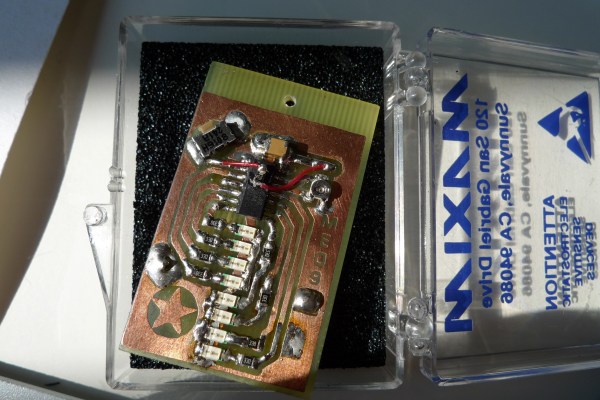
So! He toiled late into the night, his eyes burning with love and from the fumes of solder smoke. For her he would put his wizardry to work. At the wave of a hand would write songs of adoration in the air with nothing but light. The runes of power, all typed out in the proper order, would be held by a ATiny. A CR2032 coin cell provided the magic pixies which would march to its commands, delivering their spark to the LEDs in the right order.

He etched the board, wrote the code, and soldered the components. He encased it in his finest box of crystal clear plastic and black static foam, a gift of the samples department of the Maxim corporation.

Presumably the full moon was high in the air when he presented the box. He took it out and waved it with a flair. Poetry floated there in front of her eyes. It read, “Jen is cool!”. A few years later, they were married.

Vintage 16mm Film Editor Is Now Retro Arcade

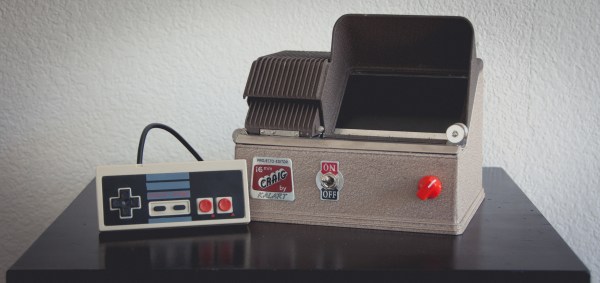
When [Douglas Welcome] found a disposed Kalart Craig 16 mm Projecto-Editor on the curb, he knew it was destined for retro-greatness. This vintage looking device was once used to view and cut 16 mm film strips, and still in mint condition, it was just too cool to pass up. With help of a similarly historic Raspberry Pi 1 Model B, and a little LCD screen, [Douglas] now turned the little box into an awesome retro arcade game console

Continue reading “Vintage 16mm Film Editor Is Now Retro Arcade”

Bicycle Seismograph Measures The Streets

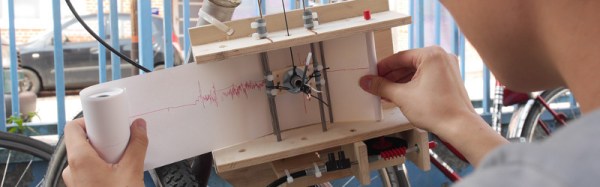
Riding the streets of the Netherlands on a bicycle is a silky-smooth experience compared to doing the same on those of Germany. So says [Kati Hyyppä], who made the move with her trusty Dutch bike. The experience led her to record the uneven cobblestones and broken asphalt of the German roads on a home-made seismograph, a paper chart recorder driven by the bike’s motion and recorded upon by a pen free to vibrate as it passed over any bumps.

The resulting instrument is a wooden frame with a ballpoint pen mounted in a sliding holder weighted with some washers and kept under some tension with elastic bands. The paper roll is driven from the motion of the bike by the drive from a mechanical speedometer feeding a set of FischerTechnik gears, and the whole unit is suspended from the crossbar.

You can see it in action in the video below the break, and if you would like to build one yourself she has put the project up on Instructables as well as posting the description linked above.

Continue reading “Bicycle Seismograph Measures The Streets”

Run A RepRap On An ESP8266

What can’t the little $5 WiFi module do? Now that [lhartmann] has got an ESP8266 controlling the motors of a 3D printer, that’s one more item to check off the list.

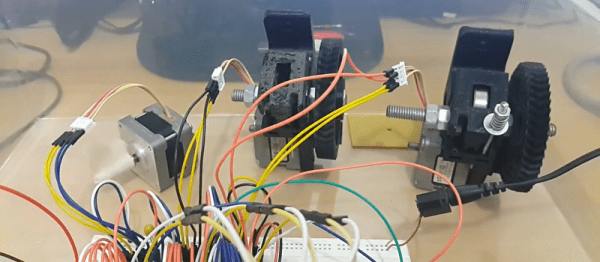
What’s coolest about this project is the way that [lhartmann] does it. The tiny ESP8266 has nowhere near the required number of GPIO pins, the primary SPI is connected to the onboard flash memory, and the secondary SPI is poorly documented and almost nobody uses it. So, [lhartmann] chose to use the I2S outputs.

I2S is most often an audio protocol, so this might at first seem like a strange choice. Although I2S sounds like I2C, it’s really essentially an SPI protocol with a fourth wire that alternates to designate the right or left channel. It’s actually just perfect for sending 16×2 bits of data at high data rates.

[lhartmann] takes these 32 bits and feeds them into four shift registers, producing 32 outputs from just the four I2S data lines. That’s more than enough signals to run the stepper motors. And since it updates at 192 kHz sample rate, it’s plenty fast enough to drive them.

The other side benefit of this technique is that it can work on single-board computers with just a little bit of software. Programming very complicated stepper movements then becomes just a matter of generating the right “audio” file and playing it out. [lhartmann] demonstrated this earlier with an Orange Pi. That’s pretty cool, too.

The code for turning the ESP8266 and a short handful of 74HC595s into a 3D printer controller are up on GitHub, so go check it out.

Thanks [CNLohr] for the tip!