FIDO2: The Dream Of Password-Free Authentication On The WWW

Of all the things which are annoying about the modern World Wide Web, the need to create and remember countless passwords is on the top of most people’s lists. From dozens of passwords for everything from social media sites to shopping, company, and productivity-related platforms like Github, a large part of our day is spent dealing with passwords.

While one can totally use a password manager to streamline the process, this does not absolve you from having to maintain this list and ensure you never lose access to it, while simultaneously making sure credentials for the password manager are never compromised. The promise of password-less methods of authentication is that of a world where one’s identity is proven without hassle, and cannot ever be stolen, because it relies on biometrics and hardware tokens instead of an easily copied password.

The FIDO2 project promises Web Authentication that means never entering a password into a website again. But like everything, it comes with some strings attached. In this article, we’ll take a look at how FIDO2 plans to work and how that contrasts with the state of security in general.

Continue reading “FIDO2: The Dream Of Password-Free Authentication On The WWW”

Solar System Wars: Walmart Versus Tesla

It seems like hardly a day goes by that doesn’t see some news story splashed across our feeds that has something to do with Elon Musk and one or another of his myriad companies. The news is often spectacular and the coverage deservedly laudatory, as when Space X nails another double landing of its boosters after a successful trip to space. But all too often, it’s Elon’s baby Tesla that makes headlines, and usually of the kind that gives media relations people ulcers.

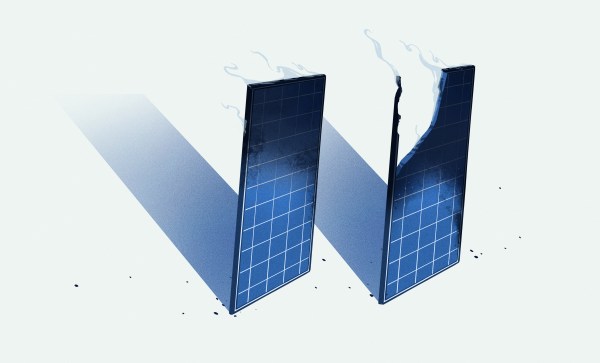
The PR team on the automotive side of Tesla can take a bit of a breather now, though. This time it’s Elon’s solar power venture, Tesla Energy Operations, that’s taking the heat. Literally — they’ve been sued by Walmart for rooftop solar installations that have burst into flames atop several of the retail giant’s stores. While thankfully no lives have been lost and no major injuries were reported, Walmart is understandably miffed at the turn of events, leading to the litigation.

Walmart isn’t alone in their exposure to potential Tesla solar problems, so it’s worth a look to see what exactly happened with these installations, why they failed, and what we as hackers can learn from the situation. As we’ll see, it all boils down to taking electrical work very seriously and adhering to standards designed to keep everyone safe, even when they just seem like a nuisance.

Continue reading “Solar System Wars: Walmart Versus Tesla”

Tool Rolls, The Fabric Design Challenge That Can Tidy Up Any Workshop

You’ve designed PCBs. You’ve cut, drilled, Dremeled, and blow-torched various objects into project enclosurehood. You’ve dreamed up some object in three dimensions and marveled as the machine stacked up strings of hot plastic, making that object come to life one line of g-code at a time. But have you ever felt the near-limitless freedom of designing in fabric?

I don’t have to tell you how satisfying it is to make something with your hands, especially something that will get a lot of use. When it comes to that sweet cross between satisfaction and utility, fabric is as rewarding as any other medium. You might think that designing in fabric is difficult, but let’s just say that it is not intuitive. Fabric is just like anything else — mysterious until you start learning about it. The ability to design and implement in fabric won’t solve all your problems, but it sure is a useful tool for the box.

WoF? Fat quarter? How much is a yard of fabric, anyway?

To prove it, I’m going to take you through the process of designing something in fabric. More specifically, a tool roll. These two words may conjure images of worn, oily leather or canvas, rolled out under the open hood of a car. But the tool roll is a broad, useful concept that easily and efficiently bundles up anything from socket wrenches to BBQ utensils and from soldering irons to knitting needles. Tool rolls are the best in flexible, space-saving storage — especially when custom-designed for your need.

In this case, the tools will be pens, notebooks, and index cards. You know, writer stuff. But the same can just as easily organize your oscilloscope probes. It’s usefully and a great first foray into building things with fabric if this is your first time.

Continue reading “Tool Rolls, The Fabric Design Challenge That Can Tidy Up Any Workshop”

Linux Fu: Shell Scripts In C, C++, And Others

At first glance, it might not seem to make sense to write shell scripts in C/C++. After all, the whole point to a shell script is to knock out something quick and dirty. However, there are cases where you might want to write a quick C program to do something that would be hard to do in a traditional scripting language, perhaps you have a library that makes the job easier, or maybe you just know C and can knock it out faster.

While it is true that C generates executables, so there’s no need for a script, usually, the setup to build an executable is not what you want to spend your time on when you are just trying to get something done. In addition, scripts are largely portable. But sending an executable to someone else is fairly risky — but your in luck because C shell scripts can be shared as… well, as scripts. One option is to use a C interpreter like Cling. This is especially common when you are using something like Jupyter notebook. However, it is another piece of software you need on the user’s system. It would be nice to not depend on anything other than the system C compiler which is most likely gcc.

Luckily, there are a few ways to do this and none of them are especially hard. Even if you don’t want to actually script in C, understanding how to get there can be illustrative.

Continue reading “Linux Fu: Shell Scripts In C, C++, And Others”

India’s Moon Mission Is Far From Over

India’s Chandrayaan-2 mission to the Moon was, in a word, ambitious. Lifting off from the Satish Dhawan Space Centre on July 22nd, the mission hoped to simultaneously deliver an orbiter, lander, and rover to our nearest celestial neighbor. The launch and flight to the Moon went off without a hitch, and while there were certainly some tense moments, the spacecraft ultimately put itself into a stable lunar orbit and released the free-flying lander so it could set off on its independent mission.

Unfortunately, just seconds before the Vikram lander touched down, an anomaly occurred. At this point the Indian Space Research Organisation (ISRO) still doesn’t know exactly what happened, but based on the live telemetry stream from the lander, some have theorized the craft started tumbling or otherwise became unstable between three and four kilometers above the surface.

Telemetry indicates a suboptimal landing orientation

In fact, for a brief moment the telemetry display actually showed the Vikram lander completely inverted, with engines seemingly accelerating the spacecraft towards the surface of the Moon. It’s unclear whether this was an accurate depiction of the lander’s orientation in the final moments before impact or a glitch in the real-time display, but it’s certainly not what you want to see when your craft is just seconds away from touchdown.

But for Chandrayaan-2, the story doesn’t end here. The bulk of the mission’s scientific goals were always to be accomplished by the orbiter itself. There were of course a number of scientific payloads aboard the Vikram lander, and even the Pragyan rover that it was carrying down to the surface, but they were always secondary objectives at best. The ISRO was well aware of the difficulties involved in making a soft landing on the Moon, and planned their mission objectives accordingly.

Rather than feel sorrow over the presumed destruction of Vikram and Pragyan, let’s take a look at the scientific hardware aboard the Chandrayaan-2 orbiter, and the long mission that still lies ahead of it.

Continue reading “India’s Moon Mission Is Far From Over”

Hams In Space: Gearing Up For The Lunar Gateway

Humanity had barely taken its first tentative steps into space with primitive satellites when amateur radio operators began planning their first satellites. Barely four years after Sputnik’s brief but momentous launch and against all odds, OSCAR 1 was launched as a secondary payload from an Air Force missile taking a spy satellite into orbit. Like Sputnik, OSCAR 1 didn’t do much, but it was a beginning.

Since then, amateur radio has maintained a more or less continuous presence in space. That first OSCAR has been followed by 103 more, and hams have flown on dozens of missions from the Space Shuttle to the ISS, where pretty much everyone is a licensed amateur. And now, as humans prepare once again to journey into deep space via the stepping stone of the proposed Lunar Gateway, amateur radio is planning on going along for the ride.

Continue reading “Hams In Space: Gearing Up For The Lunar Gateway”

Watching The Watchers: The State Of Space Surveillance

By now you’ve almost certainly heard about the recent release of a high-resolution satellite image showing the aftermath of Iran’s failed attempt to launch their Safir liquid fuel rocket. The geopolitical ramifications of Iran developing this type of ballistic missile technology is certainly a newsworthy story in its own right, but in this case, there’s been far more interest in how the picture was taken. Given known variables such as the time and date of the incident and the location of the launch pad, analysts have determined it was likely taken by a classified American KH-11 satellite.

The image is certainly striking, showing a level of detail that far exceeds what’s available through any of the space observation services we as civilians have access to. Estimated to have been taken from a distance of approximately 382 km, the image appears to have a resolution of at least ten centimeters per pixel. Given that the orbit of the satellite in question dips as low as 270 km on its closest approach to the Earth’s surface, it’s likely that the maximum resolution is even higher.

Of course, there are many aspects of the KH-11 satellites that remain highly classified, especially in regards to the latest hardware revisions. But their existence and general design has been common knowledge for decades. Images taken from earlier generation KH-11 satellites were leaked or otherwise released in the 1980s and 1990s, and while the Iranian image is certainly of a higher fidelity, this is not wholly surprising given the intervening decades.

What we know far less about are the orbital surveillance assets that supersede the KH-11. The satellite that took this image, known by its designation USA 224, has been in orbit since 2011. The National Reconnaissance Office (NRO) has launched a number of newer spacecraft since then, with several more slated to be lifted into orbit between now and 2021.

So let’s take a closer look at the KH-11 series of reconnaissance satellites, and compare that to what we can piece together about the next generation or orbital espionage technology that’s already circling overhead might be capable of.

Continue reading “Watching The Watchers: The State Of Space Surveillance”