Everyone one of us is likely aware of what lead — as in the metal — is. Having a somewhat dull, metallic gray appearance, it occupies atomic number 82 in the periodic table and is among the most dense materials known to humankind. Lead’s low melting point and malleability even when at room temperature has made it a popular metal since humans first began to melt it out of ore in the Near East at around 7,000 BC in the Neolithic period.
Although lead’s toxicity to humans has been known since at least the 2nd century BC and was acknowledged as a public health hazard in the late 19th century, the use of lead skyrocketed in the first half of the 20th century. Lead saw use as a gasoline additive beginning in the 1920s, and the US didn’t abolish lead-based paint until 1978, nearly 70 years after France, Belgium and Austria banned it.
With the rise of consumer electronics, the use of lead-based solder became ever more a part of daily life during the second part of the 20th century, until an increase in regulations aimed at reducing lead in the environment. This came along with the World Health Organization’s fairly recent acknowledgment that there is truly no safe limit for lead in the human body.
In this article I’ll examine the question of why we are still using lead, and if we truly must, then how we can use this metal in the safest way possible.
However, this only tells part of the story. Carbon dioxide is not alone in its role as a greenhouse gas, with many others contributing significantly to global temperature rises. As humanity struggles to keep warming below 2 degrees C over the century, strategies will be needed to tackle the problem on all fronts.
There’s A Bad Smell Around Methane
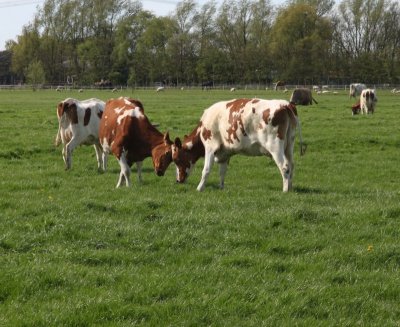
Ruminant animals are a major source of greenhouse gas emissions, which is probably no surprise to some. Source: Peter van der Sluijs, CC-BA-SA-2.0
Methane is a remarkably potent greenhouse gas, having 28 times the warming potential of CO2 by weight over a 100-year period. Historically, it’s mostly been released from natural sources, like bacteria processing organic material in stagnant watercourses, or from thawing permafrost. However, scientists now consider around 60% of methane in the atmosphere to be a direct result of human activity.
Agriculture is a major contributor in this area. Ruminant animals raised for human consumption are major methane emitters, as the microbes in their digestive systems release the gas when breaking down plant material. With the demand for meat and dairy showing no signs of slowing down, this could prove difficult to tackle. There are a variety of other diffuse sources of the gas, too. Landfills and sewage plants have significant methane emissions of their own, and it’s also often released from oil and gas drilling operations, too.
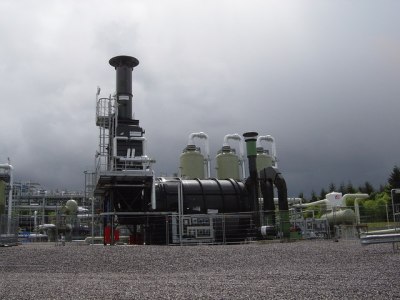
Oil and gas operations release significant quantities of methane into the atmosphere, often due to leaks or plant malfunctions. Credit: Hugh Chevallier, CC:BA:SA-2.0
Levels of methane in the atmosphere have been low compared to carbon dioxide. Methane also tends to have a short life in the atmosphere, of around 9 years. These factors have meant that methane has historically been of lower concern to environmental organisations. However, after levels plateaued from the 1990s to the mid-2000s, they have once again begun to climb precipitously. Scientists have yet to identify the cause of this rise, and it has the potential to undo hard-fought gains in the fight against global warming on the CO2 front. Theories range from a reduced level of chemicals that break down methane in the atmosphere, to increased livestock production or the rise of the hydraulic fracturing industry.
Whatever the cause of the recent rise, stemming the increase will require significant work. The Environmental Defence Fund is launching MethaneSAT in an attempt to better locate and quantify releases to the atmosphere, aiming to stem easily-fixed leaks in fossil fuel operations. Other ideas include using antibiotics to reduce animal’s methane output, or to capture the emissions from landfills and use them as an energy source. It’s likely a rigorous approach to both monitoring and emissions reduction will be required to keep methane levels in check.
Nitrous Oxide
Nitrous oxide isn’t just the favorite gas of the Fast and the Furious. It’s also a potent greenhouse gas, with 300 times the warming potential of carbon dioxide, pound for pound. With plenty of staying power, it sticks around in the atmosphere for 114 years on average. With 40 percent of NOx emissions coming from human activity, it’s a significant player as far as greenhouse gases go.
Fertilizer use in agriculture is the major contributor to nitrous oxide releases into the atmosphere. As farms push for ever-greater yields, there has been a corresponding increase in the use of nitrogen-containing fertilizers. Other lesser sources include fossil fuel combustion and various chemical production processes.
Reducing nitrous oxide emissions to any major degree is a difficult problem. Reducing farm yields is impractical if we wish to continue feeding as many people as possible. Increasing the efficiency of fertiliizer application is instead a more viable way to go. By applying fertilizers in the right way, in the right quantities at the right time, has the benefit of both reducing nitrous oxide emissions as well as cutting costs for farming operations. Other gains in this space can be made by reducing fossil fuel use by switching to renewable energy production, or cleaner burning technologies. The famous catalytic converter, introduced to gasoline-powered vehicles in the 1970s, plays a major role in reducing these emissions, and urea injection does much the same for diesel engines, which we’ve talked about before.
Sulfur Hexa-what now?
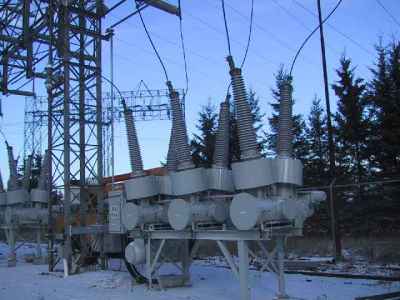
Sulfur hexafluoride is used heavily in high-voltage switchgear, as seen here in this hydroelectric installation. This circuit breaker is rated to run at 115 kV, 1200 A. Credit: Wtshymanski, public domain
Recently, sulfur hexafluoride has come under scrutiny. Also known by its chemical formula, SF6, it’s a highly potent greenhouse gas, with a warming potential of over 23,000 times that of CO2. Prized for its performance as a gaseous dielectric medium, it’s used heavily in high-voltage circuit breakers in modern electricity grids. It enables the construction of much more compact switchgear, while remaining safe and reliable in operation.
Concentrations of SF6 have begun to tick up in recent times, raising alarm bells. Speculation is that this is down to leaks of the gas from electrical equipment. As the world’s energy mix changes, grids have come to rely on more distributed generation, from sources like wind farms and solar. This mode of generation necessitates many more connections to the grid, which means more switchgear, and thus more SF6 out in the wild.
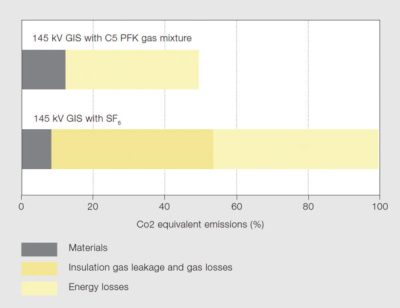
This graph shows the lifetime equivalent emissions of AirPlus versus SF6 technology. There are major gains to be had, thanks to the low global warming potential of AirPlus. Credit: 3M/ABB
Work is afoot to slow this trend before things get out of hand. A replacement has been developed in a collaboration between ABB and 3M, by the name of AirPlus. While the production process releases more CO2, over the lifecycle of an installation, AirPlus-based switchgear should have far lower impact on warming. This is due to the fact that when released into the atmosphere, AirPlus degrades under UV light exposure in just 15 days, versus 3200 years for SF6. Its global warming potential is less than 1, meaning it has less of a warming effect than even CO2, while delivering comparable dielectric performance to SF6. Variants are available for both medium and high voltage applications.
Over time, as goverments work to reduce the prevalance of SF6 in new installations, its likely that we’ll see AirPlus and other alternatives gain steam. The gas has already been banned in the EU for all non-electrical purposes, since 2014. Industry is typically slow to act unless there’s a strong business case, so government intervention is likely to be the game changer that pushes adoption of newer, cleaner technology in this space.
Other Fluorinated Gases
SF6 is just one of a series of fluorinated gases that have significant global warming potential. Many of these were introduced as replacements for chlorofluorocarbons (CFCs), which tend to eat a hole in the ozone layer. Thankfully, that problem was largely solved when production of CFCs was tailed off in 1996, but their replacements can still cause further troubles.
With lifetimes in the hundreds to thousands of years in the upper atmosphere, gases like hydrofluorocarbons and perfluorocarbons have an outsized effect on atmospheric warming, thousands of times that of CO2 on a per-molecule basis. They have applications as aerosol propellants, solvents, and fire retardants, but their primary use is as refrigerants in cooling systems. HFC-134a is the most well-known, used widely in air conditioning systems worldwide, and particularly in motor vehicles. This has led to its position as the most abundant HFC in the atmosphere.
Efforts are in place to limit the impact of these chemicals, through precautionary measures. This involves taking more care during the repair and disposal of HVAC systems, as well as designing systems to be more resilient of leaks in the first place. Recycling methods are also beneficial to ensure that where possible, these gases are captured rather then simply vented to the atmosphere. Enforcement on a broad scale remains a challenge.
Automakers are already planning to switch air conditioning systems to use gases that have less global warming potential. Source: Mercedes Benz
Sometimes, it’s better to avoid the problem entirely. A transition away from using refrigerants like HFC-134a is in progress. The EPA has legislated that all light vehicles manufactured or sold in the USA by model year 2021 must no longer use HFC-134a. Instead, alternatives like HFO-1234yf, HFC-152a, and R-744 will be legal. The first two are mildly flammable, while the latter is simply another name for good old CO2. These refrigerants will require different technology to existing air conditioners. CO2-based systems in particular needing to operate at up to 10 times the pressure of traditional systems. However, progress in technology should allow these gases to take over, reducing the impact these refrigeration gases have on global warming.
The Fight Continues
CO2 is still the primary greenhouse gas, but it’s not the whole story. We’ve looked at a wide variety of chemicals, each with their own important roles and impact on the Earth’s atmosphere. This highlights the fact that there’s no single panacea to heading off global warming; instead, a broad spectrum approach across all aspects of human endeavour is required.
Halting the impacts of these chemicals is difficult, and will require decisive action by both government bodies, as well as cooperation from relevant industries. In some cases, there are additional gains to be had, while in others, the solution comes with high costs and painful changes. We engineered ourselves into this situation, so we can probably engineer ourselves out. Regardless, if humanity is to flourish in the next century, there remains much work to be done.
In the early days of spaceflight, when only the governments of the United States and the Soviet Union had the ability to put an object into orbit, even the most fanciful of futurists would have had a hard time believing that commercial entities would one day be launching sixty satellites at a time. What once seemed like an infinite expanse above our heads is now starting to look quite a bit smaller, and it’s only going to get more crowded as time goes on. SpaceX is gearing up to launch nearly 12,000 individual satellites for their Starlink network by the mid-2020s, and that’s just one of the “mega constellations” currently in the works.
Just some of the objects in orbit around the Earth
It might seem like overcrowding of Earth orbit is a concern for the distant future, but one needs only look at recent events to see the first hints of trouble. On September 2nd, the European Space Agency announced that one of its research spacecraft had to perform an evasive maneuver due to a higher than acceptable risk of colliding with one of the first-generation Starlink satellites. Just two weeks later, Bigelow Aerospace were informed by the United States Air Force that there was a 1 in 20 chance that a defunct Russian Cosmos 1300 satellite would strike their Genesis II space station prototype.
A collision between two satellites in orbit is almost certain to be catastrophic, ending with both spacecraft either completely destroyed or severely damaged. But in the worst case, the relative velocity between the vehicles can be so great that the impact generates thousands of individual fragments. The resulting cloud of shrapnel can circle the Earth for years or even decades, threatening to tear apart any spacecraft unlucky enough to pass by.
Fortunately avoiding these collisions shouldn’t be difficult, assuming everyone can get on the same page before it’s too late. The recently formed Space Safety Coalition (SSC) is made up of more than twenty aerospace companies that realize the importance of taking proactive steps to ensure humanity retains the unfettered access to outer space by establishing some common “Rules of the Road” for future spacecraft.
Openness has been one of the defining characteristics of the Internet for as long as it has existed, with much of the traffic today still passed without any form of encryption. Most requests for HTML pages and associated content are in plain text, and the responses are returned in the same way, even though HTTPS has been around since 1994.
But sometimes there’s a need for security and/or privacy. While the encryption of internet traffic has become more widespread for online banking, shopping, the privacy-preserving aspect of many internet protocols hasn’t kept pace. In particular, when you look up a website’s IP address by hostname, the DNS request is almost always transmitted in plain text, allowing all the computers and ISPs along the way to determine what website you were browsing, even if you use HTTPS once the connection is made.
The idea of also encrypting DNS requests isn’t exactly new, with the first attempts starting in the early 2000s, in the form of DNSCrypt, DNS over TLS (DoT), and others. Mozilla, Google, and a few other large internet companies are pushing a new method to encrypt DNS requests: DNS over HTTPS (DoH).
DoH not only encrypts the DNS request, but it also serves it to a “normal” web server rather than a DNS server, making the DNS request traffic essentially indistinguishable from normal HTTPS. This is a double-edged sword. While it protects the DNS request itself, just as DNSCrypt or DoT do, it also makes it impossible for the folks in charge of security at large firms to monitor DNS spoofing and it moves the responsibility for a critical networking function from the operating system into an application. It also doesn’t do anything to hide the IP address of the website that you just looked up — you still go to visit it, after all.
And in comparison to DoT, DoH centralizes information about your browsing in a few companies: at the moment Cloudflare, who says they will throw your data away within 24 hours, and Google, who seems intent on retaining and monetizing every detail about everything you’ve ever thought about doing.
Four weeks from today the Hackaday Superconference comes alive for the fifth year. From engineering in challenging environments to elevating the art form of electronics, here are nine more talks that will make this a year to remember.
In addition to the slate of speakers below there are three other announcements, plus workshops. Jeroen Domburg (aka Sprite_TM) is designing this year’s badge based around a beefy FPGA running a RISC-V core and using open source synthesis tools. We’ll have more on that soon, but if you just can’t wait, check out the expansion board spec he just published, and join the conference chat room for the inside track. Badge hacking is sure to be the liveliest we’ve ever seen.
Tickets are sold out but you can still get on the waiting list and hope that one becomes available. If you are holding onto one of these hot commodities but are unable to use it, please return your ticket so that we can get it to someone waiting with their fingers crossed.
The Talks (Part Four of Many)
Laurel Cummings
When it Rains, It Pours
Over the last two years my work has been beyond ordinary, building and prototyping in strange locations like being stranded on a sailboat in the Atlantic Ocean, teaching US Marines in Kuwait, and building fuel gauge sensors for generators for vital systems in North Carolina post hurricane Florence. Some of the big lessons I’ve learned are about how to source materials and supplies in weird places, like finding potentiometers in the backwoods of North Carolina when Amazon cannot physically deliver across flooded highways, how to find welding gas in Kuwait City (and how a local chef could possibly be your best bet), or how far you can get with an O’Reilly’s Auto Parts store near the city docks. These situations help you really see the “engineer creep” that can happen to a project. I’ve learned that when you’re in high-risk situations, you really should stop caring about whether the edges of your 3D print are chamfered. In fact, version 1 of the hurricane fuel gauge sensor was demonstrated while being housed inside an elegant, tasteful sandwich baggie.
Angela Sheehan
Building Whimsical Wearables: Leveling Up Through Playful Prototyping
Whether it’s for a theme party, Halloween, cosplay, or That Thing in The Desert, designing wearables for whimsical self expression presents a great opportunity to challenge yourself as a maker, wearer, and collaborator. As an artist and designer who crash landed into a career in tech, I’ve found that imposter syndrome can often place limits on what feels personally achievable from an electronics and programming standpoint. Recontextualizing a project to shift the focus from ‘wearable tech hardware endeavor’ to ‘quirky mixed media experiment in personal styling’, I’ve created a safe space to play and try new things just outside my skill set and produced some of my most technically complex and polished personal work. Take a journey with me through the process of conceptualizing and building my Color Stealing Fairy project, an exercise in iterative design and upgrading an interactive wearable project over the course of two years and counting.
Michael Ossmann and Kate Temkin
Software-Defined Everything
The popularity of Software-Defined Radio (SDR) has led to the emergence of powerful open source software tools such as GNU Radio that enable rapid development of real-time Digital Signal Processing (DSP) techniques. We’ve used these tools for both radio and non-radio applications such as audio and infrared, and now we are finding them tremendously useful for diverse sensors and actuators that can benefit from DSP. In this talk we’ll show how we use the open source GreatFET platform to rapidly develop an SDR-like approach to just about anything.
Kelly Heaton
“Hacking Nature’s Musicians” (or, “The Art of Electronic Naturalism”)
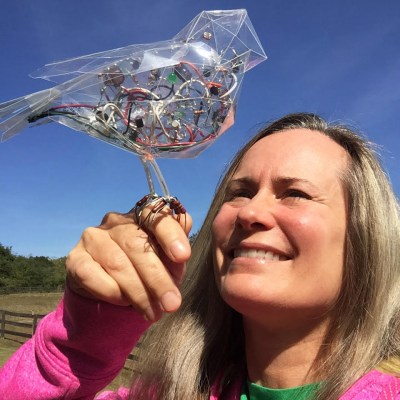
The general lack of acceptance of electronic art results from a scarcity of critics, curators, collectors, and grantors who understand electronic media, compounded by a cultural gap between the artistic and engineering communities. In order to solve this problem, we must stretch our comfort zone and vocabularies to have a respectful, enlightening conversation with people with different educational backgrounds. In this talk I’ll discuss my wonderment at the simple, analog circuit designs that mimic life-like behavior such as chirping crickets and singing birds. This will include discussion of various schematics and demonstrations of a small. along with an abbreviated survey of my work to-date.
Jasmine Brackett
Setting your Electronics Free
In this panel we’ll discuss the key ways to get your projects from your workshop into the hands of the first few users, and what you can do to scale up from there. We’ll talk about common pitfalls, and also what are the best resources to draw upon.
David Williams
MicroFPGA – The Coming Revolution in Small Electronics
Big FPGA’s are awesome. They’re doing what they’ve always done, enabling AI, signal processing, military applications etc. However, there is a new possibility emerging – FPGA’s for small applications – which is quite possibly even more significant. Using open source tools, cheap flexible development boards, and new libraries, designers have a whole new set of options, creating incredibly high performance, flexible, low power projects and products.
Nick Poole
Boggling the Boardhouse: Designing 3D Structures, Circuits, and Sensors from PCBs
The presentation will be a series of design features or techniques with a few minutes of exploration into the ‘gotchas’ of each, as well as example layouts in EAGLE and physical examples. I’d like to cover as many different techniques as I can cram into 30 minutes, including bringing weird shapes into EDA, the inside corner problem caused by tab and slot, fillet soldering, stacking boards, imitating model sprues with mouse bites, manipulating the mask layer for custom displays, bendy tab buttons, working rotary encoder, and ergonomic design for handheld PCBs.
Ted Yapo
Towards an Open-Source Multi-GHz Sampling Oscilloscope
Tektronix designed a 14.5 GHz sampling oscilloscope in 1968. With the easy multi-layer PCB designs, tiny surface-mount parts, blazingly fast semiconductors, and computer horsepower available to the individual designer today, can a similar sampling head be re-created inexpensively with common, off-the-shelf components? Should be easy, right? It’s not. In this talk, I’ll discuss progress towards an open-source GHz+ sampling oscilloscope, including a lot of dead ends, plus some very promising leads.
Jeroen Domburg
Building the Hackaday Superconference Badge
The tradition of the Hackaday Supercon badge is to build something unlike any Supercon badge that came before. This year’s badge has an FPGA as its central component, and this comes with some extra challenges: the FPGA only comes in a BGA package with a whopping 381 pads to solder, and instead of just referring to the datasheet of the SoC to write the badge software, the SoC itself had to be written first. I will discuss the development process of the badge, as well as the many challenges encountered along the way.
Keep Your Eye on Hackaday for the Livestream
The speakers you’ll see at Supercon have an amazing wealth of experience and we can’t wait to see their talks. But even if you couldn’t get a ticket, that doesn’t mean you have to miss out. Keep your eye on Hackaday for a link to the livestream which will begin on Saturday, November 16th.
It should probably go without saying that the main reason most people buy an electric vehicle (EV) is because they want to reduce or eliminate their usage of gasoline. Even if you aren’t terribly concerned about your ecological footprint, the fact of the matter is that electricity prices are so low in many places that an electric vehicle is cheaper to operate than one which burns gas at $2.50+ USD a gallon.
Another advantage, at least in theory, is reduced overal maintenance cost. While a modern EV will of course be packed with sensors and complex onboard computer systems, the same could be said for nearly any internal combustion engine (ICE) car that rolled off the lot in the last decade as well. But mechanically, there’s a lot less that can go wrong on an EV. For the owner of an electric car, the days of oil changes, fouled spark plugs, and the looming threat of a blown head gasket are all in the rear-view mirror.
Home directories have been a fundamental part on any Unixy system since day one. They’re such a basic element, we usually don’t give them much thought. And why would we? From a low level point of view, whatever location $HOME is pointing to, is a directory just like any other of the countless ones you will find on the system — apart from maybe being located on its own disk partition. Home directories are so unspectacular in their nature, it wouldn’t usually cross anyone’s mind to even consider to change anything about them. And then there’s Lennart Poettering.
In case you’re not familiar with the name, he is the main developer behind the systemd init system, which has nowadays been adopted by the majority of Linux distributions as replacement for its oldschool, Unix-style init-system predecessors, essentially changing everything we knew about the system boot process. Not only did this change personally insult every single Perl-loving, Ken-Thompson-action-figure-owning grey beard, it engendered contempt towards systemd and Lennart himself that approaches Nickelback level. At this point, it probably doesn’t matter anymore what he does next, haters gonna hate. So who better than him to disrupt everything we know about home directories? Where you _live_?
Although, home directories are just one part of the equation that his latest creation — the systemd-homed project — is going to make people hate him even more tackle. The big picture is really more about the whole concept of user management as we know it, which sounds bold and scary, but which in its current state is also a lot more flawed than we might realize. So let’s have a look at what it’s all about, the motivation behind homed, the problems it’s going to both solve and raise, and how it’s maybe time to leave some outdated philosophies behind us.