How To Test A B-52 Against EMP: Project ATLAS-I

Audacious times generate audacious efforts, especially when national pride and security are perceived to be at stake. Such was the case in the 1950s and 1960s, with the Space Race that started with a Russian sphere whizzing around the planet and ended with Neil Armstrong’s footprint on the Moon. But at the same time, other efforts were underway to answer big questions of national import, such as determining how durable the United States’ strategic assets were, and whether they could withstand the known effects of electromagnetic pulse (EMP), a high-intensity burst of electromagnetic energy that could potentially disable a plane in flight. Finding out just what an EMP could do to a plane would take big engineering and a large forest’s worth of trees.

Continue reading “How To Test A B-52 Against EMP: Project ATLAS-I”

The Pontoon Bridge Being Floated As An NYC Transit Fix

New York City’s L train carries about 400,000 passengers a day, linking Manhattan and Brooklyn and bringing passengers along 14th Street, under the East River, and through the neighborhoods of Williamsburg, Bushwick, Ridgewood, Brownsville, and Canarsie. About 225,000 of these passengers pass through the Canarsie Tunnel, a two-tube cast iron rail tunnel built below the East River between Manhattan and Brooklyn in 1924. Like many other New York City road and subway tunnels, the Canarsie Tunnel was badly damaged when Hurricane Sandy’s storm surge inundated the tubes with million of gallons of salt water. Six years later, the impending closure of the tunnel is motivating New Yorkers to develop their own ambitious infrastructure ideas.

Continue reading “The Pontoon Bridge Being Floated As An NYC Transit Fix”

A Bit More Than A Microphone: The Electret Story

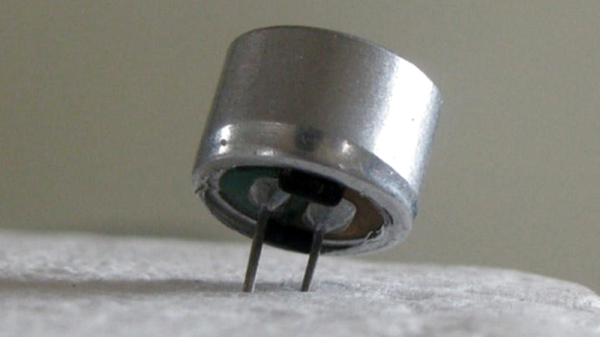
When designing a microphone assembly the other day, I reached for an electret condenser microphone capsule without thinking. To be strictly accurate I ordered a pack of them, these small cylindrical microphones are of extremely high quality for their relatively tiny price.

It was only upon submitting the order that I had a thought for the first time in my life: Just what IS an electret condenser microphone?

A condenser microphone is easy enough to explain. It’s a capacitor formed from a very thin conductive sheet that functions as the diaphragm, mounted in front of another conductor, usually a piece of mesh. Sound waves cause the diaphragm to vibrate, and these vibrations change the capacitance between diaphragm and mesh.

If that capacitance is incorporated into an RC circuit with a very high impedance and a high voltage is applied, a near constant charge is placed upon it. Since the charge stays constant, changing the capacitance causes a tiny voltage fluctuation that can be retrieved as the audio signal from the microphone. Condenser microphones built in this way can be extremely high quality, but come at the expense of needing a high voltage power supply to supply the charge and an amplifier to buffer and magnify the audio.

Continue reading “A Bit More Than A Microphone: The Electret Story”

What’s Inside A Neonode Laser Sensor?

Every once in a while, you get your hands on a cool piece of hardware, and of course, it’s your first instinct to open it up and see how it works, right? Maybe see if it can be coaxed into doing just a little bit more than it says on the box? And so it was last Wednesday, when I was at the Embedded World trade fair, and stumbled on a cool touch display floating apparently in mid-air.

The display itself was a sort of focused Pepper’s Ghost illusion, reflected off of an expensive mirror made by Aska3D. I don’t know much more — I didn’t get to bring home one of the fancy glass plates — but it looked pretty good. But this display was interactive: you could touch the floating 2D projection as if it were actually there, and the software would respond. What was doing the touch response in mid-air? I’m a sucker for sensors, so I started asking questions and left with a small box of prototype Neonode zForce AIR sensor sticks to take apart.
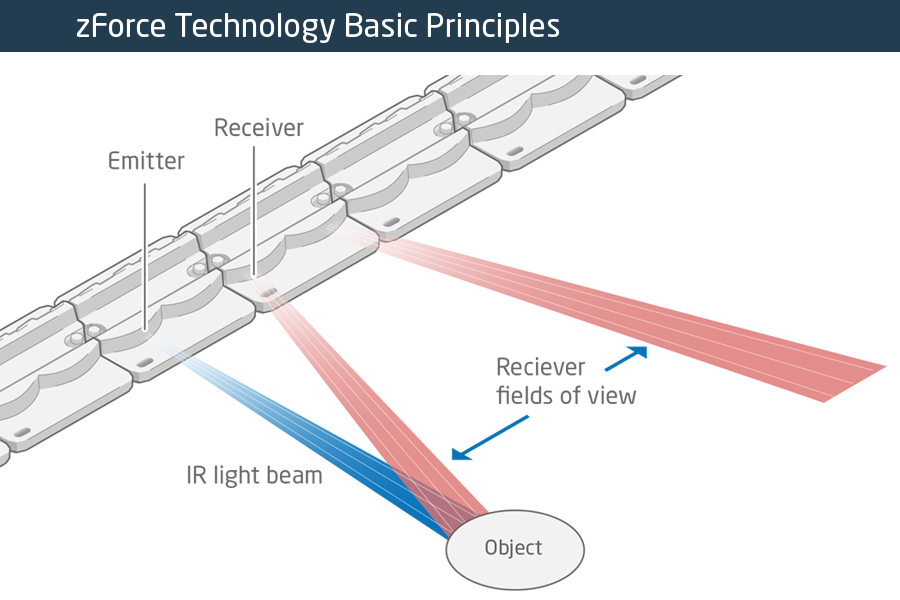
The zForce sensors are essentially an array of IR lasers and photodiodes with some lenses that limit their field of view. The IR light hits your finger and bounces back to the photodiodes on the bar. Because the photodiodes have a limited angle over which they respond, they can be used to triangulate the distance of the finger above the display. Scanning quickly among the IR lasers and noting which photodiodes receive a reflection can locate a few fingertips in a 2D space, which explained the interactive part of the floating display. With one of these sensors, you can add a 2D touch surface to anything. It’s like an invisible laser harp that can also sense distance.

The intended purpose is fingertip detection, and that’s what the firmware is good at, but it must also be the case that it could detect the shape of arbitrary (concave) objects within its range, and that was going to be my hack. I got 90% of the way there in one night, thanks to affordable tools and free software that every hardware hacker should have in their toolbox. So read on for the unfortunate destruction of nice hardware, a tour through some useful command-line hardware-hacking tools, and gratuitous creation of animations from sniffed SPI-like data pulled off of some test points.

Continue reading “What’s Inside A Neonode Laser Sensor?”

Badgelife: From 1 To 100

Blame it on the falling costs of printed circuit boards, the increased accessibility of hardware design tools, the fact that GCC works on microcontrollers now, whatever the ‘maker movement’ is, or any one of a number of other factors. There’s a hardware demoscene now. Instead of poking bits, writing code, and dividing by zero to create impressive multimedia demonstrations on a computer, there is a small contingent of very creative people who are building their own physical hardware, just for the hell of it. They’re pushing boundaries of what can be done with hardware design, demonstrating manufacturing know-how, and turning a (small) profit while doing it. This is badgelife, the tiny subculture dedicated to creating custom electronic conference badges.

At Hackaday, we’ve been doing a deep dive into the rigors of this demoscene of hardware, and last week we had the pleasure of hosting a meetup with some of the big players of the badgelife community as guests of honor. There were, of course, talks discussing the trials and tribulations of designing, manufacturing, and shipping hundreds of pieces of hardware on a limited budget with not enough time. If you want to know how hard electronic design and manufacturing can be, you want to check out these talks below. Continue reading “Badgelife: From 1 To 100”

Creality CR10-S Upgrade Shows The Effect Of Bad Power

The Creality CR10-S is a printer that has become quite popular, and is not an uncommon sight in a hackspace or makerspace. Some models have a slight defect, a smoothing capacitor is of insufficient size, resulting in reduced print quality. [Jozerworx] has replaced the capacitor, and posted a full guide as to how the task can be performed.

Hackaday readers will have among their number many for whom replacing a surface mount electrolytic is no bother at all, indeed we’d expect most 3D printer owners to be able to perform the task. Maybe that the post has such an extensive FAQ and seems to be aimed at newbies to soldering points to 3D printing having moved to a wider market. But it has to be remembered that the value in this piece is not in the work, but in the characterisation. At the end he posts graphs showing the effect of the modification on the temperature of the extruder, and on the temperature noise brought about by the poor capacitor choice. A reduction from a +/- 3 Celcius variation to one of around +- 0.1 Celcius may not seem like much, but it seems it has a significant effect on the reliability of the printer.

So this isn’t the most elite of hacks, on a printer heading for a wider marketplace. But it serves to illustrate that bad quality power regulation can have some surprising effects. It seems every new printer comes with a list of community-developed mods to make it usable, perhaps one day we’ll find a printer that’s at peak performance out-of-the-box.

Mechanisms: The Reed Switch

Just about everywhere you go, there’s a reed switch nearby that’s quietly going about its work. Reed switches are so ubiquitous that you’re probably never more than a few feet away from one at any given time, especially at home or in the car. You might have them on your doors and windows as part of a burglar alarm system. They keep your washing machine from running when the lid is open, and they put your laptop to sleep when you close the lid. They know if the car has enough brake fluid and whether or not your seat belt is fastened.

Reed switches are interesting devices with a ton of domestic and industrial applications. We call them switches, but they’re also sensors. In fact, they only do the work of a switch while they can sense a magnetic field. They are capable of switching AC or DC at low and high voltages, but they don’t need electricity to work. Since they’re sealed in glass, they are impervious to dirt, dust, corrosion, temperature swings, and explosive environments. They’re cheap, they’re durable, and in low-current applications they can last for about a billion actuations.

Continue reading “Mechanisms: The Reed Switch”