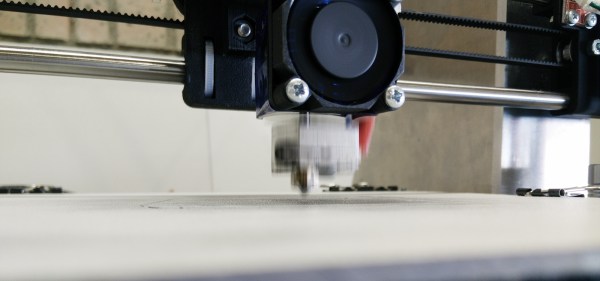
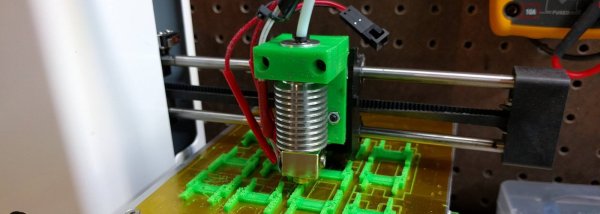
3D Printering: the final frontier. These are the voyages of another 3D printer hack. Its mission: to explore strange new ways of leveling a print bed.
So far, we’ve had servo probes, Allen key probes, Z-sled probes, inductive and capacitive contactless switches, just to name a few. All of them allow a 3D printer to probe its print bed, calculate a correction plane or mesh, and compensate for its own inherent, time variant, inaccuracies.
How does one go about measuring the mass of an object? Mass is defined as the amount of matter an object contains. This is very different from weight, of course, as the mass of our object would remain the same despite the presence or size of a gravitational field. It is safe to say, however, that most laboratory measurement systems are here on Earth, and we can use the Earth’s gravity to aid in our mass measurement. One way is to use a balance and a known amount of mass. Simply place our object on one side of the balance, and keep adding known amounts of mass to the other side until the balance is balanced.
But what if our object is very small…too small to see and too light to measure with gravity? How does one measure the mass of single atom? Furthermore, how does one determine how much of an object consists of a particular type of atom? There are two commonly used tools just for this purpose. Chances are you’ve heard of one of these but not the other. These tools used to measure substances on the atomic level is the focus of today’s article.
Like many people, going through university followed an intense career building period was a dry spell in terms of making things. Of course things settled down and I finally broke that dry spell to work on what I called “non-conventional propulsion”.
I wanted to stay away from the term “anti-gravity” because I was enough of a science nut to know that such a thing was dubious. But I also suspected that there might be science principles yet to be discovered. I was willing to give it a try anyway, and did for a few years. It was also my introduction to the world of high voltage… DC. Everything came out null though, meaning that any effects could be accounted for by some form of ionization or Coulomb force. At no time did I get anything to actually fly, though there was a lot of spinning things on rotors or weight changes on scales and balances due to ion propulsion.
So when a video appeared in 2001 from a small company called Transdimensional Technologies of a triangle shaped, aluminum foil and wire thing called a lifter that actually propelled itself off the table, I immediately had to make one. I’d had enough background by then to be confident that it was flying using ion propulsion. And in fact, given my background I was able to put an enhancement in my first version that others came up with only later.
Lifter parts
Lifter flying
For those who’ve never seen a lifter, it’s extremely simple. Think of it as a very leaky capacitor. One electrode is an aluminum foil skirt, in the shape of a triangle. Spaced apart from that around an inch or so away, usually using 1/6″ balsa wood sticks, is a very thin bare wire (think 30AWG) also shaped as a triangle. High voltage is applied between the foil skirt and the wire. The result is that a downward jet of air is created around and through the middle of the triangle and the lifter flies up off the table. But that is just the barest explanation of how it works. We must go deeper!
The history of capacitors starts in the pioneering days of electricity. I liken it to the pioneering days of aviation when you made your own planes out of wood and canvas and struggled to leap into the air, not understanding enough about aerodynamics to know how to stay there. Electricity had a similar period. At the time of the discovery of the capacitor our understanding was so primitive that electricity was thought to be a fluid and that it came in two forms, vitreous electricity and resinous electricity. As you’ll see below, it was during the capacitor’s early years that all this changed.
The history starts in 1745. At the time, one way of generating electricity was to use a friction machine. This consisted of a glass globe rotated at a few hundred RPM while you stroked it with the palms of your hands. This generated electricity on the glass which could then be discharged. Today we call the effect taking place the triboelectric effect, which you can see demonstrated here powering an LCD screen.
Young electronics hackers today are very fortunate to grow up in an era with both a plethora of capable devices to stimulate their imagination, and cheap and ready access to them. Less than the price of a hamburger meal can secure you a Linux computing platform such as the Raspberry Pi Zero, and a huge choice of sensors and peripherals are only an overnight postage envelope away.
Casing back a few decades to the 1980s, things were a little different for electronically inclined youth. We had the first generation of 8-bit microcomputers but they were expensive, and unless you had well-heeled parents prepared to buy you a top-end model they could be challenging to interface to. Other electronic parts were far more expensive, and mail order could take weeks to deliver the goods.
For some of us, this was not a problem. We simply cast around for other sources of parts, and one of the most convenient was the scrap CRT TV you’d find in nearly every dumpster in those days before electronic recycling. If you could make it from 1970s-era consumer-grade discrete components, we probably did so having carefully pored over a heap of large PCBs to seek out the right component values. Good training, you certainly end up knowing resistor colour codes by sight that way.
If you’ve been reading the news lately, you doubtless read about the find of a really big new helium gas field in Tanzania. It’s being touted as “life-saving” and “game-changing” in the popular media, but this is all spin. Helium is important for balloon animals, scientists, and MRI machines alike, but while it’s certainly true that helium prices have been rising steadily since 2000, this new field is unlikely to matter all that much in the grand scheme of things.
Source: USGS
The foundation of every news story on helium is that we’re running out of the stuff. As with most doomsday scenarios, the end of the world’s supply of helium is overstated, and we don’t just mean in light of the new Tanzanian field. Helium is the second-most abundant element, making up 24% of the total mass of the universe. And while the earth has a disproportionate amount of heavier elements, helium is in rocks everywhere. It’s just a question of getting it out, and at what price that’s viable.
So while we’re stoked that the era of (relatively) cheap helium can continue onwards for a few more years, we’re still pretty certain that the price is going to continue to rise, and our children’s children won’t be using the stuff for something so frivolous as blowing up party balloons — it’ll be used primarily, as it is now, where it’s more valuable: in science, medicine, and industry.
Let’s take this moment to reflect on the economics of second-lightest element. Here’s to you, Helium!
Two weeks after my review of the MP Select Mini 3D printer, Monoprice’s own website has said this printer has been out of stock, in stock, and out of stock again several times. This almost unimaginably cheap 3D printer is proving to be exceptionally popular, and is in my opinion, a game-changing machine for the entire world of 3D printing.
With the popularity of this cheap printer that’s more than halfway decent, there are bound to be improvements. Those of us who have any experience with 3D printers aren’t going to be satisfied with a machine with any shortcomings, especially if it means we can print enhancements and mods for our printers.
Below are the best mods currently available for this exceptional printer. Obvious problems with the printer are corrected, and it’s made a little more robust. There are mods to add a glass build plate, and a few people are even messing around with the firmware on this machine. Consider this volume one of the MP Mini hacks; with a cheap printer that’s actually good, there are bound to be more improvements.