Adventures In Overclocking: Which Raspberry Pi 4 Flavor Is Fastest?

There are three different versions of the Raspberry Pi 4 out on the market right now: the “normal” Pi 4 Model B, the Compute Module 4, and the just-released Raspberry Pi 400 computer-in-a-keyboard. They’re all riffing on the same tune, but there are enough differences among them that you might be richer for the choice.

The Pi 4B is easiest to integrate into projects, the CM4 is easiest to break out all the system’s features if you’re designing your own PCB, and the Pi 400 is seemingly aimed at the consumer market, but it has a dark secret: it’s an overclocking monster capable of running full-out at 2.15 GHz indefinitely in its stock configuration.

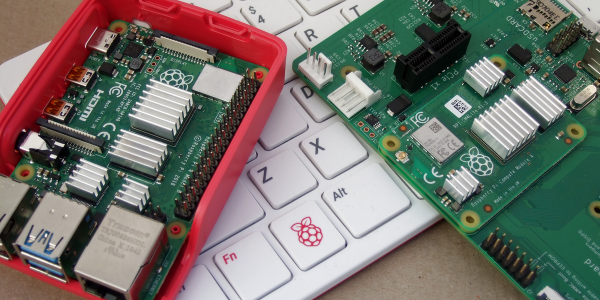
In retrospect, there were hints dropped everywhere. The system-on-a-chip that runs the show on the Model B is a Broadcom 2711ZPKFSB06B0T, while the SOC on the CM4 and Pi 400 is a 2711ZPKFSB06C0T. If you squint just right, you can make out the revision change from “B” to “C”. And in the CM4 datasheet, there’s a throwaway sentence about it running more efficiently than the Model B. And when I looked inside the Pi 400, there was this giant aluminum heat spreader attached to the SOC, presumably to keep it from overheating within the tight keyboard case. But there was one more clue: the Pi 400 comes clocked by default at 1.8 GHz, instead of 1.5 GHz for the other two, which are sold without a heat-sink.

Can the CM4 keep up with the Pi 400 with a little added aluminum? Will the newer siblings leave the Pi 4 Model B in the dust? Time to play a little overclocking!

Continue reading “Adventures In Overclocking: Which Raspberry Pi 4 Flavor Is Fastest?”

Linux Fu: Send In The (Cloud) Clones

Storing data “in the cloud” — even if it is your own server — is all the rage. But many cloud solutions require you to access your files in a clumsy way using a web browser. One day, operating systems will incorporate generic cloud storage just like any other file system. But by using two tools, rclone and sshfs, you can nearly accomplish this today with a little one-time setup. There are a few limitations, but, generally, it works quite well.

It is a story as old as computing. There’s something new. Using it is exotic and requires special techniques. Then it becomes just another part of the operating system. If you go back far enough, programmers had to pull specific records from mass storage like tapes, drums, or disks and deblock data. Now you just open a file or a database. Cameras, printers, audio, and even networking once were special devices that are now commonplace. If you use Windows, for example, OneDrive is well-supported. But if you use another service, you may or may not have an easy option to just access your files as a first-class file system.

The rclone program is the Swiss Army knife of cloud storage services. Despite its name, it doesn’t have to synchronize a local file store to a remote service, although it can do that. The program works with a dizzying array of cloud storage providers and it can do simple operations like listing and copying files. It can also synchronize, as you’d expect. However, it also has an experimental FUSE filesystem that lets you mount a remote service — with varying degrees of success.

What’s Supported?

If you don’t like using someone like Google or Amazon, you can host your own cloud. In that case, you can probably use sshfs to mount a file using ssh, although rclone can also do that. There are also cloud services you can self-host like OwnCloud and NextCloud. A Raspberry Pi running Docker can easily stand up one of these in a few minutes and rclone can handle these, too.

Continue reading “Linux Fu: Send In The (Cloud) Clones”

Sending 3D Printed Parts To Mars: A Look Inside JPL’s Additive Manufacturing Center

With the Mars 2020 mission now past the halfway point between Earth and its destination, NASA’s Jet Propulsion Lab recently released a couple of stories about the 3D-printed parts that made it aboard the Perseverance rover. Tucked into its aeroshell and ready for its high-stakes ride to the Martian surface, Perseverance sports eleven separate parts that we created with additive manufacturing. It’s not the first time a spacecraft has flown with parts made with additive manufacturing technique, but it is the first time JPL has created a vehicle with so many printed parts.

To take a closer look at what 3D-printing for spaceflight-qualified components looks like, and to probe a little into the rationale for additive versus traditional subtractive manufacturing techniques, I reached out to JPL and was put in touch with Andre Pate, Additive Manufacturing Group Lead, and Michael Schein, lead engineer on one of the mission’s main scientific instruments. They both graciously gave me time to ask questions and geek out on all the cool stuff going on at JPL in terms of additive manufacturing, and to find out what the future holds for 3D-printing and spaceflight.

Continue reading “Sending 3D Printed Parts To Mars: A Look Inside JPL’s Additive Manufacturing Center”

Prism Lighting – The Art Of Steering Daylight

The incandescent light bulb was one of the first early applications of electricity, and it’s hard to underestimate its importance. But before the electric light, people didn’t live in darkness — they thought of ways to redirect sunlight to brighten up interior spaces. This was made possible through the understanding of the basic principles of optics and the work of skilled glassmakers who constructed prism tiles, deck prisms, and vault lights. These century-old techniques are still being applied today for the diffusion of LEDs or for increasing the brightness of LCD displays.

Semantics First!

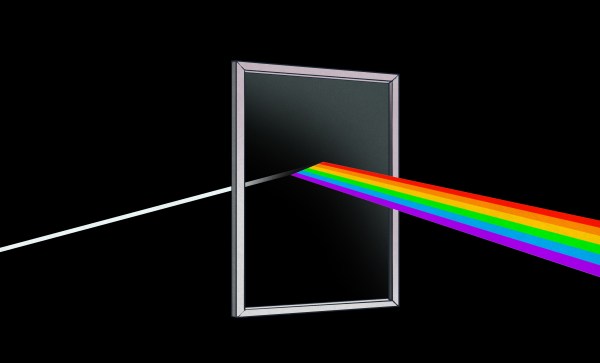
People in optics are a bit sloppy when it comes to the definition of a prism. While many of them are certainly not geometric prisms, Wikipedia defines it as a transparent optical element with flat, polished surfaces of which at least one is angled. As can be seen in the pictures below some of the prisms here do not even stick to this definition. Browsing the catalog of your favorite optics supplier you will find a large variety of prisms used to reflect, invert, rotate, disperse, steer, and collimate light. It is important to point out that we are not so much interested in dispersive prisms that split a beam of white light into its spectrum of colors, although they make great album covers. The important property of prisms in this article is their ability to redirect light through refraction and reflection.

A Safe Way to Bring Light Under Deck

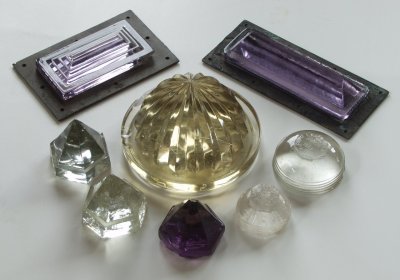
A collection of deck lights used to direct sunlight below deck in ships. Credit: glassian.org

One of the most important uses of prism lighting was on board ships. Open flames could have disastrous consequences aboard a wooden ship, so deck prisms were installed as a means to direct sunlight into the areas below decks. One of the first patents for deck lights “THE GREAT AND DURABLE INCREASE OF LIGHT BY EXTRAORDINARY GLASSES AND LAMPS” was filed by Edward Wyndus as early as 1684. Deck prisms had typical sizes of 10 to 15 centimeters. The flat top was installed flush with the deck and the sunlight was refracted and directed downward from the prism point. Because of the reversibility of light paths (“If I can see you, you can see me”) deck prisms also helped to spot fires under deck. Continue reading “Prism Lighting – The Art Of Steering Daylight”

The BYTE Is The Grand Prize Winner Of The 2020 Hackaday Prize

The BYTE, an open-source mouth-actuated input device for people with physical challenges has just been named the Grand Prize winner of the 2020 Hackaday Prize. The award for claiming the top place and title of “Best All Around” in this global engineering initiative is $50,000. Five other top winners and four honorable mentions were also named during this evening’s Hackaday Prize Ceremony, held during the Hackaday Remoticon virtual conference.

This year’s Hackaday Prize focused on challenges put forth by four non-profit partners who have first hand knowledge of the problems that need solving as they work to accomplish their missions. These organizations are Conservation X Labs, United Cerebral Palsy Los Angeles, CalEarth, and Field Ready. Join us below for more on the grand prize winner and to see the Best in Category and Honorable Mention winners from each non-profit challenge, as well as the Best Wildcard project.

Over $200,000 in cash prizes have been distributed as part of this year’s initiative where hundreds of hardware hackers, makers, and artists competed to build a better future. Continue reading “The BYTE Is The Grand Prize Winner Of The 2020 Hackaday Prize”

Bespoke Storage Technologies: The Alphabet Soup Found In Modern Hard Drives And Beyond

It seems like just yesterday (maybe for some of you it was) we were installing Windows 3.1 off floppy drives onto a 256 MB hard drive, but hard drives have since gotten a lot bigger and a lot more complicated, and there are a lot more options than spinning platters.

The explosion of storage options is the result of addressing a variety of niches of use. The typical torrenter downloads a file, which is written once but read many times. For some people a drive is used as a backup that’s stored elsewhere and left unpowered. For others it is a server frequently reading and writing data like logs or swap files. In all cases it’s physics that sets the limits of what storage media can do; if you choose wisely for your use case you’ll get the bet performance.

The jargon in this realm is daunting: superparamagnetic limit, LMR, PMR, CMR, SMR, HAMR, MAMR, EAMR, XAMR, and QLC to name the most common. Let’s take a look at how we got here, and how the past and present of persistent storage have expanded what the word hard drive actually means and what is found under the hood.

Continue reading “Bespoke Storage Technologies: The Alphabet Soup Found In Modern Hard Drives And Beyond”

MOSAiC Project Freezes A Boat In The Arctic Ice Pack For Science

Just over a fortnight ago, RV Polarstern, a German research vessel, sailed back into port, heralding the end of the largest Arctic research project ever undertaken. The MOSAiC expedition, short for Multidisciplinary drifting Observatory for the Study of Arctic Climate, spent a full year running experiments to measure conditions at the North Pole, and research how the unique Arctic climate is being affected by human activity.

Unprecedented In Size And Scope

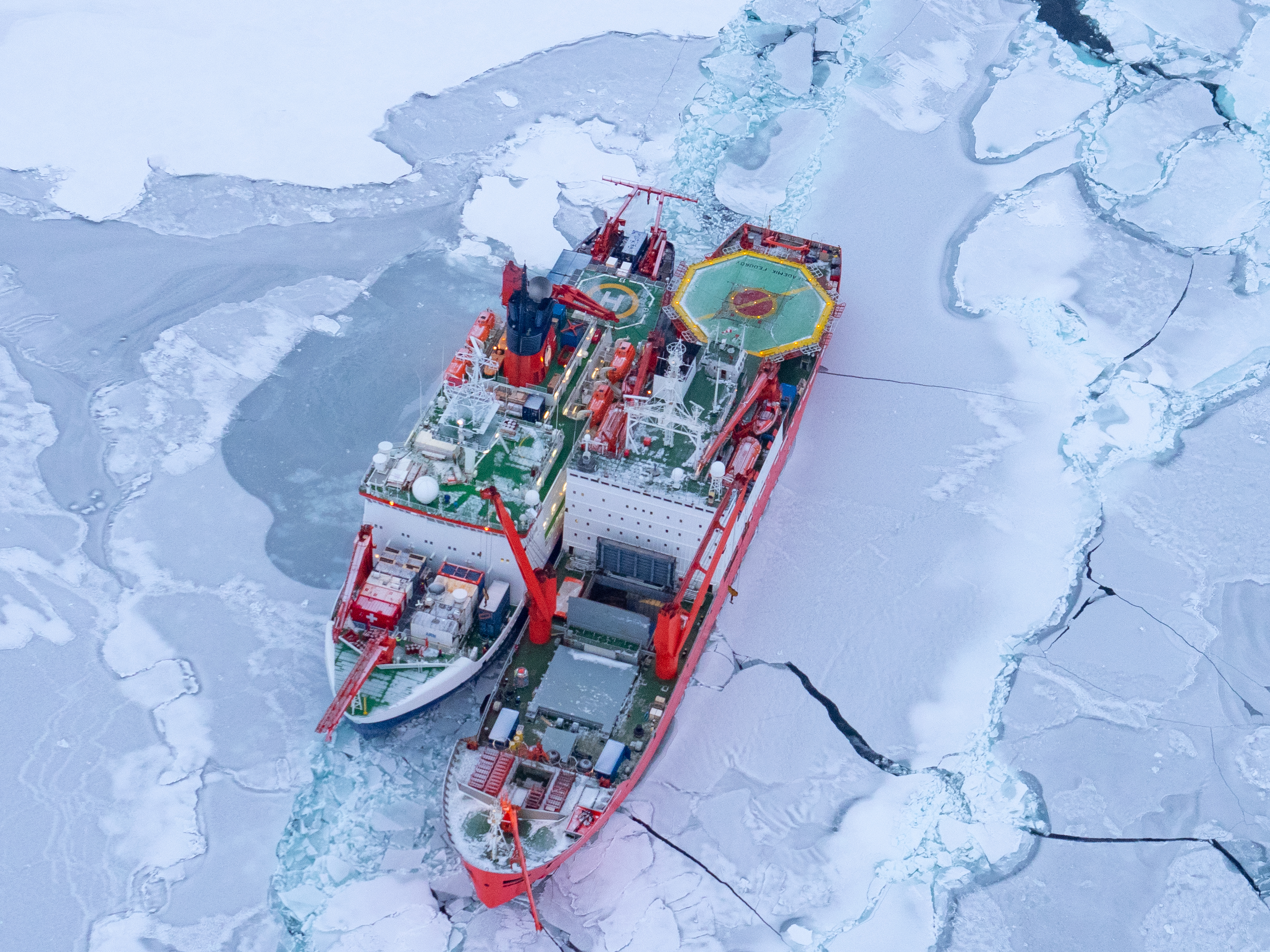
The operation was regularly resupplied by visits from other icebreakers, bringing equipment, food, and fresh personnel. Alfred-Wegener-Institut / Jan Rohde (CC-BY 4.0)

With a budget exceeding €140 million, and with over 300 scientists attached to the project, the expedition aimed to study a full year-long ice cycle in the Arctic region. To achieve this, the research vessel of the project, RV Polarstern, was navigated into an ice floe, and allowed to freeze in and drift with the ice pack. As the seasons progressed, the vessel drifted with the sea ice across the polar region. Along the way, a series of rotating research teams set up equipment on the ice and took regular measurements, investigating several scientific focus areas. Different groups observed atmospheric conditions and the sea ice itself, with researchers also focusing on biogeochemistry, the ocean, and the ecosystems in the area.

Icebreakers were used to transport goods and personnel to the RV Polarstern over the duration of the mission. The project faced issues in spring, as a pre-planned changeover executed by aircraft had to be abandoned due to restrictions brought about by the COVID-19 pandemic. Instead, this was also executed by ship, with the Polarstern temporarily leaving the ice to rendezvous with RV Sonne and RV Maria S. Merian for the changeover of approximately 100 crew and to pick up provisions. The detour took three weeks, but didn’t have any major negative impacts on the mission. Continue reading “MOSAiC Project Freezes A Boat In The Arctic Ice Pack For Science”