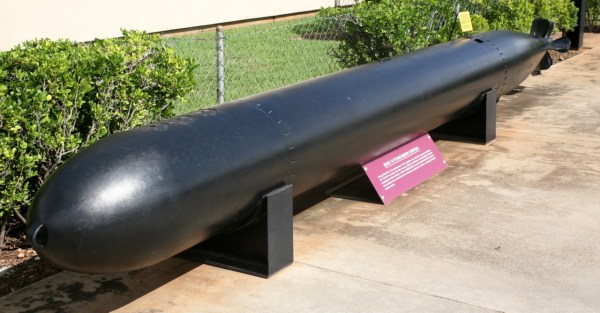
I am a fan of the saying that those who don’t know history are doomed to repeat it. After all, humans have been building things for a number of centuries and we should learn from the engineers of the past. While you can learn a lot studying successes, sometimes — maybe even most of the time — we learn more from studying failure. The US Navy’s Mark 14 torpedo certainly has a lot to teach us.
The start of the story was the WWI-era Mark 10 torpedo which was fine for its day, but with faster destroyers and some additional data about how to best sink enemy ships it seemed necessary to build a new torpedo that would be faster, carry more explosive charge, and use a new method of detonation. Work started in 1931 with a $143,000 budget which may sound laughable today, but that was a lot of coin in the 1930s. Adjusted for inflation, that’s about $2.5 million.
As electric utilization, adoption of electric cars, and the use of renewable power continues to rise, engineers all over are searching for the perfect utility scale battery. We have all heard about Tesla’s 100MW lithium battery pack in South Australia. The system is a massive success and has already paid itself back. However, engineers all over were quick to point out that, until we have a breakthrough, Lithium cells are just not the right choice for a utility system in the long run. There has to be a better solution. Continue reading “A Redox Flow Battery Made From Iron Industry Waste”→
In the two months since the harsh realities of SARS-CoV-2 and COVID-19 have come into sharp focus, Americans have become increasingly familiar with a man who has been quietly serving the people since the days when Ronald Reagan was up for re-election. For many, Dr. Anthony Fauci is the national voice of reason in a sea of dubious information. He has arguably become the most trustworthy person the government has to offer in the face of this pandemic.
Officially, Dr. Fauci is the Director of the National Institute of Allergy and Infectious Diseases (NIAID), a position he was appointed to in 1984. He has worked under six presidents, advising them on every outbreak from the HIV/AIDS epidemic up through Zika and Ebola. Now, he is part of the White House’s coronavirus task force.
At 79 years old, he still works 18-hour days, sticking it to infectious diseases with one hand, and smoothing the feathers of the American people with the other. Dr. Fauci certainly feels like the right person at the right time. So how did he get to this point?
There are many ways in which one’s youth can be misspent, most of which people wish they’d done when they get older and look back on their own relatively boring formative years. I misspent my youth pulling TV sets out of dumpsters and fixing them or using their parts in my projects. I recognise with hindsight that there might have been a few things I could have done with more street cred, but for me, it was broken TVs. Continue reading “Understanding A Bit About Noise Can Help You Go A Long Way”→
Today if you wanted a little gadget to sit on your shelf and let you play classic games from the early console era, you’d likely reach for the Raspberry Pi. With slick emulator front-ends like RetroPie and DIY kits available on Amazon, you don’t even need to be a technical wizard or veteran penguin wrangler to set it up. If you can follow an online tutorial, you can easily cram the last few decades of gaming into a cheap and convenient package.
But things were a bit different back in 2005. There weren’t a lot of options for playing old games on the big screen, and what was out there tended to be less than ideal. You could hack an original Xbox or gut an old laptop to make an emulation box that could comfortably blend in with your DVD player, but that wasn’t exactly in everyone’s wheelhouse. Besides, what if you had the original cartridges and just wanted to play them on a slightly more modern system?
I’m willing to bet whoever wrote this owns a katana.
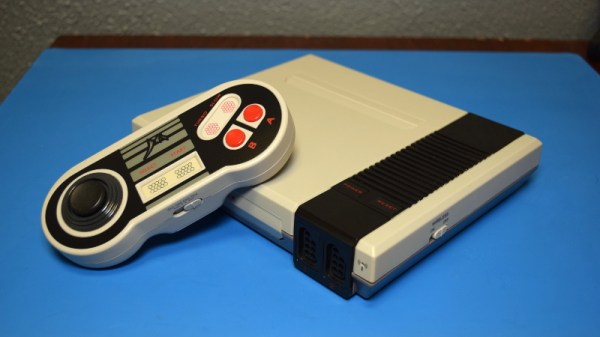
Enter Messiah, and their Generation NEX console. As you might have gathered from their ever-so-humble name, Messiah claimed their re-imagined version of the Nintendo Entertainment System would “Bring Gaming Back to Life” by playing the original cartridges with enhanced audio and visual clarity. It also featured integrated support for wireless controllers, which at the time was only just becoming the standard on contemporary consoles. According to the manufacturer, the Generation NEX used custom hardware based on the “NES algorithm” that offered nearly 100% game compatibility.
Unfortunately, the system was a complete bomb. Despite Messiah’s claims, the Generation NEX ended up being yet another “NES-on-a-chip” (NOAC) clone, and a pretty poor one at that. Reviewers at the time reported compatibility issues with many popular titles, despite the fact that they were listed as working on Messiah’s website. The touted audio and video improvements were nowhere to be found, and in fact many users claimed the original NES looked and sounded better in side-by-side comparisons.
It didn’t matter how slick the console looked or how convenient the wireless controllers were; if the games themselves didn’t play well, the system was doomed. Predictably the company folded not long after, leaving owners stuck with the over-priced and under-performing consoles. Realistically, most of them ended up in landfills. Today we’ll take a look inside a relatively rare survivor and see just what nostalgic gamers got for their money in 2005.
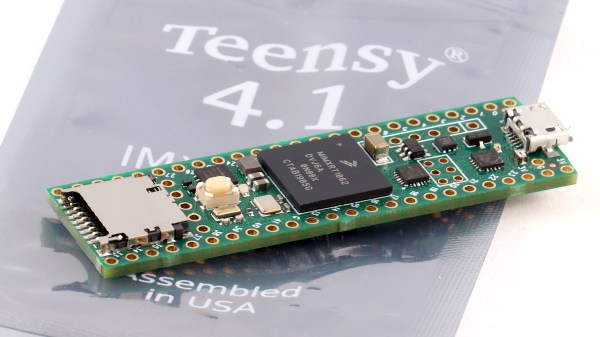
It was only last August that PJRC released Teensy 4.0. At that time, the 4.0 became the fastest microcontroller development board on the planet, a title it still holds as of this writing — or, well, not exactly. Today the Teensy 4.1 has been released, and using the same 600 MHz ARM Cortex M7 under the hood, is now also the fastest microcontroller board. What the 4.1 brings to the table is more peripherals, memory, and GPIOs. While Teensy 4.0 used the same small form factor as the 3.2, Teensy 4.1 uses the larger board size of the 3.5/3.6 to expose the extra goodies.
The now slightly older Teensy 4.0 — released on August 7th of last year — is priced at $19.95, with the new 4.1 version offered at $26.85. It seems that the 4.1 isn’t intended as a replacement for the 4.0, as they serve different segments of the market. If you’re looking for an ultra-fast affordable microcontroller board that lives up to its Teensy name, the 4.0 fits the bill. On the other hand, if you need the additional peripherals broken out and can afford the space of the larger board, the not-as-teensy-sized 4.1 is for you. How big is it? The sample board I measured was 61 x 18 mm (2.4 x 0. 7″), not counting the small protrusion of the micro-usb jack on one end.
To say that the process of installing a magnetic resonance imager in a hospital is a complex task is a serious understatement. Once the approval of regulators is obtained, a process that could take years, architects and engineers have to figure out where the massive machine can be installed. An MRI suite requires a sizable electrical service to be installed, reinforced floors to handle the massive weight of the magnet, and special shielding in the walls and ceiling. And once the millions have been spent and the whole thing is up and running, there are ongoing safety concerns when working around a gigantic magnet that can suck ferromagnetic objects into it at any time.
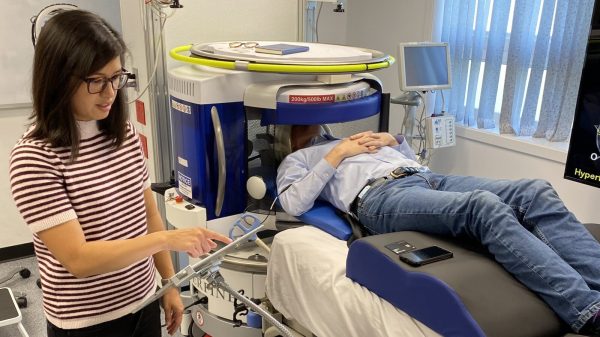
MRI studies can reveal details of diseases and injuries that no other imaging modality can match, which justifies the massive capital investments hospitals make to obtain them. But what if MRI scanners could be miniaturized? Is there something inherent in the technology that makes them so massive and so expensive that many institutions are priced out of the market? Or has technology advanced far enough that a truly portable MRI?
It turns out that yes, an inexpensive MRI scanner is not only possible, but can be made portable enough to wheel into a patient care room. It’s not without compromise, but such a device could make a huge impact on diagnostic medicine and extend MRI technologies into places far beyond the traditional hospital setting.