Peep These Ultra-Real 3D-Printed Eyeballs

For humans, life is in the eyes. Same deal with automatons. The more realistic the eyes, the more lifelike (and potentially disturbing) the automaton is. [lkkalebob] knows this. [lkkalebob] is so dedicated to ocular realism in his ultra-real eyeballs that he’s perfected a way to make the minuscule veins from a whisper of cotton thread.

First he prints an eyeball blank out of ABS. Why ABS, you ask? It has a semi-translucence that makes it look that much more real. Also, it’s easier to sand than PLA. After vigorous sanding, it’s time to paint the iris and the apply the veins. [lkkalebob] shaves strands of lint from red cotton thread and applies it with tweezers to smears of super glue.

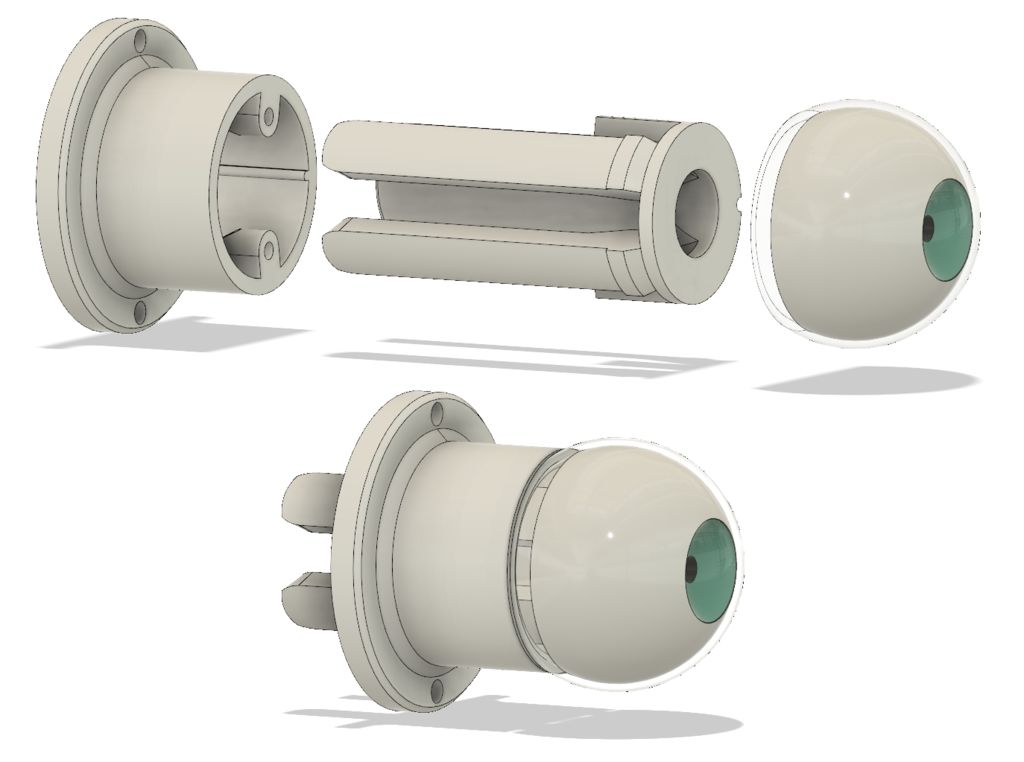
Here comes our favorite part. To make the whole process easier, [lkkalebob] designed a jig system that takes the eyeballs all the way through the stages of fabrication and into the sockets of the automaton. The hollow eye cups pressure fit on to prongs that hold it in place. This also gives the eyeball a shaft that can be chucked into a drill for easy airbrushing. In the build video after the break, he uses the eye-jig to cast a silicone mold, which he then uses to seal the eyes in resin.

Don’t have a printer or any desire to make human automata? It doesn’t take much to make mesmerizing mechanisms.

Continue reading “Peep These Ultra-Real 3D-Printed Eyeballs”

Build Your Own Plasma Ball

The simple plasma ball – it graces science museums and classrooms all around the world. It shares a place with the Van de Graaf generator, with the convenient addition of spectacular plasma rays that grace its spherical surface. High voltage, aesthetically pleasing, mad science tropes – what would make a better DIY project?

For some background, plasma is the fourth state of matter, often created by heating a neutral gas or ionizing the gas in a strong electromagnetic field. The availability of free electrons allows plasma to conduct electricity and exhibit different properties from ordinary gases. It is also influenced by magnetic fields in this state and can often be found in electric arcs.

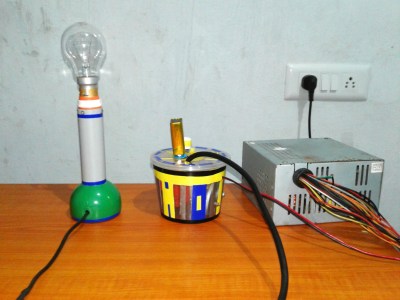
[Discrete Electronics Guy] built a plasma bulb using the casing from an old filament bulb and an ignition coil connected to a high voltage power supply. The power supply is based on the 555 timer IC. It uses a step-up transformer (the ignition coil) driven by a square wave oscillator circuit at a high frequency working as AC voltage. The square wave signal boosts the current into the power transistor, increasing its power.

The plasma is produced inside the bulb, which contains inactive noble gases. When touching the surface of the bulb, the electric arc flows to the point of contact. The glass medium protects the skin from burning, but the transparency allows the plasma to be seen. Pretty cool!

Continue reading “Build Your Own Plasma Ball”

The World’s Smallest Vacuum In An Altoids Tin

There’s been a lot of Altoids tin hacks over the years, but a vacuum cleaner in a tin is something new. In [Toby Bateson]’s first project on Hackaday, he used simple household items to create a functioning vacuum cleaner to use for sucking crumbs out of your keyboard or paper punch holes off your desk.

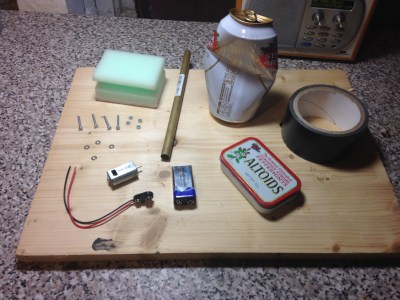
The vacuum features a retractable suction tube, a low-profile switch, and a bagless waste collection system (the waste is stored and discarded out from the tin itself). A brushed motor and impeller provide the airflow. A scrap of a beer can mounted on the shaft is used for an impeller blade, and two bolts with a thin metal sheet between them are made into a switch (the instructions recommend you finish your drink before using the scrap metal). A sponge is used for filtering the dirt from the motor while a hole is cut out of the top of the tin to provide airflow.

[Bateson] is looking to put his name in the world record book for the world’s smallest vacuum tube, as he recently created an even smaller vacuum in a 1cc tube.

“Oh dear, I’ve spilled something on my desk, whatever am I going to do? Luckily, I have my vacuum cleaner in an Altoids tin…”

Continue reading “The World’s Smallest Vacuum In An Altoids Tin”

Robotic Laundry Line Reels You In

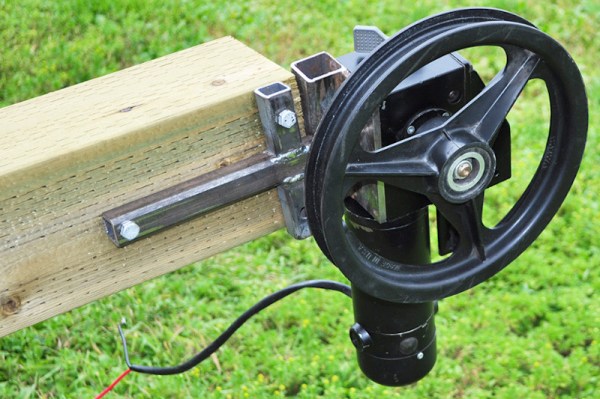
It may not be a laundry-folding robot, but this robotic launders line build by [Radical Brad Graham] is pretty neat. He has a 75-foot hanging laundry line from his house to a woodshed, and decided to roboticize it using some bits that were lying around. The result is a simple build that adds push-button control to pull the line back and forward, making it easier to hang everything out to dry. It’s a simple build, but [Brad] did a great job of documenting what he did and why, from mounting the posts that support the line to wiring up the control buttons.

Continue reading “Robotic Laundry Line Reels You In”

How To Make A Living With Embedded Systems

One of the biggest dreams anyone has is to make a living doing what they love. For all hackers, makers, and DIYers with a passion for embedded systems, it may make sense initially to pursue embedded systems design as a possible career, but without so much information on the types of qualifications or steps needed to actually secure a job offer, it may seem daunting to try and break into the field.

YouTuber [iAyan Pahwa] currently works as an embedded software engineer, having been in the field for two years, with prior experience as a hobbyist working with microcontrollers, motors, and programming in the embedded domain. In this video, embedded below, he provides his take on what you need to know to get yourself that first job.

Continue reading “How To Make A Living With Embedded Systems”

Navigate Around Garmin’s Custom Map Limits

If your only experience with Garmins is from that one rental car a few years back, it may surprise you that some of them, mostly the handheld outdoor units, allow custom maps. This sounds cool until you find out the limitations. Unless you upgrade to premium, it doesn’t allow map files larger than 3MB. What’s worse, it will choke the resolution of maps larger than one megapixel. Well, bust out your virtual hiking boots, because [facklere]’s gonna take you down the trail of DIY digital cartography.

You can use any map you want as long as its not completely fictional (although wandering the maps of middle-earth would be a fun hack on top of this one). Your map can be paper, PDF, or parchment; it just has to be converted to JPEG. The map [facklere] wanted to use was a huge PDF, so as a bonus, he shows how to get from PDF to JPEG in GIMP. Then comes the fiddly part — rooting the map in reality by overlaying it on real roads using Google Earth.

You’ve still got a huge map. Now what? The secret sauce is tiling. [facklere] used KMZfactory, a free map editor for Garmin maps that goes the extra mile to split the tiles for you, keeping them under the 1MP limit. Once that’s done, just upload it to your unit and hit the road.

Got an old Garmin that won’t do custom maps? See if you can get DOOM up and running on it.

Solve Your Precision Woes With A Sliding Angle Grinder

Angle grinders are among the most useful tools for anyone who’s ever had to cut metal. They’re ergonomic, compact, and get the job done. Unfortunately, one of the tradeoffs you usually make when using them is precision.

But thankfully, there’s a DIY solution. YouTuber [workshop from scratch] demonstrated the build process for a sliding angle grinder in a recent video, welding steel beams into a flat frame and attaching fitted beams on top to slide across the rows. Where necessary, spacers are used to ensure that the slider is perfectly fitted to the beam. The contraption holding the angle grinder – a welded piece of steel bolted to the sliding mechanism – has a grip for the user to seamlessly slide the tool across the table.

The operation is like a more versatile and robust chop saw, not to mention the customized angle references you can make to cut virtually anything you like. The build video shows the entire process, from drill pressing and turning holes to welding pieces of the frame together to artfully spray painting the surface a classy black, with familiarity enough to make the project look like a piece of cake.

As the name implies, [workshop from scratch] is all about building your own shop tools, and we’ve previously taken a look at their impressive hydraulic vise and mobile crane builds. These tools, largely hacked together from scraps, prove that setting up your own shop doesn’t necessarily mean you need to break the bank.

Continue reading “Solve Your Precision Woes With A Sliding Angle Grinder”