Towards the end of the Second World War, as the United States considered their options for a possible invasion of Japan, there was demand for a new fighter that could escort long range bombers on missions which could see them travel more than 3,200 kilometers (2,000 miles) without refueling. In response, North American Aviation created the F-82, which essentially took two of their immensely successful P-51 fighters and combined them on the same wing. The resulting plane, of which only 272 were built, ultimately set the world record for longest nonstop flight of a propeller-driven fighter at 8,129 km (5,051 mi) and ended up being the last piston engine fighter ordered by the United States Air Force.
The project provides a fascinating look at what it takes to not only return a 70+ year old ultra-rare aircraft to fully functional status, but do it in a responsible and historically accurate way. With only four other intact F-82’s in the world, replacement parts are obviously an exceptional rarity. The original parts used to rebuild this particular aircraft were sourced from literally all over the planet, piece by piece, in a process that started before [Tom] even purchased the plane itself.
In a way, the search for parts was aided by the unusual nature of the F-82, which has the outward appearance of being two standard P-51 fighters, but in fact utilizes a vast number of modified components. [Tom] would keep an eye out for parts being sold on the open market which their owners mysteriously discovered wouldn’t fit on a standard P-51. In some cases these “defective” P-51 parts ended up being intended for the Twin Mustang project, and would get added to the collection of parts that would eventually go into the XP-82 restoration.
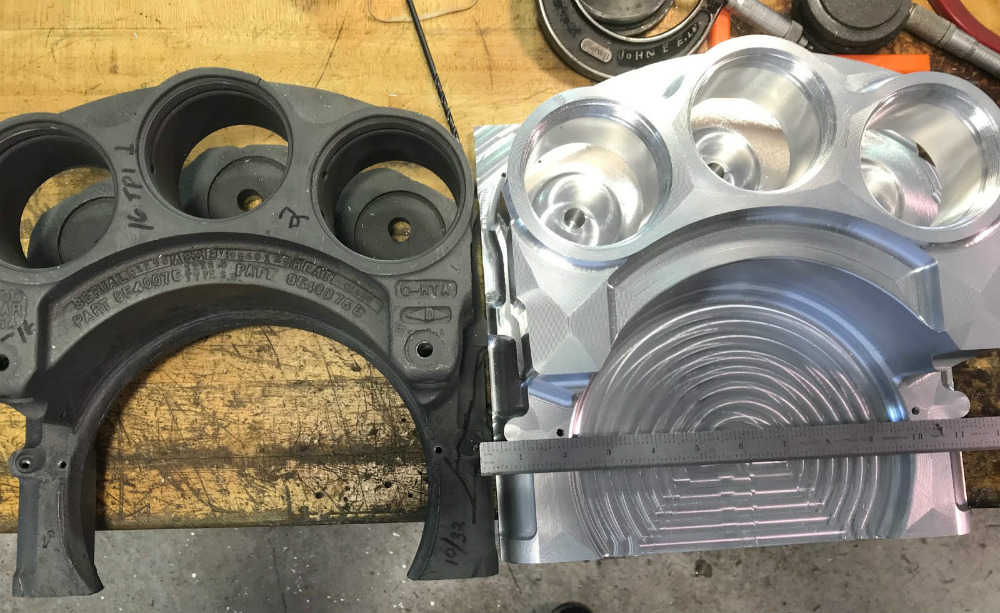
For the parts that [Tom] couldn’t find, modern manufacturing techniques were sometimes called in. The twin layout of the aircraft meant the team occasionally had one component but was missing its counterpart. In these cases, the original component could be carefully measured and then recreated with either a CNC mill or 3D printed to be used as a die for pressing the parts out of metal. In this way the team was able to reap the benefits of modern production methods while still maintaining historical accuracy; important on an aircraft where even the colors of the wires used in the original electrical system have been researched and faithfully recreated.
We’ve seen plenty of restorations here at Hackaday, but they tend to be of the vintage computer and occasionally Power Wheels variety. It’s interesting to see that the same sort of techniques we apply to our small scale projects are used by the pros to preserve pieces of history for future generations.
Metal is many things. A material hard and coarse in nature that by forging it in fire becomes sharp enough to cut through anything in its path. The music that bares its namesake is equally cutting and exudes an unyielding attitude that seeks to separate the posers from the true acolytes. Metal is the sentiment of not blindly following the rules, a path less taken to the darker side of the street. In videogame form, there is nothing more metal than Doom.
The creators of Doom, id Software, were always hellbent on changing the perception of PC gaming in the 1990s. Games of the time were rigid and slow in comparison to their console counterparts. The graphical fidelity was technically superior on PC, but no other developer could nail movement in a game like id. The team had made a name for themselves with their Commander Keen series (which came about after a failed Super Mario Bros. 3 PC demo) along with the genre defining Wolfenstein 3D, but nothing topped Doom. In an era that was already soaking with “tude”, Doom established an identity all its own. The moody lighting, the grotesque monster designs, the signature push forward combat, and all the MIDI guitars a Soundblaster could handle; Doom looked and felt a cut above everything else in 1993.
In December of that year, Senators Joe Lieberman and Herb Kohl held a hearing to publicly condemn the inclusion of violence in videogames sold in America. The bulk of the arguments sought to portray the videogame industry and its developers as deviants seeking to corrupt the nation’s youth. Id Software responded as if to raise the largest middle finger imaginable, by releasing Doom to the world the very next day. A quarter of a century later people are still talking about it.
If you happened to tune into NASA TV on December 11th, you’d have been treated to a sight perhaps best described as “unprecedented”: Russian cosmonauts roughly cutting away the thermal insulation of a docked Soyuz spacecraft with a knife and makeshift pair of shears. Working in a cloud of material ripped loose during the highly unusual procedure, cosmonauts Oleg Kononenko and Sergey Prokopyev were effectively carving out their own unique place in space history. Their mission was to investigate the external side of the suspicious hole in the Soyuz MS-09 capsule which caused a loss of air pressure on the International Space Station earlier in the year.
That astronauts don’t generally climb out the hatch and use a knife to hack away at the outside of their spacecraft probably goes without saying. Such an event has never happened before, and while nobody can predict the future, odds are it’s not something we’re likely to see again. Keep in mind that this wasn’t some test capsule or a derelict, but a vehicle slated to return three human occupants to Earth in a matter of days. Cutting open a spacecraft in which human lives will shortly be entrusted is not a risk taken likely, and shows how truly desperate the Russian space agency Roscosmos is to find out just who or what put a hole in the side of one of their spacecraft.
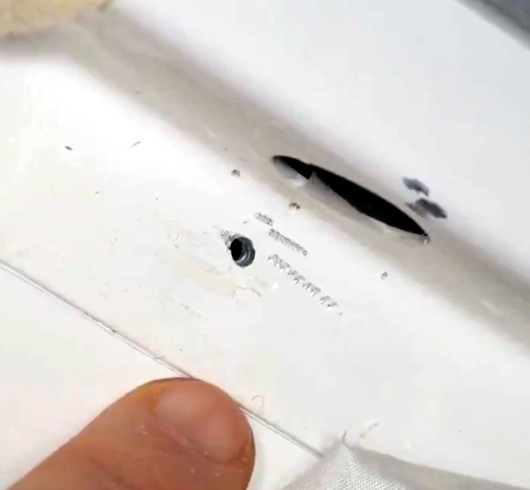
Close inspection from the inside of the spacecraft confirmed the hole wasn’t made by an impact with a micrometeorite or tiny piece of space junk as was originally assumed. It appears to have been made with a drill, which really only allows for two possible scenarios: intentional sabotage or a mistake and subsequent cover-up. In either event, a truly heinous crime has been committed and those responsible must be found. As luck would have it the slow leak of air pressure was detected early and the hole was patched before any damage was done, but what if it hadn’t?
Picture this: it’s late in the evening on a freezing cold, dark, and windy December night in southern England, and an airport worker at Gatwick — London’s second international airport — sees something fly past in the gloom above the floodlights. The weather and darkness makes it difficult to see what the object was, but the report is phoned in to security. What was it? A flock of birds? A piece of plastic litter caught by the wind and blown through the night? In this case, the call is recorded as a drone. Because the magic D-word has been uttered, a security plan swings into action, the airport is put on a high state of readiness, and flights are suspended.
Gatwick by night, on an evening far less inclement than last week. News Oresund [CC BY 2.0].Thousands of people across the site are put on alert, watching for the drone. And of course, the drone reports roll in, and the story takes on a life of its own. People who have no idea what a drone looks like in the air are now expecting to see one, so of course when a flock of birds or a plastic bag caught by the wind crosses their peripheral vision they too are convinced that it is the drone. Night turns into day, there is a lull in the reports so the airport re-opens, only to be closed again following a fresh spate of sightings. Flights are diverted all across the country, and tens of thousands of passengers are stranded in the terminals.
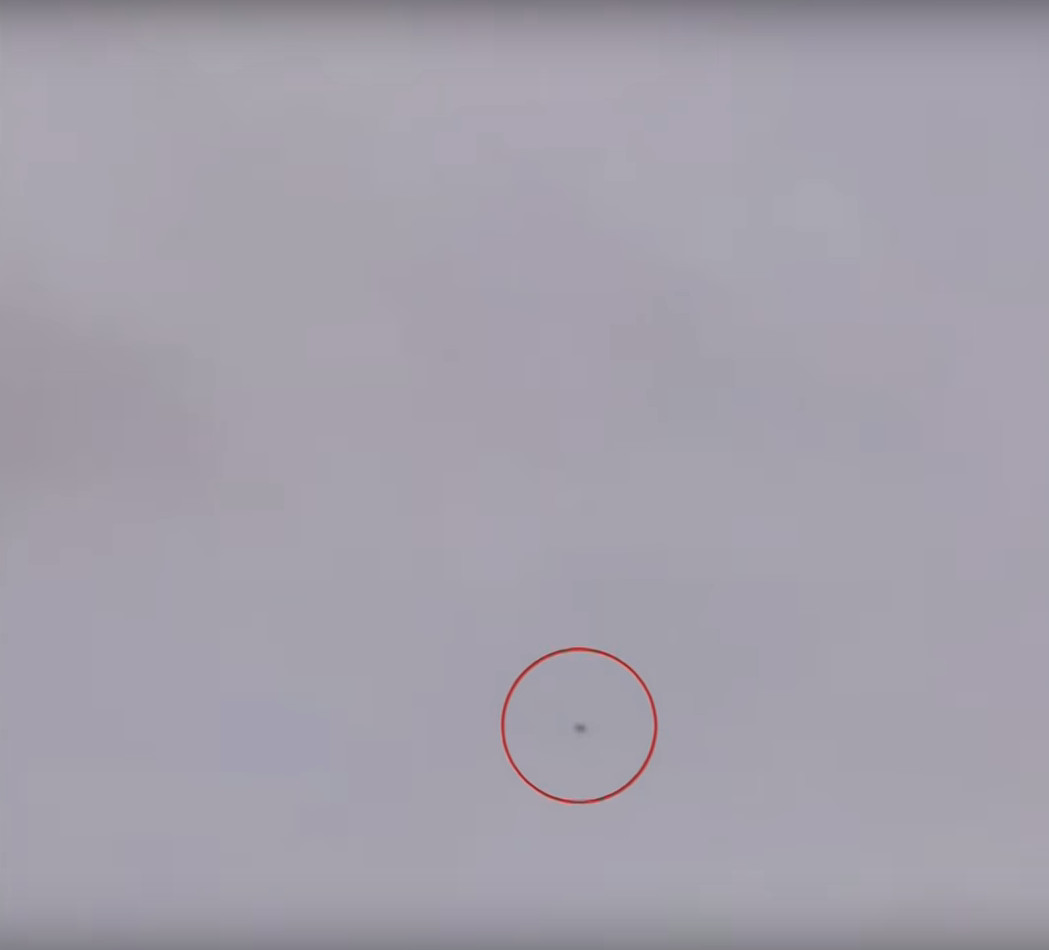
No, it’s not a speck of dirt on your screen, it’s a drone! BBC (Fair use)
There follows three days of airport closure drama. No photos emerge despite almost every one of the many thousands of people on the site having a camera phone from which they are Tweeting about the queues in the terminal. There is a grainy video, but it is indistinct, and crucially it doesn’t have anything in it that is identifiable as Gatwick. Meanwhile the police are frustrated in their search for the drone operators, who like their drone, prove difficult to pinpoint
During the third night a pair of arrests are announced, a local couple. The police have saved the day, the culprits are under lock and key. Everyone breathes a sigh of relief, the airport re-opens, and that’s the end of that. Except of course it isn’t, because inconveniently the pair are found to be blameless and released. When pressed during an interview, a police spokesman then makes the embarrassing admission that there is a possibility that there may never have been a drone at all.
You Couldn’t Make It Up
If these are the drone parts they’ve found, they’re doing it wrong. Francis Wood [CC BY-SA 3.0]You might imagine that this was the fictional plot of a thriller novel, but sadly not. All of the above is a tale of the last few days of events in the British news, save for most of the first paragraph which is our guess at how the first drone sightings may have happened. At the time of writing there remains the possibility that there could have been a drone over Gatwick, but given the current dearth of evidence it is one that seems tenuous. There are reports of drone wreckage, but since readers with long memories will recall UK police once identified RepRap parts as a 3D printed gun we’ll wait until we see it before we call it that.
If there was indeed a drone then of course we would like to see its operators brought to justice forthwith. But what concerns us at Hackaday are the implications the episode could still have for those of our community with an interest in multirotors. The usual clamour was made for Government to do something about it, and we know that would have meant a fresh set of onerous regulations for responsible multirotor owners while doing nothing about the criminals, because of course criminals have little regard for laws.
So if we are to glean anything from this sorry mess, we must examine it from several angles. Why is there a lack of drone detection technology in place? How should drone reports initially be treated and investigated on the ground? How should they be dealt with in official inquiries, and how then should lawmakers see them? This will inevitably have a British flavour to it because of the incident in question, but the points are just as valid worldwide.
When a Drone Report Comes In, We Need a Reliable Way to Evaluate It
An oft-shared drone identification guide for airline pilots, of uncertain provenance (phantompilots.com).
When we are told something new, it passes a process of evaluation in our minds. We look at the source, and weigh up the story itself. If a guy with crazy hair in the street tells us that the aliens have landed and are controlling the Prime Minister with a ray gun, it will probably be discounted. But if Hackaday tells us that someone has hacked a VGA chipset to work as a software-defined radio we’re guessing most of you would be very interested indeed.
When a fresh drone incident is reported it appears that this evaluation process has historically been defective. We have previously discussed official incident reports that come with no physical evidence of a drone, but contain descriptions of drones with capabilities unmatched even by jet fighter aircraft. It seems like any eyewitness report in which the culprit is named as a drone is automatically taken at face value no matter how unlikely it may be. The fact that a report may have come from a pilot is sometimes mentioned as a boost to its credibility, but that is a false assumption. A pilot who is not familiar with either how drones appear from a distance or what the capabilities of a drone are in the air can only be considered an unreliable witness, because while they may know a lot about aircraft they lack the required expertise for this judgement. So what can be done to help boost the quality of reporting and to immediately highlight credible reports while requiring more for dubious ones?
In the case of a near miss in open airspace there may be little effect on ground-based facilities, but at an airport such as Gatwick there can be no chances taken by the authorities. A drone collision on an aircraft on final approach could cause hundreds of fatalities, so upon receipt of a report they must have had little choice but to close the runways. There appears to have been a lack of drone detection technologies in place at Gatwick which means that the only source available to the airport would have been the eyewitnesses themselves, and since we have amply demonstrated the potential for eyewitness reports being unreliable then the current confusion becomes an inevitability. It is imperative that more reliable detection technologies be fitted or developed if necessary. This is especially true when precautionary shut-downs stretch past minutes or hours into world-news-making delays as happened in this instance.
Competent Police Investigations and Responsible Journalism on Drone Reports
The mass media tech story cycle. Our apologies to Gartner. Curve image: Jeremykemp [ CC BY-SA 3.0 ]Once an incident has started and news of it emerges there is a consequent effect upon members of our community. Legitimate drone fliers away from the airport will find themselves under more scrutiny, and since it is already a common tale to hear of police being called when flying is under way that means they could face harassment and wrongful arrest. Indeed though we do not know all the details of the pair arrested near Gatwick it smacks of their being arrested in a round-up of convenient local drone enthusiasts rather than as a result of meaningful investigation. That the names of the pair were leaked and they became the subject of a media frenzy further shows the danger in which they were placed, as well as the irresponsibility of the reporters who covered their plight.
Perhaps Most Importantly: We Need Accurate Official Incident Reports
Whatever happens in a drone report, whether it be an arrest or an embarrassing debacle, there will inevitably be an official incident report from the Civil Aviation Authority, the regulator of British civilian airspace. This will form the official record of the event, and thus should strive to be as accurate as possible, but here the process falls short for the final time. There appears to be no evaluation step performed on the available evidence and no requirement for physical proof. So if an eyewitness reports behaviors about the drone that no drone ever built could possibly be capable of, it is solemnly recorded as fact. Our previous article on this subject highlights multiple such accounts, and this is an important point because as the official record these reports are what informs legislators. When they make laws pertaining to drones it is imperative that their decisions are based upon accurate evidence, and it is clear that this is not the case. Given that they will no doubt be reviewing drone legislation in the wake of this fiasco it is particularly important that the investigators consult people with specialist knowledge in the field, demand physical proof rather than heresay, and most importantly question accounts that stretch credibility.
It seems obvious that the multirotor hobbyist is caught in a perfect storm of incompetent authorities, deeply flawed investigations, shoddy journalism, and clueless legislators. This incident has laid bare some of the shortcomings, and it is to be hoped that a few lessons might be learned to produce less of a debacle surrounding future drone incidents. It is still a developing story so there may be a breakthrough and the whole narrative will change, and if that turns out to be the case then we hope they find the correct perpetrator this time and send them away at Her Majesty’s pleasure for a very long time. We’re guessing though that every effort will be made to push it as far under the carpet as possible to save red faces among officialdom. As multirotor enthusiasts we must keep the issue of poor investigation alive though, for if we let it be buried once more it will come back to trouble us again.
We’ve seen internet-enabled holiday displays before, and we know IPv6 offers much more space than the older IPv4 addressing scheme that most of us still use today, but the two have never been more spectacularly demonstrated than at jinglepings.com. The live video stream shows an Internet-connected Christmas tree and an LED display wall that you can control by sending IPv6 ICMP echo request messages, more commonly known as pings.
Reading the page, you quickly parse the fact that there are three ways to control the tree. First, you can type a message in the box and press send – this message gets displayed on the crawl at the bottom of the LED screen. Second, you can light up the tree by sending a ping to the IPv6 address 2001:4c08:2028:2019::RR:GG:BB, where RR, GG, and BB are 8-bit hex values for red, green, and blue. This is a neat abuse of the IPv6 address space, in that the tree has 224 (around 16.8 million) IPv6 addresses, one for each color you can set. We were impressed by this brute-force use of address space, at least until we read on a little further.
You can also make your own drawings on the LED wall, again by sending pings. In this case, the address to set a pixel to a particular color is: 2001:4c08:2028:X:Y:RR:GG:BB, where X and Y are the pixel coordinates. This seems easy enough: to set pixel (10, 11) to magenta, the RGB value (0xFF, 0x00, 0xFF), you’d simply ping the IPv6 address 2001:4c08:2028:10:11:FF:00:FF. Having an array of addressable LEDs is commonplace in hacker circles today, although each of them having their own live IPv6 address on the Internet seems a little excessive at first. Then it hits you – each LED has an IPv6 address for every possible color, just like the tree: 16.8 million addresses for each LED. The LED display is 160×120 pixels in size, so the total number of IPv6 addresses used is 160x120x224, which is 75 times larger than all possible IPv4 addresses! This is a hack of monstrous proportions, and we love it.
In case you’re not running IPv6 yet, we’ve got you covered. To send individual pings using your browser, you can use a site like Ipv6now. If you want to send pixels to the display wall, you’re better off using a 6in4 tunnel that lets you access IPv6 sites using your current IPv4 connectivity. Hurricane Electric offers a free 6in4 tunnel service that we’ve found useful. Then it’s just a matter of writing some code to send pixel values as pings. The python scapy module is perfect for this sort of thing. But, first you’ll have to fill out the form on jinglepings.com and wait to get your IPv6 address whitelisted before you can draw on the display; evidently the usual bad actors have found the site and started drawing inappropriate things.
If you think this use of addresses seems wasteful, you needn’t worry. There are around 3.4×1038 IPv6 addresses, enough for 1027 such displays. We’re going to go out on a limb here and say it: nobody will ever need more than 2128 IP addresses.
Fans of game consoles from the golden era of TV game appliances have been in for a treat over the past couple of years as a slew of official reboots of the stars of the past have reached the market. These so-called “classic” consoles closely follow the styling of the originals, but under the hood they pack modern hardware running an emulator to play a selection of games from ROM. Even better, with a bit of hacking they can run more than just the supplied emulator, people have managed to use them to emulate completely different consoles. Even then, it’s unexpected to find that a PlayStation emulator on a Super Nintendo Classic runs PlayStation games better than the same emulator built in to Sony’s own PlayStation Classic console.
The feat from [8 Bit Flashback] is achieved despite both machines having near-identical hardware specifications based upon the Allwinner R16 system-on-chip. The Nintendo provides smoother action and more responsive controls, making for a far superior gaming experience. How is this achieved? The most significant difference is that the SNES Classic had the RetroArch front end installed upon it, which may have lent some optimisations and tweaks to make the system more efficient.
Readers with an eye for unusual consoles may remember another Nintendo/Sony hybrid, the ill-fated early-1990s prototype SNES with a CD-ROM which was the first machine to bear the name “PlayStation” (or “Play Station” as it was sometimes styled, leading Sony marketeers to be hot on writers using a space between the words a few years later).
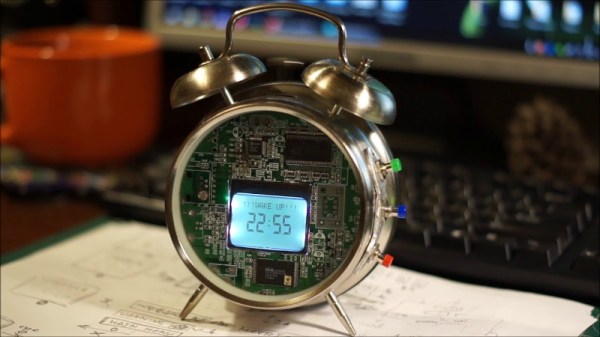
The build starts with an old alarm clock. The clockwork internals are removed, but the bells remain, powered instead by a brushed DC motor. An Arduino Nano is the brains of the operation, interfacing with the now-ubiquitous temperature, humidity and barometric pressure sensors. Time is displayed on a Nokia 5110 LCD screen of the type popular a decade ago when options for small hobby project displays were significantly more limited then they are today.
As a nice touch, an old circuit board lends a new face to this clock, with a trio of big chunky buttons to act as controls. The LCD uses attractive icons to help convey information, making the most of the graphical capabilities available. There’s even a rudimentary weather forecasting algorithm that uses barometric pressure changes to predict the likelihood of rain.
Overall, it’s a tidy build that promises to serve as a great alarm clock, given the high volume of the original bells. Alarm clocks have always been a hacker staple, but if you’re still struggling to get out of bed this fire bell build should rattle your fillings loose on a daily basis. Video after the break.





![Gatwick by night, on an evening far less inclement than last week. News Oresund [CC BY 2.0].](https://hackaday.com/wp-content/uploads/2018/12/Gatwick_Norwegian_2015mar27_0007_16333812524.jpg)
![If these are the drone parts they've found, they're doing it wrong. Francis Wood [CC BY-SA 3.0]](https://hackaday.com/wp-content/uploads/2018/12/1280px-Dunn_Chanter__Drones_Chantry.jpg?w=400)

![The mass media tech story cycle. Our apologies to Gartner. Curve image: Jeremykemp [ CC BY-SA 3.0 ]](https://hackaday.com/wp-content/uploads/2016/04/media-tech-cycle-800px1.png)