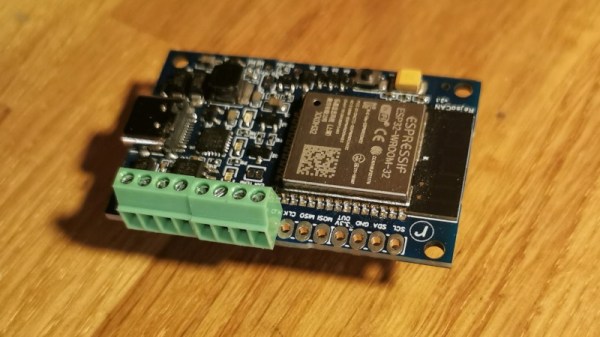
Since modern cars use the CAN bus for so many of their functions, it’s unsurprising that it’s a frequent object of interest for those in our community. Some people go no further than commercial plug-in analysers, while others build their own CAN devices. This is what [Magnus Thomé] has done, with his RejsaCAN microcontroller board.
It’s a small PCB with an onboard CAN interface from an ESP32-S3 and a car-friendly power supply circuit, and perhaps most importantly, it has an auto-shutdown feature to prevent battery drain. Software-wise it’s a blank piece of paper for the user to roll their own application, but since the ESP32 is supported by the Arduino ecosystem, there are libraries that make talking CAN as easy as it can be.
[Magnus] has a list of potential applications for the board, many of which take advantage of the ESP’s wireless capabilities. So far, [Magnus] has hooked it up to an LCD display, but we can see so many other useful things coming out powered by something like this.
You haven’t tried playing with your car’s CAN bus yet? Maybe you should read this to whet your appetite.
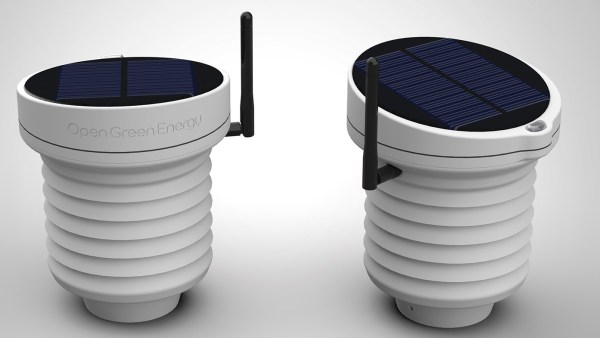
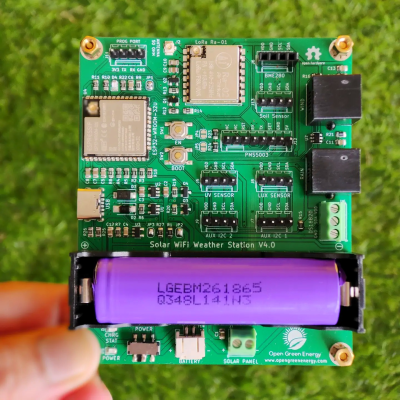 with simple 4-way I2C connectors. Temperature, humidity, and pressure are handled by a BME280 module, UV Index (SI1145), visible light (BH1750) even soil humidity and temperature with a cable-mounted SHT10 module.

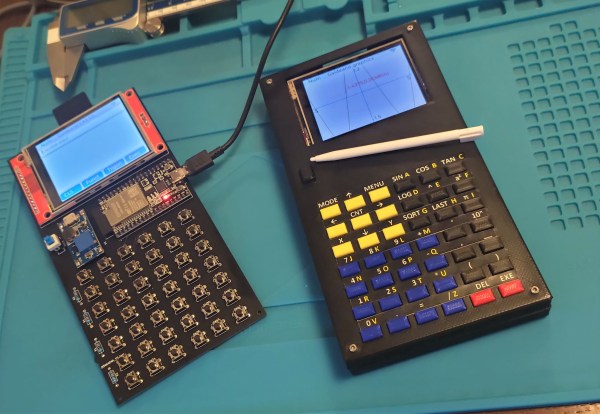
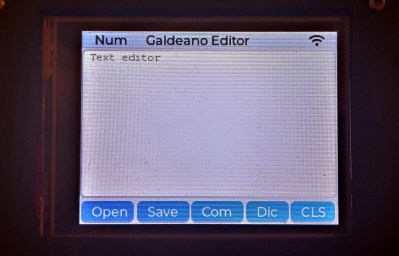 The ESP32 runs MicroPython along with a symbolic math engine called Eigenmath. This enables the Galdeano to manipulate expressions, perform integration and differentiation, and plot functions. Porting Eigenmath to a memory-constrained platform like the ESP32 was quite a challenge and required a few workarounds, including a memory partition scheme and even a custom compact font with mathematical symbols.