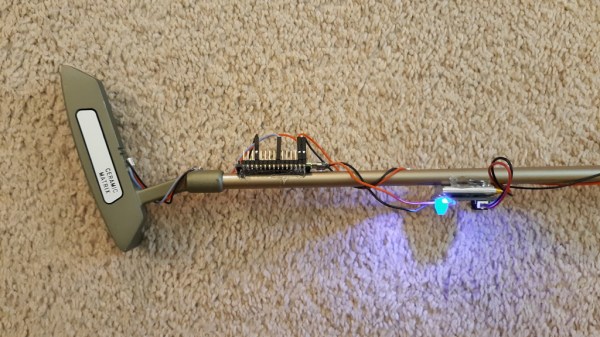
A putter with an Arduino attached to its shaft

This Golf Club Uses Machine Learning To Perfect Your Swing

Golf can be a frustrating game to learn: it takes countless hours of practice to get anywhere near the perfect swing. While some might be lucky enough to have a pro handy every time they’re on the driving range or putting green, most of us will have to get by with watching the ball’s motion and using that to figure out what we’re doing wrong.

Luckily, technology is here to help: [Nick Bild]’s Golf Ace is a putter that uses machine learning to analyze your swing. An accelerometer mounted on the shaft senses the exact motion of the club and uses a machine learning algorithm to see how closely it matches a professional’s swing. An LED mounted on the club’s head turns green if your stroke was good, and red if it wasn’t. All of this is driven by an Arduino Nano 33 IoT and powered by a lithium-ion battery.

The Golf Ace doesn’t tell you what part of your swing to improve, so you’d still need some external instruction to help you get closer to the ideal form; [Nick]’s suggestion is to bundle an instructor’s swing data with a book or video that explains the important points. That certainly looks like a reasonable approach to us, and we can also imagine a similar setup to be used on woods and irons, although that would require a more robust mounting system.

In any case, the Golf Ace could very well be a useful addition to the many gadgets that try to improve your game. But in case you still end up frustrated, you might want to try this automated robotic golf club.

Continue reading “This Golf Club Uses Machine Learning To Perfect Your Swing”

Quantum Atomic Interferometer For Precision Motion Sensing

The current state of the art of embedded motion sensing is based around micro-electromechanical systems (MEMS) devices. These miracles of microfabrication use tiny silicon structures, configured to detect acceleration and rotational velocity in three dimensions. Accumulate these accelerations and rotations, and you’ve got a device that can find its orientation and track movement without any external waypoints. This is the basis of the technique of dead reckoning.

Why do we care about dead reckoning anyway? Surely GPS and related positioning systems are good enough? Above ground GPS is usually good enough, but underwater and underground this simply won’t work. Even heading indoors has a dramatic effect on the GPS signal strength, so yes, we need another way for some applications.

Right now, the current state of the art in portable sensors are MEMS devices, and you can get them for the cost of a hamburger. But if you want the ultimate in accuracy, you’ll want a quantum atomic interferometer. What that is, and how it will be possible to make one small enough to be useful, is half of the story. But first, let’s talk MEMS.

Continue reading “Quantum Atomic Interferometer For Precision Motion Sensing”

Dream Bigger, Predict The Future

I’d love to tell you that I’m never wrong, but I’ve been wrong a lot. Remember the Arduino? When it was brand new, I thought it was some silly collection of libraries and a drop-down menu for people who are too lazy to just type out their own #include statements. Needless to say, it launched about a million hacks and brought microcontroller programming into the mainstream. Oops.

Similarly, about fifteen years ago, I saw an educational project out of MIT’s Media Lab. It consisted of a bunch of blocks that had LCD screens on them and would interact with each other when put together. The real hook, though, was that each block had an accelerometer inside, so you could “pour water” out of one block into another, for instance.

At that time, accelerometers were expensive, even in quantities. Even one of these cubes must have cost $100 at the time, much less a whole set. Accelerometers were so expensive that I wouldn’t have thought about incorporating one into a project, much less a dozen, so I ignored them for hacker purposes. Then came the cellphone and economies of scale. Today, even in chip shortage times, they’re readily available for around $2 each, making them useful for exactly this kind of “frivolous” use.

From the Arduino experience, I learned to never underestimate the impact of what seem to me to be “small” conveniences. (And maybe more so, the value of the tremendous common effort from the community.) From the MIT accelerometer story, the moral is that some parts will get drastically cheaper in the future, so you shouldn’t necessarily exclude the cool new sensor from your design repertoire. After all, ten years ago, nobody would have thought that we’d have laser time-of-flight rangefinders for less than a hamburger.

What new components are fantastically useful, or full of potential, that might be cheap enough in the future to make them also worth looking into? Swing by Hackaday tomorrow morning and join in the conversation!

LED Matrix Hourglass Knows Which Way Is Up

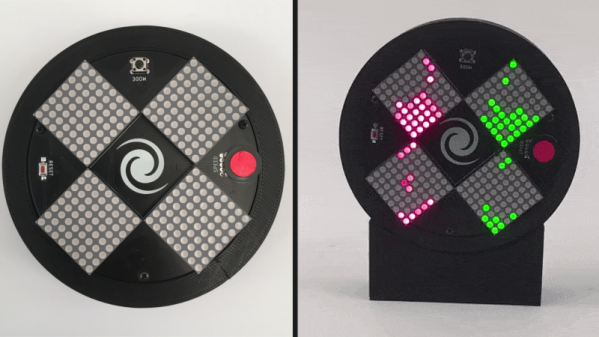
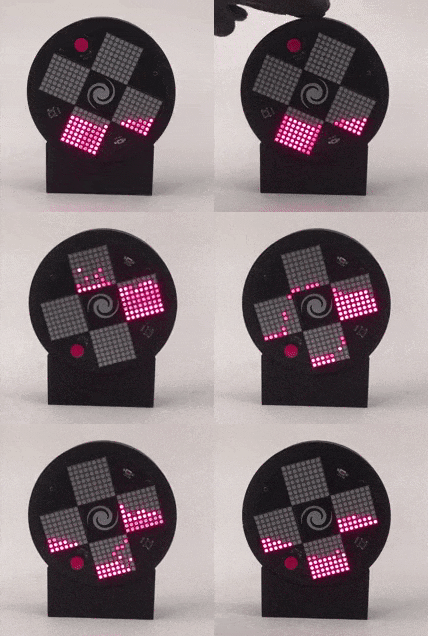
[Fearless Night]’s slick dual hourglass doesn’t just simulate sand with LEDs, it also emulates the effects of gravity on those simulated particles and offers a few different mode options.

The unit uses an Arduino (with ATMEGA328P) and an MPU-6050 accelerometer breakout board to sense orientation and movement, and the rest is just a matter of software. Both the Arduino and the MPU-6050 board are readily available and not particularly expensive, and the LED matrix displays are just 8×8 arrays of red/green LEDs, each driven by a HT16K33 LED controller IC.

The enclosure and stand are both 3D-printed, and a PCB not only mounts the components but also serves as a top cover, with the silkscreen layer of the PCB making for some handy labels. It’s a clever way to make the PCB pull double-duty, which is a technique [Fearless Night] also used on their earlier optical theremin design.

Those looking to make one of their own will find all the design files and source code handily available from the project page. It might not be able to tell time in the classical sense, but seeing the hourglass displays react to the device’s orientation is a really neat effect.

LED Hourglass Moves Like The Real Thing

If you want to waste time in a meaningful way, get yourself an hourglass. It’s simultaneously mesmerizing and terrifying to sit there and watch the seconds slip through the threshold that separates possibility from missed opportunity.

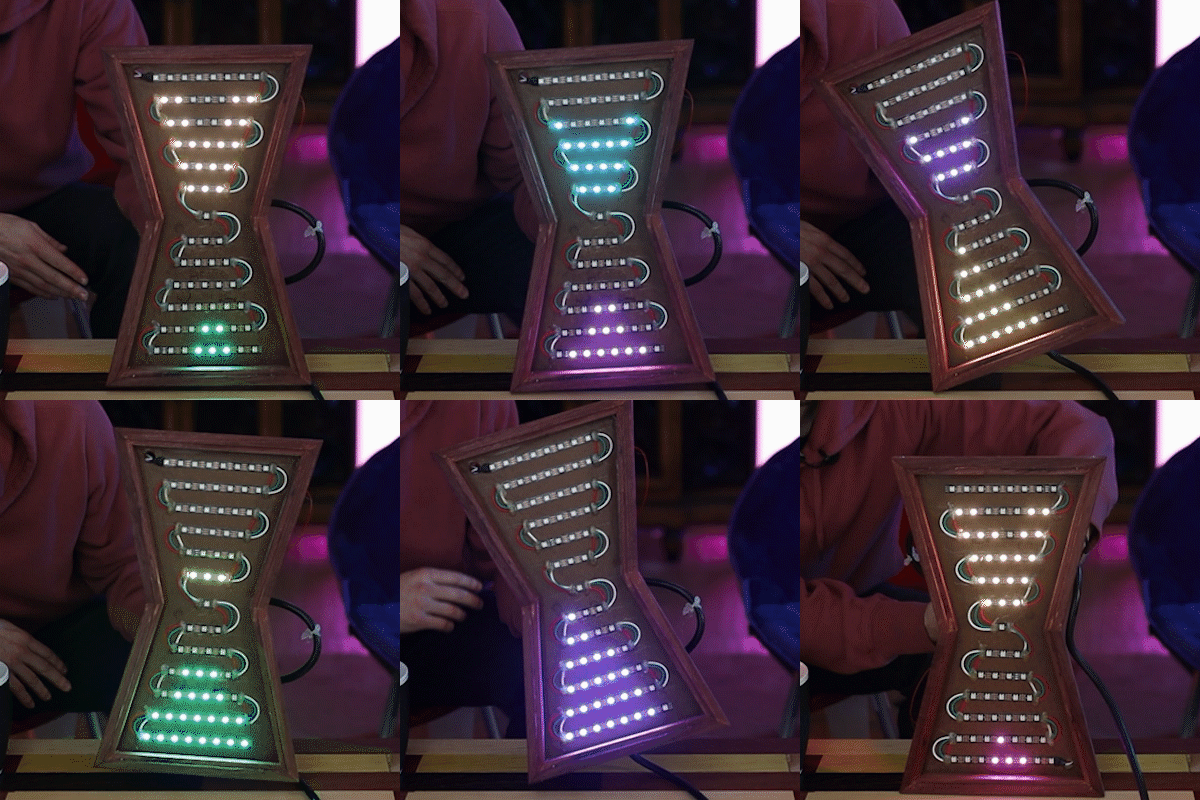
[Ty and Gig]’s LED hourglass is equally beautiful to watch. It doesn’t actually tell time, but that’s perfectly fine by us. What it does do is animate the LEDs to approximate grains of sand in gravity, no matter how the hourglass is tilted.

In either vertical orientation, the sand falls as long as there is some in the top. When the hourglass is horizontal, the LEDs settle just like real sand does. [Ty and Gig] achieved this with a whole lot of code that breaks the animation frames into structure arrays.

By contrast, the hardware part of this build is fairly simple: all that’s needed to replicate this build is some RGB LEDs a beefy power supply to drive them, an accelerometer, and a microcontroller.

[Ty and Gig] were planning to use an ESP8266, but misplaced it and went with an Arduino Mega instead. (You know what they say — buy a replacement and the one you lost will turn up almost immediately.) The beautiful frame is made from leftover purpleheart, a hardwood that turns purple with exposure to air. Check out the build video after the break.

Too lazy to reset your hourglass every hour? Here’s one that flips itself.

Continue reading “LED Hourglass Moves Like The Real Thing”

Sit Up Straight!: Open Source Bluetooth Posture Sensing

As more and more people spend their working hours behind a computer, bad posture and the accompanying back pain and back problems become a growing epidemic. To combat this in his own daily life, [ImageryEel] made PosturePack, a wearable Bluetooth-enabled posture sensor.

The PosturePack is designed to fit into a small pocket sewn into the pack of an undershirt, between the shoulder blades. It consists of a custom PCB with an ATmega32U4, BNO055 IMU, Bluetooth module,  small LiPo and power circuitry. Based on the orientation data from the IMU, a notification is sent over Bluetooth to a smartphone whenever the user hunches forward.

[ImageryEel] says although the mobile notifications worked, haptic feedback integrated into the unit would be a better option. This could also be used to remind the user to stand up and take a break now and then, and provide an alternative to a smartwatch for activity monitoring without sending every movement to someone else’s servers. Software will always be the hardest part for projects like these, especially as the device become “smarter”. Learning to recognize activity and postures is actually a good place for tiny machine learning models.

Compared The posture sensors we covered before had to be installed and set up at a specific workstation, like an ultrasound-based version attached to a chair, and a webcam-based version.

A Beeping Toy Helps A Blind Dog Play Fetch

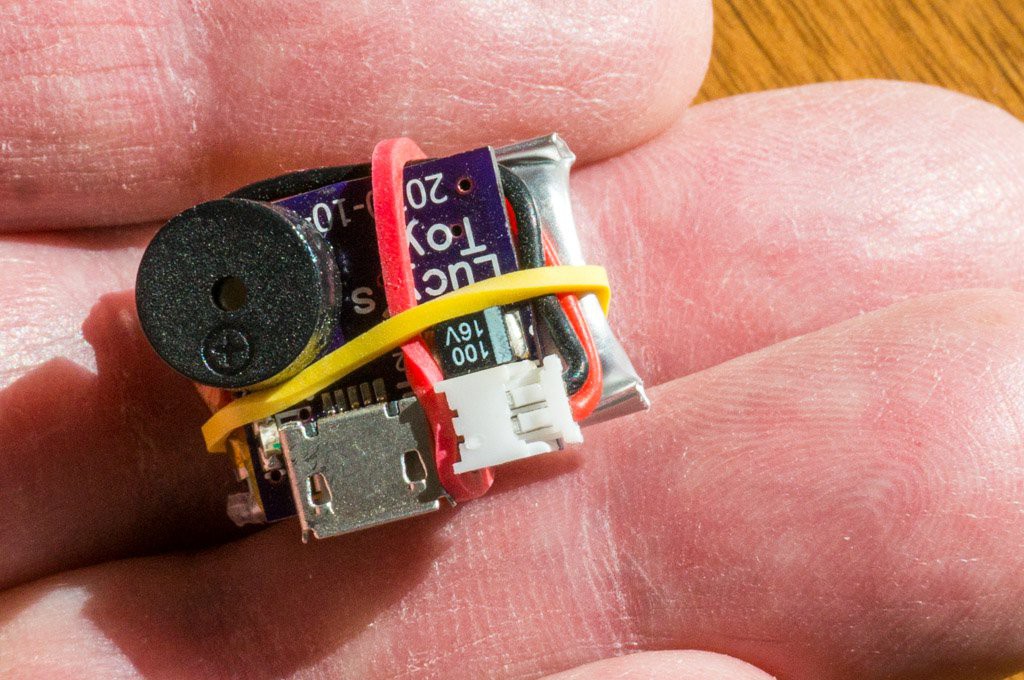
When a beloved pet goes blind, it doesn’t mean they can’t or don’t want to play fetch anymore, only that the game must change a bit. [Bud Bennett]’s dog Lucy has slowly lost her sight to progressive renal atrophy but is still up for playing with toys, so [Bud] decided to make a beeper that can go inside various stuffed toys to help Lucy locate them. Lucy doesn’t care for commercial toys that chime constantly, especially once she’s got it in her mouth.

This tiny package is centered around an LIS3DH accelerometer and programmed with a PIC16F18313. When the toy is thrown up in the air, the accelerometer determines that it’s in free fall and triggers an interrupt on the PIC. The piezo buzzer starts beeping so Lucy can find it, then stops a short while later and waits for the next free fall. The power dissipation is so low that [Bud] expects to charge the 120 mAh LiPo battery about once a year.

We bet that communication between [Bud] and Lucy is already pretty good, but maybe she could be more expressive with a doggy soundboard.