Broadcasting Bluetooth Beacons With Bubbles

Bluetooth beacons have only been around for a few years, but the draw is incredible. With Bluetooth beacons, your phone is location aware, even with location services are turned off. They’re seen in fast food joints, big box retailers, and anywhere else there’s a dollar to be made. [Nemik] has been working on a home automation project, and came up with a use for Bluetooth beacons that might actually be useful. It’s a WiFi-based Bluetooth beacon notifier that scans the area for beacons and forwards them to an MQTT server.

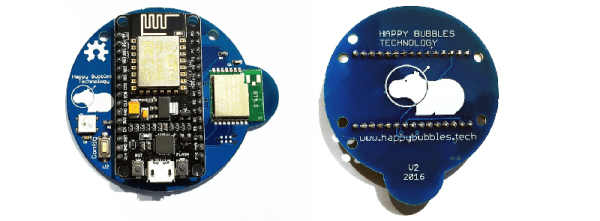
[Nemik]’s ‘Presence Detector’ for Bluetooth advertisements is actually a surprisingly simple build, leveraging the unbelievably cheap wireless modules available to us today. The WiFi side of the equation is a NodeMCU v2 ESP8266 dev board that provides all the smarts for the device via Lua scripting. The Bluetooth side of the board is a PTR5518 module that has a nRF51822 tucked inside. With the right configuration, this small board will listen for BLE advertisements and forward them to an MQTT server where they can be seen by anyone on the network.

[Nemik] is selling these beacon to WiFi bridges, but in the spirit of Open Hardware, he’s also giving away the designs and firmware so you can make your own. If you ever have an abundance of Bluetooth beacons sitting around and want to make a beacons of Things thing, this is the build for it.
Walnut Guitar Back Yields Wood For Classy Word Clock

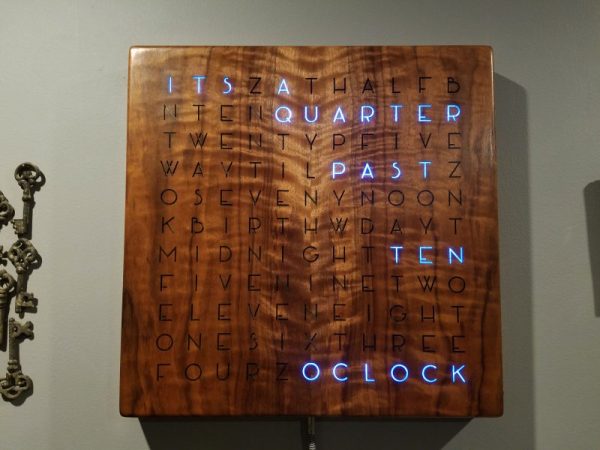
Word clocks are cool, but getting them to function correctly and look good is all about paying attention to the details. One look at this elegant walnut-veneered word clock shows what you can accomplish when you think a project through.

Most word clocks that use laser-cut characters like [grahamvinyl]’s effort suffer from the dreaded “stencil effect” – the font has bridges to support the islands in the middle of characters like “A” and “Q”. While that can be an aesthetic choice and work perfectly well, like in this word clock we featured a few months back, [grahamvinyl] was going for a different look. The clock’s book-matched walnut guitar back was covered in tape before being laser cut; the tape held the letters and islands in place. After painstakingly picking out the cutouts and tweaking the islands, he used clear epoxy resin to hold everything in place. The result is a fantastic Art Deco font and a clean, sleek-looking panel to sit on top of an MDF light box for the RGB LED strips.

The braided cloth cable adds a vintage look to the power cord, and [grahamvinyl] mentions some potential upgrades, like auto-dimming and color shifting. This is very much a work in progress, but even at this point we think it looks fabulous.

[via r/diy]

Add Slots And Tabs To Your Boxes In FreeCAD

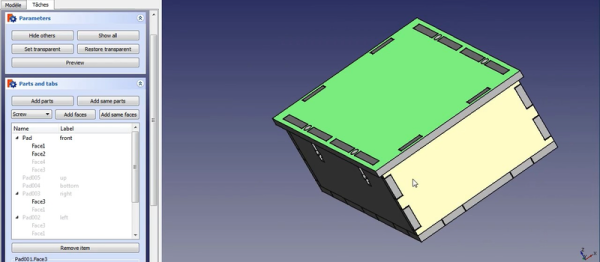
FreeCAD is a fairly sophisticated, open-source, parametric 3D modeler. The open-source part means that you can bend it to your will. [Alexandre] is working on a module that lets him easily add tabs, finger joints, and t-slots to models (YouTube link, embedded down under).

Right now the plugin is still experimental, but it looks usable. In the video demo, [Alexandre] builds up a simple box, and then adds all manner of physical connective pieces to it. You’ll note that the tabs look like they’re pieces added on to the main face — that’s because they are! He then exports the outlines to SVG and erases the lines that separate the tabs from the sides, and hands these files off to his laser cutter. Voilà! A perfect tab-and-t-slot box, with only a little bit of hand-work. ([Alexandre] mentions that it’s all still very experimental and that you should check out your design before sending it to the laser.)

Continue reading “Add Slots And Tabs To Your Boxes In FreeCAD”

Improving Rice Cooker Efficiency

Looking at the plate on the bottom of his electric rice cooker, [AC_Hacker] was surprised to find that it was rated to consume 400 watts. Furthermore when he measured its consumption he found that it consumed 385 watts without even having a cooking cycle initiated. The circuit to keep cooked rice warm was always on – even when the cooking circuit wasn’t engaged.

Something clearly had to be done, so he set about modifying the cooker for better economy. Removing the base revealed that disabling the warming circuit was as simple as disconnecting it. [AC_Hacker] also noticed that the device had no thermal insulation. There was plenty of space between the inner and outer walls, so he packed it with glass wool. The final modification was to reduce the power taken by the heater by installing a half-wave rectifier diode. The cooker still reached the desired temperature, it just used half the power.

You might think that would be the end of it, given that the modifications significantly reduced the cooker’s power consumption without detriment to its rice cooking ability. Rice now took a little longer to cook, so there was still room for improvement. The moment of inspiration came when [AC_Hacker] realized that the cooking time was proportional to the amount of water used in a cooking cycle. He could safely reduce the water without affecting the cooked rice. A 30% water reduction led to a proportional cooking time reduction, and rice cooked using a lot less power.

Surprisingly this seems to have been Hackaday’s first rice cooker hack. Perhaps that’s because you’ve been so busy supplying us with sous vide hacks to write about.

Hackaday Prize Entry: Modular, Low Cost Braille Display

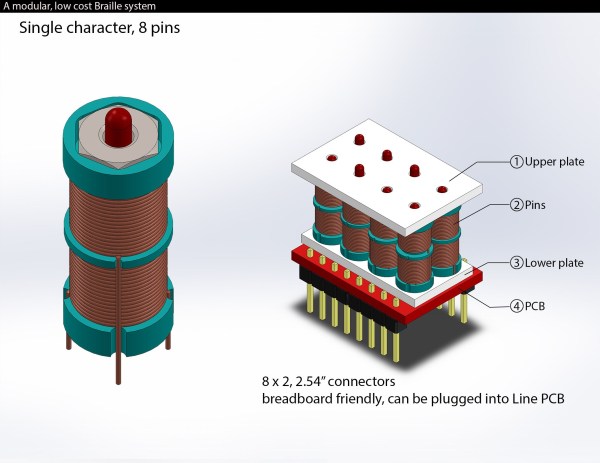
A lot of work with binary arithmetic was pioneered in the mid-1800s. Boolean algebra was developed by George Boole, but a less obvious binary invention was created at this time: the Braille writing system. Using a system of raised dots (essentially 1s and 0s), visually impaired people have been able to read using their sense of touch. In the modern age of fast information, however, it’s a little more difficult. A number of people have been working on refreshable Braille displays, including [Madaeon] who has created a modular refreshable Braille display.

The idea is to recreate the Braille cell with a set of tiny solenoids. The cell is a set of dots, each of which can be raised or lowered in a particular arrangement to represent a letter or other symbol. With a set of solenoids, this can be accomplished rather rapidly. [Madaeon] has already prototyped these miniscule controllable dots using the latest 3D printing and laser cutting methods and is about ready to put together his first full Braille character.

While this isn’t quite ready for a full-scale display yet, the fundamentals look like a solid foundation for building one. This is all hot on the heels of perhaps the most civilized patent disagreement in history regarding a Braille display that’s similar. Hopefully all the discussion and hacking of Braille displays will bring the cost down enough that anyone who needs one will easily be able to obtain and use one.

Continue reading “Hackaday Prize Entry: Modular, Low Cost Braille Display”

Modular Drum Machine Creates Random Rhythms

Don’t worry, the rhythms themselves aren’t random! That would hardly make for a useful drum machine. [kbob]’s creation does have the ability to randomly generate functional rhythms, though, and it’s all done on a breadboard.

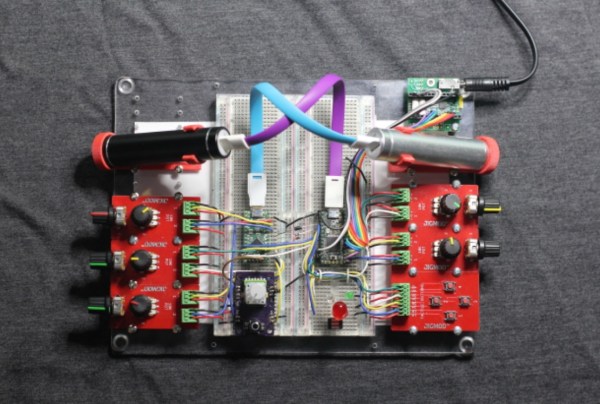
The core of this tiny drum machine is two Teensy dev boards. One is an FM synth tuned to sound like drums, and the other is a random rhythm generator with several controls. The algorithms are from Mutable Instruments’ open source Eurorack modules. The entire thing fits on a breadboard with JIGMOD modules for the user interface. The machine runs on lithium batteries in the form of USB cell phone chargers. The battery holders were designed in Fusion 360 and 3D printed.

The function of the drum machine is pretty interesting as well. There are a set of triggers tied to the buttons on the machine. When a button is pressed, the drum machine plays that sound at the appropriate time, ensuring there are no offbeat beats. The potentiometers are polled once every millisecond and the program updates the output as required. There’s also a “grid” of rhythms that are controlled with two other knobs (one to map the X coordinate and the other for the Y) and a “chaos” button which adds an element of randomness to this mapping.

The modular nature of this project would make this a great instrument to add to one’s musical repertoire.It’s easily customizable, and could fit in with any of a number of other synthesizer instruments.

Continue reading “Modular Drum Machine Creates Random Rhythms”

3D Printering: Makerbot’s Class Action Suit Dismissed

This time last year, Stratasys, parent company of Makerbot, was implicated in a class action suit. Investors claimed Stratasys violated securities laws, and overstated both the performance of the 5th generation of Makerbot printers and the performance of the company itself. Court docs received by Adafruit have revealed this case has been dismissed with prejudice. Makerbot won this one.

The case presented by Stratasys investors relied on two obvious facts. First, the price of Stratasys shares fell far beyond expectations. Second, the extruder for the 5th generation of Makerbot printers – the ‘Smart Extruder’ – was terrible. No one can reasonably dispute these claims; shares of SYSS fell from $120 in September of 2014 to $30 in September of 2015. With many returns to handle, Makerbot quickly redesigned the Smart Extruder.

Both of these indisputable facts are in stark contrast to statements made by Stratasys and Makerbot at the time. In a press release for the 4th quarter 2013 financial results, Stratasys’ expected sales to grow at least 25% over 2013 and stated it was experiencing “strong sales” of its desktop 3D printer. Concerning the Smart Extruder, Makerbot stated this new feature of the 5th generation Makerbots would make them easy to use, and “define the new standard for quality and reliability.”

The facts of this case are not in dispute – Stratasys did not see the growth they expected in late 2013. The Smart Extruder certainly did not make printers more reliable. These facts, however, are not sufficient to violate securities law.  In a wonderful legal turn of phrase, the judge deciding this case called the statements about the quality of the 5th generation Makerbots consisted of, “non-actionable puffery,” and a ‘statement so vague and such obvious hyperbole than no reasonable investor would rely on them.’

Statements made by Stratasys on their financial performance were also found not to be sufficient to violate securities laws. Stratasys did make several statements about negative performance in late 2014 and 2015, and positive statements made earlier did not have an intent to deceive investors.

This is good news for Makerbot. The claims brought by investors in this case had little merit. The case cannot be appealed, and Stratasys is no longer facing a class action suit. Does this news actually matter? Not really; Makerbot is a dead man walking, and 2016 sales will be at levels not seen since 2010 or 2011.

The consumer 3D printing industry is booming, despite the Makerbot bellwether though.