Upgrading A MIDI Controller With An FPGA

While the “M” in MIDI stands for “musical”, it’s possible to use this standard for other things as well. [s-ol] has been working on a VJ setup (mixing video instead of music) using various potentiometer-based hardware and MIDI to interface everything together. After becoming frustrated with drift in the potentiometers, he set out to outfit the entire rig with custom-built encoders.

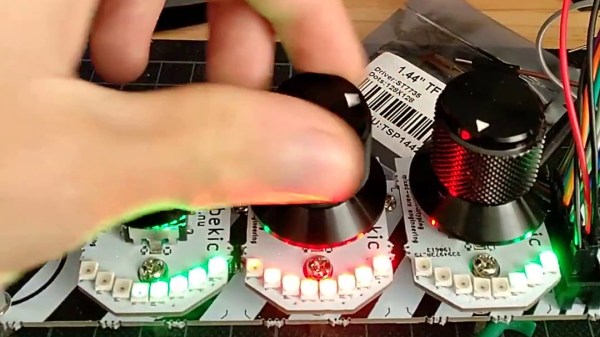
[s-ol] designed the rotary-encoder based boards around an FPGA. It monitors the encoder for changes, controls eight RGB LEDs per knob, and even does capacitive touch sensing on the aluminum knob itself. The FPGA communicates via SPI with an Arduino master controller which communicates to a PC using a serial interface. This is [s-ol]’s first time diving into an FPGA project and it looks like he hit it out of the park!.

Even if you’re not mixing video or music, these encoders might be useful to any project where a standard analog potentiometer isn’t accurate or precise enough, or if you just need something that can dial into a specific value quickly. Potentiometers fall short in many different ways, but if you don’t want to replace them you might modify potentiometers to suit your purposes.
Continue reading “Upgrading A MIDI Controller With An FPGA”

Probe The Galaxy On A Shoestring With This DIY Hydrogen-Line Telescope

Foil-lined foam insulation board, scraps of lumber, and a paint-thinner can hardly sound like the tools of a radio astronomer. But when coupled with an SDR, a couple of amplifiers, and a fair amount of trial-and-error tweaking, it’s possible to build your own hydrogen-line radio telescope and use it to image the galaxy.

As the wonderfully named [ArtichokeHeartAttack] explains in the remarkably thorough project documentation, the characteristic 1420.4-MHz signal emitted when the spins of a hydrogen atom’s proton and electron flip relative to each other is a vital tool for exploring the universe. It lets you see not only where the hydrogen is, but which way it’s moving if you analyze the Doppler shift of the signal.

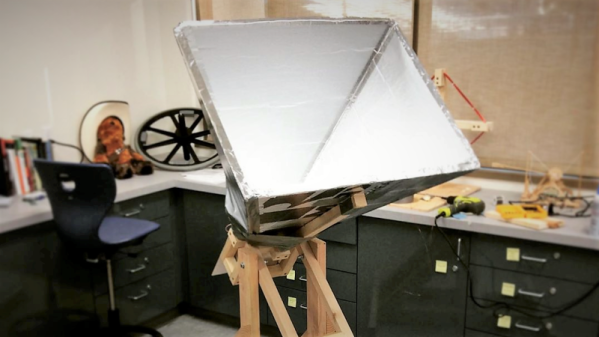
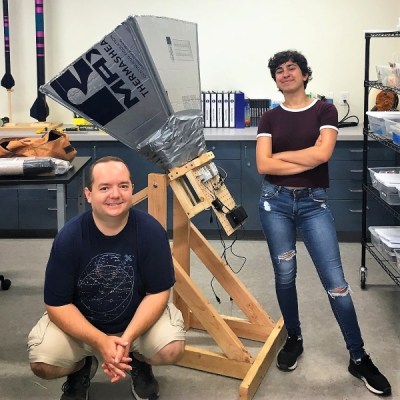
But to do any of this, you need a receiver, and that starts with a horn antenna to collect the weak signal. In collaboration with a former student, high school teacher [ArtichokeHeartAttack] built a pyramidal horn antenna of insulation board and foil tape. This collects RF signals and directs them to the waveguide, built from a rectangular paint thinner can with a quarter-wavelength stub antenna protruding into it. The signal from the antenna is then piped into an inexpensive low-noise amplifier (LNA) specifically designed for the hydrogen line, some preamps, a bandpass filter, and finally into an AirSpy SDR. GNURadio was used to build the spectrometer needed to determine the galactic rotation curve, or the speed of rotation of the Milky Way galaxy relative to distance from its center.
We’ve seen other budget H-line SDR receiver builds before, but this one sets itself apart by the quality of the documentation alone, not to mention the infectious spirit that it captures. Here’s hoping that it finds its way into a STEM lesson plan and shows some students what’s possible on a limited budget.

The Price Of Domestic Just In Time Manufacturing

Hardware is hard, manufacturing only happens in China, accurate pricing is a dark art. Facts which are Known To Be True. And all things which can be hard to conquer as an independent hardware company, especially if you want to subvert the tropes. You may have heard of [Spencer Wright] via his superb mailing list The Prepared, but he has also been selling an unusual FM radio as Centerline Labs for a few years. Two years ago they relaunched their product, and last year the price was bumped up by a third. Why? Well, the answer involves more than just a hand wave about tariffs.

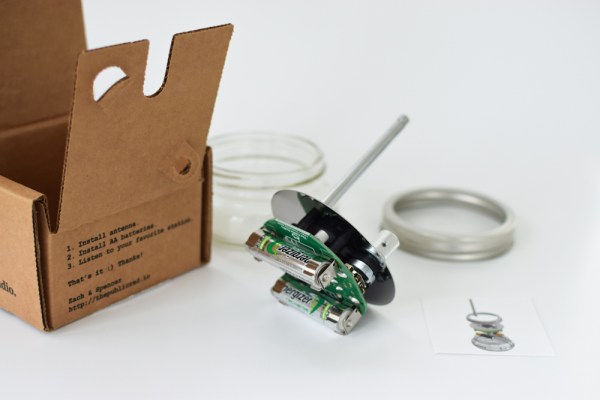
The Public Radio is a single-station FM radio in a mason jar. It’s a seemingly simple single purpose hardware product. No big mechanical assemblies, no complex packaging, not even any tangential accessories to include. In some sense it’s an archetypically atomic hardware product. So what changed? A normal product is manufactured in bulk, tested and packaged, then stored in a warehouse ready to ship. But TPR is factory programmed to a specific radio station, so unless Centerline wanted one SKU for each possible radio station (there are 300) this doesn’t work. The solution was domestic (US) just in time manufacturing. When a customer hits the buy button, a unit is programmed, tested, packed, and shipped.

As with any business, there is a lot more to things than that! The post gives the reader a fascinating look at all the math related to Centerline Labs’ pricing and expenses; in other words, what makes the business tick (or not) including discussion of the pricing tradeoffs between manufacturing different components in Asia. I won’t spoil the logical path that led to the pricing change, go check out the post for more detail on every part. 

We love hearing about the cottage hardware world. Got any stories? Drop them in the comments!

This Word Clock Has Dirty Alphanumeric Mouth

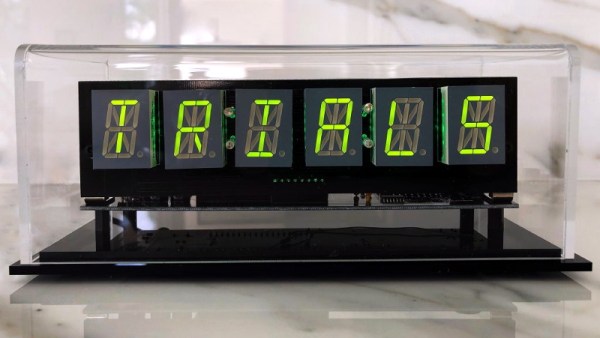
Clocks which use words to tell the time in place of numbers are an increasingly popular hacker project, but we have to admit that before seeing this gorgeous clock from [Mitch Feig], we didn’t realize how badly we wanted to see one that could curse like a sailor.

But don’t worry, the WordClock-1 knows more than just the bad words. Rather than using an array of illuminated letters as we’ve seen in previous clocks, this one uses six alphanumeric LED displays. So not only can it display the time expressed with words and numbers, but it can show pretty much any other text you might have in mind.

[Mitch] is partial to having his clock toss a swear word on the display every few seconds, but perhaps you’d rather have it show some Klingon vocabulary to help you brush up. The lack of extended characters does limit its language capabilities somewhat, but it still manages to include Spanish, Italian, French, and Croatian libraries.

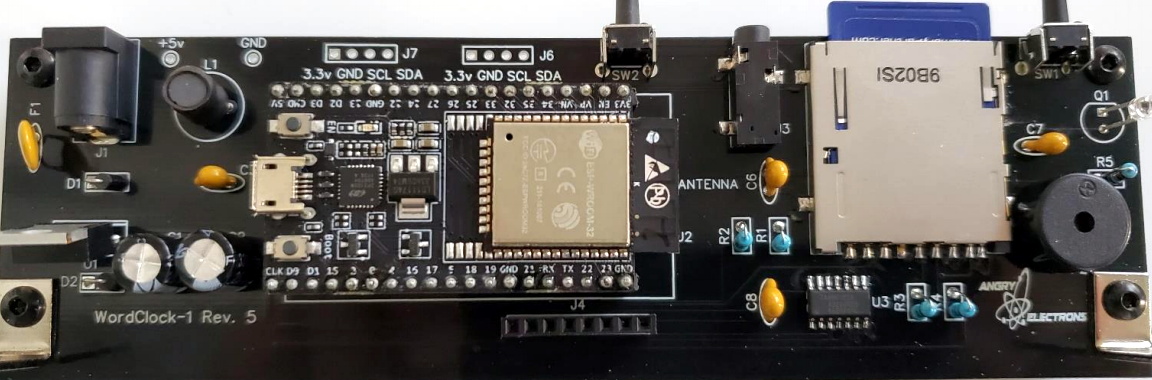
The ESP32 powered clock comes as a kit, and [Mitch] has provided some very thorough documentation that should make assembling it fairly straightforward as long as you don’t mind tackling a few SMD components. Additional word databases are stored on an SD card, and you can easily add your own or edit the existing ones with nothing more exotic than a text editor. The clock itself is configured via a web interface, and includes features like RGB LED effects and support for pulling the time down from an external GPS receiver.

Of course, if you’re content with what we can apparently now refer to as “old style” word clocks, we’ve seen plenty of projects which should serve as inspiration for anyone looking to roll their own textual timepiece.

Continue reading “This Word Clock Has Dirty Alphanumeric Mouth”

DIY Thermal Imager Uses DIY Gaussian Blur

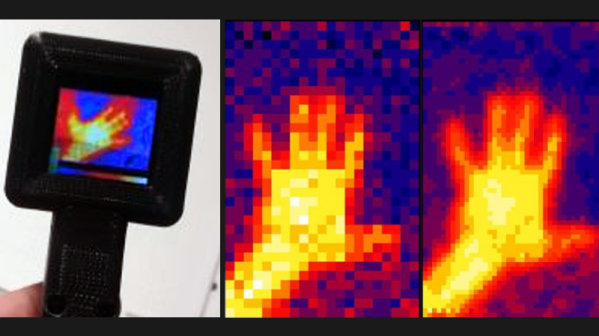
Under the right circumstances, Gaussian blurring can make an image seem more clearly defined. [DZL] demonstrates exactly this with a lightweight and compact Gaussian interpolation routine to make the low-resolution thermal sensor data display much better on a small OLED.

[DZL] used an MLX90640 sensor to create a DIY thermal imager with a small OLED display, but since the sensor is relatively low-resolution at 32×24, displaying the data directly looks awfully blocky. Gaussian interpolation to improve the display looks really good, but it turns out that the full Gaussian interpolation isn’t a trivial calculation write on your own. Since [DZL] wanted to implement it on a microcontroller, the lightweight implementation was born. The project page walks through the details of Gaussian interpolation and how some effective shortcuts were made, so be sure to give it a look.

The MLX90640 sensor also makes an appearance in the Open Thermal Camera, one of the entries for the 2019 Hackaday Prize. If you’re interested in thermal imaging, don’t miss this teardown of a thermal imaging camera.

Chinese Radio Telescope Hopes To Find Exoplanets FAST

People who enjoy radio are constantly struggling to find a place to erect a bigger and better antenna. Of course it’s a different story and the most hardcore end of the spectrum: radio astronomers. The Chinese are ready to open up a new radio telescope called FAST (Five-hundred-meter Aperture Spherical Radio Telescope). As the name implies, it is 500 meters in diameter which is about 1,600 feet — that five and a half American football fields or about four and half of the other kind of football field.

The new telescope will be the largest single-dish observatory in the world and will offer about twice the area of the next-largest single-dish instrument at Arecibo. The project is in a very remote location, presumably to reduce the level of local radio interference — it’s hard to find radio quiet zones in heavily populated areas.

Scientists hope the huge antenna will help solve the mystery of fast radio bursts and may even study exoplanets. In fact, earlier this year, the instrument detected hundreds of fast radio bursts from a source, many of which were too faint to be heard by lesser antennas. There are also plans to examine pulsars in an attempt to discover ripples in space-time. The location in the Dawodang depression of the Guizhou province uses about 4,400 panels and 2,000 mechanical winches to focus radio energy.

Other telescopes that use multiple dishes have more resolution and, in fact, FAST adds 3 dozen 5 meter commercial dishes to get an increase in resolution of 100 times. Of course, you could build your own, although to get up to 500 meters might be a stretch. If your backyard isn’t that big, you can build a tiny radio telescope too.

Maps To SMS, When You’re Really Far Away

GPS is available on most smart phones, which is all well and good unless you drive out into a place with weak service. Unless you want to go into the before-time and buy a standalone GPS (and try to update the maps every so often) or go even further back and print out MapQuest directions, you’ll need another solution to get directions. Something like this project which sends Google Maps directions over SMS.

The project is called RouteMe by [AhadCove]. It runs on a Raspberry Pi at his home which is constantly monitoring an email inbox. Using Google Voice to forward incoming text messages as emails to the Pi, the system works when your phone has a cell signal but no data connection. The Pi listens for specific commands in that SMS-to-Email connection and is able to send directions back to the phone via text message. That’s actually a neat hack you may remember from the olden days where you can send email as SMS using the phone number as the address.

If you find yourself lost in the woods with just your phone often enough, [AhadCove] has all of the code and detailed directions on how to set this up on his GitHub site. But don’t discount this particular task, anything you can script on the Pi can now be controlled via SMS without relying on a service like Twilio.

This maps hack is a pretty ingenious solution to a problem that more than a few of us have had, and it uses a lot of currently-available infrastructure to run as well. If you want another way of navigating without modern tech, have a go at dead reckoning in a car.