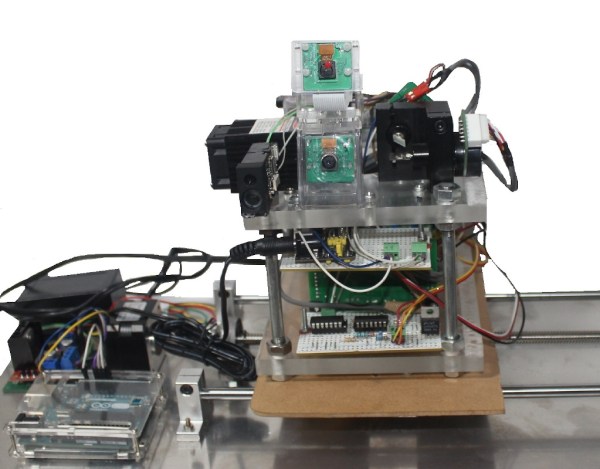
Bug Eliminator Zaps With A Laser

Mosquitoes tend to be seen as an almost universal negative, at least in the lives of humans. While they serve as a food source for plenty of other animals and may even pollinate some plants, they also carry diseases like malaria and Zika, not to mention the itchy bites. Various mosquito deterrents have been invented over the years to solve some of these problems, but one of the more interesting ones is this project by [Ildaron] which attempts to build a mosquito-tracking laser.

The device uses a neural learning algorithm to identify mosquitoes flying nearby. Once a mosquito is detected, a laser is aimed at it and activated in order to “thermally neutralize” the pest. The control system as well as the neural network and machine learning are hosted on a Raspberry Pi and Jetson Nano which give it plenty of computing power. The only major downside with this specific project is that the high-powered laser can be harmful to humans as well.

Ideally, a market for devices like these would bring the price down, perhaps even through the use of something like an ASIC specifically developed for these mosquito-targeting machines. In the meantime, [Ildaron] has made this project available for replication on his GitHub page. We have also seen similar builds before which are effective against non-flying insects, so it seems like only a matter of time before there is more widespread adoption — either that or Judgement day!


Continue reading “Bug Eliminator Zaps With A Laser”

Building Faster Rsync From Scratch In Go

For a quick file transfer between two computers, SCP is a fine program to use. For more complex, large, or regular backups, however, the go-to tool is rsync. It’s faster, more efficient, and usable in a wider range of circumstances. For all its perks, [Michael Stapelberg] felt that it had one major weakness: it is a tool written in C. [Michael] is philosophically opposed to programs written in C, so he set out to implement rsync from scratch in Go instead.

[Michael]’s path to deciding to tackle this project is a complicated one. His ISP upgraded his internet connection to 25 Gbit/s recently, which means that his custom router was the bottleneck in his network. To solve that problem he migrated his router to a PC with several 25 Gbit/s network cards. To take full advantage of the speed now theoretically available, he began using a tool called gokrazy, which turns applications written in Go into their own appliance. That means that instead of installing a full Linux distribution to handle specific tasks (like a router, for example), the only thing loaded on the computer is essentially the Linux kernel, the Go compiler and libraries, and then the Go application itself.

With a new router with hardware capable of supporting these fast speeds and only running software written in Go, the last step was finally to build rsync to support his tasks on his network. This meant that rsync itself needed to be built from scratch in Go. Once [Michael] completed this final task, he found that his implementation of rsync is actually much faster than the version built in C, thanks to the modernization found in the Go language and the fact that his router isn’t running all of the cruft associated with a standard Linux distribution.

For a software project of this scope, we find [Michael]’s step-by-step process worth taking note of for any problem any of us attempt to tackle. Not only that, refactoring a foundational tool like rsync is an involved task on its own, let alone its creation simply to increase network speeds beyond what most of us would already consider blazingly fast. We’re leaving out a ton of details on this build so we definitely recommend checking out his talk in the video below.

Thanks to [sarinkhan] for the tip!

Continue reading “Building Faster Rsync From Scratch In Go”

New Resin Printing Method Creates Objects In Seconds

For anyone looking to buy a 3D printer at home, the first major decision that needs to be made is whether to get a resin printer or a filament printer. Resin has the benefits of finer detail, but filament printers are typically able to produce stronger prints. Within those two main camps are various different types and sizes to choose from, but thanks to some researchers at Switzerland’s École polytechnique fédérale de Lausanne (EPFL) there’s a new type of resin printer on the horizon that can produce prints nearly instantaneously.

The method works similarly to existing resin printers by shining a specific light pattern on the resin in order to harden it. The main difference is that the resin is initially placed in a cylinder and spun at a high speed, and the light is shined on the resin at different angles with very precise intensities and timings in order to harden the resin in specific areas. This high-speed method allows the printer to produce prints in record-breaking time. The only current downside, besides the high price for the prototype printer, is that it’s currently limited to small prints.

With the ability to scale in the future and the trend of most new technologies to come down in price after they have been on the market for some amount of time, it would be groundbreaking to be able to produce prints with this type of speed if printers like these can be scalable. Especially if they end up matching the size and scale of homemade printers like this resin printer.

Thanks to [suicidal.banana] for the tip!

Automatic Water Turret Keeps Grass Watered

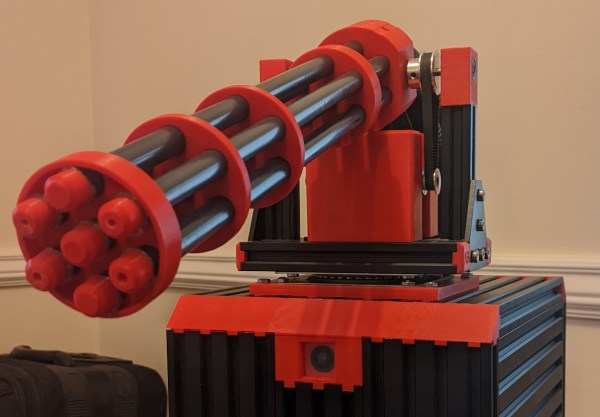
Summer is rapidly approaching (at least for those of us living in the Northern Hemisphere) and if you are having to maintain a lawn at your home, now is the time to be thinking about irrigation. Plenty of people have built-in sprinkler systems to care for their turf, but this is little (if any) fun for any children that might like to play in those sprinklers. This sprinkler solves that problem, functioning as an automatic water gun turret for anyone passing by.

This project was less a specific sprinkler build and more of a way to reuse some Khadas VIM3 single-board computers that the project’s creator, [Neil], wanted to use for something other than mining crypto. The boards have a neural processing unit (NPU) in them which makes them ideal for computer vision projects like this. The camera input is fed into the NPU which then directs the turret to the correct position using yaw and pitch drivers. It’s built out of mostly aluminum extrusion and 3D printed parts, and the project’s page goes into great details about all of the parts needed if you are interested in replicating the build.

[Neil] is also actively working on improving the project, especially around the turret’s ability to identify and track objects using OpenCV. We certainly look forward to more versions of this build in the future, and in the meantime be sure to check out some other automated sprinkler builds we’ve seen which solve different problems.

Continue reading “Automatic Water Turret Keeps Grass Watered”

Saving Birds With 3D Printed Boats

Montana, rightfully nicknamed the big sky country, is a beautiful state with abundant wide open landscapes, mountains, and wildlife. It’s a fantastic place to visit or live, but if you happen to reside in the city of Butte, that amazing Montana landscape is marred by the remnants of an enormous open pit mine. Not only is it an eyesore, but the water that has filled the pit is deadly to any bird that lands there. As a result, a group of people have taken to some ingenious methods to deter birds from landing in the man-made toxic lake for too long.

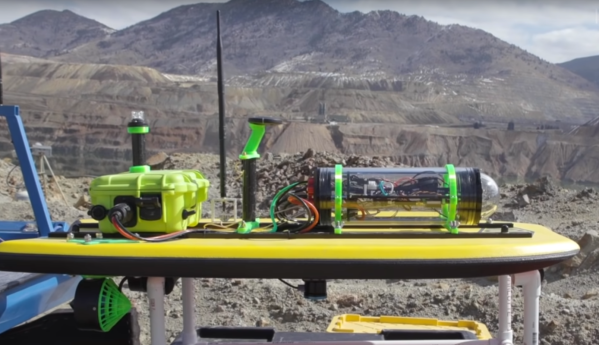
When they first started, the only tool they had available was a rifle. Scaring birds this way is not the most effective way for all species, though, so lately they have been turning to other tools. One of which is a custom boat built on a foam bodyboard which uses a plethora of 3D printed parts and sensors to allow the operator to remotely pilot the boat on the toxic lake. The team also has a drone to scare birds away, plus an array of other tools like high-powered lasers, propane cannons, and various scopes in order to put together the most effective response to help save wildlife.

While this strategy runs the gamut of the tools most commonly featured here, from 3D printers to drones to lasers, the only thing that’s missing is some automation like we have seen with other drone boat builds we’ve featured in the past. It takes quite a bit of time to continually scare birds off this lake, even through the winter, so every bit of help the team can get could go even further.

Continue reading “Saving Birds With 3D Printed Boats”

Remote Screen Viewer Is Text-Only

Have you been slowly falling down a rabbit hole of Stallman-like paranoia of computers ever since installing Ubuntu for the first time in 2007? Do you now abhor anything with a GUI, including browsers? Do you check your mail with the command line even though you’re behind seven proxies? But, do you still want to play Minecraft? If so, this command-line-only screen viewer might just be the tool to use a GUI without technically using one.

This remote screen viewer is built in Python by [louis-e] and, once installed, allows the client to view the screen of the server even if the client is a text-only console. [louis-e] demonstrates this from within a Windows command prompt. The script polls the server screen and then displays it in the console using the various colors and textures available. As a result, the resolution and refresh rate are both quite low, but it is still functional enough to play Minecraft and do other GUI-based tasks as long as there’s no fine text to read anywhere.

The video below only shows a demonstration of the remote screen viewer, and we can imagine plenty of uses beyond this proof-of concept game demonstration. Installing a desktop environment and window manager is not something strictly necessary for all computers, so this is a functional workaround if you don’t want to waste time and resources installing either of those components. If you’re looking for remote desktop software for a more specific machine, though, take a look at this software which enables remote desktop on antique Macs.

Continue reading “Remote Screen Viewer Is Text-Only”

Electronic Dice Is Introduction To Microcontroller Programming

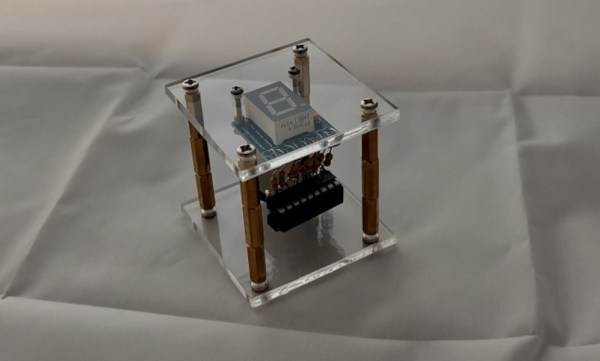
By now most of us are familiar with the Arduino platform. It’s an inexpensive and fairly easy way into the world of microcontrollers. For plenty of projects, there’s no need to go beyond that unless you have a desire to learn more of the inner workings of microcontrollers in general. [Cristiano] was interested in expanding some of his knowledge, so he decided to build this electronic dice using a PIC microcontroller instead of the Arduino platform he was more familiar with.

As a result, this project is set up as a how-to for others looking to dive further into the world of microcontrollers that don’t have the same hand-holding setup as the Arduino. To take care of the need for a random number for the dice, the PIC’s random number generator is used but with the added randomness of a seed from an internal timer. The timer is started when a mercury tilt switch signals the device that it has been rolled over, and after some computation a single digit number is displayed on a seven-segment display.

While it might seem simple on the surface, the project comes with an in-depth guide on programming the PIC family of microcontrollers, and has a polish not normally seen on beginner projects, including the use of the mercury tilt switch which gives it a retro vibe. For some other tips on how to build projects like this, take a look at this guide on how to build power supplies for your projects as well.

Continue reading “Electronic Dice Is Introduction To Microcontroller Programming”