Retrotechtacular: Design For Assembly, 1980s-Style

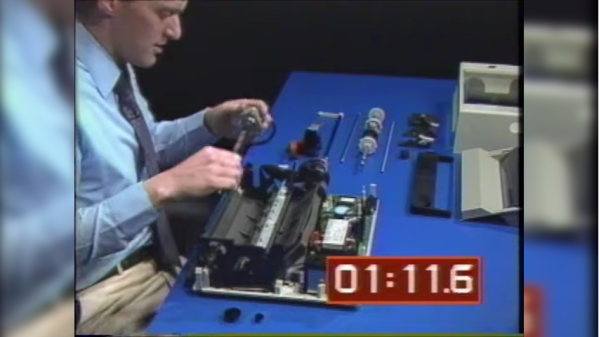
To get its engineers thinking about design for assembly back in the 1980s, Westinghouse made a video about a product optimized for assembly: the IBM Proprinter. The technology may be dated, but the film presents a great look at how companies designed not only for manufacturing, but also for ease of assembly.

It’s not clear whether Westinghouse and IBM collaborated on the project, but given the inside knowledge of the dot-matrix printer’s assembly, it seems like they did. The first few minutes are occupied by an unidentified Westinghouse executive talking about design for assembly in general terms, and how it impacts the bottom line. Skip ahead to 3:41 if talking suits aren’t your thing.

Once the engineer gets going on the printer, though, things get really interesting. The printer’s guts are laid out before him, ready to be assembled. What’s notably absent from the table are tools — the Proprinter was so well designed that the only tool needed is a pair of human hands. And they don’t have to be particularly dexterous hands, either — the design favors motions that are straight down, letting gravity assist the assembly process and preventing assemblers from the need to contort their bodies. Almost everything is held in place by compliant mechanisms built into the plastic parts. There are a few gems in the film, like the plastic lead screw that drives the printhead, obviating the need to string a fussy timing belt, or the unique roller that twists to lock onto a long shaft, rather than having to be pushed to its center.

We found this film which we’ve placed below the break to be very instructive, and the fact that a device as complex as a printer can be assembled in just a few minutes without picking up a single tool is pretty illustrative of the power of designing for assembly. Slick designs that can’t be manufactured at scale are all too common in this age of powerful design tools and desktop manufacturing, so these lessons from the past might be worth relearning.

Continue reading “Retrotechtacular: Design For Assembly, 1980s-Style”

Building A 60s Toy The Way It Should Have Been

The original Hasbro “Think-a-Tron”, a toy from the dawn of the computer revolution, was billed with the slogan, “It thinks! It answers! It remembers!” It, of course, did only one of these things, but that didn’t stop the marketers of the day from crushing the hopes and dreams of budding computer scientists and their eager parents just to make a few bucks. It’s not like we’re bitter or anything — just saying.

In an effort to right past wrongs, [Michael Gardi] rebuilt the 1960s “thinking machine” toy with modern components. The original may not have lived up to the hype, but at least did a decent job of evoking the room-filling computers of the day is a plastic cabinet with a dot-matrix-like display. The toy uses “punch-cards” with printed trivia questions that are inserted into the machine to be answered. A disk with punched holes spins between a light bulb and the display lenses, while a clever linkage mechanism reads the position of a notch in the edge of the card and stops the wheel to display the letter of the correct answer.

[Michael]’s update to the Think-aTron incorporates what would have qualified as extraterrestrial technology had it appeared in the 1960s. A 35-LED matrix with a 3D-printed diffuser and case form the display, with trivia questions and their answer as a QR code standing in for the punch-cards.He also added a pair of user consoles, so players can lock-in and answer before an ESP32-Cam reads the QR code and displays the answer on the LED matrix, after playing some suitable “thinking music” through a speaker.

As usual with [Michael]’s retrocomputing recreations, the level of detail here is fantastic. We especially like the custom buttons; controls like these seem to be one of his specialties judging by his slide switches and his motorized rotary switch.

Continue reading “Building A 60s Toy The Way It Should Have Been”

“Alexa, Stop Listening To Me Or I’ll Cut Your Ears Off”

Since we’ve started inviting them into our homes, many of us have began casting a wary eye at our smart speakers. What exactly are they doing with the constant stream of audio we generate, some of it coming from the most intimate and private of moments? Sure, the big companies behind these devices claim they’re being good, but do any of us actually buy that?

It seems like the most prudent path is to not have one of these devices, but they are pretty useful tools. So this hardware mute switch for an Amazon Echo represents a middle ground between digital Luddism and ignoring the possible privacy risks of smart speakers.  Yes, these devices all have software options for disabling their microphone arrays, but as [Andrew Peters] relates it, his concern is mainly to thwart exotic attacks on smart speakers, some of which, like laser-induced photoacoustic attacks, we’ve previously discussed. And for that job, only a hardware-level disconnect of the microphones will do.

To achieve this, [Andrew] embedded a Seeeduino Xiao inside his Echo Dot Gen 2. The tiny microcontroller grounds the common I²S data line shared by the seven (!) microphones in the smart speaker, effective disabling them. Enabling and disabling the mics is done via the existing Dot keys, with feedback provided by tones sent through the Dot speaker. It’s a really slick mod, and the amount of documentation [Andrew] did while researching this is impressive. The video below and the accompanying GitHub repo should prove invaluable to other smart speaker hackers.

Continue reading ““Alexa, Stop Listening To Me Or I’ll Cut Your Ears Off””

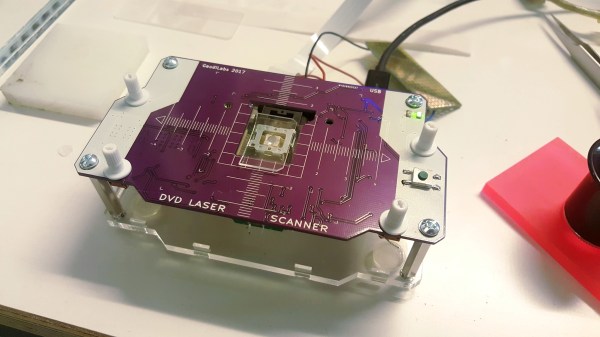
DVD Optics Power This Scanning Laser Microscope

We’ve all likely seen the amazing images possible with a scanning electron microscope. An SEM can yield remarkably detailed 3D images of the tiniest structures, and they can be invaluable tools for research. But blasting high-energy cathode rays onto metal-coated samples in the vacuum chamber of a bulky and expensive instrument isn’t the only way to make useful images, as this home-brew laser scanning microscope demonstrates.

This one comes to us by way of [GaudiLabs], a Swiss outfit devoted to open-source lab equipment that enables citizen science; we saw their pocket-sized thermal cycler for PCR a while back. The basic scheme here is known as confocal laser scanning fluorescence microscopy, where a laser at one wavelength excites fluorescent tags bound to structures in a sample. Light emitted by the tags is collected, and a 3D image is built up from multiple scans of the sample at different focal planes.

Like many DIY projects, this microscope is built from old DVD parts, specifically the pickup heads. The precision optics in these commonly available assemblies, which are good enough to read pits as small as 150 nm on a Blu-Ray DVD, are well-suited for resolving similarly sized microstructures. One DVD pickup is used to scan the laser in the X-axis, while the other head is modified to carry the sample and move it in the Y-axis. The pickup head coils and laser are driven by an Arduino carried on a custom PCB along with the DVD heads. Complete build files are posted on GitHub for anyone interested in recreating this work.

We love tips like this that dig back a bit and find things we missed the first go-around. And the equipment [GaudiLabs] lists really has potential for the budding biohacker, which we also like.

Thanks for the tip on this one, [Bill].

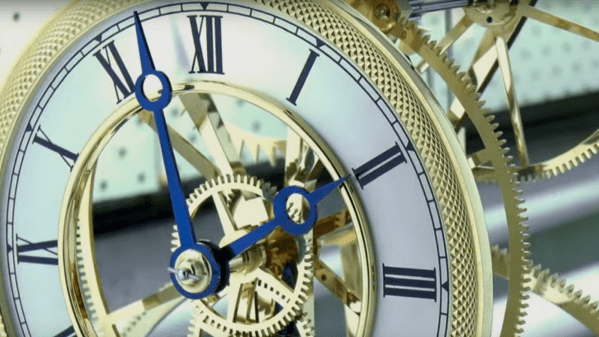
Mechanical Timekeeping Hack Chat With Clickspring

Join us on Wednesday, February 3 at noon Pacific for the Mechanical Timekeeping Hack Chat with Clickspring!

The reckoning of the passage of time has been of vital importance to humans pretty much for all our history, but for most of that time we were stuck looking at the movements of heavenly bodies or noting the changing of the seasons to answer questions of time. The search for mechanical aids to mark the passage of time began surprisingly early, though, pretty much from the time our ancestors first learned to work with metals.

Timekeeping devices were often created to please a potentate or to satisfy a religious imperative, but whatever the reason for their invention, these early clocks and calendars were key to a ton of discoveries. Timekeeping devices were among the first precision mechanisms, and as such formed the basis of much of our mechanical world. A mechanical representation of the passage of time also gave us some of the first precise observations of the physical world, which led to an enormous number of discoveries about the nature of the universe, not to mention practical skills such as navigation, which allowed us to explore the world with greater confidence.

In our era, precision timekeeping has moved beyond the mechanical realm into the subatomic world, and mechanisms built to please a prince are relegated to museums and collectors. That’s not to say there isn’t plenty to learn from the building of mechanical timepieces, as anyone who has watched any of the videos on Clickspring’s YouTube channel can attest. Clickspring not only makes some magnificent modern timepieces, like his famous open-frame clock, but recently he’s also branched out into the timekeeping mechanisms of the ancients. He built a reproduction Byzantine sundial-calendar, and tackled a reproduction of the famous Antikythera mechanism. The latter was undertaken using only the tools and materials that would have been available to the original maker. That led to an unexpected discovery and a detour into the world of scholarly publishing.

Clickspring has been busy lately, but he made some time to stop by the Hack Chat and talk about mechanical timepieces. We’ll talk about his modern builds, his forays into the mechanisms of antiquity, and his serendipitous discovery. On the way we’re likely to talk about what it takes to build precision mechanisms in a small shop, and whatever else that crops up.

join-hack-chatOur Hack Chats are live community events in the Hackaday.io Hack Chat group messaging. This week we’ll be sitting down on Wednesday, February 3 at 12:00 PM Pacific time. If time zones have you tied up, we have a handy time zone converter.

Click that speech bubble to the right, and you’ll be taken directly to the Hack Chat group on Hackaday.io. You don’t have to wait until Wednesday; join whenever you want and you can see what the community is talking about.

Continue reading “Mechanical Timekeeping Hack Chat With Clickspring”

Electric Candle Replaces Flame With Plasma

Ah, the charm of candlelight! Nothing says “romance” — or “extended power outage” — like the warm, soft glow of a real candle. But if you’re not a fan of burning wax for whatever reason, this electric plasma candle may be just the thing to build for your next dinner for two.

This re-imagining of the humble candle comes to us by way of plasma super-fan [Jay Bowles], who has a lot of experience with plasmas and the high-voltage circuits that often go along with them. Even so, he had to enlist help with the circuit, with is essentially a 10-MHz Class-E oscillator, from [Leon] at the Teslaundmehr channel on YouTube. The most prominent feature of the build is the big resonator coil, surrounded by the shorter primary coil and sitting atop the heatsink for the MOSFET driver. [Jay]’s usual acrylic-rich style is well represented here, and the resulting build is quite lovely.

The tuning process, though, sounds like it was pure torture. It took a lot of tweaking — and a lot of MOSFETs — to get the candle to produce a stable flame. But once it did, the results were striking. The plasma coming off the breakout point on the resonator coil is pretty much the same size, shape, and — occasionally — the color as a candle flame. It’s also hot enough to do some damage, so do be careful if you build this. We’ve included both [Jay]’s and [Leon]’s videos below; [Leon]’s has great step-by-step build instructions.

We’ve been following [Jay]’s journey through the plasmaverse for a while now, from his cheap and simple Tesla coils to using corona discharge to clean his hands. He even hosted a Hack Chat on the subject last year.

Note: [Jay] reached out to us after publication about mitigating RF noise. He does his experiments inside a steel-reinforced concrete building with grounded metal screens over the windows. An RF-wizard friend has checked across the spectrum and detected no leaks to the outside. Sounds like the business to us.

Continue reading “Electric Candle Replaces Flame With Plasma”

Hackaday Links Column Banner

Hackaday Links: January 31, 2021

There are an awful lot of machines on the market these days that fall under the broad category of “cheap Chinese laser cutters”. You know the type — the K40s, the no-name benchtop CO2 cutters, the bigger floor-mount units. If you’ve recently purchased one of these machines from one of the usual vendors, or even if you’re just thinking about doing so, you’ll likely have some questions. In which case, this “Chinese Laser Cutters 101” online class might be right up your alley. We got wind of this though its organizer, Jonathan Schwartz of American Laser Cutter in Los Angeles, who says he’s been installing, repairing, and using laser cutters for a decade now. The free class will be on February 8 at 5:00 PM PST, and while it’s open to all, it does require registration.

We got an interesting tip the other day that had to do with Benford’s Law. We’d never heard of this one, so we assumed was a “joke law” like Murphy’s Law or Betteridge’s Rule of Headlines. But it turns out that Benford’s Law describes the distribution of leading digits in large sets of numbers. Specifically, it says that the leading digit in any given number is more likely to be one of the smaller numbers. Measurements show that rather than each of the nine base 10 digits showing up about 11% of the time, a 1 will appear in the leading digit 30% of the time, while a 9 will appear about 5% of the time. It’s an interesting phenomenon, and the tip we got pointed to an article that attempted to apply Benford’s Law to image files. This technique was used in a TV show to prove an image had been tampered with, but as it turns out, Hollywood doesn’t always get technical material right. Shocking, we know, but the technique was still interesting and the code developed to Benford-ize image files might be useful in other ways.

Everyone knew it was coming, and for a long time in advance, but it still seems that the once-and-for-all, we’re not kidding this time, it’s for realsies shutdown of Adobe Flash has had some real world consequences. To wit, a railroad system in the northern Chinese city of Dalian ground to a halt earlier this month thanks to Flash going away. No, they weren’t using Flash to control the railroad, but rather it was buried deep inside software used to schedule and route trains. It threw the system into chaos for a while, but never fear — they got back up and running by installing a pirated version of Flash. Here’s hoping that they’re working on a more permanent solution to the problem.

First it was toilet paper and hand sanitizer, now it’s…STM32 chips? Maybe, if the chatter on Twitter and other channels is to be believed. Seems like people are having a hard time sourcing the microcontroller lately. It’s all anecdotal so far, of course, but the prevailing theory is that COVID-19 and worker strikes have lead to a pinch in production. Plus, you know, the whole 2020 thing. We’re wondering if our readers have noticed anything on this — if so, let us know in the comments below.

And finally, just because it’s cool, here’s a video of what rockets would look like if they were transparent. Well, obviously, they’d look like twisted heaps of burning wreckage on the ground is they were really made with clear plastic panels and fuel tanks, but you get the idea. The video launches a virtual fleet — a Saturn V, a Space Shuttle, a Falcon Heavy, and the hypothetical SLS rocket — and flies them in tight formation while we get to watch their consumables be consumed. If the burn rates are accurate, it’s surprising how little fuel and oxidizer the Shuttle used compared to the Saturn. We were also surprised how long the SLS holds onto its escape tower, and were pleased by the Falcon Heavy payload reveal.