Homemade Shop Vise Packs A Hydraulic Punch

It’s a sad day when one of the simplest and generally most reliable tools in the shop – the bench vise – gives up the ghost. With just a pair of beefy castings and a heavy Acme screw, there’s very little to go wrong with a vise, but when it happens, why not take it as an opportunity to make your own? And, why not eschew the screw and go hydraulic instead?

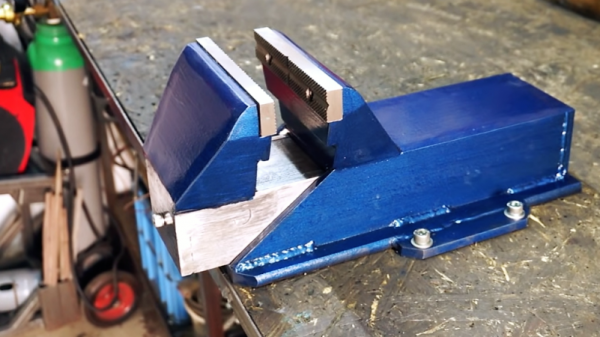
That’s the path [Darek] plotted when his somewhat abused vise reached end-of-life with an apparently catastrophic casting failure. His replacement is completely fabricated from steel bar and channel stock, much of it cut on his nifty plasma cutter track. The vice has a fixed base and rear jaw, with a moving front jaw. Hiding inside is a 5-ton single-acting hydraulic cylinder. A single acting cylinder won’t open the vise on its own, so [Darek] came up with a clever return mechanism: a pair of gas springs from a car trunk.

With a pair of hardened steel jaws, some modifications to the power cylinder to allow foot operation, and a spiffy paint job, the vise was ready for service. Check out the build in the video below; we’re impressed with the power the vise has, and hands-free operation is an unexpected bonus.

Yes, most people buy vises, but from the small to the large, it’s nice to see them built from scratch too.

Continue reading “Homemade Shop Vise Packs A Hydraulic Punch”

Sidney Darlington

In a field where components and systems are often known by sterile strings of characters that manufacturers assign or by cutesy names that are clearly products of the marketing department and their focus groups, having your name attached to an innovation is rare. Rarer still is the case where the mere mention of an otherwise obscure inventor’s name brings up a complete schematic in the listener’s mind.

Given how rarely such an honor is bestowed, we’d be forgiven to think that Sidney Darlington’s only contribution to electronics is the paired transistor he invented in the 1950s that bears his name to this day. His long career yielded so much more, from network synthesis theory to rocket guidance systems that would eventually take us to the Moon. The irony is that the Darlington pair that made his name known to generations of engineers and hobbyists was almost an afterthought, developed after a weekend of tinkering.

Continue reading “Sidney Darlington”

Wave-Powered Glider Delivers Your Message In A Bottle

Setting a bottle adrift with a message in it is, by most measures, an act of desperation. The sea regularly swats mighty ships to their doom, so what chance would a tiny glass bottle have bobbing along the surface, subject as it is to wind, waves, and current? Little to none, it would seem, unless you skew the odds a bit with a wave-powered undersea glider to the help the bottle along.

Before anyone gets too worked up about this, [Rulof Maker]’s “Sea Glider” is about a low-tech as a device with moving parts can be. This craft, built from a scrap of teak and a busted wooden ruler, is something that could be assembled in a few hours from whatever you have on hand, even if you’re marooned on an uncharted desert isle. The body of the craft sprouts a set of horizontal planes that can swivel up and down independently. The key to providing a modicum of thrust is that each plane is limited to a 90° swing by stop blocks above and below the pivot. The weighted glider, tethered to the bottle, bobs up and down below the waves, flapping the planes and providing a tiny bit of thrust.

Was it enough to propel the bottle any great distance? We won’t ruin the surprise, but we will say that [Rulof]’s essentially zero-cost build appears to have improved the message in a bottle bandwidth at least somewhat. It’s not a Hackaday Prize-winning robotic sea glider, but it’s a neat hack nonetheless.

Continue reading “Wave-Powered Glider Delivers Your Message In A Bottle”

The BNC Connector And How It Got That Way

When I started working in a video production house in the early 1980s, it quickly became apparent that there was a lot of snobbery in terms of equipment. These were the days when the home video market was taking off; the Format War had been fought and won by VHS, and consumer-grade VCRs were flying off the shelves and into living rooms. Most of that gear was cheap stuff, built to a price point and destined to fail sooner rather than later, like most consumer gear. In our shop, surrounded by our Ikegami cameras and Sony 3/4″ tape decks, we derided this equipment as “ReggieVision” gear. We were young.

For me, one thing that set pro gear apart from the consumer stuff was the type of connectors it had on the back panel. If a VCR had only the bog-standard F-connectors like those found on cable TV boxes along with RCA jacks for video in and out, I knew it was junk. To impress me, it had to have BNC connectors; that was the hallmark of pro-grade gear.

I may have been snooty, but I wasn’t really wrong. A look at coaxial connectors in general and the design decisions that went into the now-familiar BNC connector offers some insight into why my snobbery was at least partially justified.

Continue reading “The BNC Connector And How It Got That Way”

Playing Doom On Keysight Oscilloscope Via Windows CE

We all know the drill when buying a digital oscilloscope: buy the most hackable model. Some choose to void the warranty right away and access features for which the manufacturer has kindly provided all the hardware and software but has disabled through licensing. Few of us choose to tap into the underlying embedded OS, though, which seems a shame.

When [Jason Gin]’s scope started giving him hints about its true nature, he decided to find a way in. The result? An oscilloscope with a Windows desktop that plays Doom. The instrument is a Keysight DSOX1102G which [Jason] won during the company’s “Scope Month” giveaway. Relatively rare system crashes showed the familiar UI trappings of Windows CE.

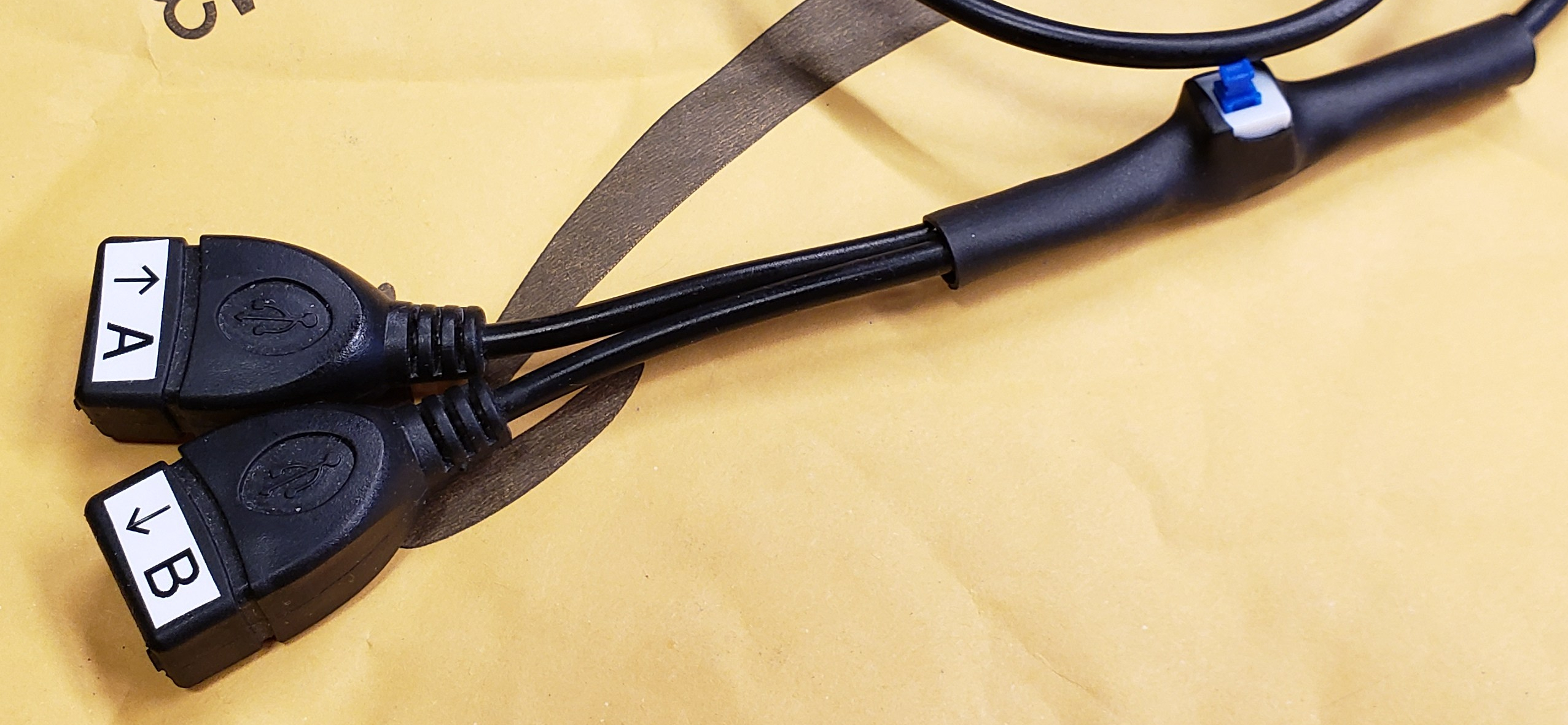
Try as he might, [Jason] couldn’t get the scope to crash on cue — at least not until he tried leaving an external floppy drive plugged into the USB port on startup. But in order to use the desktop thus revealed, a keyboard and mouse were needed too. So he whipped up a custom USB switch cable, to rapidly toggle in the keyboard and mouse after the crash. This gave him the keys to the kingdom, but he still had a long way to go. We won’t spoil the story, but suffice it to say that it took [Jason] a year and a half, and he learned a lot along the way.

It was nice to hear that our review of the 1000X series scopes helped [Jason] accomplish this exploit. This hack’s great for bragging rights, as one way to prove you’ve owned a system is telling people it runs Doom!

Mechatronic Hand Mimics Human Anatomy To Achieve Dexterity

Behold the wondrous complexity of the human hand. Twenty-seven bones working in concert with muscles, tendons, and ligaments extending up the forearm to produce a range of motions that gave us everything from stone tools to symphonies. Our hands are what we use to interface with the physical world on a fine level, and it’s understandable that we’d want mechanical versions of ourselves to include hands that were similarly dexterous.

That’s a tall order to fill, but this biomimetic mechatronic hand is a pretty impressive step in that direction. It’s [Will Cogley]’s third-year university design project, which he summarizes in the first video below. There are two parts to this project; the mechanical hand itself and the motion-capture glove to control it, both of which we find equally fascinating. The control glove is covered with 3D-printed sensors for each joint in the hand. He uses SMD potentiometers to measure joint angles, with some difficulty due to breakage of the solder joints; perhaps he could solve that with finer wires and better strain relief.

The hand that the glove controls is a marvel of design, like something on the end of a Hollywood android’s arm. Each finger joint is operated by a servo in the forearm pulling on cables; the joints are returned to the neutral position by springs. The hand is capable of multiple grip styles and responds fairly well to the control glove inputs, although there is some jitter in the sensors for some joints.

The second video below gives a much more detailed overview of the project and shows how [Will]’s design has evolved and where it’s going. Anthropomorphic hands are far from rare projects hereabouts, but we’d say this one has a lot going for it.

Continue reading “Mechatronic Hand Mimics Human Anatomy To Achieve Dexterity”

DIY Arc Light Makes An Unnecessarily Powerful Bicycle Headlight

Remember when tricking out a bike with a headlight meant clamping a big, chrome, bullet-shaped light to your handlebar and bolting a small generator to your front fork? Turning on the headlight meant flipping the generator into contact with the front wheel, powering the incandescent bulb for the few feet it took for the drag thus introduced to grind you to a halt. This ridiculous arc-lamp bicycle headlight is not that. Not by a long shot.

We’re used to seeing [Alex] doing all manner of improbable, and sometimes impossible, things on his popular KREOSAN YouTube channel. And we’re also used to watching his videos in Russian, which detracts not a whit  from the entertainment value for Andglophones; subtitles are provided for the unadventurous, however. The electrodes for his arc light are graphite brushes from an electric streetcar, while the battery is an incredibly sketchy-looking collection of 98 18650 lithium-ion cells. A scary rat’s nest of coiled cable acts as a ballast to mitigate the effects of shorting when the arc is struck. The reflector is an old satellite TV dish covered in foil tape with the electrodes sitting in a makeshift holder where the feedhorn used to be. It’s bright, it’s noisy, it’s dangerous, and it smokes like a fiend, but we love it.

Mounting it to the front of the bike was just for fun, of course, and it works despite the janky nature of the construction. The neighbors into whose apartments the light was projected could not be reached for comment, but we assume they were as amused as we were.

Continue reading “DIY Arc Light Makes An Unnecessarily Powerful Bicycle Headlight”