Hoverboard Reborn For Electric Rollerblading

Rollerblading is fun, but who needs all that pesky exercise? Wouldn’t strapping on the blades be so much more tempting if you had an electric pusher motor to propel you along your way?
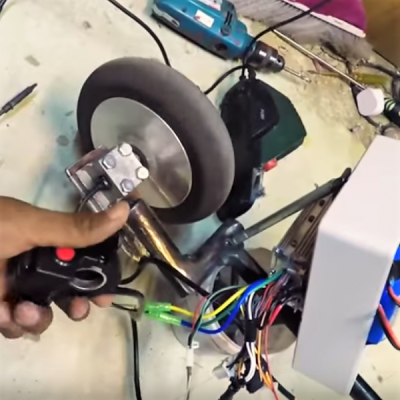
We have to admit that we raised a wary eyebrow as we first watched [MakerMan]’s video below. We thought it was going to be just another hoverboard hack at first, but as we watched, there were some pretty impressive fabrication skills on display. Yes, the project does start with tearing into a defunct hoverboard for parts, primarily one wheel motor and the battery pack. But after that, [MakerMan] took off on a metalworking tear. Parts of the hoverboard chassis were attached to a frame built from solid bar stock — we’ll admit never having seen curves fabricated in quite that way before. The dead 18650 in the battery pack was identified and replaced, and a controller from an e-bike was wired up. Fitted with a thumb throttle and with a bit of padding on the crossbar, it’s almost a ride-upon but not quite. It seems to move along at quite a clip, even making allowances for the time-compression on the video.

We’ve seen lots of transportation hacks before, from collapsible longboards to steam-powered bicycles, but this one is pretty unique.

Continue reading “Hoverboard Reborn For Electric Rollerblading”
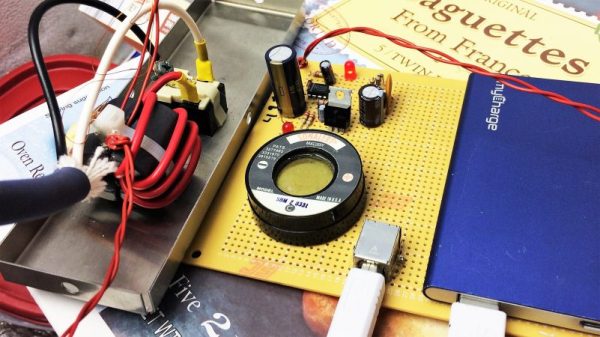
Junkbox Freezer Alarm Keeps Steaks Safe

A fully stocked freezer can be a blessing, but it’s also a disaster waiting to happen. Depending on your tastes, there could be hundreds of dollars worth of food in there, and the only thing between it and the landfill is an uninterrupted supply of electricity. Keep the freezer in an out-of-the-way spot and your food is at even greater risk.

Mitigating that risk is the job of this junkbox power failure alarm. [Derek]’s freezer is in the garage, where GFCI outlets are mandated by code. We’ve covered circuit protection before, including GFCIs, and while they can save a life, they can also trip accidentally and cost you your steaks. [Derek] whipped up a simple alarm based on current flow to the freezer. A home-brew current transformer made from a split ferrite core and some magnet wire is the sensor, and a couple of op-amps and a 555 timer make up the detection and alarm part. And it’s all junk bin stuff — get a load of that Mallory Sonalert from 1983!

Granted, loss of power on a branch circuit is probably one of the less likely failure modes for a freezer, but the principles are generally applicable and worth knowing. And hats off to [Derek] for eschewing the microcontroller and rolling this old school. Not that there’s anything wrong with IoT fridge and freezer alarms.

Continue reading “Junkbox Freezer Alarm Keeps Steaks Safe”

Automate Wire Prep With A Robot Wire Cutter

When you move from one-off builds to production scale, perhaps to meet that Kickstarter commitment or to keep your Tindie store stocked, you’re going to need to tool up. Jobs like building wiring harnesses can be tedious and time-consuming, so outsourcing them to this robot wire cutter might be a good idea.

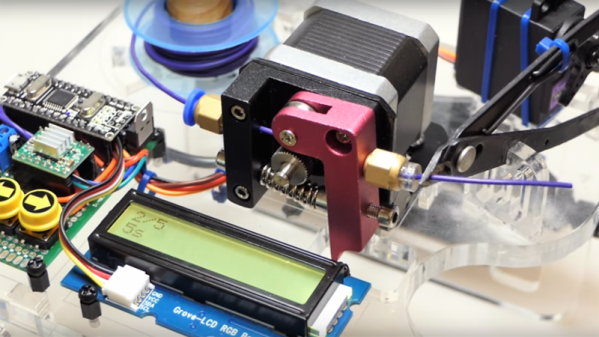
The video below tells the whole tale of this build, which despite the fact that [Maclsk] seems to have put it together quickly from scrap bin parts still looks pretty professional. The business end of the machine is a 3D printer extruder, minus the hot end, of course. A Nano controls the extruder’s stepper to shoot out the right length of wire, as well as the servo that squeezes the snippers. An LCD display and some pushbuttons provide the UI that rounds out the build. Tell it how long and how many, and you’ll be ready to build. We can see how this might be upgraded to strip the wires as well, although getting both ends stripped might be tricky.

Might this component tape-cutting robot from a few weeks back have inspired [Maclsk]’s build? Perhaps, but in any case, both are fun to watch.

Continue reading “Automate Wire Prep With A Robot Wire Cutter”

Instrument Packed Pedal Keeps Track Of Cyclist’s Power

Exactly how much work is required to pedal a bike? There are plenty of ways to measure the power generated by a cyclist, but a lot of them such as heavily instrumented bottom brackets and crank arms, can be far too expensive for casual use. But for $30 in parts you can build this power-measuring bike pedal. and find out just how hard you’re stoking.

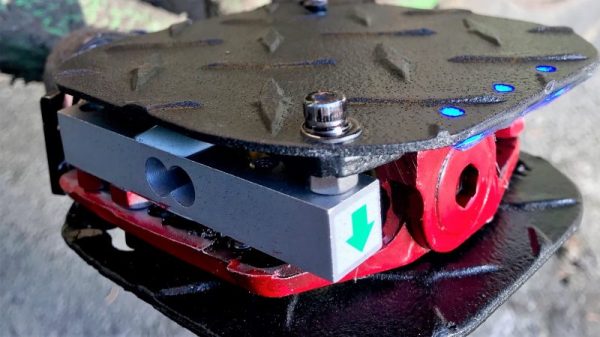
Of course it’s not just the parts but knowing what to do with them, and [rabbitcreek] has put a lot of thought and engineering into this power pedal. The main business of measuring the force applied to the crank falls to a pair of micro load cells connected in parallel. A Wemos, an HX711 load-cell amp, a small LiPo pack and charging module, a Qi wireless charger, a Hall sensor, a ruggedized power switch, and some Neopixels round out the BOM. Everything is carefully stuffed into very little space in a modified mountain bike pedal and potted in epoxy for all-weather use. The Hall sensor keeps tracks of the RPMs while the strain gauges measure the force applied to the pedal, and the numbers from a ride can be downloaded later.

We recall a similar effort using a crank studded with strain gauges. But this one is impressive because everything fits in a tidy package. And the diamond plate is a nice touch.

Listen To The Netherworld With Artificial Intelligence

It’s that time of year again, and with Halloween arguably being the hacker’s perfect holiday, we’re starting to see a tick up in projects with a spooky theme. Most seem to do with making some otherwise tame Halloween decorations scarily awesome, but this is different — using artificial intelligence to search for ghosts.

It seems like [Matt Reed]’s “DeepWhisper” project is meant to be taken as light-hearted fun for the spooky season, but there may be a touch of seriousness to his efforts to listen in on ghostly conversations. The principle behind this is electronic voice phenomena (EVP), whereby the metabolically and/or dimensionally challenged are purported to influence electronic systems, resulting in heavily processed audio clips that seem to have a whispered endearment from the departed or a threat from a malevolent spirit. DeepWhisper takes this a step further by using a Raspberry Pi to feed audio into the Google Cloud Speech API for analysis. If anything is whispered in one of the 110 or so languages Google knows, it’ll get displayed on a screen. [Matt] plans to set DeepWhisper up in the aptly-named Butchertown section of Nashville and live-stream the results next week.

It’ll be interesting to see what Google’s neural network makes out of the random noise it will probably only ever hear. And [Matt] is planning on releasing his code for all to see, so there may be some valuable cloud techniques to learn from DeepWhisper. But in the unlikely event that he does discover ghosts, it’s nice to know you can have the tools and the talent to bust ’em.

Continue reading “Listen To The Netherworld With Artificial Intelligence”

Heavily Hacked Printer For DIY PCBs

Sometimes we get tips that only leave us guessing as to how — and sometimes why — a project was built. Such is the case with this PCB printer; in this case, the build specifics are the only thing in question, because it puts out some pretty impressive PCBs.

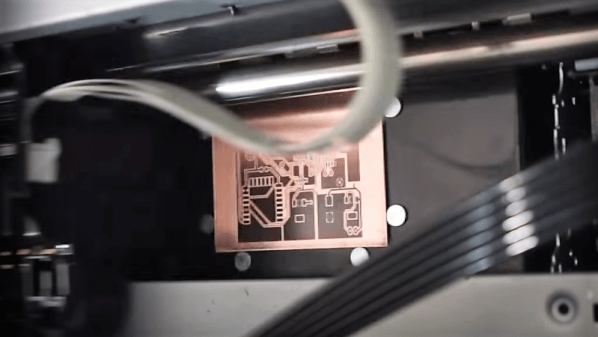
All we have to go on is the video after the break, which despite an exhaustive minutes-long search appears to be the only documentation [Androkavo] did for this build. The captions tell us that the printer is built around the guts from an Epson Stylus Photo 1390 printer. There’s no evidence of that from the outside, as every bit of the printer has been built into a custom enclosure. The paper handling gear has been replaced by an A3-sized heated flatbed, adjustable in the Z-axis to accommodate varying board thicknesses. The bed runs on linear rails that appear custom-made. Under the hood, the ink cartridges have been replaced with outboard ink bottles in any color you want as long as it’s black. The video shows some test prints down to 0.1 mm traces with 0.1 mm pitch — those were a little dodgy, but at a 0.2 mm pitch, the finest traces came out great. The boards were etched in the usual way with great results; we wonder if the printer could be modified to print resist and silkscreens too.

[Androkavo] seems to have quite a few interesting projects in his YouTube channel, one of which — this wooden digital clock — we featured recently. We’d love to learn more about this printer build, though. Hopefully [Androkavo] will see this and comment below.

Continue reading “Heavily Hacked Printer For DIY PCBs”

Rosalind Franklin Saw DNA First

It’s a standard science trivia question: Who discovered the structure of DNA? With the basic concepts of molecular biology now taught at a fairly detailed level in grade school, and with DNA being so easy to isolate that it makes a good demonstration project for school or home, everyone knows the names of Watson and Crick. But not many people know the story behind one of the greatest scientific achievements of the 20th century, or the name of the scientist without whose data Watson and Crick were working blind: Rosalind Franklin.

Continue reading “Rosalind Franklin Saw DNA First”