Additive + Subtractive = One Powerful Machine

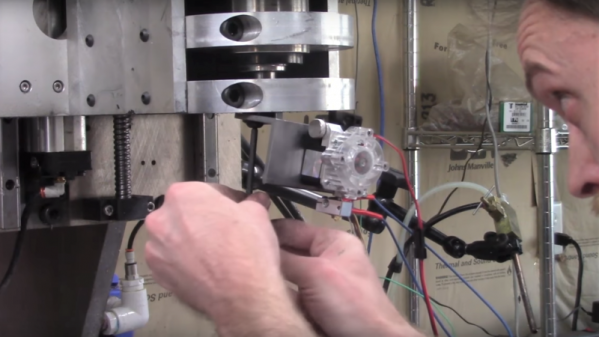
It says it right on the title of the video below: it was bound to happen eventually. It’s only natural that somebody would stick a 3D printer extruder on the business end of a CNC machine. The long-awaited convergence of additive and subtractive manufacturing is here.

OK, that may be overstating things a bit, but we think [Chris DePrisco] is on to something here. Given the considerable investment he’s made in his DIY CNC machine, an enormous vertical machining center that looks a little like a homebrew Bridgeport, it was a no-brainer to take advantage of the huge XYZ stage. Mounting the Titan Aero extruder to the quill required some custom parts; fair warning that the video below is heavy on machining, but it’s not the seven hours of video he streamed when he milled the heated aluminum bed. Skip ahead to about the six-minute mark if you want to see the first prints and how he optimized the setup.

As we watched [Chris]’ video, we were struck by the potential for adding 3D printing to CNC milling machines. What we’d like to see is a setup where the spindle and the extruder work together to build more complex parts. Or maybe a tool-changing CNC that can pick up a spindle, an extruder, and maybe even a laser or plasma cutter head. Now that would be a powerful machine!

Continue reading “Additive + Subtractive = One Powerful Machine”

Head-Up Display Augments Bionic Turtle’s Reality

There’s a harsh truth underlying all robotic research: compared to evolution, we suck at making things move. Nature has a couple billion years of practice making things that can slide, hop, fly, swim and run, so why not leverage those platforms? That’s the idea behind this turtle with a navigation robot strapped to its back.

This reminds us somewhat of an alternative universe sci-fi story by S.M. Stirling called The Sky People.  In the story, Venus is teeming with dinosaurs that Terran colonists use as beasts of burden with brain implants that stimulate pleasure centers to control them. While the team led by [Phill Seung-Lee] at the Korean Advanced Institute of Science and Technology isn’t likely to get as much work from the red-eared slider turtle as the colonists in the story got from their bionic dinosaurs, there’s still plenty to learn from a setup like this. Using what amounts to a head-up display for the turtle in the form of a strip of LEDs, along with a food dispenser for positive reinforcement, the bionic terrapin is trained to associate food with the flashing LEDs. The LEDs are then used as cues as the turtle navigates between waypoints in a tank. Sadly, the full article is behind a paywall, but the video below gives you a taste of the gripping action.

Looking for something between amphibian and fictional dinosaurs to play mind games with? Why not make your best friend bionic? Continue reading “Head-Up Display Augments Bionic Turtle’s Reality”

What Lies Within: SMT Inductor Teardown

Ever wonder what’s inside a surface-mount inductor? Wonder no more as you watch this SMT inductor teardown video.

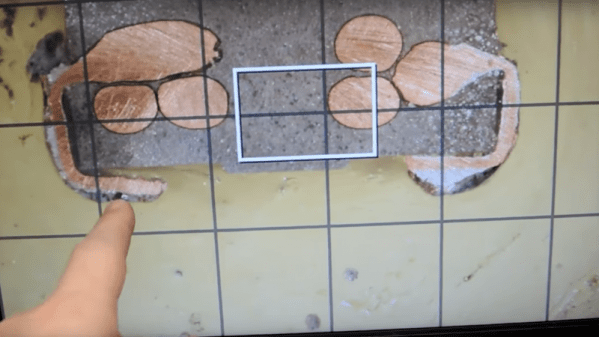
“Teardown” isn’t really accurate here, at least by the standard of [electronupdate]’s other component teardowns, like his looks inside LED light bulbs and das blinkenlights. “Rubdown” is more like it here, because what starts out as a rather solid looking SMT component needs to be ground down bit by bit to reveal the inner ferrite and copper goodness. [electronupdate] embedded the R30 SMT inductor in epoxy and hand lapped the whole thing until the windings were visible. Of course, just peeking inside is never enough, so he set upon an analysis of the inductor’s innards. Using a little careful macro photography and some simple image analysis, he verified the component’s data sheet claims; as an aside, is anyone else surprised that a tiny SMT component can handle 30 amps?

Looking for more practical applications for decapping components? How about iPhone brain surgery?

Continue reading “What Lies Within: SMT Inductor Teardown”

On Point: The Yagi Antenna

If you happened to look up during a drive down a suburban street in the US anytime during the 60s or 70s, you’ll no doubt have noticed a forest of TV antennas. When over-the-air TV was the only option, people went to great lengths to haul in signals, with antennas of sometimes massive proportions flying over rooftops.

Outdoor antennas all but disappeared over the last third of the 20th century as cable providers became dominant, cast to the curb as unsightly relics of a sad and bygone era of limited choices and poor reception. But now cheapskates cable-cutters like yours truly are starting to regrow that once-thick forest, this time lofting antennas to receive digital programming over the air. Many of the new antennas make outrageous claims about performance or tout that they’re designed specifically for HDTV. It’s all marketing nonsense, of course, because then as now, almost every TV antenna is just some form of the classic Yagi design. The physics of this antenna are fascinating, as is the story of how the antenna was invented.

Continue reading “On Point: The Yagi Antenna”

Tightwad Hacks Label Printer, Beats Manufacturer At Own Game

Sometimes we hack for the thrill of making something new, and sometimes we hack to push back the dark veil of ignorance to shed fresh light on a problem. And sometimes, like when turning a used label printer into a point-of-sale receipt printer, we hack because we’re cheapskates.

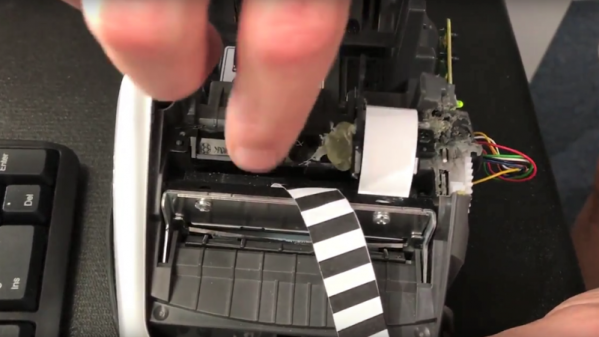
We say that with the utmost respect and affection — there’s nothing to be ashamed of when your motive is strictly pecuniary. In [Dan Herlihy]’s case, hacking a cheap Brother label printer to use thermal paper meant saving $300 on a dedicated receipt printer. But it also meant beating Brother at their “Razor and Blades” business model that keeps you buying their expensive proprietary labels. A pattern of holes in the plastic label roll tells the printer what size labels are loaded, so [Dan] defeated that by breaking off a piece of the plastic and gluing it on the sensor. To convince the printer that plain thermal paper is label stock, he printed up a small strip of paper with the same pattern of black registration stripes that appear on the back of the labels. Pretty clever stuff, and it lets him print high-resolution receipts for his electronics shop on the seriously cheap.

[Dan]’s hack is simple, but may suffer from wear on the paper encoder strip. Perhaps this Brother hack using the gears as encoders will provide some inspiration for long-term fix.

Continue reading “Tightwad Hacks Label Printer, Beats Manufacturer At Own Game”

Custom Workstation Makes Plasma Cutting A Breeze

A plasma cutter is probably top of every metalworker’s short list of dream tools. From freehand curves to long straight cuts, nothing beats a plasma cutter for getting the creative juices flowing. Unfortunately, there’s also the jet of superheated metal blasting through the workpiece to deal with, which is the reason behind this shop-built plasma cutting workstation.

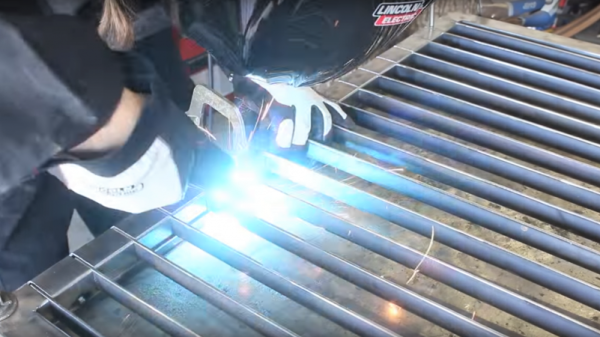
[Regalzack] looks like he had a couple of design goals in mind for his table. A solid work surface isn’t a great idea for plasma cutting, so he designed the top as a grid of replaceable steel slats. Underneath is a hopper to collect the slag, both for neatness and for fire safety. The table top and hopper live on a custom-built wheeled steel frame, and the lower shelf provides plenty of room for his Lincoln 375 plasma rig. With hooks for cables and a sturdy ground clamp tab, the whole thing is a nicely self-contained workstation. The video below shows the build and some of the fabrication techniques [Regalzack] used; we were especially taken by the clever way he cut the slots for the table slats.

Plasma is versatile stuff – you can use it to make music, cook a burger, or decorate wood. And it’s not too shabby for notching metal tubing either.

Continue reading “Custom Workstation Makes Plasma Cutting A Breeze”

Blacksmith’s Junkyard Power Hammer Packs A Punch

Any way you look at it, blacksmithing is a punishing trade. Heavy tools, a red-hot forge, flying sparks, and searing metal all exact a toll on the smith’s body unless precautions are taken. After proper safety equipment and good training, a blacksmith may want to invest is power hammer to replace at least some of the heavy hammer work needed to shape hot metal.

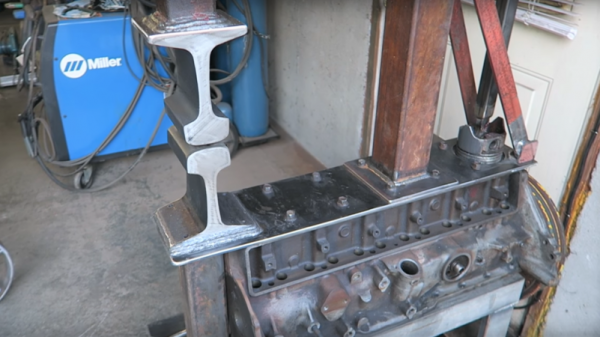
Power hammers aren’t cheap, though, which is why [70kirkster] built one from an old engine block. You’ve got to admire the junkyard feel of this thing; it’s almost nothing but scrap. The engine block is a straight-6 from an old Ford pickup stripped of everything but the crankshaft and one piston. An electric motor spins the crankshaft and moves the hammer against the anvil through connecting rods and a trip arm fashioned from a trailer leaf spring. Everything looks super solid and the hammer hits hard; the videos below tell the tale of the build and show the hammer in action. Not bad for $100 out-of-pocket.

Blacksmithing is one of those dark arts that really deserves to have more adherents. The barriers to entry can be high, but the rewards are great. Looking to get started on the cheap? Then check out [Bil Herd]’s guide to hacking together a backyard smithy.

Continue reading “Blacksmith’s Junkyard Power Hammer Packs A Punch”