DIY Ram Pump Obeys The Laws Of Physics

Despite the claims of “free energy” on the title of the video below, this is not yet another wacky perpetual motion story. We here at Hackaday fully support the laws of thermodynamics, and we think you should too. But you have to admit that a pump that works without any apparent energy inputs looks kind of shady at first glance.

The apparatus in question is a ram pump, a technology dating back all the way to the 18th century. The version that [Junkyard – Origin of Creativity] built uses commonly available materials like PVC pipes and fittings. About the only things on the BOM that might be hard to scratch up are the brass check valves, which should probably be flap valves rather than the easier to find spring valves. And the only custom part is an adapter to thread the plastic soda bottle that’s used as an air chamber to the PVC, which a 3D printer could take care of if you choose not to hack a bottle cap like [Junkyard] did. The video below shows the impressive lift achieved just by tapping the kinetic energy of the incoming flow.

There, the Second Law of Thermodynamics remains inviolate. But if you still think you can get something for nothing, check out our roundup of perpetual motion and Overunity quackery.

Continue reading “DIY Ram Pump Obeys The Laws Of Physics”

The Other Kind Of Phone Hacking

While it’s true that your parts bin might have a few parts harvested from outdated devices of recent vintage, there’s not much to glean anymore aside from wall warts. But the 3×48-character LCD from [Kerry Wong]’s old Uniden cordless landline phone was tempting enough for him to attempt a teardown and reverse engineering, and the results were instructive.

No data sheet? No problem. [Kerry] couldn’t find anything out about the nicely backlit display, so onto the logic analyzer it went. With only eight leads from the main board to the display module, it wasn’t likely to be a parallel protocol, and the video below shows that to be the case. A little fiddling with the parameters showed the protocol was Serial Peripheral Interface, but as with other standards that aren’t exactly standardized, [Kerry] was left with enough ambiguity to make the analysis interesting. Despite a mysterious header of 39 characters, he was able in the end to drive the LCD with an Arduino, and given that these phones were usually sold as a bundle with a base and several handsets, he ought to have a nice collection of displays for the parts bin.

With how prevalent this protocol has gotten, [Kerry]’s post makes us want to get up to speed on the basics of SPI. And to buy a logic analyzer too.

Continue reading “The Other Kind Of Phone Hacking”

Automate The Freight: Maritime Drone Deliveries

Ships at sea are literally islands unto themselves. If what you need isn’t on board, good luck getting it in the middle of the Pacific. As such, most ships are really well equipped with spare parts and even with raw materials and the tools needed to fabricate most of what they can’t store, and mariners are famed for their ability to make do with what they’ve got.

But as self-sufficient as a ship at sea might be, the unexpected can always happen. A vital system could fail for lack of a simple spare part, at best resulting in a delay for the shipping company and at worst putting the crew in mortal danger. Another vessel can be dispatched to assist, or if the ship is close enough ashore a helicopter rendezvous might be arranged. Expensive options both, which is why some shipping companies are experimenting with drone deliveries to and from ships at sea. Continue reading “Automate The Freight: Maritime Drone Deliveries”

Hand-Wound Brushless Motors Revive Grounded Quad

You’re happily FPVing through the wild blue yonder, dodging and jinking through the obstacles of your favorite quadcopter racing course. You get a shade too close to a branch and suddenly the picture in your goggles gets the shakes and your bird hits the dirt. Then you smell the smoke and you know what happened – a broken blade put a motor off-balance and burned out a winding in the stator.

What to do? A sensible pilot might send the quad to the healing bench for a motor replacement. But [BRADtheRipper] prefers to take the opportunity to rewind his burned-out brushless motors by hand, despite the fact that new ones costs all of five bucks. There’s some madness to his method, which he demonstrates in the video below, but there’s also some justification for the effort. [Brad]’s coil transplant recipient, a 2205 racing motor, was originally wound with doubled 28AWG magnet wire of unknown provenance. He chose to rewind it with high-quality 25AWG enameled wire, giving almost the same ampacity in a single, easier to handle and less fragile conductor. Plus, by varying the number of turns on each pole of the stator, he’s able to alter the motor’s performance.

In all, there are a bunch of nice tricks in here to file away for a rainy day. If you need to get up to speed on BLDC motor basics, check out this primer. Or you may just want to start 3D printing your own BLDC motors.

Continue reading “Hand-Wound Brushless Motors Revive Grounded Quad”

Soft-legged Robot Handles Rough Terrain With Ease

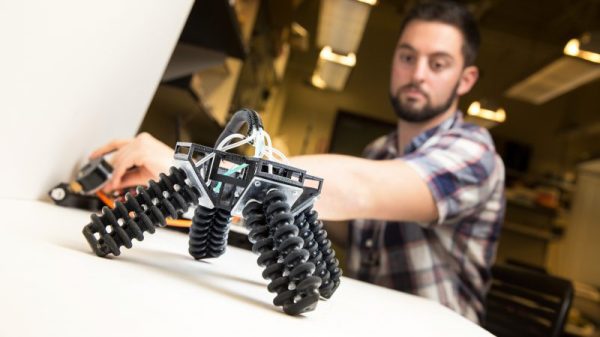
Whether it’s wheels, tracks, feet, or even a roly-poly body like BB-8, most robots have to deal with an essential problem: dirt and grit can get into the moving bits and cause problems. Some researchers from UCSD have come up with a clever way around this: pneumatically actuated soft-legged robots that adapt to rough terrain.

At a top speed of 20 mm per second, [Michael Tolley]’s squishy little robot won’t set any land speed records. But for applications like search and rescue or placing sensors in inhospitable or inaccessible locations, slow and steady might just win the race. The quadrupedal robot’s running gear can be completely 3D-printed on any commercial printer capable of using a soft filament. The legs each contain three parallel air chambers within a bellowed outer skin; alternating how the chambers are inflated controls how they move. The soft legs adapt to unstructured terrain and are completely sealed, eliminating intrusion problems. The video below shows how the bot gets around just fine over rocks and sand.

The legs remind us a little of our [Joshua Vazquez]’s tentacle mechanism, but with fewer parts. Right now, the soft robot is tethered to its air supply, but the team is working on a miniaturized pump to make the whole thing mobile. At which point we bet it’ll even be able to swim.

Continue reading “Soft-legged Robot Handles Rough Terrain With Ease”

Arduino And Encoder Form Precision Jig For Cutting And Drilling

“Measure twice, cut once” is great advice in every aspect of fabrication, but perhaps nowhere is it more important than when building a CNC machine. When precision is the name of the game, you need measuring tools that will give you repeatable results and preferably won’t cost a fortune. That’s the idea behind this Arduino-based measuring jig for fabricating parts for a CNC build.

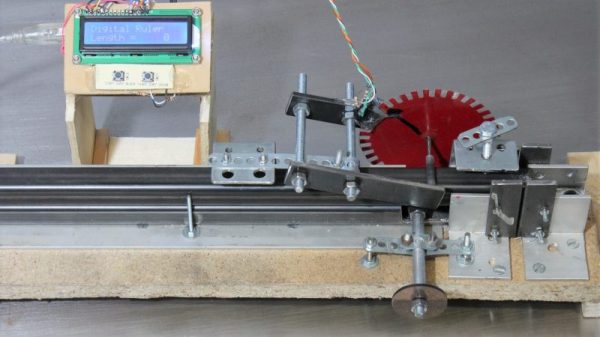
When it comes to building on the cheap, nobody holds a candle to [HomoFaciens]. We’ve seen his garbage can CNC build and encoders from e-waste and tin cans, all of which gave surprisingly good results despite incorporating such compliant materials as particle board and scraps of plumber’s strapping. Looking to build a more robust machine, he finds himself in need of parts of consistent and accurate lengths, so he built this jig. A sled of particle board and a fence of angle aluminum position the square tube stock, and a roller with a paper encoder wheel bears on the tube under spring pressure. By counting pulses from the optical sensors, he’s able to precisely position the tube in the jig for cutting and drilling operations. See it in action in the video after the break.

If you’ve been following [HomoFaciens], you’ll no doubt see where he’s been going — build a low-end tool, use that to build a better one, and so on. We’re excited to see him moving into more robust materials, but we’ll miss the cardboard and paperclip builds.

Continue reading “Arduino And Encoder Form Precision Jig For Cutting And Drilling”

And The Grandfather Of The Year Award Goes To…

Hacker dads often have great plans for all the fun projects they’ll build for their kids. Reality often intrudes, though, creating opportunities for hacker grandfathers who might have more time and resources to tackle the truly epic kid hacks. Take, for instance, [rwreagan] and the quarter-scale model railroad he built for his granddaughter.

Taking inspiration from a 1965 issue of Popular Mechanics, grandpa hit this one out of the park. Attention to detail and craftsmanship are evident from the cowcatcher to the rear coupler of this 4-2-0 steam engine replica, and everywhere along the 275 feet of wooden track — that’s almost a quarter-mile at scale. The locomotive runs on composite wood and metal flanged wheels powered by pair of 350-watt motors and some 12-volt batteries; alas, no steam. The loco winds around [rwreagan]’s yard through a right-of-way cut into the woods and into a custom-built engine house that’ll make a great playhouse. And there are even Arduino-controlled crossbucks at the grade crossing he uses for his tractor on lawn mowing days.

The only question here is: will his granddaughter have as much fun using it as he had building it? We’ll guess yes because it looks like a blast all around. Other awesome dad builds we’ve covered include this backyard roller coaster and a rocketship treehouse.

Continue reading “And The Grandfather Of The Year Award Goes To…”