Watch VCF Southwest In Retrotastic SGI-Edited Footage

There’s just something about backing way, way off the cutting edge to rediscover the simpler joys of yesteryear. We’ve got a contest about to wrap up along those lines, and there are festivals celebrating all things retro in the world of computers and electronics the world over. Vintage Computer Festival (VCF) Southwest happened back in the summer, but [Wave Design] just posted a gloriously retro retrospective, complete with the full 1990s video-editing workflow, completed on an SGI O2.

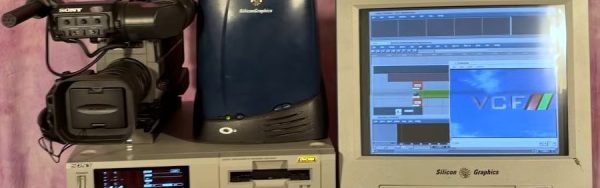
The footage was recorded on a 1990s vintage DV camera, and read using a somewhat-newer Sony tapedeck that we sadly have to admit also counts as retro in these late days. That gets piped into a vintage SGI O2 workstation that would have had us drooling back in the day, whose only concession to modernity is the inclusion of an NVMe SSD through a collection of adapters we can only call a hack. This may be burying the lede deep, but it turns out there is now an NVMe driver for IRIX 6.5. Using a modern SSD saves [Wave] from dealing with the literal stack of external drives video editing called for back in the day, so we can’t hardly blame him.

After the hardware walk-through, [Wave]’s video gets into the software, which is surprisingly modern. The footage he creates is decidedly not. It looks exactly like it was broadcast in 1996, perhaps following an episode of ReBoot — which conveniently enough, also used SGI workstations in its production, though with a decidedly rarer type of digital video tape.

Continue reading “Watch VCF Southwest In Retrotastic SGI-Edited Footage” →

Rear view of the sand rail whizzing by.

When You Can’t Pick Between Electric And Jet Power, This Buggy Has You Covered

Technically, what [Macona] built with a surplus Garrett GTP30-150(F) turbine is not a dune buggy, but a sand rail, but it does have the delightfully rare combination of electric and turbine drive that is absolutely worth wading through a 53-page forum thread to learn about.

The turbine came bare as surplus, but [Marcona] used a pair of Kia/Hyundai HSG water-cooled motor-generators to turn it back into something very much like the APU it likely started out as. That’s APU as in “Auxiliary Power Unit” in this context, the little generator that keeps the lights on when your plane is sitting on the tarmac. That went into the sort of frame you’d once have put a VW bug engine in — and the 150 HP off the shaft of the turbine beats anything you’ll get with Wolfsburg’s little boxer motor, even after losses in the generator and motors. Even better, the whole assembly, which uses the electric motor from a Mitsubishi Outlander, likely doesn’t weigh any more than the internal combustion engine and transmission, so whatever you call this little off-roader it ought to move well. It certainly seems to in the demo video embedded below.

What it doesn’t do is sip fuel, the T-62 being rated at 19.3 gallons/hr at full load. Fuel efficiency is definitely not the motivation here. He’s absolutely not saving money, especially not with what jet fuel costs these days. It’s one of those projects done purely for the joy of it — where if you have to ask why, you’re barking up the wrong tree. The vehicle isn’t yet street legal, but [Marcona] is working on it.

If you do like the idea of this kind of series hybrid drive, Edison Motors of Canada is working on bringing it both to semitrucks and heavy trucks, and that is motivated by fuel savings. Continue reading “When You Can’t Pick Between Electric And Jet Power, This Buggy Has You Covered” →

Thunderbolt Strikes Windows98

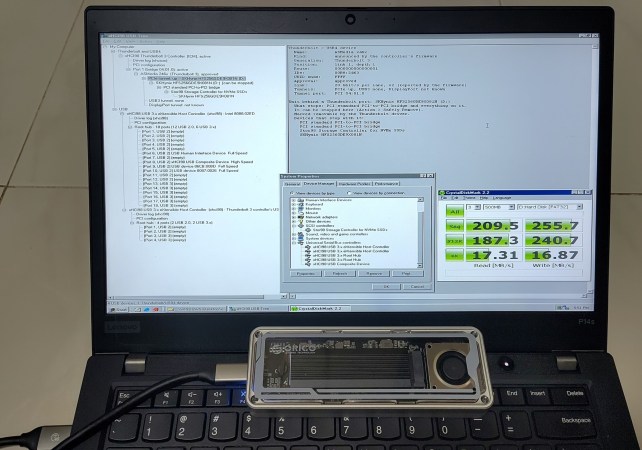
If there’s one thing everyone hated about Windows 98, was the lack of USB4.0 support. We remember vividly the cries of anguish at the launch party when we found out that 21 years in the future, the operating system wouldn’t support the then-undreamt of speeds of the thunderbolt-based fastest USB protocol. After two decades of living with this crushing disappointment, [Yeo Kheng Meng] has delivered the goods: the most modern of USB interfaces on some very much not modern versions of windows.

This builds on [Yeo Kheng Meng]’s work on xHCI drivers for USB2.0 support, which we covered at the time. Like that hack, this one applies to Windows 98 through 7, and has a similar level of LLM-wrangling involved. There are actually a few parts to it– one is a USB3.0 driver, which replaces the old xHCI98 driver and is available on GitHub. On Windows98, USB3.0 speed caps out around 200 MB/s, likely restricted by Windows98’s maximum request limit of 64kB on USB transfers. Even with the faster bus in action, it can only gobble those tiny blocks of data so fast.

There’s also experimental USB4.0/Thunderbolt support, as stated above. While not as stable as the USB3.0 portion, we’re kind of impressed it runs at all. Thunderbolt is more than just a faster data bus, after all– you have to support multiple protocols. To handle all that you can install xhcicm.sys and have the surreal experience of accessing an docked NVMe drive from the last century’s best Windows via his Stor98 driver. That’s based largely on [SweetLow]’s NVMe9x project, which he forked but is going to be bundled into the main repo.

What might be more helpful to the community than these drivers is [Yeo Kheng Meng]’s fork of QEMU11 that emulates USB4/Thunderbolt hosts and devices. Having a working emulator seems like it would be a huge boon for this sort of semi-automated development. That’s available in its own repo.

Aside from the already-linked USB2.0 drivers, [Yao Kheng Meng] has an impressive retro-computing record, that includes Swift on the Apple II and turning DOS into llama.c habitat. It should be noted that that llama.c’s TinyStories is not the LLM that assisted with this project.

Thanks to [Yeo Kheng Meng] for the tip!

C64 Hardware Simulator Isn’t (Just) For Playing Around

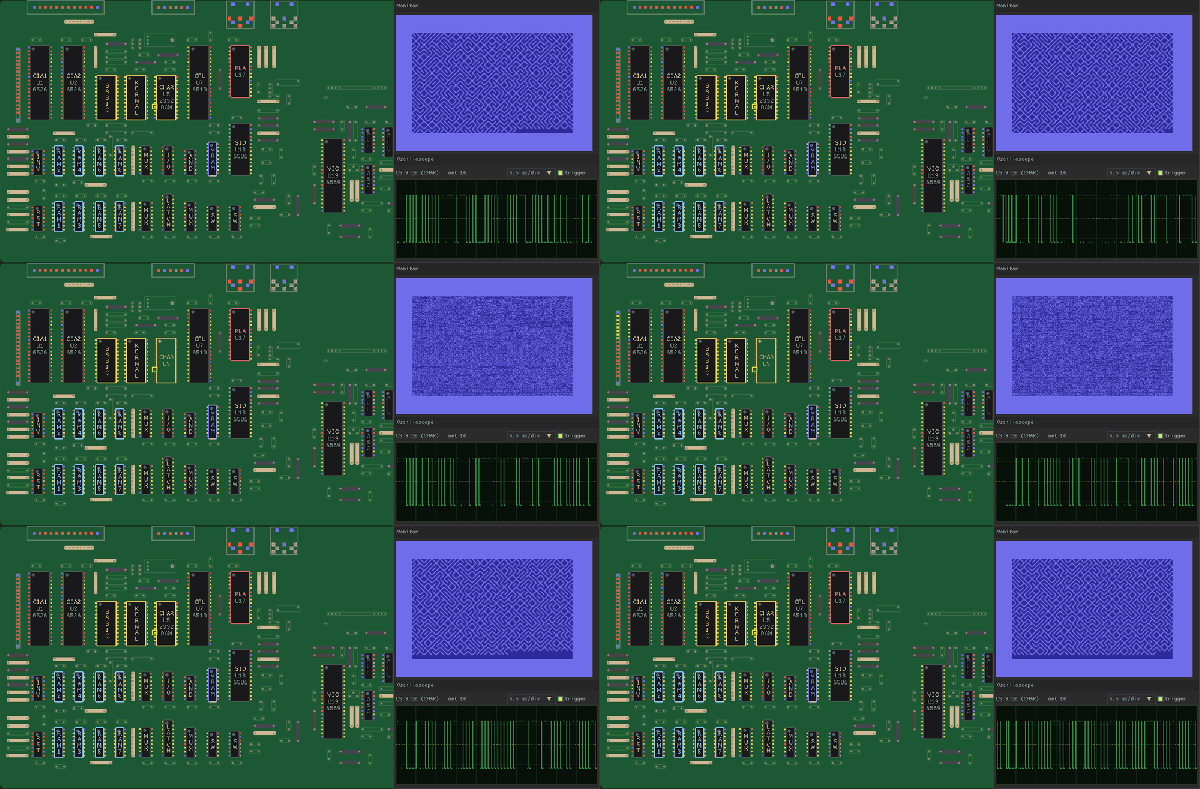
If you want to play old Commodore games, there are C-64 emulators available for just about any platform– but most of them are so high level, they’re really meant for just that: playing games. [antirez] has a different goal with his c64-hw-sim project— it’s a lower-level emulation that simulates every chip and every connection on an ASSY 250407 motherboard, and all the chips on it, too. Ever wondered what happens when a specific chip is missing, or a random pin is shorted to ground or forced high? You can do all that in software, with no risk of harming antique hardware.

While that might be a fun bit of faffing about for a certain sort electronics sadist, the real utility is to learn about the hardware, both in the abstract and to help you troubleshoot a board you might have. It’s likely that many given failure modes reproduce the same effects– lots of things can knock out the display output, for example–but at least if you’ve reproduced a flaw in software you can try testing the hardware to see if that’s the cause of your problem. Assuming the simulation covers your hardware issue, anyway.

There’s cycle-accurate chip emulation for the processor, CIAs, SID and VIC-II via code by [Andre Weissflog], a.k.a. [flooh]. Meanwhile analog circuitry in the video, audio and power sections are not simulated so not everything fault will be replicable here. Still, it might be a neat tool– just don’t try and run any games on it, because even on high-end modern hardware it only runs at about one-third speed. That’s fast enough for diagnostics, but not so much for Maniac Mansion, never mind Elite. 

Speaking of Elite, did you know the source– both of the port and the original– is available with comments? If you want an emulator you can play, you can get it on everything from microcontrollers like Teensy to your personal computer.

Thanks to [Salvatore] for the tip!

Hand-Machined Stake Sharpener Just In Time For Dracula Season

Vampires aren’t as common as they once were, but in most places they aren’t fully protected and it’s still possible to get a tag for legal hunting come October — at least if you’re using traditional weapons, like a good old wooden stake.

[This Old Tony] on YouTube didn’t have a good old wooden stake handy, but he does have a machine shop. Does he turn stakes on a lathe? Hardly. He turns an aluminum block into a giant pencil sharpener so he can use his drill to make vampire-removers out of any stick he finds.

If you thought that intro was too silly, you can skip the video. [Tony] is a funny guy, and is obviously enjoying himself in the voice over. He also obviously knows his way around a machine shop, and the 22 minute video shows every step of making a tool from a solid block of aluminum and some steel plate. It isn’t as soothing as some machinist’s videos are, though, as roughing out the 30 degree interior cone that will hold the stake against the steel blade is somewhat nerve-wracking to watch. Getting the blade mount tangent to the cone may have been trickier machining overall, but [Old Tony] nails every step. He’s now ready to dust any Nostferatu or Lasombra who darkens his door, assuming he has the strength to hammer the 3″ stakes he’s making through their undead ribs.

We’ve been enjoying [Old Tony] since we saw him build his own CNC table, only to ignore it in favour of his hard-earned skills. If you like that sort of thing, take a look — [Tony]’s cutting wit can make even videos about boring tools entertaining.

Continue reading “Hand-Machined Stake Sharpener Just In Time For Dracula Season” →

Tiny E-Paper Display Delivers 30 FPS Of Game Boy Fun

Slow refresh, ghosting and low-contrast — wait, are we talking about passive matrix LCDs, or e-paper displays? That might be why e-paper Game Boy emulators are a thing: the limitations of the black-on-grey e-paper screens remind us of the grey-on-green LCDs Nintendo used in the 80s. In this case [Bo Made It] made it out of a Waveshare ESP32-S3-ePaper-1.54, and got 30 FPS from it. 

Now, regular readers might be thinking, “So, we’ve seen the 60 FPS e-paper monitor, how is this special?” It’s a fair question. The answer is that [Bo] is doing this on a randomly chosen dev board with a built in wavetable e-paper controller, rather than the bare inputs that allowed the [Wenting Zhang]’s project to work. On the other hand, [Bo] does credit [Wenting], particularly his e-ink PaperBoy project, with directly inspiring both the project and his implementation.

Again, the big difference is going through the blob of the controller, but it turns out you can still address individual pixels through it. [Bo] gave each pixel a ‘budget’ for up to 8 pulses it depending on how much it needs to change, speeding things up immensely. Our favorite part is how he achieves the Game Boy’s 4-bit greyscale by, in effect, deliberately ghosting the display. Pixels aren’t driven long enough to fully flip them if they’re going only one shade lighter or darker. This complicated matters, since going from black to ‘white’ now takes longer than ‘white’ to the next darker grey, and the exact timing needs to be worked out for each color transition. Getting that timing right took a lot of calibration, and we like how he used video to help automate the process.

That process is still ongoing, so there’s no GitHub link yet. [Bo] will open source everything when it’s ready, and we look forward to it. We also look forward to the PDA-like device he’s going to be using this display driver for. If this all sounds similar to a recent 20 FPS e-paper hack, that’s because it’s the same underlying technology.

Continue reading “Tiny E-Paper Display Delivers 30 FPS Of Game Boy Fun” →

2026 Retrocomputing Challenge: USBSID-Pico Has Two SIDs, Many Inputs

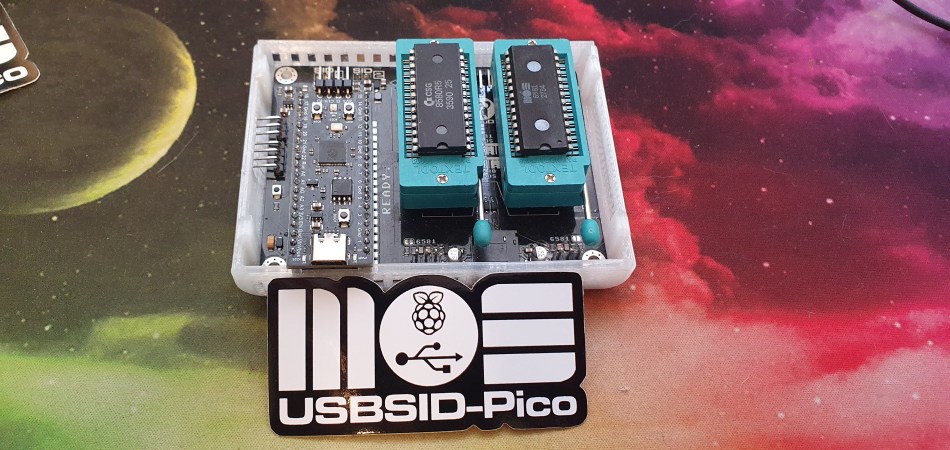
We’ll give you three guesses what the most important bits of silicon in [LouD]’s USBSID-Pico are, and two don’t count. Yes, there’s a Raspberry Pi Pico, and a pair of the unforgettable SID chips from MOS– the sound chip of the C64, the die that launched a thousand chiptunes. Well, unless you build it with a hardware SID replacement, but the goal of this device is to get SIDs hooked up to modern hardware.

To that end, USBSID-Pico can be controlled via USB– obviously– in the form of CDC/WebUSB/WebSerial but also MIDI, and even ASID, which is a specific protocol for streaming SID register data over MIDI. You might be wondering the point, since surely you can get cycle-accurate SID emulation on an RP2040, right? Well, not everyone agrees that cycle-accurate emulation is accurate enough; like the people who swear by the subtle distortions tube amplifiers introduce into the sound, some say the chip’s own inaccuracies give the sound out of the physical device a unique vibe emulators don’t match. That’s a fight for others to litigate; we just appreciate the work that went into getting these old sound chips talking to modern hardware, and getting the project certified as Open Source Hardware.

This combination of old sound and new microcontroller makes the USBSID-Pico a good entry for our ongoing retrocomputing contest, particularly the retro-modern category. Just be aware of PAL and NTSC differences with these old chips, or your beeps and boops might be out of tune. They haven’t made them in decades, but there are more than a few modern replacements for the MOS 6581.