Better 3D Printing Through Holography

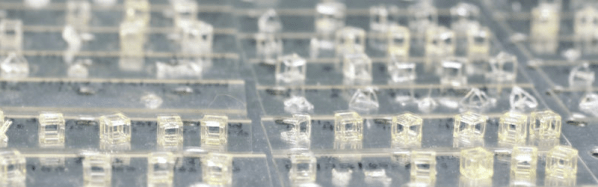
When most of us think about 3D printing, we usually think about a machine that melts plastic filament and extrudes it through a nozzle. But we all know that there are other technologies out there that range from cutting and laminating paper, to printing with molten metal or glass. Many of those are out of range for the common hacker. Probably the second most common method uses photo resin and some light source to build the layers in the resin. Researchers at Lawrence Livermore National Laboratory (LLNL) and several universities are experimenting with a new technique that exposes photo resin using three lasers, printing an entire object at one time. You can see a cube formed using the technique in the video below.

In all fairness, the process really isn’t holography but LLNL refers to it as “hologram-like.” In fact, it appears the lasers project more like an oblique projection (you know, like in drafting) which is considerably simpler. Simple enough, that we can’t help but wonder if the hacker community couldn’t develop machines based on this principle. The key would be arranging for the resin to only cure where laser light overlaps.

Continue reading “Better 3D Printing Through Holography”

Don’t Get Caught Up In Blockchain Hype

It’s the story of the moment, isn’t it. As the price of Bitcoin continues on its wild and crazy rollercoaster ride, everyone’s talking about cryptocurrencies, and in almost mystical terms, about blockchains. Perhaps to be a little more accurate, we should report that they are talking about The Blockchain, a single entity which it seems is now the answer to all ills.

Of course, there is no single blockchain, instead blockchain technologies form the underpinnings of the cryptocurrency boom. Since little dollar signs seem to be buzzing around in front of everyone talking about that subject, it has attracted the attention of hordes of people with little understanding of it. APNIC have a good article aimed at those people: Don’t Get Caught Up In Blockchain Hype, which is worth a read even if you do understand blockchain technologies.

It makes the point that many large enterprises are considering investments in blockchain technologies, and lists some of the potential pitfalls that they may encounter. There may be a slight element of schadenfreude for some of the technically literate in seeing this in action, but given that such things can have consequences for those among us it’s too important to ignore.

As an analogy of a relatively clueless executive jumping on a tech-driven bandwagon, a software company of our acquaintance had a boss who decided in the heady days before the dotcom crash that the organisation would fully embrace open-source. Something to be welcomed, you might think, but given that the software in question was a commercially sensitive asset upon which all company salaries depended, it was fortunate that he listened to his developers when they explained to him exactly what open source entails.

Whether you are a blockchain savant or an uninterested bystander, it’s worth a read as you may sometime need its arguments to save someone from their own folly. If you fancy a simple example to help understand something of how blockchains work, we’ve got that covered for you.

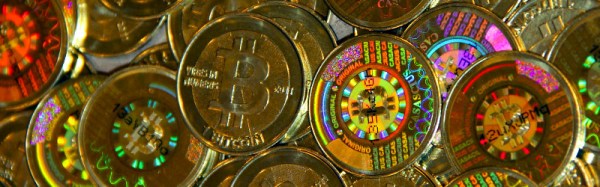
Bitcoin coins image: Mike Cauldwell [Public domain].

Digital Kiln

A kiln or foundry is too often seen as a piece of equipment which is only available if a hackspace is lucky enough to have one or individuals are dedicated enough to drop the cash for one of their own. [The Thought Emporium] thought that way until he sourced materials to make his own kiln which can also be seen after the break. It costs half the price of a commercial model not including a failed—and exploded—paint can version.

As described in the video, these furnaces are tools capable of more than just pottery and soft metal baubles. Sure, a clay chess set would be cool but what about carbon fiber, graphene, aerogel, and glass? Some pretty hot science happens at high temperatures.

We get a nice walk-through of each part of the furnace starting with the container, an eleven-gallon metal tub which should set the bar for the level of kiln being built. Some of the hardware arrangements could be tweaked for safety and we insist that any current-carrying screw is safely mounted inside an enclosure which can’t be opened without tools. There’s good advice about grounding the container if metal is used. The explanation of PID loops can be ignored.

What else can you do with a kiln? How about jewelry, heat treating metal, or recycle your beer cans into an engine.

Continue reading “Digital Kiln”

The Smartest Air Freshener In The Room

Many automatic air fresheners are wasteful in that they either ceaselessly spritz the room, and manual ones need to be — well — manually operated. This will not do in an era of smart products, so Instructables user [IgorF2] has put together an air freshener that does more than check if you’re around before freshening things up.

The air freshener uses a NodeMCU LoLin and an MG 995 servomotor, with a NeoPixel ring acting as a status light. Be aware — when the servo is triggered there is a significant spike in current, so be sure you aren’t powering the air freshener from a PC USB port or another device. After modeling the air freshener’s case in Fusion 360 — files available here — [IgorF2] wired the components together and mounted them inside the 3D printed case.

Hardware work completed, [IgorF2] has detailed how to set up the Arduino IDE and ESP8266 support for a first-time-user, as well as adding a few libraries to his sketch. A combination of an Adafruit.IO feed and ITTT — once again, showing the setup steps — handles how the air freshener operates: location detection, time specific spritzing, and after tapping a software button on your phone for those particularly lazy moments.

Continue reading “The Smartest Air Freshener In The Room”

Give Workshop Pencils A Flush-Mounted Home

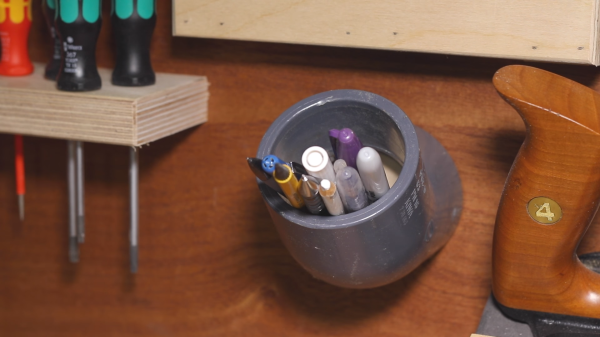
Pencils and pens are apt to go wandering in a busy workshop if they don’t have a handy storage spot. For most of us a soup can or an old coffee mug does the trick, but for a prettier and more useful holder [Stuff I Made] has a short video demonstrating a storage unit made from an elbow fitting and a scrap piece of plywood. He cuts a plywood disk that is friction-fit into one end of the elbow, then it gets screwed into a wall making an attractively flush-mounted holder in a convenient spot.

With the right joint the bottom of the holder remains accessible, as a 90 degree bend would be no good. With a shallower joint angle, a regular screwdriver can still reach the mounting screw and it’s possible to access the bottom of the holder just in case it needs cleaning or something small falls inside. You can see the process and results in the video embedded below. Not bad for one screw, a spare joint, and a scrap piece of plywood.

Continue reading “Give Workshop Pencils A Flush-Mounted Home”

Turning Saw Blades Into Throwing Stars

The holidays are nearly upon us, and if you haven’t found the perfect gift for the Mall Ninja in your life yet, this latest hack might be just what you’re looking for. On his YouTube channel, [The Nocturnal Alchemist] demonstrates how to make ninja throwing stars (shuriken) out of an old circular saw blade. One could probably argue that a circular saw itself is close enough to throwing star if your only goal is to wreck some stuff in your backyard, but with this method they’ll have that official samurai look.

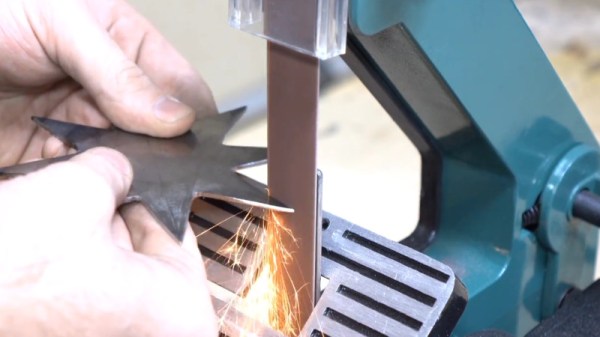
To start the process, he hits both sides of the circular saw blade with a grinder to smooth out the surface. He then traces the desired star shapes onto the blade, and cuts the blade into pieces so it’s easier to manage. The rough shape of the stars is cut out with an angle grinder, and a belt sander lets him sharpen the edges.

At this point the stars are effectively finished, but if you want something that’s going to look good on the shelf next to the katana you bought online, you need to do some more finish work. He sands both sides of the stars by hand, starting at 80 grit and working all the way up to 1200 grit wet paper. Once sanded, paste wax is rubbed in with a cloth to give it a protective coating.

With the finish work done, all that’s left to do is throw your new shuriken at cans of soda and watermelons as a demonstration of their power. To this end, he has come prepared with a 1,000 FPS camera; so if you’ve ever wanted to see cans of off-brand soda getting exploded with a throwing star, your Mall Ninja friend isn’t the only one about to get a gift.

With circular saw blade shuriken completed, all you’ll need to do to complete your urban samurai transformation is forge yourself a sword, and perfect your run in virtual reality.

Continue reading “Turning Saw Blades Into Throwing Stars”

Coin Cell Powered Sea Turtle Research

Hacking and tinkering are always fun and games, but one just has to appreciate when all efforts are additionally aimed towards doing something good. [Nikos] sets an example by combining his interest in technology with his passion for wildlife conservation by creating a low cost and ultra-low power temperature logger — and he is using a coin cell for it.

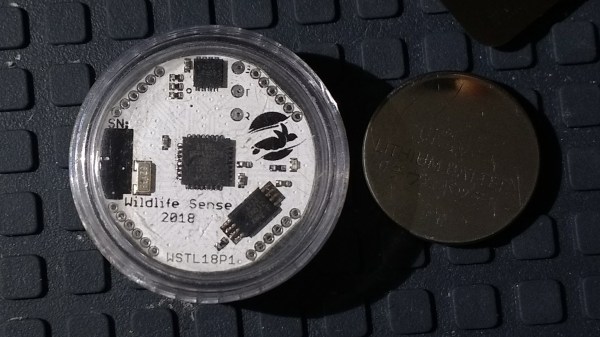
As the founder of a sea turtle conservation project in Greece, [Nikos] enjoys building scientific instruments that help him and his team on their mission. With a goal to log the temperature every 10 minutes over a period of at least 180 days, he designed a PCB just big enough to hold a CR2032 coin cell. Fifty of them will eventually be sealed in waterproof enclosures, and buried in the sand for the whole research duration.

Limiting the design to its bare necessities, the rest of the PCB is housing a digital temperature sensor, an SPI EEPROM to hold all the recorded sensor values over those 180 days, and an ATmega328PB clocked by a 32.768kHz crystal. Wondering what to do with all the extra, unused pins of the ATmega, [Nikos] simply routed them to be accessible through pin headers, thus turning the data logger alternatively into a coin cell powered development board.

Assuming your logging interval requirements are significantly lower, you might be thrilled to hear that [Nikos] estimates a theoretical 7+ years an average coin cell could power the data logger in sleep mode, which makes him confident to reach the 180 days goal.