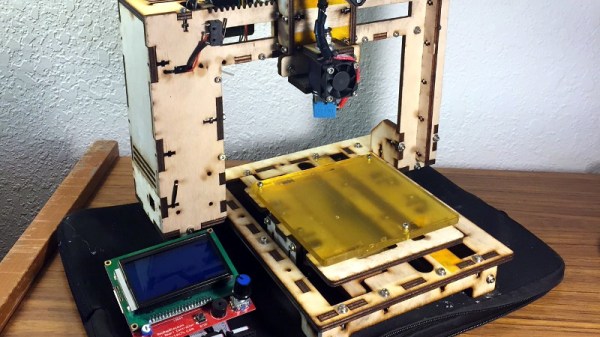
Go Back In Time With A Laser Cut Wood 3D Printer Kit

About a decade ago, the only way the average hacker was getting their hands on a desktop 3D printer was by building it themselves from a kit. Even then, to keep costs down, many of these kits were made out of laser cut wood. For a few years, wooden printers from companies like MakerBot and PrintrBot were a common sight in particularly well equipped hackerspaces. But as the market expanded and production went up, companies could afford to bend metal and get parts injection molded; the era of the wooden 3D printer was over nearly as soon as it had started.
But [Luke Wallace] thinks there’s still some life left in the idea. For his entry into the 2019 Hackaday Prize, he’s proposing a revival of the classic laser cut 3D printer kit. But this time, things are a bit different. Today, laser cutters are cheap enough that these kits could conceivably be manufactured at your local hackerspace. With a total bill of materials under $100 USD, these kits could be pumped out for less than the cheapest imports, potentially driving adoption in areas where the current options are too expensive or unavailable.

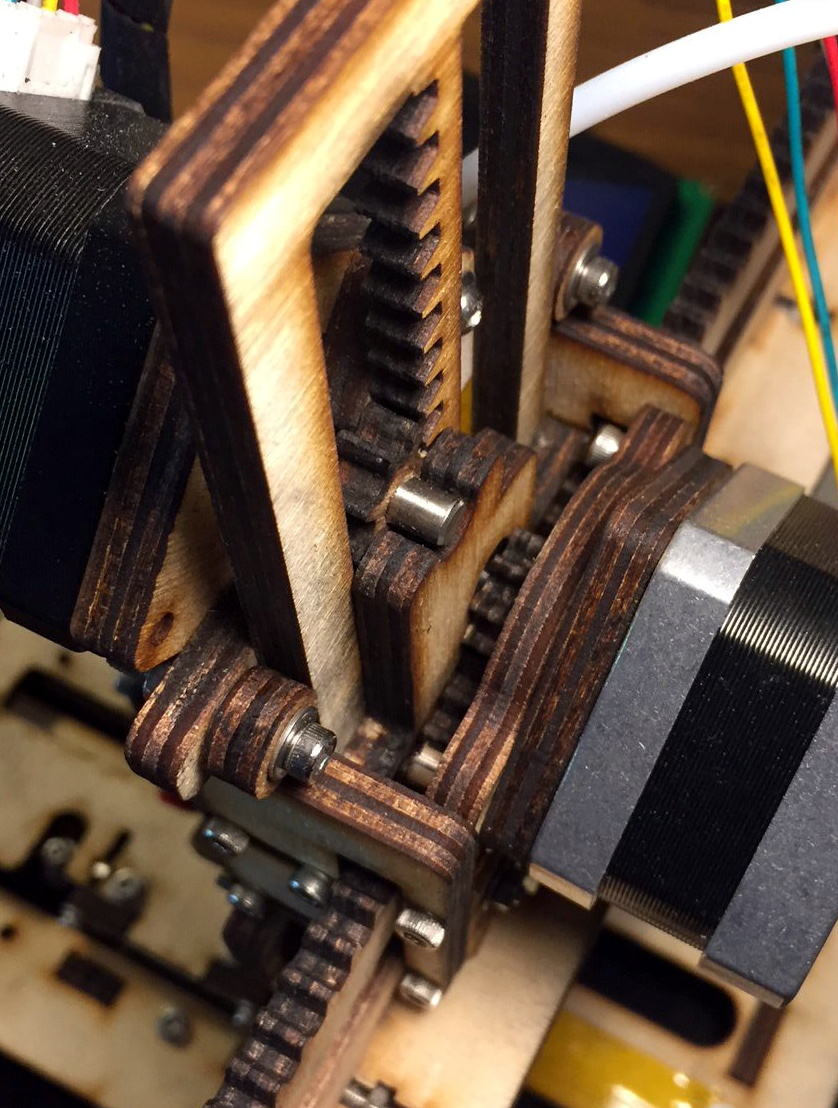
Of course, just a laser cut wood frame wouldn’t be enough to break the fabled $100 barrier. To drive the cost down even farther, [Luke] has redesigned essentially every component so it could be made out of wood. If its not electronic, there’s a good chance its going to be cut out of the same material the frame is made out of. Probably the biggest change is that the traditional belt and pulley system has been replaced with rack and pinion arrangements.

After cutting all the pieces, essentially all you need to provide is the stepper motors, a RAMPS controller, the hotend, and the extruder. He’s even got a design for a laser cut wood extruder if you want to go back to the real olden days and save yourself another few bucks. Or skip the LCD controller and just run it over USB.

But what do the prints look like? [Luke] has posted a few pictures of early test pieces on the project’s Hackaday.io page, and to be honest, they’re pretty rough. But they don’t look entirely unlike the kind of prints you’d get on one of those early printers before you really got it dialed in, so we’re interested in seeing how the results improve with further refinements and calibration. (Editor’s note: Since writing this, he got backlash compensation up and running, and it looks a ton better already. Very impressive for something running on wooden gears!)


A Compact Strain Wave Gear Assembly

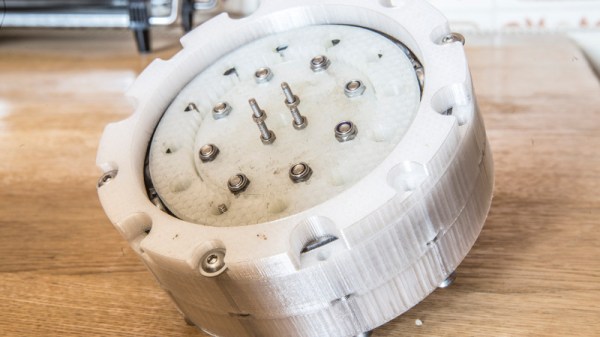
Strain wave gearing is a clever way to produce a high-efficiency, high ratio gearbox within a small space. It involves an outer fixed ring of gear teeth and an inner flexible ring of teeth which are made to mesh with the outer by means of an oval rotor distorting the ring. They aren’t cheap, so [Leo Vu] has had a go at producing some 3D-printable strain wave gearboxes that you could use in your robotic projects.

He’s created his gearbox in three ratios, 1:31, 1:21 and 1:15. It’s not the most miniature of devices at 145mm in diameter and weighing well over a kilogram, but we can still imagine plenty of exciting applications for it. We’d be curious as to how tough a 3D printed gear can be, but we’d expect you’ll be interested in it for modest-sized robots rather than Formula One cars. There’s a video featuring the gearbox which we’ve placed below the break.

This certainly isn’t the first strain wave gearset we’ve brought you, more than one 3D printed project has graced these pages. We’ve even brought you a Lego version. Continue reading “A Compact Strain Wave Gear Assembly”

Transparent And Flexible Circuits

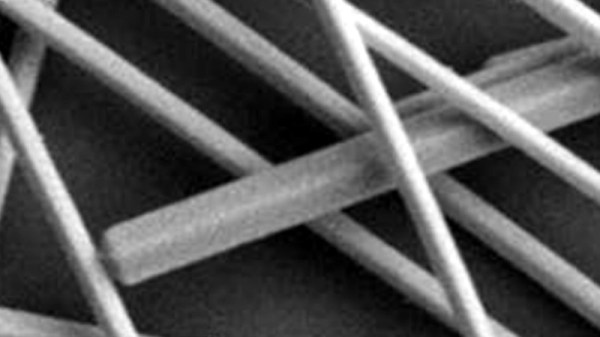
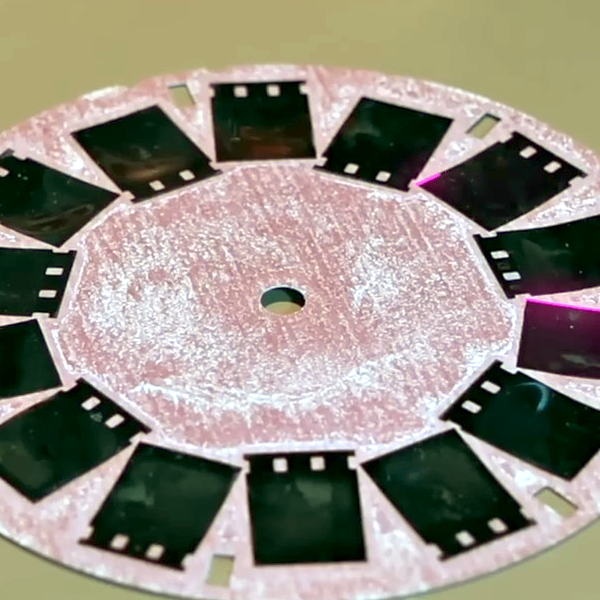
German researchers have a line on 3D printed circuitry, but with a twist. Using silver nanowires and a polymer, they’ve created flexible and transparent circuits. Nanowires in this context are only 20 nanometers long and only a few nanometers thick. The research hopes to print things like LEDs and solar cells.

Of course, nothing is perfect. The material has a sheet resistance as low as 13Ω/sq and the optical transmission was as high as 90%. That sounds good until you remember the sheet resistance of copper foil on a PCB is about 0.0005Ω.

Continue reading “Transparent And Flexible Circuits”

A Better Bowden Drive For Floppy Filaments

You might not think to use the word “rigid” to describe most 3D-printer filaments, but most plastic filaments are actually pretty stiff over a short length, stiff enough to be pushed into an extruder. Try the same thing with a softer plastic like TPE, though, and you might find yourself looking at this modified Bowden drive for elastomeric filaments.

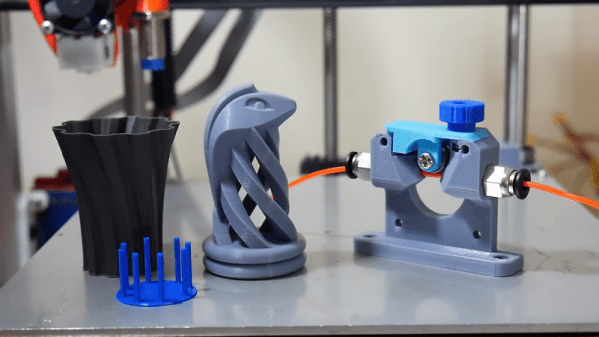
The idea behind the Bowden drive favored by some 3D-printer designers is simple: clamp the filament between a motor-driven wheel and an idler to push it up a pipe into the hot end of the extruder. But with TPE and similar elastomeric filaments, [Tech2C] found that the Bowden drive on his Hypercube printer was causing jams and under-extrusion artifacts in finished prints. A careful analysis of the stock drive showed a few weaknesses, such as how much of the filament is not supported on the output side of the wheel. [Tech2C] reworked the drive to close that gap and also to move the output tube opening closer to the drive. The stock drive wheel was also replaced with a smaller diameter wheel with more aggressive knurling. Bolted to the stepper, the new drive gave remarkably improved results – a TPE vase was almost flawless with the new drive, while the old drive had blobs and artifacts galore. And a retraction test print showed no stringing at all with PLA, meaning the new drive isn’t just good for the soft stuff.

All in all, a great upgrade for this versatile and hackable little printer. We’ve seen the Hypercube before, of course – this bed height probe using SMD resistors as strain gauges connects to the other end of the Bowden drive.

Continue reading “A Better Bowden Drive For Floppy Filaments”

Microscope-Inspired Toolchanger Spins Multicolor 3D Prints

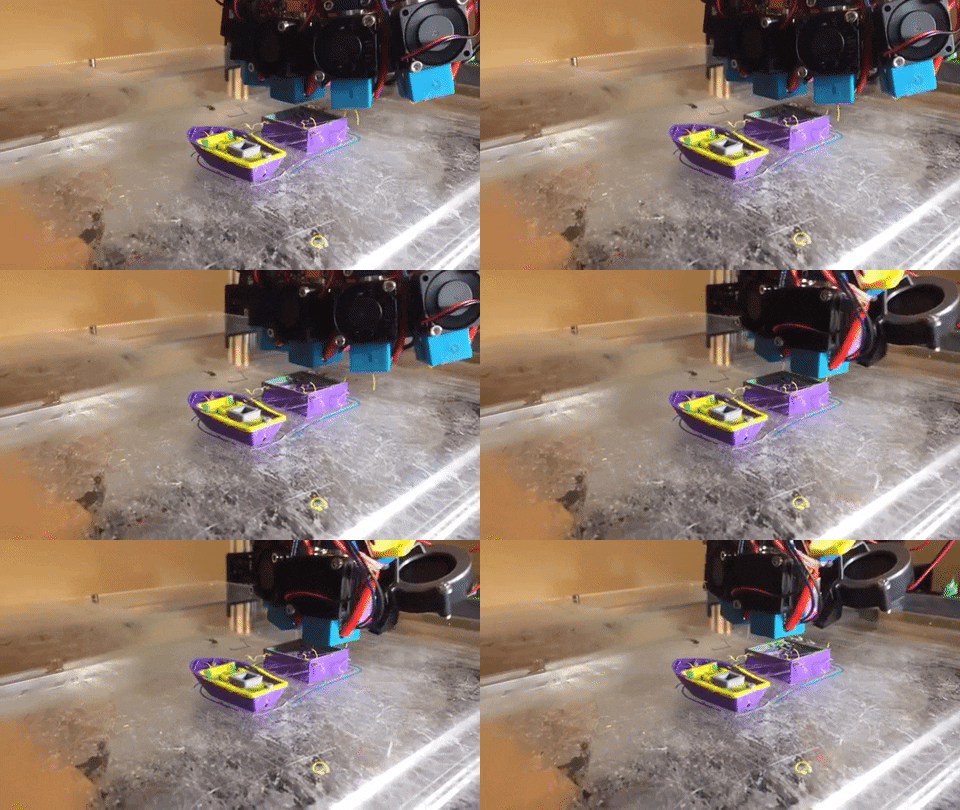
The 3D printing community is simply stirring with excitement over toolchanging printers, but these machines are still the exception rather than the norm. Here’s an exceptional exception: [Paul Paukstelis] built a five-color printer with a novel head-changing solution.

[Paul’s] 3D printer is a hat-tip to anyone who’s spent time in the wetlab. For starters, the printer is born from the remains of a former liquid handling system, a mighty surplus score. When it comes to headchanging, [Paul] combined some honest inspiration from E3D’s toolchanging videos with some design features borrowed from the microscope in his lab. The result is that the printer’s five-tool head-changer mechanically behaves very similarly to the nose piece in a compound light microscope.

Because the printer evolved from old lab equipment, [Paul] dubs his printer into a lineage that he calls the “Reclaimed Rapid-Prototyper,” or the RecRap. Best of all, he’s kindly posted up the CAD files on the Thingiverse such that you too can take a deep look into this head-changing solution.

We love seeing these tools get a second life, and we think there’s plenty of potential for new offspring in this lineage of discarded lab equipment.

Continue reading “Microscope-Inspired Toolchanger Spins Multicolor 3D Prints”

For Better Photogrammetry, Just Add A Donut

If you don’t have access to a 3D scanner, you can get a lot done with photogrammetry. Basically, you take a bunch of pictures of an object from different angles, and then stitch them together with software to create a 3D model. For best results, you need consistent, diffuse lighting, an unchanging background, and a steady camera.

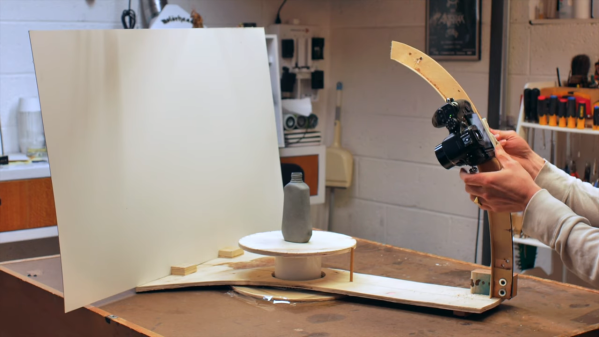
Industrial designer [Eric Strebel] recently made an Intro to Photogrammetry video wherein he circled an object taking photos with his bare hands. One commenter suggested a different method: build a donut-shaped turntable that circles the object, which sits on a stationary platform. Attach the camera to the donut, counterbalance the weight, and Bob’s your proverbial uncle. [Eric] thought it was a brilliant idea (because it is), and he built a proof of concept. This is that video.

[Eric] can move the camera up and down the arc of the boom to get all the Z-positions he wants. The platform has a mark every 10° and there’s a pointer in the platform to line them up against for consistent camera positioning. He was pleasantly surprised by the results, which we agree are outstanding.

We always learn a lot from [Eric]’s videos, and this one’s no exception. Case in point: he makes a cardboard mock-up by laying out the pieces, and uses that to make a pattern for the recycled plywood and melamine version. In the photogrammetry video, he covers spray paint techniques to make objects reflect as little light as possible so the details don’t get lost.

If you prefer to rotate your objects, get an Arduino out and automate the spin.

Continue reading “For Better Photogrammetry, Just Add A Donut”

Custom Storage Boxes, From Cardboard And 3D Printed Bits

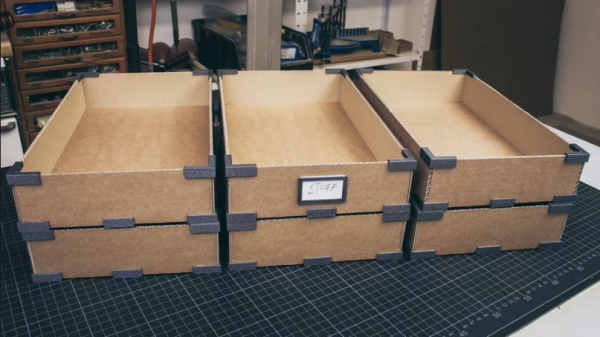
It’s not that storage boxes and organizers are hard to find. No, the problem this project set out to solve was more nuanced than that. The real trouble [theguymasamato] had was that his storage options — wide shelves and deep drawers — weren’t well suited to storing a lot of small and light objects. The result was a lot of wasted space and poor organization. To make matters worse, his big drawers had oddball dimensions, meaning that store bought organizers weren’t a good fit either.

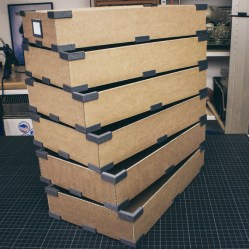
To solve these problems, [theguymasamato] decided to design his own stackable boxes to store small and light objects far more efficiently than before. The design also allows the boxes to be made in a variety of sizes without changing any of the 3D printed parts. Carefully measured and cut cardboard is critical, but that’s nothing a utility knife and ruler can’t solve. The only other requirements are a few simple plastic parts, and some glue. He can fit six of these inside a single one of his drawers with enough room to access and handle them, but without wasting space.

Cardboard is really versatile stuff. Not only has it been behind some amazingly complex devices such as this tiny working plotter, but we’ve seen it form major components in the remarkably ambitious cardboard CNC.