There Is No Parity: Chien-Shiung Wu

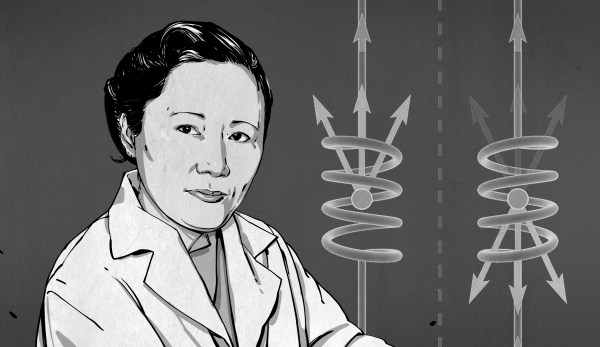
Hold out your hands in front of you, palms forward. They look quite similar, but I’m sure you’re all too aware that they’re actually mirror images of each other. Your hands are chiral objects, which means they’re asymmetric but not superimposable. This property is quite interesting when studying the physical properties of matter. A chiral molecule can have completely different properties from its mirrored counterpart. In physics, producing the mirror image of something is known as parity. And in 1927, a hypothetical law known as the conservation of parity was formulated. It stated that no matter the experiment or physical interaction between objects – parity must be conserved. In other words, the results of an experiment would remain the same if you tired it again with the experiment arranged in its mirror image. There can be no distinction between left/right or clockwise/counter-clockwise in terms of any physical interaction.

Dr. Wu working with a particle accelerator via Biography.

The nuclear physicist, Chien-Shiung Wu, who would eventually prove that quantum mechanics discriminates between left- and right-handedness, was a woman, and the two men who worked out the theory behind the “Wu Experiment” received a Nobel prize for their joint work. If we think it’s strange that quantum mechanics works differently for mirror-image particles, how strange is it that a physicist wouldn’t get recognized just because of (her) gender? We’re mostly here to talk about the physics, but we’ll get back to Chien-Shiung Wu soon.

The End of Parity

Conservation of parity was the product of a physicist by the name of Eugene P. Wigner, and it would play an important role in the growing maturity of quantum mechanics. It was common knowledge that macro-world objects like planets and baseballs followed Wigner’s conservation of parity. To suggest that this law extended into the quantum world was intuitive, but not more than intuition. And at that time, it was already well known that quantum objects did not play by the same rules as classical objects. Would quantum mechanics be so strange as to care about handedness? Continue reading “There Is No Parity: Chien-Shiung Wu”

The Engineering That Survives Hurricanes

Florida is a great place to live, especially around January when it’s sunny and 24 degrees outside (76F) while all of your friends from back home are dealing with scraping ice off of their windshields every morning. In the late summer, though, this pleasant tropical paradise can sometimes take a turn for the worse, because Florida is one of the handful of places that frequently see some of the worst storms on the planet: hurricanes. As a Floridian myself, perhaps I can shed some light on some of the ways that the various local governments and their residents have taken to mitigate the destruction that usually accompanies these intense tropical storms when it seems that, to outsiders, it might be considered unwise to live in such a place.

Continue reading “The Engineering That Survives Hurricanes”

Cuban Embassy Attacks And The Microwave Auditory Effect

If you’ve been paying attention to the news, you may have seen a series of articles coming out about US staffers in Cuba. It seems that 21 staffers have suffered a bizarre array of injuries ranging from hearing loss to dizziness to concussion-like traumatic brain injuries. Some staffers have reported hearing incapacitating sounds in the embassy and in their hotel rooms. The reports range from clicking to grinding, humming, or even blaring sounds. One staffer described being awoken to a horrifically loud sound, only to have it disappear as soon as he moved away from his bed. When he got back into bed, the mysterious sound came back.

Cuba has denied any wrongdoing. However, the US has already started to take action – expelling two Cuban diplomats from the US in May. The question though is what exactly could have caused these injuries. The press has gone wild with theories of sonic weaponry, hidden bugs, and electronic devices, poisons, you name it. Even Julian Assange has weighed in, stating “The diversity of symptoms suggests that this is a pathogen combined with paranoia in an isolated diplomatic corps.”

So what’s going on? Bizarre accidents? Cloak and dagger gone awry? Mass hysteria among the US state department, or something else entirely? Continue reading “Cuban Embassy Attacks And The Microwave Auditory Effect”

Inventing The Induction Motor

When you think of who invented the induction motor, Nikola Tesla and Galileo Ferraris should come to mind. Though that could be a case of the squeaky wheel being the one that gets the grease. Those two were the ones who fought it out just when the infrastructure for these motors was being developed. Then again, Tesla played a huge part in inventing much of the technology behind that infrastructure.

Although they claimed to have invented it independently, nothing’s ever invented in a vacuum, and there was an interesting progression of both little guys and giants that came before them; Charles Babbage was surprisingly one of those giants. So let’s start at the beginning, and work our way to Tesla and Ferraris.

Continue reading “Inventing The Induction Motor”

There Is No Such Thing As An Invalid Unit

The Mars Climate Orbiter was a spacecraft launched in the closing years of the 1990s, whose job was to have been to study the Martian atmosphere and serve as a communications relay point for a series of other surface missions. It is famous not for its mission achieving these goals, but for the manner of its premature destruction as its orbital insertion brought it too close to the planet’s atmosphere and destroyed it.

The ill-fated Mars Climate Orbiter craft. NASA [Public domain].
The cause of the spacecraft entering the atmosphere rather than orbiting the planet was found in a subsequent investigation to be a very simple one. Simplifying matters to an extent, a private contractor supplied a subsystem which delivered a reading whose units were in the imperial system, to another subsystem expecting units in the SI, or metric system. The resulting huge discrepancy caused the craft to steer towards the surface of the planet rather than the intended orbit, and caused the mission to come to a premature end. Billions of dollars lost, substantially red faces among the engineers responsible.

This unit cock-up gave metric-using engineers the world over a brief chance to feel smug, as well as if they were being honest a chance to reflect on their good fortune at it not having happened on their watch. We will all at some time or another have made an error with respect to our unit calculations, even though in most cases it’s more likely to have involved a simple loss of a factor of ten, and not with respect to a billion dollar piece of space hardware.

But it also touches on one of those fundamental divides in the world between the metric and imperial systems. It’s a divide that brings together threads of age politics, geography, nationalism, and personal choice, and though it may be somewhere angels fear to tread (we’ve seen it get quite heated before to the tune of 885+ comments), it provides a fascinating subject for anyone with an interest in engineering culture.

Continue reading “There Is No Such Thing As An Invalid Unit”

In-Band Signaling: Quindar Tones

So far in this brief series on in-band signaling, we looked at two of the common methods of providing control signals along with the main content of a transmission: DTMF for Touch-Tone dialing, and coded-squelch systems for two-way radio. For this installment, we’ll look at something that far fewer people have ever used, but almost everyone has heard: Quindar tones.

Continue reading “In-Band Signaling: Quindar Tones”

AI: This Decade’s Worst Buzz Word

In hacker circles, the “Internet of Things” is often the object of derision. Do we really need the IoT toaster? But there’s one phrase that — while not new — is really starting to annoy me in its current incarnation: AI or Artificial Intelligence.

The problem isn’t the phrase itself. It used to mean a collection of techniques used to make a computer look like it was smart enough to, say, play a game or hold a simulated conversation. Of course, in the movies it means HAL9000. Lately, though, companies have been overselling the concept and otherwise normal people are taking the bait.

The Alexa Effect

Not to pick on Amazon, but all of the home assistants like Alexa and Google Now tout themselves as AI. By the most classic definition, that’s true. AI techniques include matching natural language to predefined templates. That’s really all these devices are doing today. Granted the neural nets that allow for great speech recognition and reproduction are impressive. But they aren’t true intelligence nor are they even necessarily direct analogs of a human brain.

Continue reading “AI: This Decade’s Worst Buzz Word”