Life On Contract: How To Find Clients As An Engineering Contractor

The following is my personal advice, it probably doesn’t apply to all contractors, but it’s certainly applied to me. When you start contracting, your most pressing question is probably “how do I find clients” so here’s what little I’ve learned so far…

1. Don’t

For some, contracting is seen as a potential escape route from the hum-drum of a dull, often political office environment. But contracting isn’t always the answer. Pay, while often better, is inconsistent. I’ve had clients pay two months late (and think it’s normal), pay the wrong amount (due to misunderstanding currency conversion) and just plain forget to sign off an invoice. Chasing down these invoicing issues will all be your job. Clients will say “we’ll definitely hire you” and then a contract will never happen.

Continue reading “Life On Contract: How To Find Clients As An Engineering Contractor”

Sailing Ships, Slide Rules, And The Quality Of Engineering

We recently ran a post about engineers being worse, better, or the same than they “used to be” and it got me thinking. Of course “used to be” is in the eyes of the beholders. To me, that’s the 1950s and 1960s. To some of you, my generation is the “used to be” generation. To some of you, I’m past even that.

I’ve often said, there are two things that are simple: something really simple, and something really complex. For example, when a caveman grabbed a log floating down the river and hitched a ride a few miles downstream that was pretty simple. Today, you can go on a well-equipped boat, stab your finger at a map, click go, and the boat will do almost all the work. However, get onboard a sailing vessel from 1850 and you better know what you are doing. What’s more is, some sailors were better than others.

What’s Better or Best?

Were yesterday’s engineers better than today? That’s like asking who is the “best” driver. It depends a lot on what “best” means. Safer? Faster? Most efficient? I would suggest that yesterday’s engineers were better at doing yesterday’s jobs. I own several slide rules and I can use them, but I bet my mentor who finished college in the 1940s was faster. I don’t need to be faster. On the other hand, he might have some trouble doing a good Internet search.

But here’s the problem. Doing basic math is like the caveman on the log (and yes, that begs for a slide rule joke). Asking Wolfram Alpha to solve your set of simultaneous equations is like the modern computer-controlled ship with GPS. You can bet that the sailing master of a barque in 1850 knew a lot more about sailing and winds and ship construction than the average guy on a modern ship. He had to. That gave him extra reasoning tools when faced with a problem.

Slide Rules Do (Most) of the Math

By the same token, using a slide rule is very helpful but–paradoxically–you have to know a little math to be able to use it. In particular, you had to have a rough idea of the magnitude of the answer to get the right answer. If you couldn’t get that concept or do the simple estimate in your head, the slide rule was useless and you probably dropped out of engineering school. Today, you may or may not have that kind of math smarts, and it doesn’t matter.

I’ve known graybeards that keep up with the modern technology. I’ve also known plenty who are stuck in the past, talking about how horrible transistors, or ICs, or software is and how it has ruined everything. Of course, they haven’t.

Lesson Learned

As Gerrit pointed out, we tend to remember the brilliant engineers and projects and forget the bad ones (unless they are really bad). Even in “the golden age” there were good engineers and bad.

So how can you maximize your chances of being one of the good ones when this turns into some kid’s golden age? Two things, I think. Never stop learning the new technology. The hot-shot engineer with the slide rule wouldn’t function as well in today’s world unless he was willing to learn about the new things. But also, learn the fundamentals. You don’t have to know how an engine works to drive a car. But all the race car drivers do know. Having tools to do circuit analysis or solve thorny math equations is a great time saver. But you ought to know how to do it without those tools. The insights you’ll gain will give you more tools at your disposal when faced with a problem.

Engineering is a series of abstractions. Always try to drive down the abstraction layers. Know how to program? How does a CPU work at the logic gate level? Know how that works? Then how do the transistors form those gates? When you understand that, dig into why the transistors work at all. Sure, you probably aren’t going to build a transistor from raw materials. But you’ll gain new insights and those insights will help you solve future problems. Besides, if there’s ever a zombie apocalypse, it might be good to know how to use a slide rule or build a transistor.


Death To The 3.5mm Audio Jack, Long Live Wireless

There’s been a lot of fuss over Apple’s move to ditch the traditional audio jack. As for me, I hope I never have to plug in another headphone cable. This may come off as gleeful dancing on the gravesite of my enemy before the hole has even been dug; it kind of is. The jack has always been a pain point in my devices. Maybe I’ve just been unlucky. Money was tight growing up. I would save up for a nice set of headphones or an mp3 player only to have the jack go out. It was a clear betrayal and ever since I’ve regarded them with suspicion. Is this the best we could do?

I can’t think of a single good reason not to immediately start dumping the headphone jack. Sure it’s one of the few global standards. Sure it’s simple, but I’m willing to take bets that very few people will miss the era of the 3.5mm audio jack once it’s over. It’s a global episode of the sunk cost fallacy.

In the usual way hindsight is 20/20, the 3.5mm audio jack can be looked at as a workaround, a stop over until we didn’t need it.  It appears to be an historic kludge of hack upon hack until something better comes along. When was the last time it was common to hook an Ethernet cable into a laptop? Who would do this when we can get all the bandwidth we want reliably over a wireless connection. Plus, it’s not like most Ethernet cables even meet a spec well enough to meet the speeds they promise. How could anyone reasonably expect the infinitely more subjective and variable headphone and amplifier set to do better?

But rather than just idly trash it, I’d like to make a case against it and paint a possible painless and aurally better future.

Continue reading “Death To The 3.5mm Audio Jack, Long Live Wireless”

Engage Tinfoil Hat: Samsung Note 7 Battery Theory

For the most part I believe things are as they seem. But every once in a while I begin to look at notable technology happenings from a different angle. What if things are not like they seem? This is conspiracy theory territory, and I want to be very clear about this: what follows is completely fictitious and not based on fact. At least, I haven’t tried to base it on facts surrounding the current events. But perhaps you can. What if there’s more to the battery fires in Samsung’s Galaxy Note 7 phones?

I have a plausible theory, won’t you don your tinfoil hat and follow me down this rabbit hole?

Continue reading “Engage Tinfoil Hat: Samsung Note 7 Battery Theory”

Should You Outsource Manufacturing? A Handy Guide

A lot of people assume that the product development cycle involves R&D, outsourcing to a Chinese manufacturer, and then selling the finished product. It’s almost ingrained in our heads that once a prototype has been developed, the next step involves a visa and airplane tickets. Here is a guide that will explore a few other options, and why outsourcing may not be appropriate for everyone.

First, let’s talk about goals. We’ll assume you’re not a large company, and that you don’t have a huge budget, and that you’re just getting started with your product and don’t have big volumes; a startup trying to sell a kit or breakout board, or a consumer electronics product. Your goals are the following:

  1. Validate your product in the market. Build a minimum viable product and get it in the hands of lots of users
  2. Get the most bang for your limited bucks. All money should go towards getting products out the door
  3. Reduce risk to your company so that any single failure doesn’t crater the whole operation and you can safely grow.

With that in mind, what are your options?

Continue reading “Should You Outsource Manufacturing? A Handy Guide”

Two-Stage Tentacle Mechanisms Part III: Putting It All Together

Welcome back to the final chapter in our journey exploring two-stage tentacle mechanisms. This is where we arm you with the tools and techniques to get one of these cretins alive-and-kicking in your livingroom. In this last installment, I’ll guide us through the steps of building our very own tentacle and controller identical to one we’ve been discussing in the last few weeks. As promised, this post comes with a few bonuses:

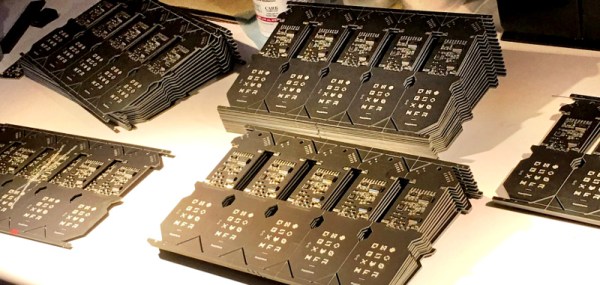
29323707092_28d8bd1eb8_z
Nothing like a fresh batch o’ parts.

Design Files

  1. The Almighty Bill-o’-Materials
  2. Vector Drawings for laser cutting
    1. DXF files pre-offset (0.003″)
    2. DXF files original
  3. STL Models for 3D Printing
  4. Original Tentacle CAD Model Files
  5. Original Controller CAD Model Files

Depending on your situation, some design files may be more important than others. If you just want to get parts made, odds are good that you can simply cut the pre-offset DXFs from the right plate thicknesses and get rolling. Of course, if you need to tune the files for a laser with a slightly different beam diameter, I’ve included the original DXFs for good measure. For the heavy-hitters, I’ve also included the original files if there’s something about this design that just deserves a tweak or two. Have at it! (And, of course, let us know how you improve it!)

Ok, now that we’ve got the parts on-hand in a pile of pieces,let’s walk through the last-mile tweaks to making this puppet work: assembly and tuning. At this point, we’ve got a collection of parts, some laser-cut, some off the shelf. Now it’s time to string them together.

Continue reading “Two-Stage Tentacle Mechanisms Part III: Putting It All Together”

A Machine Shop In A Toolbox: Just Add Time

You don’t need any fancy tools. A CNC machine is nice. A 3D printer can help. Laser cutters are just great. However, when it comes to actually making something, none of this is exactly necessary. With a basic set of hand tools and a few simple power tools, most of which can be picked up for a pittance, many things of surprising complexity, precision, and quality can be made.

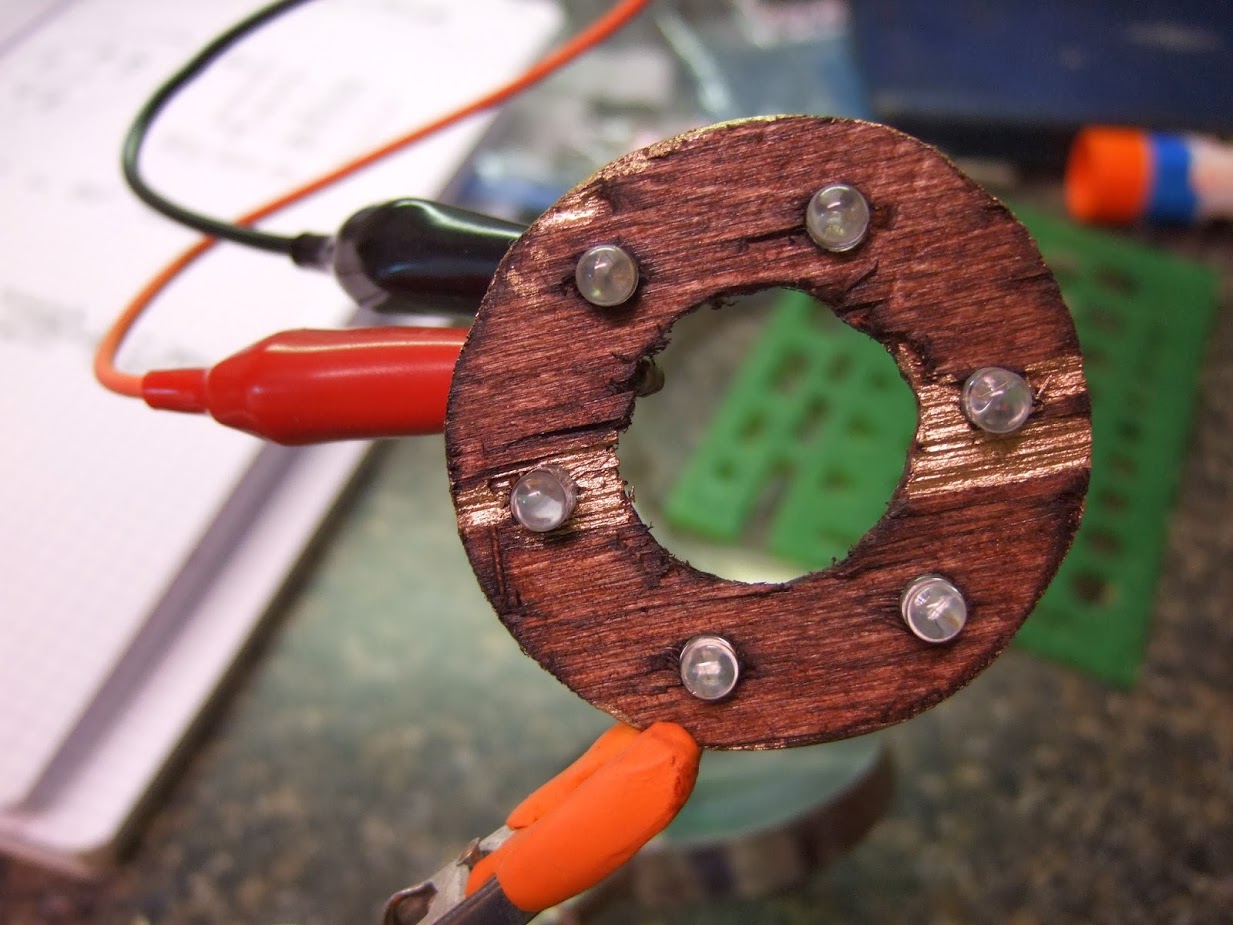
Not as pretty, but worked just the same.

A while back I was working on a ring light for my 3D printer. I already had a collection of LEDs, as all hackers are weak for a five-dollar assortment box. So I got on my CAD software of choice and modeled out a ring that I was going to laser cut out of plywood. It would have holes for each of the LEDs. To get a file ready for laser cutting ook around ten minutes. I started to get ready to leave the house and do the ten minute drive to the hackerspace, the ten minutes firing up and using the laser cutter (assuming it wasn’t occupied) and the drive back. It suddenly occurred to me that I was being very silly. I pulled out a sheet of plywood. Drew three circles on it with a compass and subdivided the circle. Under ten minutes of work with basic layout tools, a power drill, and a coping saw and I had the part. This was versus the 40 minutes it would have taken me to fire up the laser cutter.

Continue reading “A Machine Shop In A Toolbox: Just Add Time”