Ask Hackaday: Wink Hubs, Extortion As A Service?

Wink Labs just announced that their home automation hub, the Wink Hub, is “transitioning to a $4.99 monthly subscription, starting on May 13, 2020.” Should you fail to pay the fiver every month, you will lose access to their app, voice control, and automations, which is everything it does as far as we can tell.

This is an especially bitter pill to swallow for Hub users, because the device was just that — a hub. It speaks Bluetooth, Z-Wave, ZigBee, WiFi, Kidde, and a couple other specific device protocols, interfaces with Amazon’s Alexa, has a handy Android master panel app, and had a nice “robot” system that made the automation side of “home automation” simple for normal people. In short, with its low one-time purchase price, compatibility with many devices, nice phone app, and multiple radios, it was a great centerpiece for a home-automation setup.

“Nice home automation system you’ve got there. Would be a shame if anything happened to it.”

Continue reading “Ask Hackaday: Wink Hubs, Extortion As A Service?”

EARN IT: Privacy, Encryption, And Policing In The Information Age

You may have heard about a new bill working its way through the US congress, the EARN IT act. That’s the “Eliminating Abusive and Rampant Neglect of Interactive Technologies Act of 2020”. (What does that mean? It means someone really wanted their initials to spell out “EARN IT”.)

EARN IT is a bipartisan bill that claims to be an effort to put a dent in child exploitation online. It’s also managed to catch the attention of the EFF, Schneier, and a variety of news outlets. The overwhelming opinion has been that EARN IT is a terrible idea, will make implementing end-to-end encryption impossible, and violates the First and Fourth Amendments. How does a bill intended to combat child pornography and sex trafficking end up on the EFF bad list? It’s complicated.

Continue reading “EARN IT: Privacy, Encryption, And Policing In The Information Age”

Inputs Of Interest: I’m Building An ErgoDox!

I’ve been using my Kinesis Advantage keyboard for two months, and I love it. I’ll never go back to a regular keyboard again if I can help it.

There are a few downsides to it, however. The biggest one is that split distance between the two sides is fixed. It doesn’t have Cherry MX blues (although the browns plus the firmware beeps is pretty nice). It doesn’t have layers, really — just a ten-key under the right hand. And honestly, it’s not very portable.

ErgoDox with Nuclear Data keycaps via geekhack

I took the Kinesis out to a coffee shop a few times before they all dried up into drive-thrus, and plunking it down on a four-top out in public made me realize just how large and loud it really is.

And so I’m building an ErgoDox keyboard. What I really want to build is a Dactyl — a curved variation on the ErgoDox — but I can’t just go whole-hog into that without building some type of keyboard first. That’s just my practical nature, I guess. I realize that the comparison is weak, because I’ll have to hand-wire the keyboard matrix when I make the dactyl. Assembling an ErgoDox is child’s play, comparatively. Our goal today is to lay out just what I’m getting myself into with a build like this one.

Continue reading “Inputs Of Interest: I’m Building An ErgoDox!”

NASA’s Plan For Sustained Lunar Exploration

The Apollo program proved that humans could land on the Moon and do useful work, but due to logistical and technical limitations, individual missions were kept short. For the $28 billion ($283 billion adjusted) spent on the entire program, astronauts only clocked in around 16 days total on the lunar surface. For comparison, the International Space Station has cost an estimated $150 billion to build, and has remained continuously occupied since November 2000. Apollo was an incredible technical achievement, but not a particularly cost-effective way to explore our nearest celestial neighbor.

Leveraging lessons learned from the Apollo program, modern technology, and cooperation with international and commercial partners, NASA has recently published their plans to establish a sustained presence on the Moon within the next decade. The Artemis program, named for the twin sister of Apollo, won’t just be a series of one-off missions. Fully realized, it would consist not only of a permanent outpost where astronauts will work and live on the surface of the Moon for months at a time, but a space station in lunar orbit that provides logistical support and offers a proving ground for the deep-space technologies that will eventually be required for a human mission to Mars.

It’s an ambitious program on a short timeline, but NASA believes it reflects the incredible technological strides that have been made since humans last left the relative safety of low Earth orbit. Operating the International Space Station for 20 years has given the countries involved practical experience in assembling and maintaining a large orbital complex, and decades of robotic missions have honed the technology required for precision powered landings. By combining all of the knowledge gained since the end of Apollo, the Artemis program hopes to finally establish a continuous human presence on and around the Moon.

Continue reading “NASA’s Plan For Sustained Lunar Exploration”

The Vaccine Factory Inside You: RNA Vaccine Basics

As the world pulls back from the acute phase of the COVID-19 pandemic, it enters what will be perhaps a more challenging time: managing the long-term presence of the SARS-CoV-2 virus that causes the disease. In the roughly two-century history of modern vaccination practices, we’ve gotten pretty good at finding ways to protect ourselves from infectious diseases, and there’s little doubt that we’ll do the same for SARS-CoV-2. But developing a vaccine against any virus or bacterium takes time, and in a pandemic situation, time is exactly what’s at a premium.

In an effort to create an effective vaccine against this latest viral threat, scientists and physicians around the world have been taking a different approach to inoculation. Rather than stimulating the immune system in the usual way with a weakened sample of the virus, they’re trying to use the genetic material of the virus to stimulate an immune response. These RNA vaccines are a novel approach to a novel infection, and understanding how they work will be key to deciding whether they’ll be the right way to attack this pandemic.

Continue reading “The Vaccine Factory Inside You: RNA Vaccine Basics”

Time Enough At Last: Reviving An Heirloom Typewriter

You may find yourself living in interesting times. The world we knew two months ago is gone, and there is time enough at last, to finally go through those projects we’ve been putting off for one reason or another. Today, I wanted to explore and possibly repair an old unidentified typewriter that belonged to my late aunt for many decades.

A small disclaimer though, I am not an avid typewriter collector or connoisseur. I enjoy looking at them and using them, but by no stretch of the imagination I want to claim to be an expert in their history or inner workings — I’m a hacker after all. What follows is a layman’s adventure into her first typewriter repair, an exciting tale that explores typewriter anatomy and troubleshooting. Let’s dig in.

Continue reading “Time Enough At Last: Reviving An Heirloom Typewriter”

Oil Wells Done Rube-Goldberg Style: Flatrods And Jerk Lines

The news is full of the record low oil price due to the COVID-19-related drop in demand. The benchmark Brent crude dipped below $20 a barrel, while West Texas intermediate entered negative pricing. We’ve all become oil market watchers overnight, and for some of us that’s led down a rabbit hole of browsing to learn a bit about how oil is extracted.

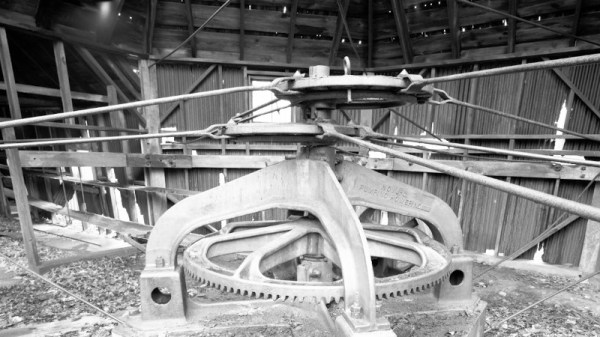
Many of us will have seen offshore oil platforms or nodding pumpjacks, but how many of us outside the industry have much more than a very superficial knowledge of it? Of all the various technologies to provide enlightenment of the curious technologist there’s one curious survivor from the earliest days of the industry that is definitely worth investigation, the jerk line oil well pump. This is a means of powering a reciprocating pump in an oil well not through an individual engine or motor as in the pump jacks, but in a system of rods transmitting power over long distances from a central location by means of reciprocating motion. It’s gloriously simple, which has probably contributed to its survival in a few small-scale oil fields over a century and a half after its invention.

Continue reading “Oil Wells Done Rube-Goldberg Style: Flatrods And Jerk Lines”