New Part Day: The ESP8266 Killer

Around this time last year we first heard of the ESP8266 WiFi module. It’s still a great little module, providing WiFi connectivity for all those Internet of Things things at a price point of just $5. It’s an attractive price for a great module with a huge community pumping out a lot of projects for the platform.

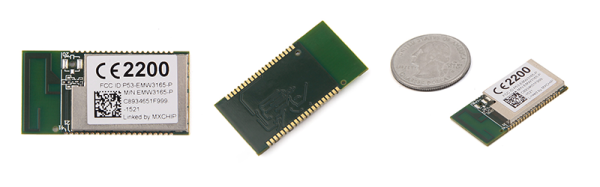
Now there’s a new kid on the block. It’s called the EMW3165, and like the ESP it provides WiFi connectivity for a bunch of wireless projects. It’s much, much more capable with an STM32F4 ARM Coretex M4 microcontroller, a ‘self hosted’ networking library, more RAM, more Flash, and more GPIOs. How much, you’re probably asking yourself. It’s a dollar more than the ESP8266.

The datasheet for the module goes over all the gritty details. While this chip has 3.6V I/Os, there are some 5V tolerant pins – a boon for the Arduino crowd. It’s also surprisingly low power for something that connects to an 802.11n network. The real bonus here is the STM32F4 core – that’s a very, very powerful microcontroller, and if you want a 2-component WiFi webcam build, this is the part you should use. There will be a lot of interesting builds using this part. It’s also passed FCC certification. Very cool.

Micro:bit — BBC Gets A Million Kids Into Embedded Dev

In the Early 1980s, the BBC launched a project to teach computer literacy to a generation of British schoolchildren. This project resulted in the BBC Micro, a very capable home computer that showed a generation exactly what a computer could do. These children then went home, turned on their ZX Spectrums, and became a generation of software engineers. Still, the BBC Micro is remembered fondly.

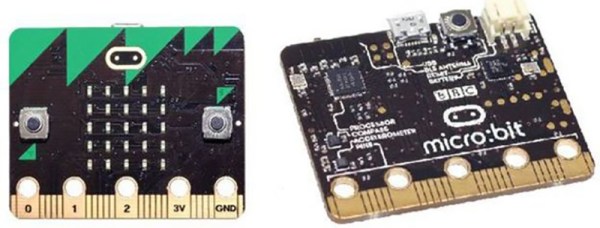
The computer revolution is long over, but today we suffer a sea change of embedded processors and microcontrollers. With Arduinos and Raspberry Pis, the BBC has decided it’s time to put the power of an ARM microcontroller into the hands of a million 11- and 12-year olds. The result is the Micro:bit. It’s a small microcontroller board with an ARM processor, an IMU, buttons, Bluetooth and a 5×5 LED array – exactly what you need if you’re teaching a million kids how to blink an LED.

Although the BBC has finalized the design for the Micro:bit, there are no specs at all. However, a few educated guesses can be made. The USB controller is provided by Freescale, who also provide the digital compass and magnetometer. Programming is done through a web-based, Arduino-like IDE with what appears to be a decent Micro:bit specific library. The board is also mbed compatible. Bluetooth, and apparently the ARM Cortex M0 core, is provided by a Nordic nRF51822. There are only three alligator clip-compatible I/Os, and its doubtful any student will be building anything that would be too complex for an entry level ARM. It’s also 3V logic; finally, the tyranny of 5V has fallen.

The Micro:bit is best seen as a tool that enables the relatively recent addition of a computer science curriculum in UK schools. There is now a requirement for seven-year-olds to understand algorithms and create simple programs. Previously computer education in the UK has consisted of PowerPoint. Now, secondary school students will be learning Boolean logic.

While the Micro:bit is utterly useless as a tool for doing real work, education is not real work. For blinking a few LEDs, having a device react to movement, playing with Bluetooth, and other lesser evils of electronics, the Micro:bit is great. Not everyone will become the digital technologists this initiative is trying to create, but for those who have an inclination towards semicolons and electrons, this is a great introduction to technology.

Logic Noise: Ping-pong Stereo, Mixers, And More

So far on Logic Noise, we’ve built up a bunch of sound-making voices and played around with sequencing them. The few times that we’ve combined voices together, we’ve done so using the simplest possible passive mixer — a bunch of resistors. And while that can work, we’ve mostly just gotten lucky. In this session, we’ll take our system’s output a little bit more seriously and build up an active mixer and simple stereo headphone driver circuit.

For this, we’ll need some kind of amplification, and our old friend, the 4069UB, will be doing all of the heavy lifting. Honestly, this week’s circuitry is just an elaboration of the buffer amplifiers and variable overdrive circuits we looked at before. To keep things interesting we’ll explore ping-pong stereo effects, and eventually (of course) put the panning under logic-level control, which is ridiculous and mostly a pretext to introduce another useful switch IC, the 4066 quad switch.

At the very end of the article is a parts list for essentially everything we’ve done so far. If you’ve been following along and just want to make a one-time order from an electronics supply house, check it out.

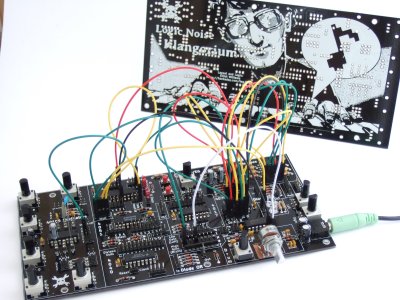
klangoriumIf you’re wondering why the delay in putting out this issue of Logic Noise, it’s partly because I’ve built up a PCB that incorporates essentially everything we’ve done so far into a powerhouse of a quasi-modular Logic Noise demo — The Klangorium. The idea was to take the material from each Logic Noise column so far and build out the board that makes experimenting with each one easy.

Everything’s open and documented, and it’s essentially modular so you can feel free to take as much or as little out of the project as you’d like. Maybe you’d like to hard-wire the cymbal circuit, or maybe you’d like to swap some of the parts around. Copy ours or build your own. If you do, let us know!

OK, enough intro babble, let’s dig in.

Continue reading “Logic Noise: Ping-pong Stereo, Mixers, And More” →

Gates To FPGAs: TTL Electrical Properties

On the path to exploring complex logic, let’s discuss the electrical properties that digital logic signals are comprised of. While there are many types of digital signals, here we are talking about the more common voltage based single-ended signals and not the dual-conductor based differential signals.

Simulated "Real Life"
Single-ended Logic Signal

I think of most logic as being in one of two major divisions as far as the technology used for today’s logic: Bipolar and CMOS. Bipolar is characterized by use of (non-insulated gate) transistors and most often associated with Transistor Transistor Logic (TTL) based logic levels. As CMOS technology came of age and got faster and became able to drive higher currents it began to augment or offer an alternative to bipolar logic families. This is especially true as power supply voltages dropped and the need for low power increased. We will talk more about CMOS in the next installment.

TTL was a result of a natural progression from the earlier Resistor Transistor Logic (RTL) and Diode Transistor Logic (DTL) technologies and the standards used by early TTL became the standard for a multitude of logic families to follow.

Continue reading “Gates To FPGAs: TTL Electrical Properties” →

True Random Number Generator For A True Hacker

How can you generate random bits? Some people think it’s not easy, others will tell you that it’s pretty damn hard, and then there are those who wonder if it is possible at all. Of course, it is easy to create a very long pseudorandom sequence in software, but even the best PRNG (Pseudorandom Number Generator) needs a good random seed, as we don’t want to get the same sequence each time we switch on the unit, do we? That’s why we need a TRNG (True Random Number Generator), but that requires special hardware.

Some high-end microprocessors are equipped with an internal hardware TRNG, but it is, unfortunately, not true for most low-cost microcontrollers. There are a couple of tricks hackers use to compensate. They usually start the internal free running counter and fetch its contents when some external event occurs (user presses a button, or so). This works, but not without disadvantages. First, there is the danger of “locking” those two events, as a timer period may be some derivative of input scan routine timing. Second, the free running time (between switching on and the moment the unit requests a random number) is often too short, resulting in the seed being too close to the sequence start, and thus predictable. In some cases even, there is no external input before the unit needs a random seed!

Despite what has already been discussed, microcontrollers do have a source of true randomness inside them. While it might not be good enough for crypto applications, it still generates high enough entropy for amusement games, simulations, art gadgets, etc.

Continue reading “True Random Number Generator For A True Hacker” →

Talking Big Changes At SparkFun With Nathan Seidle

SparkFun, you know them, you love them. They list themselves as “an online retail store” but I remember them for well-designed breakout boards, free-day, videos about building electronics, and the Autonomous Vehicle Competition. This week SparkFun turned my head for a different reason with the announcement that [Nathan Siedle], founder and CEO will be stepping down. He’s not leaving, but returning to the Engineering department while someone else takes the reigns. I spoke with him yesterday about what this means for him, the company, and what SparkFun has planned for the future.

Stepping Down Without Saying Goodbye

[Nate] founded Sparkfun in 2003 while still working on his Electrical Engineering degree from the University of Colorado Boulder. He cites wanting to return to his engineering roots as the reason for his title shift, which won’t happen for at least 9 or 10 months. It’s the concept of leaving the CEO position without leaving the company that raises many questions in my mind.

Continue reading “Talking Big Changes At SparkFun With Nathan Seidle” →

An Interview With The CEO Of MakerBot

A few days ago, we posed a question to the Hackaday community. If you could ask the CEO of MakerBot a question, what would it be?

It’s an interesting proposition; there is no company serving the maker community – and those of us who refuse to call ourselves part of the maker community – more hated than MakerBot. They’ve patented ideas uploaded to Thingiverse. They’ve turned their back on the open hardware community they grew out of, They’re undercutting their own resellers, and by all accounts, they don’t know how to make a working extruder. MakerBot was the company that would show the world Open Hardware could be successful, but turned into a company that seemed to reject Open Hardware and Open Source more than any other.

Needless to say, the readers of Hackaday responded. Not with actual questions for the MakerBot CEO, mind you, but oh how you responded. This effort by MakerBot was likened to the hail Mary thrown by Radio Shack  a few years ago. We know how that turned out.

Nevertheless, questions were collected, The MakerBot CEO was interviewed by Lady Ada, and a summary compiled. You can check that interview, originally posted on the Adafruit blog, below.

Continue reading “An Interview With The CEO Of MakerBot” →