Karting Hands-Free

Some of us have computer mice with more buttons than we have fingers, resolution tracking finer than a naked eye can discern, and forced-air vents. All these features presuppose one thing; the user has a functioning hand. [Federico Runco] knows that amyotrophic lateral sclerosis, ALS, or Lou Gehrig’s disease, will rob a person of their ability to use standard computer inputs, or the joystick on a motorized wheelchair. He is building EyesDrive for the 2020 Hackaday Prize, to restore that mobility to ALS patients. There are already some solutions, but this one focuses on a short bill of materials.

Existing systems are expensive and often track pupil location, which returns precise data, but EyesDrive only discerns, left, right, and resting. For these, we need three non-invasive electrodes, a custom circuit board with amplifiers, signal processing circuits, and a microcontroller. He includes a Bluetooth socket on the custom PCBs, which is the primary communication method. In the video below he steers a virtual kart around a knotty course to prove that his system is up to the task of an urban wheelchair.

EyesDrive by [Federico Runco] should not be confused with the HackadayPrize2015 winner, Eyedrivomatic, lead by two remarkable hackers, Steve Evans and Patrick Joyce.


Continue reading “Karting Hands-Free”

Sudden Death Rainbow Sorting Game Reveals Your True Colors

When [marzsman]’s eight-year-old daughter thought up a game they could play together involving rainbows, he was all ears. She is a certified rainbow expert, after all. They had a few R&D sessions and came up with a rainbow sorting speed trial game that looks fun to play and fairly easy to build.

Press that blue button on the side, and the RGB LEDs along the top are put in randomized order. The object of this game is simple — just sort the rainbow before the other player by pressing each LED’s corresponding arcade button. Whoever sorts faster is rewarded with a rainbow animation behind their set of way-cool clear buttons.

Inside the laser-cut box is an Espruino, which is a handy little microcontroller that speaks JavaScript. All of the arcade buttons are wired up as a key matrix. The astute among you have noticed there is six of everything, and that’s because indigo light is too hard to distinguish from blue. Check out the intense gameplay after the break.

If [marzsman]’s daughter wants to learn computer science, rainbows are good for that, too.

Continue reading “Sudden Death Rainbow Sorting Game Reveals Your True Colors”

Automation With A New Twist

Turning on a lightbulb has never been easier. You can do it from your mobile. Voice activation through home assistants is robust. Wall switches even play nicely with the above methods. It was only a matter of time before someone decided to make it fun, if you consider a Rubik’s cube enjoyable. [Alastair Aitchison] at Playful Technology demonstrated that it is possible to trigger a relay when you match all the colors. Video also after the break.

The cube does little to obfuscate game data, so in this scope, it sends unencrypted transmissions. An ESP32 with [Alastair]’s Arduino code, can track each movement, and recognize a solved state. In the video, he solves the puzzle, and an actuator releases a balloon. He talks about some other cool things this could do, like home automation or a puzzle room, which is in his wheelhouse judging by the rest of his YouTube channel.

We would love to see different actions perform remote tasks. Twisting the top could set a timer for 1-2-3-4-5 minutes, while the bottom would change the bedroom lights from red-orange-yellow-green-blue-violet. Solving the puzzle should result in a barrage of NERF darts or maybe keep housemates from cranking the A/C on a whim.

Continue reading “Automation With A New Twist”

GTA V Mod Shows (And Cheats) Those Stunt Jump Hoops

While the recent announcement of Grand Theft Auto V for the upcoming next-generation game consoles was a disappointment for those fervently waiting for a successor in the infamous video game series, it shows that after almost seven years of its initial release, the epic title is still going strong — and rightfully so. But a game as varied and complex as GTA V isn’t without some quirks, especially if you’re going for 100% completeness.

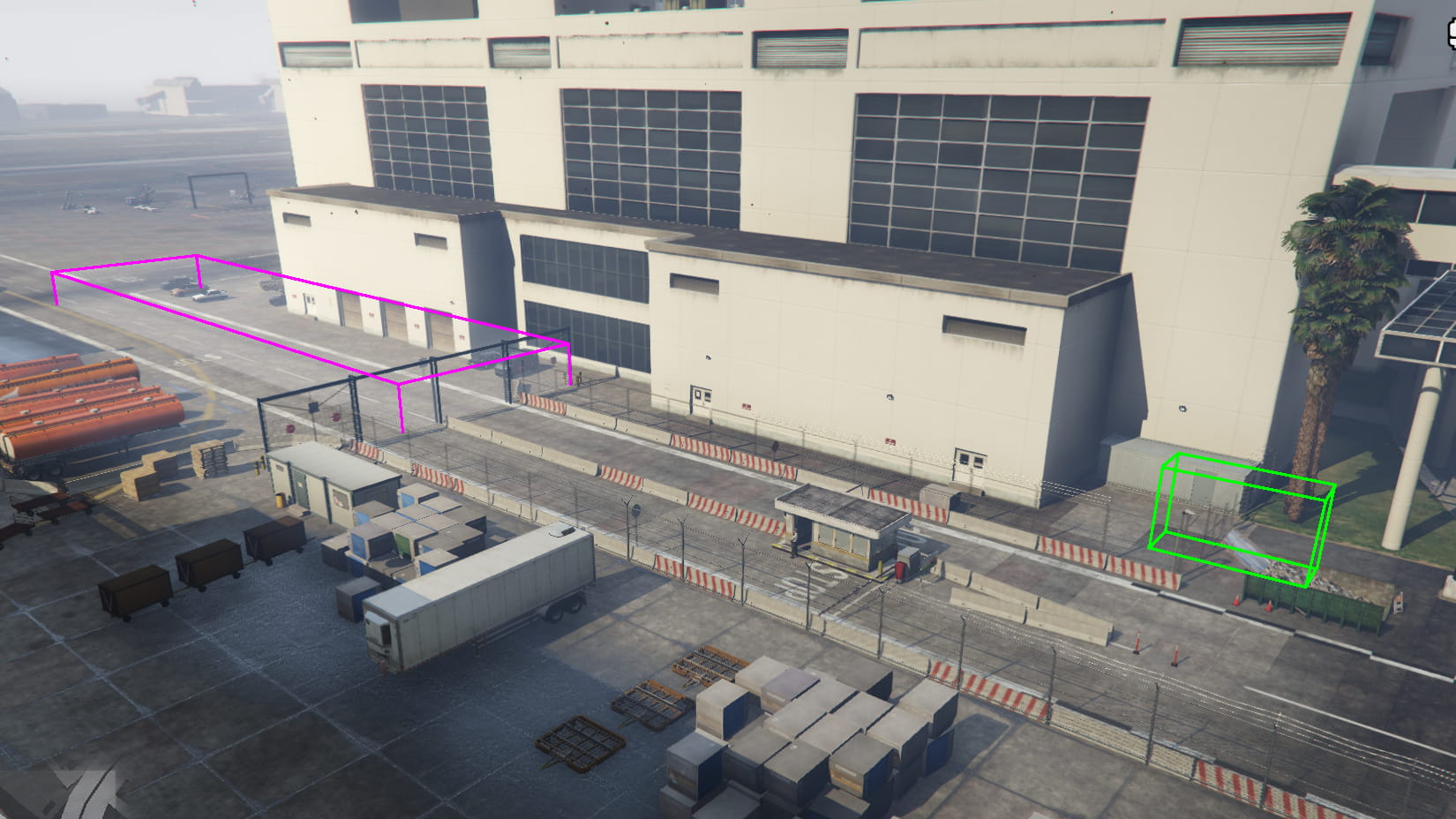
The stunt jumps seem a particular pesky nut to crack here, so [Anthony Som] made it his mission to shed some light on what qualifies as a successful jump by reverse engineering the system and writing both a mod for displaying the landing zone and a cheat to instant success.

If you’re not familiar with the game, its vast open world map features a variety of side quests, one of them being stunt jumps, where certain locations allow you to launch the vehicle you’re driving into the air in hopes to land on an adjacent road or area — whether to evade the people chasing you, or just for fun. There’s no telling how to actually succeed though, the game just tells you if you did or not afterwards, causing some degree of frustration. As an avid speedrunner (as in finishing a game in the shortest possible time), [Anthony] was looking for a way to increase the success rate for those stunt jumps, and decided to dig into the code to find out how to get there. Of course, being a proprietary game, he had to resort to reverse engineering and utilizing GTA’s vivid modding scene to do so.

His initial outcome was a mod that displays the launch and landing area as rectangles inside the game itself, which was a great help. But well, after already getting that far, [Anthony] figured he might as well continue and add a cheat mode to teleport the car right inside that expected landing area and be done with second-guessing his attempts once and for all.

If you’re curious about modding GTA yourself, his write-up has a few good pointers for that, and of course features some real examples of it. Whether this is a good idea for the self-driving AI that uses GTA as learning environment is probably a different story though.

Building The Scoreboard Of Your Imagination

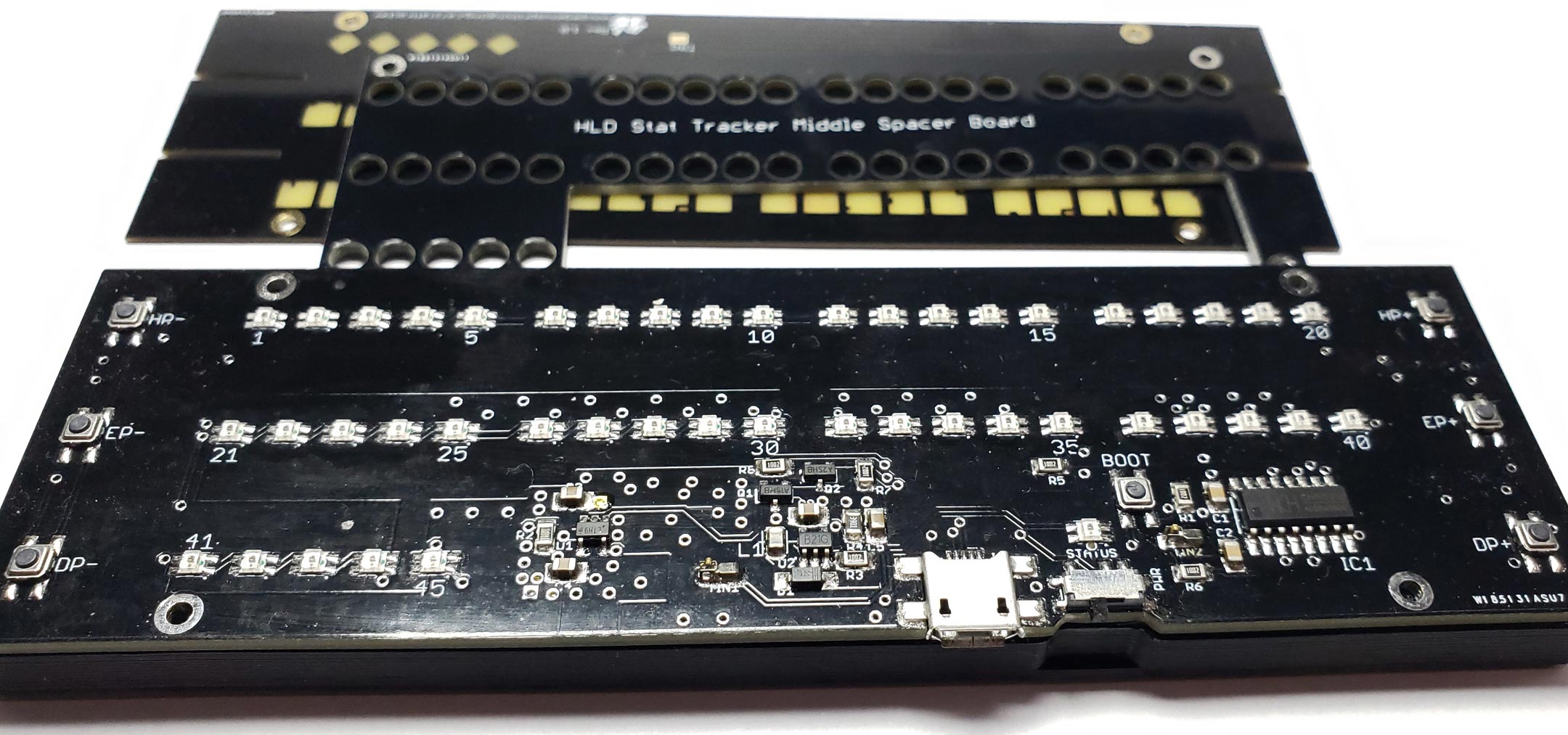
It might seem like electronic games and tabletop games are somewhat at odds. But there are always places where the lines are cleverly blurred as with this stat tracker beautifully constructed from a sandwich of circuit boards.

The nature of role playing games is one of deep imagination, putting yourself in the shoes of the player your are building though out a campaign. But of course the game board and pieces are there to keep track of all the data that your imagination just can’t. This can be done with a character card and some markers, a pad of paper, or a spreadsheet on your laptop. But to keep his mind in the world of Hyper Light Drifter, [Albert Phan] built this stat tracker that lives up to the aesthetic of the game.

The stackup of three PCBs does a brilliant job here, using cutouts on either end of the faceplate as a flexible tab that you press to actuate the surface mount button on the bottom PCB. The third PCB act as a spacer, not just for the six low-profile buttons, but also for the 40 LEDs that display status. That spacer has holes cut out for each light, providing isolation, with the FR4 substrate of the top plate acting as a diffuser.

It looks spectacular, it saves state between uses, and can be recharged via USB. But what’s that you say? You don’t play Hyper Light Drifter? Just respin the top PCB (and we suppose you’d need to tweak firmware as well) and you can swap it out for your game of choice.

Continue reading “Building The Scoreboard Of Your Imagination”

Miniature Star Wars Arcade Lets You Blow Up The Death Star On The Go

If you have fond childhood memories of afternoons spent at the local arcade, then you’ve had the occasional daydream about tracking down one of those old cabinets and putting it in the living room. But the size, cost, and rarity of these machines makes actually owning one impractical for most people.

While this fully functional 1/4th scale replica of the classic Star Wars arcade game created by [Jamie McShan] might not be a perfect replacement for the original, there’s no denying it would be easier to fit through your front door. Nearly every aspect of the iconic 1983 machine has been carefully recreated, right down to a working coin slot that accepts miniature quarters. Frankly, the build would have been impressive enough had he only put in half the detail work, but we certainly aren’t complaining that he went the extra mile.

[Jamie] leaned heavily on resin 3D printed parts for this build, and for good reason. It’s hard to imagine how he could have produced some of the tiny working parts for his cabinet using traditional manufacturing techniques. The game’s signature control yoke and the coin acceptor mechanism are really incredible feats of miniaturization, and a testament to what’s possible at the DIY level with relatively affordable tools.

The cabinet itself is cut from MDF, using plans appropriately scaled down from the real thing. Inside you’ll find a Raspberry Pi 3 Model A+ running RetroPie attached directly to the back of a 4.3 inch LCD with integrated amplified speakers. [Jamie] is using an Arduino to handle interfacing with the optical coin detector and controls, which communicates with the Pi over USB HID. He’s even added in a pair of 3,000 mAh LiPo battery packs and a dedicated charge controller so you can blow up the Death Star on the go.

Still don’t think you can fit one in your apartment? Not to worry, back in 2012 we actually saw somebody recreate this same cabinet in just 1/6th scale.

Continue reading “Miniature Star Wars Arcade Lets You Blow Up The Death Star On The Go”

Scratch Built Subnautica Sub Explores The Pool

In Subnautica, players explore an alien underwater landscape with the help of a number of futuristic tools and vehicles. [Robert Cook] found himself particularly enamored with the large submarine you unlock towards the later parts of the game, so much so that he decided to build his own real-life version.

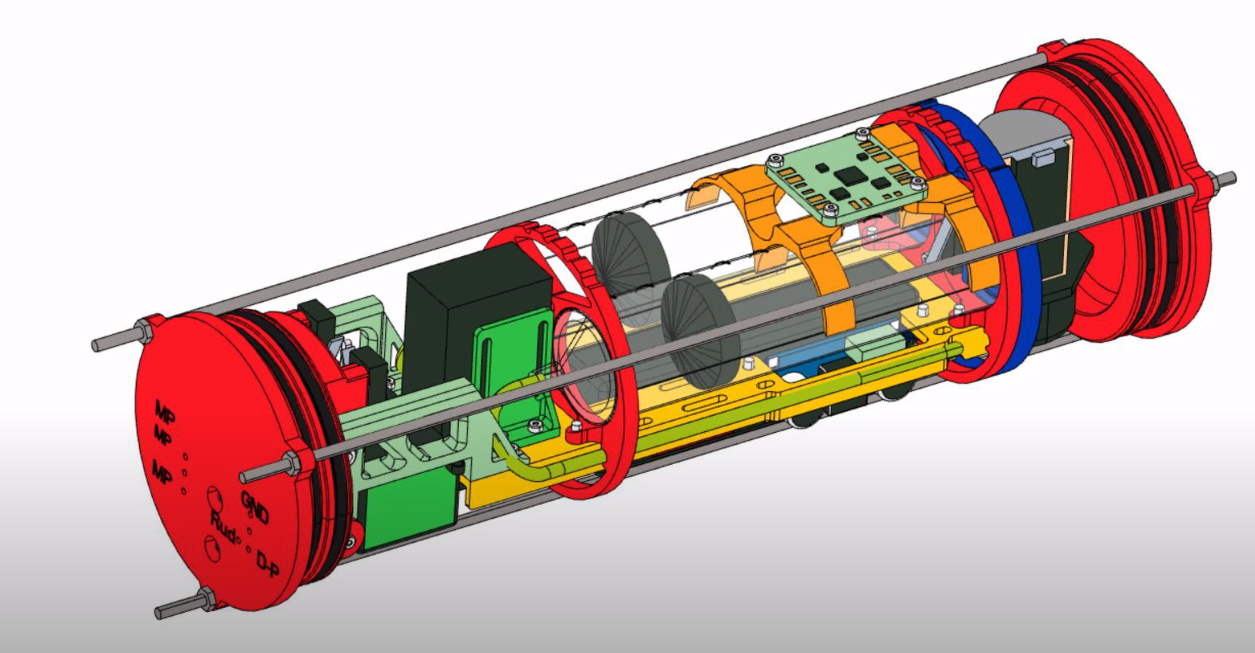
Even though the RC version of the Cyclops [Robert] has designed is only big enough to explore swimming pool sized alien landscapes, it’s by no means a simple build. In fact, the sub’s internal watertight compartment holds an impressive array of electronics and systems that are arguably overkill for what’s essentially a toy. Not that we’re complaining, of course.

Beyond the electronics and a few key components, almost every part of the RC Cyclops has been 3D printed. From the bulkheads that cap off the internal watertight acrylic tube to the hull itself, there’s a lot of plastic aboard this ship. Which might explain why it takes nearly two kilograms of lead weight to get the sub close to neutral buoyancy. From there, a clever ballast tank arrangement made from a syringe and peristaltic pump allow the vehicle to dive and surface on command.

[Robert] is in the process of releasing the STL files for all the submarine’s 3D printed components, and has done an excellent job of documenting the roughly four months he’s spent working on the project in a series of videos on his YouTube channel. The videos contain a wealth of fascinating tips and tricks regarding DIY submersible vehicles, such as selecting the proper radio frequencies for maximum penetration through water and counteracting the permeability of 3D printed parts with a generous coating of epoxy.

Modern RC hardware makes it easier than ever to cobble together a “submarine”, but there’s still something to be said for a project that takes the long way around and actually implements features like a functioning ballast system.

Continue reading “Scratch Built Subnautica Sub Explores The Pool”