ERRF 18: Slice Engineering Shows Off The Mosquito

With few exceptions, it seemed like every 3D printer at the first inaugural East Coast RepRap Festival (ERRF) was using a hotend built by E3D. There’s nothing inherently wrong with that; E3D makes solid open source products, and they deserve all the success they can get. But that being said, competition drives innovation, so we’re particularly interested anytime we see a new hotend that isn’t just an E3D V6 clone.

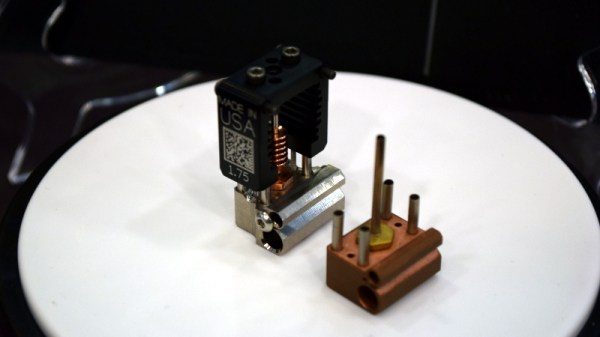
The Mosquito from Slice Enginerring is definitely no E3D clone. In fact, it doesn’t look much like any 3D printer hotend you’ve ever seen before. Tiny and spindly, the look of the hotend certainly invokes its namesake. But despite its fragile appearance, this hotend can ramp up to a monstrous 500 C, making it effectively a bolt-on upgrade for your existing machine that will allow you to print in exotic materials such as PEEK.

We spent a little time talking with Slice Engineering co-founder [Dan], and while there’s probably not much risk it’s going to dethrone E3D as the RepRap community’s favorite hotend, it might be worth considering if you’re thinking of putting together a high-performance printer.

Continue reading “ERRF 18: Slice Engineering Shows Off The Mosquito”

Friday Hack Chat: Hacking Voice Assistants

The future of consumer electronics is electronic voice assistants, at least that’s what the manufacturers are telling us. Everything from Alexas to Google Homes to Siris are invading our lives, and if predictions hold, your next new car might just have a voice assistant in it. It’s just a good thing we have enough samples of Majel Barrett’s voice for a quality virtual assistant.

For this week’s Hack Chat, we’re going to be talking all about voice interfaces. There are hundreds of Alexa and Google Home hacks around, but this is just the tip of the iceberg. What else can we do with these neat pieces of computer hardware, and how do we get it to do that?

Our guest for this week’s Hack Chat will be Nadine Lessio, a designer and technologist out of Toronto with a background in visual design and DIY peripherals. Nadine holds an MDes from OCADU where she spent her time investigating the Internet of Things through personal assistants. Currently, she’s working at OCADUs Adaptive Context Environments Lab where she’s researching how humans and devices work together.

During this Hack Chat, Nadine will be talking about voice assistants and answering questions like:

  • What languages can be used to program voice assistants
  • How do you use voice and hardware together?
  • What goes into the UX of a voice assistant?
  • How do these assistants interface with microcontrollers, Pis, and other electronics platforms?

You are, of course, encouraged to add your own questions to the discussion. You can do that by leaving a comment on the Hack Chat Event Page and we’ll put that in the queue for the Hack Chat discussion.join-hack-chat

Our Hack Chats are live community events on the Hackaday.io Hack Chat group messaging. This week is just like any other, and we’ll be gathering ’round our video terminals at noon, Pacific, on Friday, July 13th.  Need a countdown timer? Yes you do.

Click that speech bubble to the right, and you’ll be taken directly to the Hack Chat group on Hackaday.io.

You don’t have to wait until Friday; join whenever you want and you can see what the community is talking about.

Putting More Tech Into More Hands: The Robin Hoods Of Hackaday Prize

Many different projects started with the same thought: “That’s really expensive… I wonder if I could build my own for less.” Success is rewarded with satisfaction on top of the money saved, but true hacker heroes share their work so that others can build their own as well. We are happy to recognize such generosity with the Hackaday Prize [Robinhood] achievement.

Achievements are a new addition to our Hackaday Prize, running in parallel with our existing judging and rewards process. Achievements are a way for us to shower recognition and fame upon creators who demonstrate what we appreciate from our community.

Fortunately there is no requirement to steal from the rich to unlock our [Robinhood] achievement, it’s enough to give away fruits of price-reduction labor. And unlocking an achievement does not affect a project’s standings in the challenges, so some of these creators will still collect coveted awards. The list of projects that have unlocked the [Robinhood] achievement will continue to grow as the Hackaday Prize progresses, check back regularly to see the latest additions!

In the meantime, let’s look at a few notable examples that have already made the list:

Continue reading “Putting More Tech Into More Hands: The Robin Hoods Of Hackaday Prize”

Rocket Bullets: The Flame And Fizzle Of The Gyrojet

In the 1950’s and 60’s, the world had rocket fever. Humankind was taking its first steps into space and had sights on the moon. Kids could build rockets at the kitchen table and launch them in the schoolyard. On the darker side, the arms race was well underway with the US and USSR trying to close the fictional missile gap.

All around the world, engineers were trying to do new things with rockets. Among these were Robert Mainhardt and Arthur T. Biehl, who thought rockets could be useful as small arms. Together they formed MBA (short for Mainhardt and Biehl Associates), with an eye toward future weapons – – specifically rocket bullets.

Continue reading “Rocket Bullets: The Flame And Fizzle Of The Gyrojet”

Hackaday Links Column Banner

Hackaday Links: July 8, 2018

Software-defined radio has been around for years, but it’s only recently that it’s been accessible to those of us who don’t have tens of thousands of dollars worth of equipment in their lab. Here’s a new book from Analog Devices that gives you the lowdown on software-defined radio. It’s heavy on MATLAB and components from Analog, but it’s still a solid foundation for SDR.

Do you like cyberpunk? Do you like stories about rebellious people overthrowing the system? How about androids? Do you like androids? Here’s a Kickstarter that’s tying all of that togetherNeptune Frost is (will be?) a movie about an e-waste village in Burundi that’s home to the ‘world’s most subversive hacking collective’, a coltan miner and an inter-sex runaway. It’s literally got everything.

Hey, this is cool, Hackaday has been cited in a journal article. The title of the article is An open-source approach to automation in organic synthesis: The flow chemical formation of benzamides using an inline liquid-liquid extraction system and a homemade 3-axis autosampling/product-collection device,  and can be found in Tetrahedron Volume 74, Issue 25, 21 June 2018, Pages 3152-3157.

Asteroid day was a few days ago, and there’s a Kickstarter to go with it. The Planetary Society, headed up by Bill Nye (a science guy) is raising awareness about the threat of asteroid impacts. There’s hilarious swag that says ‘Kick Asteroid’, even though actually kicking an asteroid might be a bad idea; a gravity tractor would be the best method of nudging the orbit of an asteroid given enough time.

Last year, a company in the US trademarked the word ‘RetroPie’ and used that trademark to sell Raspberry Pis loaded up with (you guessed it) RetroPie software. This company also used the trademark to force anyone else doing the same to stop. Obviously, this didn’t sit well with the developers of RetroPie. After some generous legal help, the RetroPie trademark issue has been resolved. That’s a tip of the hat to Eckland & Blando who offered some pro bono legal work.

Circuit VR: Simple Buck Converters

The first thing I ever built without a kit was a 5 V regulated power supply using the old LM309K. That’s a classic linear regulator like a 7805. While they are simple, they waste a lot of energy as heat, especially if the input voltage goes higher. While there are still applications where linear regulators make sense, they are increasingly being replaced by switching power supplies that are much more efficient. How do switchers work? Well, you buy a switching power supply IC, add an inductor and you are done. Class dismissed. Oh wait… while that might be the best way to do it from a cost perspective, you don’t really learn a lot that way.

In this installment of Circuit VR, we’ll look at a simple buck converter — that is a switching regulator that takes a higher voltage and produces a lower voltage. The first one won’t actually regulate, mind you, but we’ll add that in a future installment. As usual for Circuit VR, we’ll be simulating the designs using LT Spice.

Interestingly, LT Spice is made to design power supplies so it has a lot of Linear Technology parts in its library just for that purpose. However, we aren’t going to use anything more sophisticated than an op amp. For the first pass, we won’t even be using those.

Continue reading “Circuit VR: Simple Buck Converters”

Wrangling RC Servos Becoming A Hassle? Try Serial Bus Servos!

When we need actuators for a project, a servo from the remote-control hobby world is a popular solution. Though as the number of servos go up, keeping their wires neat and managing their control signals become a challenge. Once we start running more servos than we have fingers and toes, it’s worth considering the serial bus variety. Today we’ll go over what they are and examine three products on the market.

Continue reading “Wrangling RC Servos Becoming A Hassle? Try Serial Bus Servos!”