The Essential List Of 3D Printer Accessories

You’ve acquired your first 3D printer and are giddy with excitement. But like all new additive manufacturing adventurers, the more you do with your printer the more questions arise. Don’t worry, we’ve got your back.

Getting the most out of your time with a new 3D printer has a lot to do with the tools and accessories on hand and what you do with them. Let’s take a look at a few of the accessories that should accompany every 3D printer, be it in your home, school, or hackerspace. There’s already enough potential aggravation when it comes to 3D printing, the goal here is to ensure you won’t be without a tool or supply when you need it the most.

Continue reading “The Essential List Of 3D Printer Accessories”

Scotty Allen Visits Strange Parts, Builds An IPhone

Scotty Allen has a YouTube blog called Strange Parts; maybe you’ve seen his super-popular video about building his own iPhone “from scratch”. It’s a great story, and it’s also a pretext for a slightly deeper dive into the electronics hardware manufacturing, assembly, and repair capital of the world: Shenzhen, China. After his talk at the 2017 Superconference, we got a chance to sit down with Scotty and ask about cellphones and his other travels. Check it out:

The Story of the Phone

Scotty was sitting around with friends, drinking in one of Shenzhen’s night markets, and talking about how bizarre some things seem to outsiders. There are people sitting on street corners, shucking cellphones like you’d shuck oysters, and harvesting the good parts inside. Electronics parts, new and used, don’t come from somewhere far away and there’s no mail-ordering. A ten-minute walk over to the markets will get you everything you need. The desire to explain some small part of this alternate reality to outsiders was what drove Scotty to dig into China’s cellphone ecosystem.

Continue reading “Scotty Allen Visits Strange Parts, Builds An IPhone”

Retrotechtacular: A 180 GB Drive From 1994

Hard drive storage has gone through the roof in recent years. Rotating hard drives that can hold 16 terabytes of data are essentially available today, although pricey, and 12 terabyte drives are commonplace. For those who remember when a single terabyte was a lot of storage, the idea that you can now pick up a drive of that size for under $40 is amazing. Bear in mind, we are talking terabytes.

In 1994, that was an unimaginable amount of storage. Just a scant 24 years ago, though, you could get 90 gigabytes — 0.09 terabytes — if you didn’t mind buying an IBM mainframe and a RAMAC disk storage unit. You can see a promotional video digitized by Archive.org, below. Just keep in mind that IBM has a long history of calling disk drives DASD — an acronym for Direct Access Storage Device. You pronounce that “dazz-dee”, as you’ll hear in the video.

Continue reading “Retrotechtacular: A 180 GB Drive From 1994”

Cutting Edge Of 3D Printing Revealed At Last Weekend’s Midwest RepRap Festival

The last three days marked the 2018 Midwest RepRap Festival. Every year, the stars of the 3D printing world make it out to Goshen, Indiana for the greatest gathering of 3D printers and printing enthusiasts the world has ever seen. This isn’t like any other 3D printing convention — everyone here needs to take the time to get to Goshen, and that means only the people who want to be here make it out.

Over the weekend we covered some amazing hacks and printer builds from MRRF. The ‘BeagleBone On A Chip’ has become a complete solution for a 3D printer controller. This is a great development that takes advantage of the very under-used Programmable Real-Time Units found in the BeagleBone, and will make an excellent controller for that custom printer you’ve been wanting to build. E3D has announced they’re working on an automatic tool-changing printer. It’s a slight derivative of their now-defunct BigBox printer, but is quite possibly the best answer to multi-material filament printers we’ve ever seen. There’s some interest from the community, and if everything goes well, this printer may become a kit, or something of the sort. Filament splicing robots also made an appearance at this year’s MRRF, and the results are extremely impressive. Now you can create multi-color prints with the printer you already own. Is it expensive? Yes, but it looks so good.

This wasn’t all that could be found at MRRF. There were hundreds of printers at the event, and at last count, over 1300 attendees. That’s amazing for a 3D printer convention that is held every year in the middle of nowhere, Indiana. What were the coolest sights and sounds coming out of MRRF this year? Check out the best-of list below.

Continue reading “Cutting Edge Of 3D Printing Revealed At Last Weekend’s Midwest RepRap Festival”

Hackaday Links Column Banner

Hackaday Links: March 25, 2018

File this one under, ‘don’t do this yourself, but we’re glad they filmed it.’ [Denis Koryakin] flew a quadcopter to 10km, or about 33,000 feet. This was just an experiment to see if it was possible. A few items of note from the video: this thing was climbing at 14-15 m/s when it first took off. It was barely climbing at 2 m/s at 10km. Second: it was really, really cold. The ground temperature was -10 C, and temperatures at 8km reached -50 C. Density altitude is on this guy’s side, and I don’t know if this would be possible in warmer temperatures.

Hold on to your hats, there’s a gigantic space station that’s going to crash sometime in the next few weeks. Tiangong-1, an 8-ton space station launched in 2011, is going to reenter the atmosphere ‘sometime between March 30 and April 6’. Because of orbits and stuff, it’s more likely to reenter at the highest latitudes, and this space station has an inclination of 42.7 degrees. If your latitude is 42° N or 42° S, you should probably pull a Liza Minnelli on this situation and spend the next month in bed.

Hey, cool! The Tindie Badge is being used to teach orphans in Bosnia how to solder.

The BBC has decided to cancel Robot Wars. No, it’s not Battlebots — the house robots always seemed to be a bit overkill and added too much drama. No, it’s not Scrapheap Challenge or Junkyard Wars, but Robot Wars was legitimately fun, and cheap-to-produce reality TV. The engineering that went into these bots was amazing, and this is a loss for the entire engineering community. Here’s a change.org petition against its cancellation, but we all know how successful those change.org petitions can be.

FREE CHIPS!. Free motor drivers, actually, which is even more impressive. Aisler puts together BOMs for projects and such — think of it as an on-demand kitting service. They’re throwing in free Trinamic drivers with orders. Someone should build a motor driver breakout.

Hackaday Visits World’s Oldest Computer Festival: TCF 43

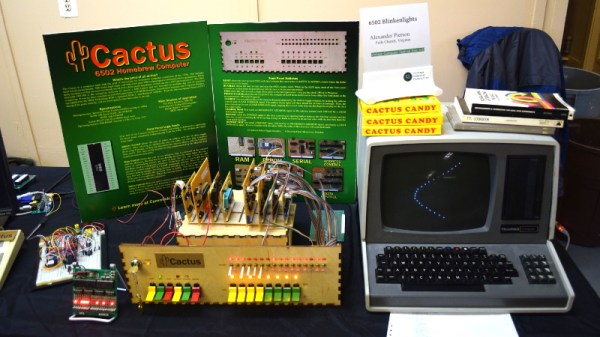
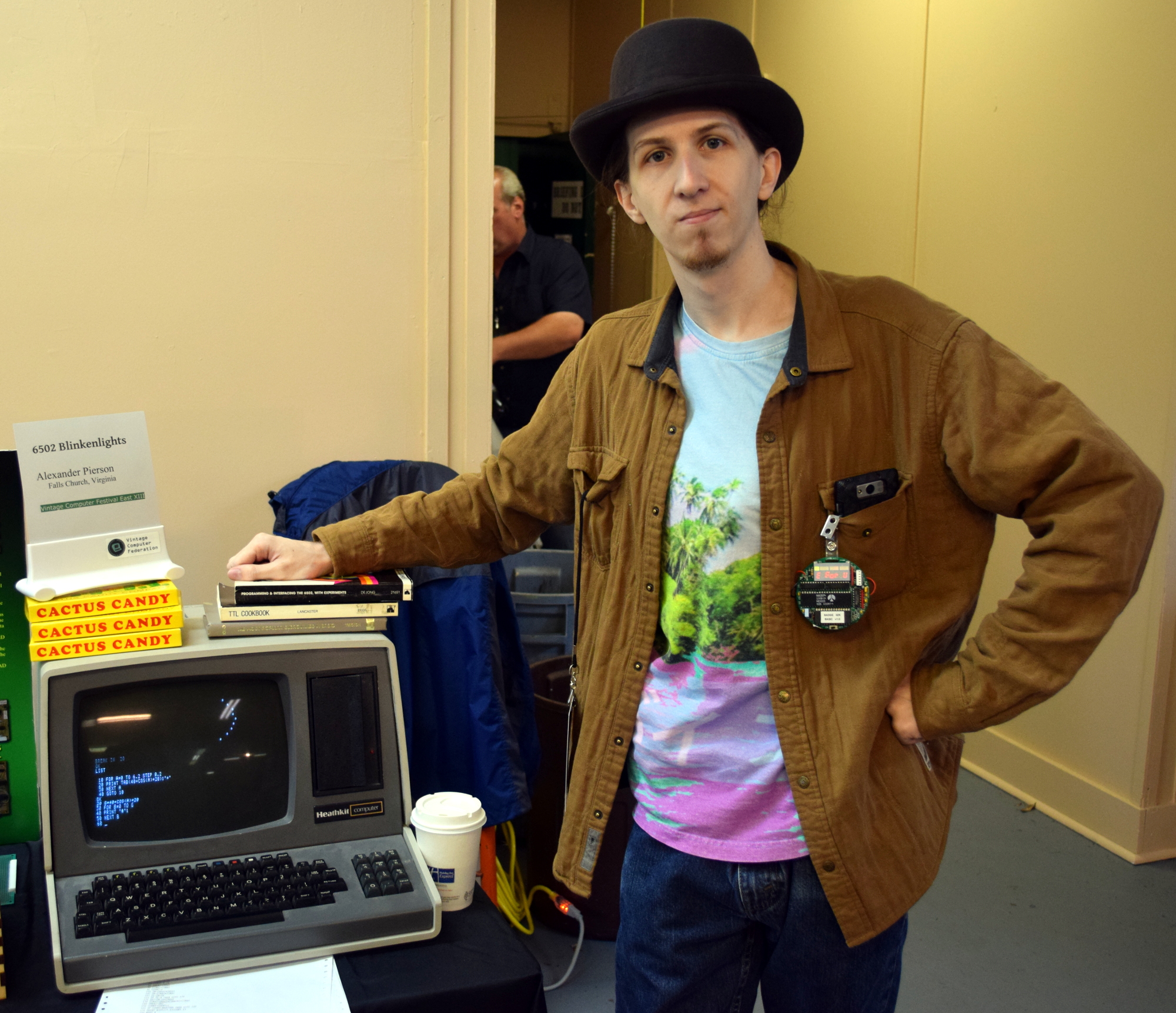
I was fortunate enough to visit the Trenton Computer Festival last weekend. The show struck a very interesting mix of new and old, commercial and educational. Attendees were writing programs in BASIC on an Apple I (courtesy of the Vintage Computer Federation) not more than five feet from where students were demonstrating their FIRST robot.

The one-day event featured over fifty demonstrations, talks, and workshops on topics ranging from a crash course in lock picking to the latest advancements in quantum computing. In the vendor room you could buy a refurbished laptop while just down the hall talks were being given on heady topics such as using neural networks and genetic algorithms for day trading on the stock market.

Recent years have seen a widening of the content presented, but TCF’s longevity means there is a distinct “vintage” vibe to the show and the culture surrounding it. Many of the attendees, and even some of the presenters, can proudly say they’ve been attending since the very first show in 1976.

There was simply too much going on to see everything. At any given time, there were eleven talks happening simultaneously, and that doesn’t include the demonstrations and workshops which ran all day. I documented as many highlights from this year’s TCF as I could for those who haven’t had a chance to visit what might be the most low-key, and certainly oldest, celebration of computing technology on the planet. Join me after the break for the whirlwind tour.

Continue reading “Hackaday Visits World’s Oldest Computer Festival: TCF 43”

Mechanisms: Cable Ties

Zip ties, Ty-Raps, cable ties; call them what you will, but it’s hard to imagine doing without these ubiquitous and useful devices. Along with duct tape and hot glue, they’re part of the triumvirate of fasteners used to solve nasty problems quickly and cheaply. They’re next up on the list of mechanisms we find fascinating, and as it turns out, there’s more to these devices than meets the eye.

Continue reading “Mechanisms: Cable Ties”