When Hackerspace Directors Burn Out

A friend of mine once suggested that there should be a support group for burned-out former hackerspace directors. We could have our own Village of the Damned at summer camps, where we’d sit moodily in the gathering twilight sipping our bourbon and Club Mate and decrying whatever misfortunes came to our space to leave such visible mental scars, or gazing hollow-eyed into the laser-tinged haze and moving gently to the pulse of the chiptune music. “See that’s Jenny over there, she don’t say much“. Hackerspace noir, where the only entry criterion is being crazy enough to stand for election to your space’s board.

You can tell [Dr. Seuss] is thinking about his next volume: <em>How The Grinch Stole Whoville Hackspace</em>. Al Ravenna, World Telegram [Public domain].
You can tell [Dr. Seuss] is thinking about his next volume: How The Grinch Stole Whoville Hackspace. Al Ravenna, World Telegram [Public domain].
There must be spaces somewhere that live in such perfect harmony, in which a happy membership support a board for whom everything falls into place. Maybe the makerspace in [Dr. Seuss]’s Whoville would have that kind of atmosphere, but the reality of life is that every group is made up of both Grinch and Who. Keeping a diverse group of people harmonious is a huge challenge, but that’s what hackerspaces are really about — the people make the space.

There are several defined periods in the gestation of a hackerspace, and at least from where I’m sitting they relate to its member count. Some spaces pass through them all as they grow, while others are lucky enough to reach an equilibrium and spare themselves some of the drama.

If you recognise yourselves in some of the following then you have my commiserations, while if your space hasn’t got there yet or has managed to dodge some of the bullets then consider yourselves lucky.

Continue reading “When Hackerspace Directors Burn Out”

RIP DIP ARM

Every month, semiconductor manufacturers across the globe retire old devices. A product that has been superseded, isn’t selling well, or maybe whose application has declined, is removed from the catalogue and ceases to be manufactured. Usually these moments pass unnoticed, just one old device among many. Who is going to remark upon the demise of a chip for a VGA card for example, or a long-ago-left-behind Flash memory chip?

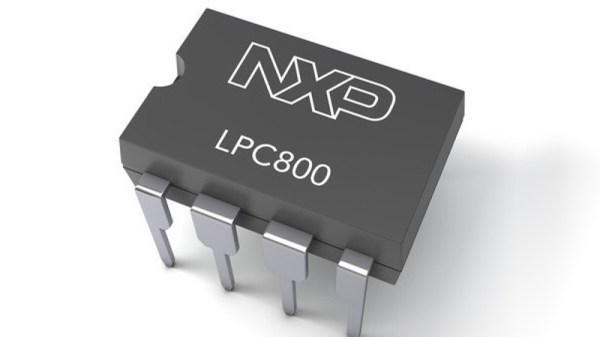
One has come to our attention that is pretty unremarkable, but that could concern some of our readers. NXP have stopped manufacturing the LPC810M021FN8. What on earth is an LPC810M021FN8, you ask, the answer being that it appears to have been the last microcontroller with an ARM core available in a DIP package. Even that in itself is hardly earth-shattering, for if you really must use an ARM core rather than any of the myriad 8, 16, or 32 bit microcontrollers still available you can always get a DIP breakout board for a small surface mount chip.

This turn of events comes as a reminder that, while breadboard-friendly and popular among a section of our community, DIP packages are now particularly old-school. Other once-popular devices such as the LPC1114 have also long-since ceased to be available in this format, and we have to wonder how long we will be able to take advantage of DIP packages for some of the other microcontroller families.

A few years ago this news might have come as something of a disaster, but it now has more of a sense of the passing of a bygone era. It’s normal to use microcontroller dev boards in a larger DIP format for prototyping, so maybe getting used to a bit of surface-mount soldering on a break-out board will be only for the truly hard-core when the last DIP package has been retired. Other than that of course, the 555 is still available in a DIP8, and you can make anything with one of them!

If you didn’t have a chance to take the 810 for a test drive, the usual suppliers still list it in stock, Adafruit have a starter pack for it, and it will no doubt be possible to find it in small quantities for years to come.

[Thanks Tod E. Kurt for the tip]

Hackaday And Tindie Are Coming To London On Sunday!

Hackaday and Tindie have arrived in London at the weekend, fresh from our Dublin Unconference. Join us this Sunday afternoon, as we convene at the Artillery Arms, a pub on the northeastern edge of the City. It’s a free event, we ask though that you sign up for it via Eventbrite if you’d like to attend.

We’re following our usual Bring-a-Hack style format, so come along and hang out with members of the London Hackaday community, and if you have a project to bring along then don’t be shy as we’d love to see it. And especially if you have a Hackaday Prize entry to show then we’d particularly like to see it. You never cease to amaze us with the work you do, be it the simplest of hacks or the most technically advanced. Just one thing though, if you bring something, make sure it’s handheld or portable enough to easily sit on a pub tabletop, space may be limited.

In attendance will be Tindie’s [Jasmine Brackett] and Hackaday’s [Jenny List], as well as quite a few of our community regulars. What better way could there be to spend a spring Sunday afternoon in London?

But what if you can’t make London, and face the prospect of missing out on us entirely? Fortunately, this one is not the only meetup we have planned, we’re heading to Nottingham and Cambridge on the 18th and 19th of April, respectively, and might even squeeze in another date if we can.

Leap Motion Announces Open Source Augmented Reality Headset

Leap Motion just dropped what may be the biggest tease in Augmented and Virtual Reality since Google Cardboard. The North Star is an augmented reality head-mounted display that boasts some impressive specs:

  • Dual 1600×1440 LCDs
  • 120Hz refresh rate
  • 100 degree FOV
  • Cost under $100 (in volume)
  • Open Source Hardware
  • Built-in Leap Motion camera for precise hand tracking

Yes, you read that last line correctly. The North Star will be open source hardware. Leap Motion is planning to drop all the hardware information next week.

Now that we’ve got you excited, let’s mention what the North Star is not — it’s not a consumer device. Leap Motion’s idea here was to create a platform for developing Augmented Reality experiences — the user interface and interaction aspects. To that end, they built the best head-mounted display they could on a budget. The company started with standard 5.5″ cell phone displays, which made for an incredibly high resolution but low framerate (50 Hz) device. It was also large and completely unpractical.

The current iteration of the North Star uses much smaller displays, which results in a higher frame rate and a better overall experience.  The secret sauce seems to be Leap’s use of ellipsoidal mirrors to achieve a large FOV while maintaining focus.

We’re excited, but also a bit wary of the $100 price point — Leap Motion is quick to note that the price is “in volume”. They also mention using diamond tipped tooling in a vibration isolated lathe to grind the mirrors down. If Leap hasn’t invested in some injection molding, those parts are going to make the whole thing expensive. Keep your eyes on the blog here for more information as soon as we have it!

Applications Open: Ada Lovelace Fellowships For 2018 Open Hardware Summit

The Open Source Hardware Association is now accepting applications for the Ada Lovelace fellowship which provides free admission to the Open Hardware Summit and a $500 travel stipend. One of OSHWA’s goals is to foster a more diverse community within open source. As part of this, Ada Lovelace Fellowships are open to women, LGBTA+, and people of color. There are a total of 10 fellowships available and applications are due by April 30th. The Open Hardware Summit will be held on September 27th at MIT.

The fellowship program, founded by Addie Wagenknecht and Alicia Gibb in 2013, builds on the ideal that Open Hardware is one way to reduce the barriers associated in access to technology. Removing some of the financial barriers associated with attending the Summit will help to ensure more people of diverse backgrounds are involved in shaping the Open Hardware world. In addition to the talks shared at the gathering, over the last several year OSWHA has been evolving the Open Hardware definition and an Open Hardware certification.

Disclaimer: [Christopher Wang] is a board member of the Open Source Hardware Association

Firefox Reality, A Browser For VR Devices

The browser you are reading this page in will be an exceptionally powerful piece of software, with features and APIs undreamed of by the developers of its early-1990s ancestors such as NCSA Mosaic. For all that though, it will very probably be visually a descendant of those early browsers, a window for displaying two-dimensional web pages.

Some of this may be about to change, as in recognition of the place virtual reality devices are making for themselves, Mozilla have released Firefox Reality, in their words “a new web browser designed from the ground up for stand-alone virtual and augmented reality headset“. For now it will run on Daydream and GearVR devices as a developer preview, but the intended target for the software is a future generation of hardware that has yet to be released.

Readers with long memories may remember some of the hype surrounding VR in browsers back in the 1990s, when crystal-ball-gazers who’d read about VRML would hail it as the Next Big Thing without pausing to think about whether the devices to back it up were on the market. It could be that this time the hardware will match the expectation, and maybe one day you’ll be walking around the Hackaday WrencherSpace rather than reading this in a browser. See you there!

They’ve released a video preview that disappointingly consists of a 2D browser window in a VR environment. But it’s a start.

Continue reading “Firefox Reality, A Browser For VR Devices”

The Amazing Hacks Of World Create Day

For this year’s Hackaday Prize, we started an amazing experiment. World Create Day organized hundreds of hackerspaces around the world to come together and Build Hope for the future. This was an experiment to bring community shops and workspaces together to prototype their entries for the Hackaday Prize, and boy was it a success. We had hackerspaces from Portland to Pakistan taking part, and these are just a few of the amazing hacks they pulled off.

Students In Canada Repairing LipSyncs!

The theme of this year’s Hackaday Prize is to Build Hope, and students in Burnaby, British Columbia worked on some very cool projects that did just that. They created custom video game controllers, prototyped a few exoskeleton arms, and repaired LipSyncs. A LipSync is a mouth-operated joystick that allows a person to control a cursor on a computer with a minimum amount of head and neck movement. The idea behind the LipSync is to give wheelchair-bound people access to computers. This is important because an estimated one million people in Canada and the United States have limited or no use of their arms, rendering touchscreens inoperable.

The LipSync was an entry into the 2016 Hackaday Prize, and while it didn’t win the grand prize, it did bring a device that usually costs $3,000 down to about $300. That’s an order of magnitude of cost reduction that Builds Hope for the future. It’s amazing!

Raspberry Pis and Tschunk Slushies!

You might think that mixing alcohol and electronics might be dangerous, but not the people of kraut space, the hackerspace in Jena, Germany. For their World Create Day adventures, they made Tschunk Slushies! What is Tschunk? It’s rum and Club Mate, the definitive hacker drink! You might even say the addition of ethanol made it even more of a hacker drink. Ha ha.

While the Tschunk Slushies were mixing up, the team at the Jena Hackerspace set to work on their World Create Day project, an interface that logs their electricity usage. In reality this is just a photosensor taped to their power meter, but they’ve hooked everything up to a Raspberry Pi, giving them the ability to monitor electricity consumption over the Internet. That’s amazing. Governments and utility companies have spent billions of dollars developing ‘smart’ electricity meters, but a few ‘hackers’ have created their own in just hours! It’s almost as if that ‘hacker’ title isn’t bad at all, and being a ‘hacker’ is a good thing!

Making Laser Cutters Safe And Soldering Keychains

You’ll shoot your eye out, kid! Or at least you stand a decent chance of suffering irreversible eye damage if you’re running a laser cutter with the lid open. And for some reason, most of the cheap laser cutters out there come without safety interlocks if you can believe it. For his World Create Day Project, [RoboterFreak] made a laser cutter more secure. By putting a relay, microswitch, and Arduino in line with the laser tube, you can safely modify an off-the-shelf laser cutter to be vastly safer.

It’s not much, but it goes a long way toward making a laser cutter safe. With the simple addition of a switch, this laser cutter is now a machine that can be used within a quarter mile of children. This is something simple that you should do at your own hackerspace.

But World Create Day and the Hackaday Prize isn’t only about fretting over safety concerns. The folks at Thimble.io had fun soldering their own keychain flashlight. This is an awesome way to learn how to solder and hardware development. That’s exactly what we’re looking for in this year’s Hackaday Prize, by the way. We want people who will Build Hardware to Change The World.

The Hackaday Prize is running until November, and there’s still plenty of time to get your entry in. It doesn’t even have to be related to World Create Day, the most amazing virtual congregation of hackerspaces the world has ever seen. You can start your entry for the Hackaday Prize right here, build a project that will Build Hope, and be in the running to win tens of thousands of dollars. It’s an amazing contest, and we couldn’t have done it without the support of our amazing online community.