Choosing A ‘Scope: Examining Bandwidth

A few weeks ago I asked the Hackaday community for some help and advice in buying a new budget oscilloscope. Thank you very much to those of you who responded both here online and in person among my friends closer to home. I followed the overwhelming trend in the advice I received, and bought myself a Rigol DS1054z, an instrument with which I am very happy. It’s a nominally a 50 MHz scope, but there’s a software hack that can bring it up to 100 MHz. How fast can it go?

My trusty Cossor, its 2 MHz bandwidth as yet unverified.

This question became a mini scope-shootout after a conversation with my Hackaday colleague [Elliot] about measuring oscilloscope bandwidth, and then my fellow Oxford Hackspace members producing more than one scope for comparison. You know who you are, thank you. I found myself with ready access to several roughly equivalent models and one very high-end one in specification terms representing different strata of test equipment manufacture, and with the means to examine their performance.

Continue reading “Choosing A ‘Scope: Examining Bandwidth”

The Art Of Making A Nixie Tube

Three years ago we covered [Dalibor Farnby]’s adventures in making his own Nixie tubes. Back then it was just a hobby, a kind of exploration into the past. He didn’t stop, and it soon became his primary occupation. In this video he shows the striking process of making one of his Nixie tubes.

Each of his tubes get an astounding amount of love and attention. An evolution of the process he has been working on for five years now. The video starts with the cleaning process for the newly etched metal parts. Each one is washed and dried before being taken for storage inside a clean hood. The metal parts are carefully hand bent. Little ceramic pins are carefully glued and bonded. These are used to hold the numbers apart from each other. The assembly is spot welded together.

In a separate cut work begins on the glass. The first part to make is the bottom which holds the wire leads. These are joined and then annealed. Inspection is performed on a polariscope and a leak detector before they are set aside for assembly. Back to the workbench the leads are spot welded to the frame holding the numbers.

It continues with amazing attention to detail. So much effort goes into each step. In the end a very beautiful nixie tube sits on a test rack, working through enough cycles to be certified ready for sale. The numbers crisp, clear, and beautiful. Great work keeping this loved part of history alive in the modern age.

Continue reading “The Art Of Making A Nixie Tube”

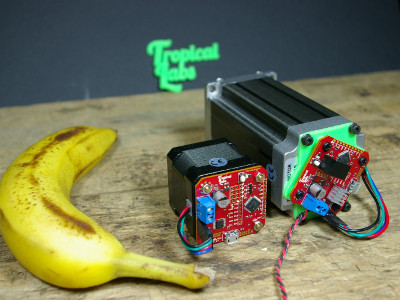
Glitching USB Firmware For Fun

[Micah Elizabeth Scott], aka [scanlime], has been playing around with USB drawing tablets, and got to the point that she wanted with the firmware — to reverse engineer, see what’s going on, and who knows what else. Wacom didn’t design the devices to be user-updateable, so there aren’t copies of the ROMs floating around the web, and the tablet’s microcontroller seems to be locked down to boot.

With the easy avenues turning up dead ends, that means building some custom hardware to get it done and making a very detailed video documenting the project (embedded below). If you’re interested in chip power glitching attacks, and if you don’t suffer from short attention span, watch it, it’s a phenomenal introduction.

Continue reading “Glitching USB Firmware For Fun”

How To Get Started With The ESP32

ESP32 is the hottest new wireless chip out there, offering both WiFi and Bluetooth Low Energy radios rolled up with a dual-core 32-bit processor and packed with peripherals of every kind. We got some review sample dev boards, Adafruit and Seeed Studio had them in stock for a while, and AI-Thinker — the company that makes the most popular ESP8266 modules — is starting up full-scale production on October 1st. This means that some of you have the new hotness in your hands right now, and the rest of you aren’t going to have to wait more than a few more weeks.

As we said in our first-look review of the new chip, many things are in a state of flux on the software side, but the basic process of writing, compiling, and flashing code to the chip is going to remain stable. It’s time to start up some tutorials!

Continue reading “How To Get Started With The ESP32”

How To Hack A Spacecraft To Die Gracefully

Last week, the Rosetta spacecraft crashed into comet 67P/Churyumov-Gerasimenko after orbiting it since 2014. It was supposed to do that: the mission was at an end, and the mission designers wanted to end it by getting a close look at the surface of the comet. But this raises an interesting problem: how do you get a device that is designed to never stop to actually stop?
Continue reading “How To Hack A Spacecraft To Die Gracefully”

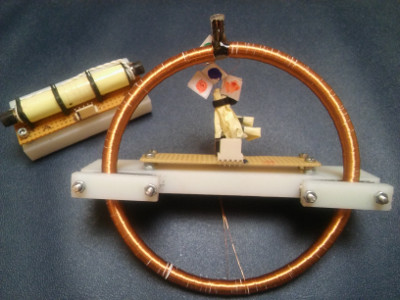
Homemade Capacitors Of A Mad Scientist

Once upon a time I was a real mad scientist. I was into non-conventional propulsion with the idea of somehow interacting with the quantum vacuum fluctuations, the zero point energy field. I was into it despite having only a vague understanding of what that was and without regard for how unlikely or impossible anyone said it was to interact with on a macro scale. But we all had to come from somewhere, and that was my introduction to the world of high voltages and homemade capacitors.

And along the way I made some pretty interesting, or different, capacitors which I’ll talk about here.

Large Wax Cylindrical Capacitor

As the photos show, this capacitor is fairly large, appearing like a thick chunk of paraffin wax sandwiched between two wood disks. Inside, the lead wires go to two aluminum flashing disks that are the capacitor plates spaced 2.5cm (1 inch) apart. But in between them the dielectric consists of seven more aluminum flashing disks separated by plain cotton sheets immersed in more paraffin wax. See, I told you these capacitors were different.

I won’t go into the reasoning behind the construction — it was all shot-in-the-dark ideas, backed by hope, unicorn hairs, and practically no theory. The interesting thing here was the experiment itself. It worked!

I sat the capacitor on top of a tall 4″ diameter ABS pipe which in turn sat on a digital scale on the floor. High voltage in the tens of kilovolts was put across the capacitor through thickly insulated wires. The power supply contained a flyback transformer and Cockcroft-Walton voltage multiplier at the HV side. As I dialed up the voltage, the scale showed a reducing weight. I had weight-loss!

But after a few hours of reversing polarities and flipping the capacitor the other way around and taking plenty of notes, I found the cause. The weight-loss happened only when the feed wires were oriented with the top one feeding downward as shown in the diagram, but there was no weight change when the top wire was oriented horizontally. I’d seen high voltage wires moving before and here it was again, producing what looked like weight-loss on the scale.

But that’s only one of the interesting capacitors I’ve made. After the break we get into gravitators, polysulfide and even barium titanate.

Continue reading “Homemade Capacitors Of A Mad Scientist”

Everything You’ll Find At The SuperConference

The 2016 Hackaday SuperConference is the ultimate hardware con. It will take place on November 5+6, 2016 in Pasadena, California. SuperCon is about hardware creation — everything at this conference is geared toward sharing the knowledge, excitement, experience, and motivations that go into building cutting edge electronics.

We offer you 48 hours packed with 21 talks, 5 workshops, lightning talks, 4 meals, the Hackaday Prize party, a hardware badge hacking competition, a crypto challenge, and a most excellent village of hackers to enjoy it with. For one weekend Pasadena will be the hardware center of the universe. Get your ticket to the Hackaday SuperConference now.

Want to know more? The full list of talks, works, and details about everything else is found below. We do anticipate adding to this massive list of talks and workshops as we receive final confirmation from the presenters not yet listed.

Continue reading “Everything You’ll Find At The SuperConference”