We recently went through our twice yearly period of communal venting called adjusting for daylight saving time (DST), or British Summer Time (BST) as it’s called in the UK. But why are we changing the time? Seriously, who caused all this? Does it do any good? Do we still need it? And what can we do about it? As it turns out, most of us want it, as you’ll see below.
We’ve known a few people over the years that have some secret insight into antennas. To most of us, though, it is somewhat of a black art (which explains all the quasi-science antennas made out of improbable elements you can find on the web). There was a time when only the hams and the RF nerds cared about antennas, but these days wireless is everywhere: cell phones, WiFi, Bluetooth, and even RF remote controls all live and die based on their antennas.
You can find a lot of high-powered math discussions about antennas full of Maxwell’s equations, spherical integration and other high-power calculus, and lots of arcane diagrams. [Mark Hughes] recently posted a two-part introduction to antennas that has less math and more animated images, which is fine with us (when you are done with the first part, check out part two). He’s also included a video which you can find below.
The first part is fairly simple with a discussion of history and electromagnetics. However, it also talks about superposition, reflection, and standing wave ratio. Part two, though, goes into radiation patterns and gain. Overall, it is a great gateway to a relatively arcane art.
We’ve talked about Smith charts before, which are probably the next logical step for the apprentice antenna wizard. We also covered PCB antenna design.
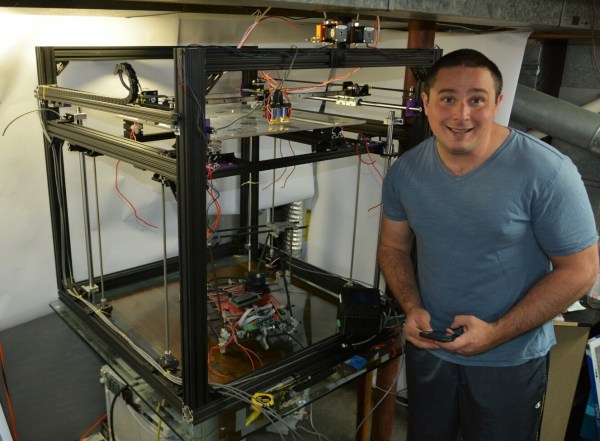
When we wrote about [Dan Beaven]’s resin printer a while back he enthusiastically ensured us that, thanks to the recent wave of attention, he would finally finish the project. That’s why today we are covering his entirely unrelated 2 cubic foot print volume FDM printer.
As we mentioned, [Dan] is no stranger to 3D printers. His addiction has progressed so far that he needs bigger and bigger parts, but when he looked at the price of printers that could sate his thirst… it wasn’t good. We assume this is the time he decided to leverage his resin printer procrastination to build a massive printer for himself.
The frame is aluminum extrusion. The bed is an 1/4″ thick aluminum plate supported just a little bit in from each corner. He can use the 4 motors to level the platform, which is a killer feature on a machine this big. More or less it’s fairly standard mechanically.
We are interested in his interesting addition of a FLIR thermal sensor to see live heat distribution. We also applaud him on his redundant safety systems (such as a smoke sensor that’s separately powered from the machine).
All the files are available on his site if you’re procrastinating on something and would like one for yourself.
[Ivan Franco] sent us this great synthesizer project that he’s working on. Or maybe it’s more like a synthesizer meta-project: a synthesizer construction set. You see, what Pryth has is a Raspberry Pi inside that’s running a custom distribution that includes SuperCollider to generate the sound, OSC for the communication layer, and a Teensy with up to 80 (!) multiplexed analog inputs that you’ll connect up to whatever hardware you desire.
What does it take to go from concept to dropping a finished product into the hands of the end user? Gather ’round for a story that pulls people and parts from around the world to make one killer piece of hardware art.
Seems like all the buzz about autonomous vehicles these days centers around self-driving cars. Hands-free transportation certainly has its appeal – being able to whistle up a ride with a smartphone app and converting commute time to Netflix binge time is an alluring idea. But is autonomous personal transportation really the killer app that everyone seems to think it is? Wouldn’t we get more bang for the buck by automating something a little more mundane and a lot more important? What about automating the shipping of freight?
Look around the next time you’re not being driven to work by a robot and you’re sure to notice a heck of a lot of trucks on the road. From small panel trucks making local deliveries to long-haul tractor trailers working cross-country routes, the roads are lousy with trucks. And behind the wheel of each truck is a human driver (or two, in the case of team-driven long-haul rigs). The drivers are the weak point in this system, and the big reason I think self-driving trucks will be commonplace long before we see massive market penetration of self-driving cars.
Open Source software has been around for decades. Over these decades, Open Source software has been the driving force behind most of the Internet, and all of the top-500 supercomputers. The product of the Open Source software movement is perhaps more important than Gutenberg’s press. But hardware has not yet fully embraced this super-charging effect of openness. Being able to simply buy an open source CPU, free of all proprietary bits and NDAs is impossible.
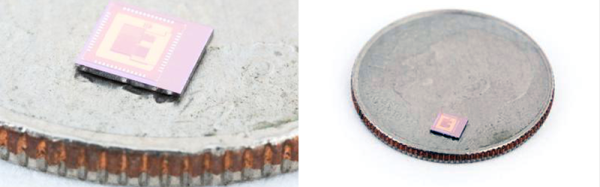
Now, this is finally changing. OnChip, a startup from a group of doctoral students at the Universidad Industrial de Santander in Colombia, have been working on mRISC-V, an open 32-bit microcontroller based on the RISC-V instruction set. It’s now a crowdfunding campaign, and yes, you can simply buy an open source chip.
We’ve taken a look at onchip’s Open microcontroller project before. The team has made significant progress of moving from something that can run on an FPGA to the tapeout of a real, physical chip. The onchip twitter timeline is a flurry of activity, with real silicon and a prediction that 50% of low-end microcontrollers will be running RISC-V in a decade.
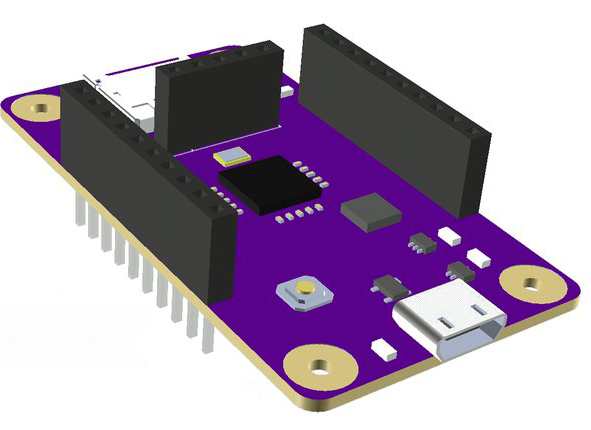
A render of the Open-V dev board
If you want to get your hands on one of these open microcontrollers, the Crowd Supply campaign is actually fairly reasonable, considering this is custom silicon. $49 USD gets you a first-run mRISC-V in a QFN-32 package. $99 gets you the mRISC-V dev board with an SD card slot, USB, regulators, and of course the micro itself.
This chip’s capabilities are almost on par with a low-power ARM Cortex M0. The chip itself runs at 160MHz, has SPI, I2C, SDIO, and JTAG, as well as a 10-bit 10MS/s ADC and a 12-bit DAC. There are 16 GPIO pins on mRISC-V. You won’t be able to build a smartphone or laptop with this chip, but you will be able to build an Internet of Things gizmo.
While OnChip’s efforts won’t result in a completely open source smartphone, there are other projects in the works that will bring an Open Source core to more powerful devices. lowRISC is a project to bring a Linux-capable System on Chip to production, and various people smarter than us have brought GCC, LLVM, and QEMU to the architecture.
Most of the efforts to bring the RISC-V architecture, and indeed most Open Source processors, have focused on the big chips — full CPUs and SoCs. Onchip’s mRISC-V goes the other direction to create a small, open microcontroller. If you’re looking to create an ecosystem of Open processors, this makes a lot of sense; there are more Honda Civics on the road than Lamborghinis, and Microchip and TI ship far more microcontrollers every year than Intel ships CPUs.