DIY Mini Printer Is 95% Wood, Prints Tiny Cute Images

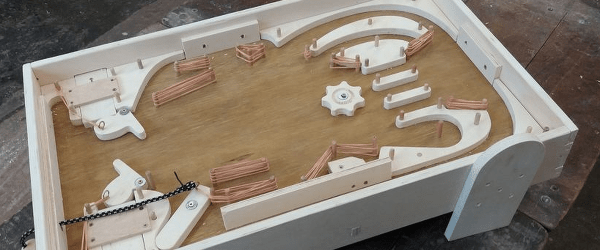
This little DIY 64×64 graphical printer by [Egor] is part pen plotter in design, somewhat dot matrix-ish in operation, and cleverly designed to use unmodified 9G servos. The project page is all in Russian (translation to English here) but has plenty of photos that make the operation and design clear. Although nearly the entire thing is made from laser-cut wood, [Egor] says that a laser cutter is optional equipment. The first version was entirely cut with hand tools.

screenshot-2016-12-06-10-49-13Small DIY CNC machines driven over a serial line commonly use Arduinos and CD-ROM drive guts (like this Foam Cutter or this Laser Paper Cutter) but this build uses its own custom rack-and-pinion system, and has some great little added details like the spring-loaded clip to hold paper onto the print pad.

The frame and parts (including all gears) are laser-cut from 4 mm plywood and the unit is driven by three small servos. A simple Java program processes images and an Arduino UNO handles the low-level control. A video of everything in action is embedded below.
Continue reading “DIY Mini Printer Is 95% Wood, Prints Tiny Cute Images”

Beautiful DIY Ambilight Display

A proper battlestation — or more colloquially, computer desk — setup can sometimes use a bit of technical flair to show off your skills. [fightforlife2] has shared their DIY ambilight monitor backlighting that flows through different colours which mimic what is displayed on the screen.

[fightforlife2]’s setup uses fifty RGB LEDs with individual controllers that support the FastLED library, regulated by an Arduino Nano clone — although any will suffice. The power requirement for the display was a bit trickier, ultimately requiring 3 amperes at 5V; an external power brick can do the trick, but [fightforlife2] also suggests the cavalier solution of using your computer power supply’s 5V line — adding the convenience of shutting off the ambilight display when you shut down your PC!

Continue reading “Beautiful DIY Ambilight Display”

Iron Tips: Soldering Headphones And Enamel Wire

We’ve all had that treasured pair of headphones fail us. One moment we’re jamming out to our favorite song, then, betrayal. The right ear goes out. No wait. It’s back. No, damn, it’s gone. It works for a while and then no jiggling of the wire will bring it back. So we think to ourselves, we’ve soldered before. This is nothing. We’ll just splice the wire together.

So we open it up only to be faced with the worst imaginable configuration: little strands of copper enamel wire intertwined with nylon for some reason. How does a mortal solder this? First you try to untwine the nylon from the strands. It kind of works, but now the strands are all mangled and weird. Huh. Okay. well, you kind of twist them together and give a go at soldering. No dice. Next comes sandpaper, torches, and all sorts of work-a-rounds. None of them seem to work. The best you manage is sound in one ear. It’s time to give up.

Soldering this stuff is actually pretty easy. It just takes a bit of knowledge about how assembly line workers do it. Let’s take a look.

Continue reading “Iron Tips: Soldering Headphones And Enamel Wire”

DIY Optical Sensor Breakout Board Makes DIY Optical Mouse

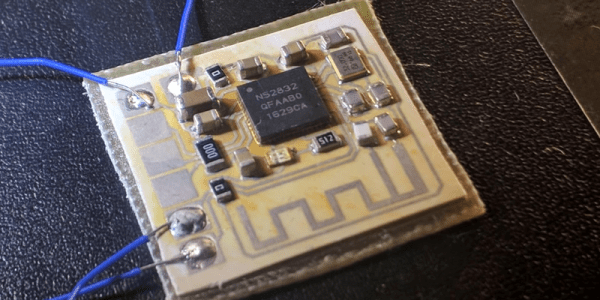
Wanting to experiment with using optical mouse sensors but a bit frustrated with the lack of options, [Tom Wiggins] rolled his own breakout board for the ADNS 3050 optical mouse sensor and in the process of developing it used it to make his own 3D-printed optical mouse. Optical mouse sensors are essentially self-contained cameras that track movement and make it available to a host. To work properly, the sensor needs a lens assembly and appropriate illumination, both of which mate to a specialized bracket along with the sensor. [Tom] found a replacement for the original ADNS LED but still couldn’t find the sensor bracket anywhere, so he designed his own.

Continue reading “DIY Optical Sensor Breakout Board Makes DIY Optical Mouse”

Stormtrooper Voice Changer Helmet Uses Teensy To Mangle Audio

Halloween has come and gone, but this DIY voice changing Star Wars Stormtrooper helmet tutorial by [Shawn Hymel] is worth a look for a number of reasons. Not only is the whole thing completely self-contained, but the voice changing is done in software thanks to the Teensy’s powerful audio filtering abilities. In addition, the Teensy also takes care of adding the iconic Stormtrooper clicks, pops, and static bursts around the voice-altered speech. Check out the video below to hear it in action.

Besides a microphone and speakers, there’s a Teensy 3.2, a low-cost add-on board for the Teensy that includes a small audio amp, a power supply… and that’s about it. There isn’t a separate WAV board or hacked MP3 player in sight.

Continue reading “Stormtrooper Voice Changer Helmet Uses Teensy To Mangle Audio”

Living Off The Grid, On Water Power

When you think of living off the grid, you often think of solar power. But if you’ve got a good head, and enough flow, water power can provide a much more consistent flow of electrons. All it requires is a little bit of engineering, epic amounts of manual labor, and some tricks of the trade, and you’ll have your own miniature hydroelectric power plant.

[Homo Ludens], the playful ape, has what looks like a fantastic self-sufficient home/cabin in a beautiful part of Chile. His webpages are a tremendous diary of DIY, but the microhydro plant stands out.

You might expect that building a hydro plant involves a lot of piping, and trenching to lie that pipe in, but the exact extent, documented in many photos, is sobering. At places, the pipe needed to be bent, and [Homo Ludens] built a wire-mesh pipe heater to facilitate the work — with the help of a few friends to weigh the pipe down at either end and create the bend. The self-wound power transformer is also a beauty.

There’s a lot more detail here than we can possibly get into, so go check it out. And if you’re in the mood for more hydro, we’ve recently run a writeup of a less ambitious, but still tidy, project that you should see. Or you could just rip apart an old washing machine.

Thanks [Patrick] for the great tip!

Glow-In-The-Dark Antenna Helps You Spot Your Car At Night

It’s late, and you’re lost in a sea of cars trying to remember where you parked. If only your vehicle had a glow-in-the-dark antenna to make it easier to find, you wouldn’t be in this situation. Faced with just such a problem himself, Instructables user [botzendesign] has put together a handy tutorial to do just that.

[botzendesign] first removed the antenna and lightly abraded it to help the three coats adhesion promoter do its job. A white base coat of vehicle primer was applied — lightly, so it doesn’t crack over time — and once it had set, three coats of Plasti Dip followed. Before that had a chance to dry, he started applying the glow-in-the-dark powder, another coat of Plasti Dip, repeating four more times to ensure the entire antenna had an even coat of the photo-luminescent powder and then letting it dry for 24 hours. Continue reading “Glow-In-The-Dark Antenna Helps You Spot Your Car At Night”