Give Me A Minute, My Eyes Are Busy

Social cues are tricky, but humans are very good at detecting where someone is looking; that goes a long way toward figuring out where someone is placing their attention. All of this goes right out the window though, when you’re talking with somebody who uses eye-tracking software to speak. [Matthew Oppenheim] with Lancaster University, UK wants to give listeners the message of Give Me a Minute with an easy-to-recognize indicator. His choice is a microBit, which displays a rotating arrow on the LED array while someone composes their speech. He chose the microBit because they are readily available, and you can get cases to fit people’s personalities. After the break, you can see a demonstration, but the graphic appears scrambled because of the screen flicker. The rotating arrow is a clear indicator that someone is writing, whereas a clock might suggest a frozen computer, and a progress bar could not be accurate.

[Matthew] wrote a program for the interpreting computer which recognizes when a message is forming by monitoring the number of black pixels in the composition field. If it changes, someone must be composing a sentence. Many people will try to peek over the speaker’s shoulder and see if they are working, but we’re sure that most readers would join the users of such tech in being unhappy if someone blatantly looks at theirr computer screen while they are typing.

Wheelchairs don’t always have to come from a hospital or supply store, and they don’t have to stay on the ground.


Continue reading Give Me A Minute, My Eyes Are Busy”

Making Baseballs Go Supersonic

When professional engineers are giggling like kids, you know something interesting is about to happen. [Destin Sandlin] of [Smarter Every Day], [Jeremy Fielding], and a few other like-minded individuals have built a very impressive air cannon, capable of launching baseballs at supersonic velocities.

Baseball execution. Not for sensitive viewers.

The muzzleloading canon consists of a large pressure chamber and vacuum chamber stuck together, with a plug and baseball separating the two. The barrel forms part of the vacuum chamber, and is sealed off at the muzzle end with plastic tape that ruptures when fired. The firing mechanism runs the entire length of the pressure chamber, exiting out the back where it is held in place by a large pneumatic sear mechanism. When the sear is released, it “pops the cork” between the two chambers, sending high-pressure nitrogen into the vacuum chamber, forcing the ball forward. This causes the plug rod to shoot out the back of the pressure chamber, where it is stopped by a pneumatic piston. The entire thing is permanently mounted on a trailer. A professional-looking control box is used to operate the beast from behind the safety of a steel blast shield.

Be sure to watch the videos after the break with subtitles turned on. The first is the highlights reel, and the second is a very entertaining hour-long behind the scenes look. To the surprise of the builders, they were able to shoot a baseball at Mach 1.38 (1050 mph or 1690 km/h) on the very first try, with only a partially pressurized system and a leaking vacuum chamber. When impacting the thick steel target, the ball disintegrates completely, imprinting its stitches on the target. [Destin] and co recorded the results with his usual high-speed cameras, but also included a Schlieren rig that allowed them to photograph the shock waves and Mach cones generated by the speeding ball. After a few shots, the bolts were stripped out of the pneumatic piston that stops the plug rod, which is no surprise judging by how much the steel frame flexes in that area. Continue reading “Making Baseballs Go Supersonic”

TV Output From Arduino — 1980s Style!

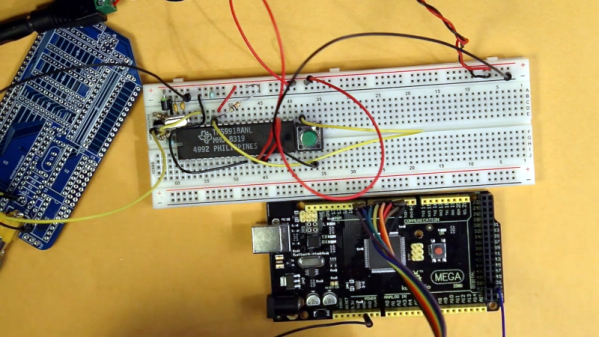
We’ll admit it, we’re all spoiled. A few bucks can now buy a computer that would have been the envy of everyone back in the late 1970s or early 1980s. So it’s no surprise that [krallja] was able to use an old-style video output chip to drive a TV with an Arduino. The TMS9918A is a venerable output device, and if the old computers could drive it then it makes sense that a modern computer could too. You can see a video of the whole experiment, below.

The Internet has also spoiled us, in that it’s dead simple to find datasheets for nearly anything, even these old chips. The only real problem with such aged silicon is that they typically expect a processor with a data and address bus, but most microcontrollers now keep all of that internal. But with enough fast I/O you can simulate a bus just fine. For now, the experiment just cycles through the color output.

Continue reading “TV Output From Arduino — 1980s Style!”

Peripheral Doesn’t Need Deskspace

Some of us are suckers for new hardware. There’s absolutely nothing shameful about a drawer overflowing with gamepads, roll-up keyboards, and those funny-shaped ergonomic mice. MyTeleTouch won’t sate your itch for new hardware because [Dimitar Danailov] didn’t design hardware you hold, because it uses your phone as a catch-all Human Interface Device, HID. A dongle plugs into a standard USB port, and your Android phone can emulate a USB keyboard, mouse, or gamepad over Bluetooth.

Chances are high that you already set up your primary computer with your favorite hardware, but we think we’ve found a practical slant for a minimalist accessory. Remember the last time you booted an obsolete Windows desktop and dug out an old mouse with a questionable USB plug? How long have you poked around the bottom of a moving box trying to find a proprietary wireless keyboard dongle, when you just wanted to type a password on your smart TV? What about RetroPi and a game controller? MyTeleTouch isn’t going to transform your daily experience, but it’ll be there when you don’t want to carry a full-size keyboard down three flights of stairs to press {ENTER} on a machine that spontaneously forgot it has a touch screen. If you don’t have opportunities to play the hero very often, you can choose to play the villain. Hide this in a coworker’s USB port, and while they think you’re sending a text message, you could be fiddling with their cursor.

We enjoy a good prank that everyone can laugh off, and we love little keyboards and this one raises the (space) bar.

Continue reading “Peripheral Doesn’t Need Deskspace”

Linux Fu: Literate Regular Expressions

Regular expressions — the things you feed to programs like grep — are a bit like riding a bike. It seems impossible until you learn to do it, and then it’s easy. Part of their bad reputation is because they use a very concise and abbreviated syntax that alarms people. To help people who don’t use regular expressions every day, I created a tool that lets you write them in something a little closer to plain English. Actually, I’ve written several versions of this over the years, but this incarnation that targets grep is the latest. Unlike some previous versions, this time I did it all using Bash.

Those who don’t know regular expressions might freak out when they see something like:

[0-9]{5}(-[0-9]{4})?

How long does it take to figure out what that does? What if you could write that in a more literate way? For example:

digit repeat 5 \

start_group \

   - digit repeat 4 \

end_group optional

Not as fast to type, sure. But you can probably deduce what it does: it reads US Zipcodes.

I’ve found that some of the most popular tools I’ve created over the years are ones that I don’t need myself. I’m sure you’ve had that experience, too. You know how to operate a computer, but you create a menu system for people who don’t and they love it. That’s how it is with this tool. You might not need it, but there’s a good chance you know someone who does. Along the way, the code uses some interesting features of Bash, so even if you don’t want to be verbose with your regular expressions, you might pick up a trick or two.

Continue reading “Linux Fu: Literate Regular Expressions”

Hackaday Podcast 084: Awful Floppy Disk Music, Watching A Robot Climb Walls, A Futuristic Undersea Lab, And Inside A Digital Pregnancy Test

With Editor in Chief Mike Szczys off this week, Managing Editor Elliot Williams is joined by Staff Writer Dan Maloney to look over the hacks from the last week. If you’ve ever wondered how the Beatles sound on a floppy disk, wonder no more. Do you fear the coming robopocalypse? This noisy wall-climbing robot will put those fears to rest. We’ll take a look at an undersea lab worthy of the Cousteau name, and finally we’ll look inside a digital pregnancy test and wonder at its unusual power switch.

Take a look at the links below if you want to follow along, and as always, tell us what you think about this episode in the comments!

Take a look at the links below if you want to follow along, and as always, tell us what you think about this episode in the comments!

Direct download (60 MB or so.)

Continue reading “Hackaday Podcast 084: Awful Floppy Disk Music, Watching A Robot Climb Walls, A Futuristic Undersea Lab, And Inside A Digital Pregnancy Test”

Friendly Fiberglassing: Can Hide Glue Replace Epoxy?

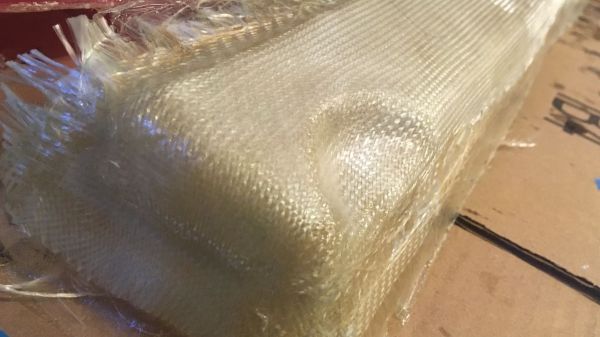
Hide glue has been around for thousands of years, and some of it is holding wood pieces three thousand years after application. It is made from animal protein, so vegetarians may want to stick to the petroleum-based adhesives. [Surjan Singh] wanted to see if its longevity made it a contender with modern epoxy by casting a couple of fiberglass car parts with the competing glues. In short, it doesn’t hold up in this situation, but it is not without merit.

Musical instrument makers and antique restorers still buy and use hide glue, but you would never expose it to heat or moisture. To its credit, hide glue doesn’t require a ventilator. All you need is boiling water and a popsicle stick, and you are in business. [Surjan] writes his findings like a narrative rather than steps, so his adventures are a delight to read. He found that a car part made with fiberglass and epoxy will withstand the weather better than the alternative because heat and humidity will soften hide glue. His Saab 96 isn’t the right application, but since it is nearly as strong as epoxy once set, you could make other fabric shapes, like a flannel nightstand or a lace coffee table, and you could shape them in the living room without toxifying yourself

No matter how you want to work with glues and substrates, Bil Herd has you covered, and here is an excellent tip for a cheap degassing setup.