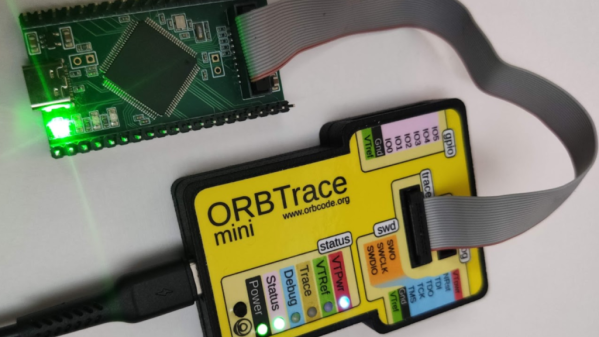
The Orbtrace debugger hardware connected to a development board t hrough a 20-pin ribbon cable. The development board has a green LED shining.

ORBTrace Effort: Open Tool For Professional Debugging

There are some fairly powerful debugging facilities available on today’s microcontrollers — if your code crashes mysteriously, chances are, there’s a debugging interface that could let you track down the exact crash circumstances in no time. Sadly, debugging tools for these powerful interfaces tend to be prohibitively expensive and highly proprietary, thus, not friendly for hobbyists. Now, there’s a community-driven high-capability debugging platform called ORBTrace, brought to us by [mubes] and [zyp].

With parallel trace, you get a constant stream of consciousness, every exact instruction executed by your CPU. [mubes] and [zyp] set out to tap into the power of parallel trace debugging for Cortex-M processors. and the ORBTrace project was born. Relying on the Orbuculum project’s software capabilities, this FPGA-based debugger platform can do parallel trace and the more popular high-speed SWO trace – and way more. ORBTrace has the potential to grow into a powerful debug helper tool, with enough capabilities for anyone to benefit. And of course, it’s fully open-source.
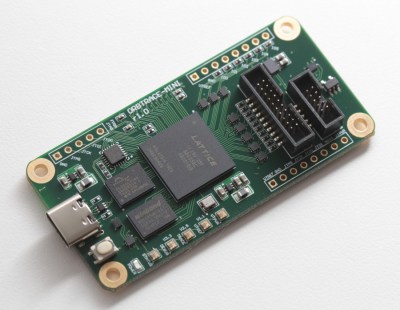
The ORBTrace board, with a FPGA in the center of it, a USB-C connector on the left, and two IDC debug connectors on the right (one ten-pin and one twenty-pin)The ORBTrace platform has plenty of untapped potential. There’s the battle-tested JTAG and SWD that you can already use with all the open tools you could expect. However, there’s also plenty of available resources on the FPGA, including even a currently unutilized RISC-V softcore. If you wanted to add support for any other family of devices to this debugger, sky’s the limit! And, of course, there’s cool software to go with it – for example, orbmortem, which keeps a ring buffer of instructions in memory and shows you the last code executed before your CPU stops, or orbstat, a tool for profiling your embedded code.

If you’re looking to purchase effortless feature parity with Segger or Lauterbach devices, the ORBTrace doesn’t promise that. Instead, it’s an open debugging toolkit project, with hardware available for purchase, and software just waiting for you take control of it. This project’s community hangs out in the 1BitSquared discord’s #orbuculum channel, and gateware’s advancing at a rapid pace – welcoming you to join in on the fun.

ORBTrace is a powerful tool for when your goals become large and your problems become complex. And, being a community-driven experimental effort, we’ll undoubtedly see great things come out of it – like the Mooltipass project, originally developed by Hackaday community members, and still going strong.
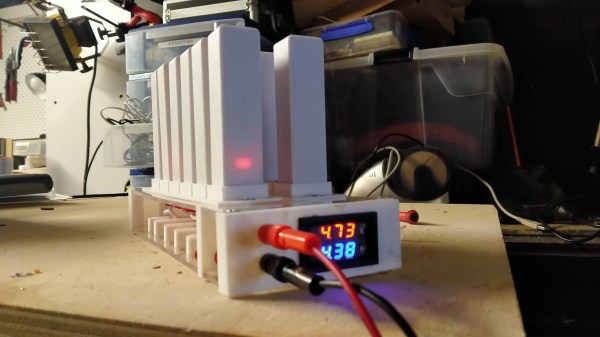
The charging station on the table, with twelve powerbanks plugged into it, charging. A small meter on the front panel shows 4.73 volts and 4.38 amps.

A Simple Charging Station For Twelve Powerbanks

[jasonwinfieldnz] uses twelve small powerbanks day to day – powering LED strips around his trampoline, presumably, to avoid the mess of wires and make the assembly easily portable. However, if you have twelve powerbanks, you’ll find yourself hogging all the household’s microUSB cables every so often, as they eventually discharge. This was not good enough for our hacker, and he decided to build a charging station to refill them all at once.

If you need 5 volts and many amps, an ATX PSU isn’t your worst bet. From there, he only had to add twelve microUSB connectors to – and condensed the entire contraption into a beautiful charging station. For the microUSB part, he hacked some microUSB cable ends off and embedded them into the case. An embedded voltage and current module is of big help – letting you see at a glance when charging has really finished. Using copper tape as bus bars and banana plugs for charging input, this project is easy to build and solves the problem well.

The 3D printing files and cutting templates are right there on the project page, so if any of us hackers has a problem that twelve powerbanks could help with, [Jason]’s project is quite repeatable. If your devices are more diverse, you could use a pegboard to build a stylish charging station for them! If, on the other hand, you have a single device you need to plug multiple cords into, moldable plastic is there to help.

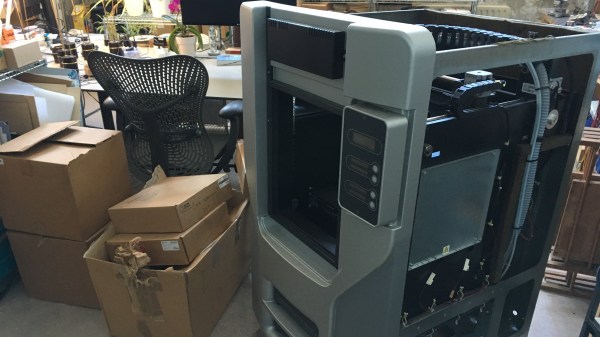
The printer in question - it's tall, about a meter and a half tall, in fact!

Hackaday Prize 2022: $40k Stratasys Printer Fix Costs $1

Companies don’t treat equipment in the same way that we, hobbyists, do. When it comes to reassessing equipment state, there’s calculations to be done – how many failures it’s experienced, what’s the rate of the support contract for it (often increasing as equipment ages), and whether it’d be more price-efficient to just buy a new one. Hobbyists aren’t tied to commercial support contracts that prohibit DIY repair, however. We can investigate things and try our luck, and in many cases, the repair will be super simple and satisfying! Today’s lucky repair story is about [Gregor], who has acquired a written-off ±$40k Stratasys 3D printer for peanuts, and repaired it with $1 in parts.

The error code shown on the display indicated an extruder changer error — yes, this is a dual extruder printer! Earlier, [Gregor] noted that some of the chamber lighting LEDs failed, very likely because of the constant heat in the chamber. After investigating the infrared LED responsible for extruder change detection, it indeed had failed as well, presumably for the same reason. After the installation of a new SMD LED, the error message went away. Thus concludes the story of [Gregor] getting himself a new professional-grade printer! He also documents other possible failure modes, some just as easy to fix. In short, if you ever spot a Stratasys Dimension printer for sale, you might want to consider it!

As it turns out, this isn’t the only Stratasys success story we’ve seen on Hackaday.io. After you’ve repaired your newly obtained Stratasys, you might want to bypass the cartridge DRM, by the way. Got repairs of your own to share, industrial printer or otherwise? Submit it for the 2022 Hackaday Prize, there’s still a few days left in the Hack it Back round!

Photo of the head unit , with "Hacked by greenluigi1" in the center of the UI

Hacker Liberates Hyundai Head Unit, Writes Custom Apps

[greenluigi1] bought a Hyundai Ioniq car, and then, to our astonishment, absolutely demolished the Linux-based head unit firmware. By that, we mean that he bypassed all of the firmware update authentication mechanisms, reverse-engineered the firmware updates, and created subversive update files that gave him a root shell on his own unit. Then, he reverse-engineered the app framework running the dash and created his own app. Not just for show – after hooking into the APIs available to the dash and accessible through header files, he was able to monitor car state from his app, and even lock/unlock doors. In the end, the dash got completely conquered – and he even wrote a tutorial showing how anyone can compile their own apps for the Hyundai Ionic D-Audio 2V dash.

In this series of write-ups [greenluigi1] put together for us, he walks us through the entire hacking process — and they’re a real treat to read. He covers a wide variety of things: breaking encryption of .zip files, reprogramming efused MAC addresses on USB-Ethernet dongles, locating keys for encrypted firmware files, carefully placing backdoors into a Linux system, fighting cryptic C++ compilation errors and flag combinations while cross-compiling the software for the head unit, making plugins for proprietary undocumented frameworks; and many other reverse-engineering aspects that we will encounter when domesticating consumer hardware.

This marks a hacker’s victory over yet another computer in our life that we aren’t meant to modify, and a meticulously documented victory at that — helping each one of us fight back against “unmodifiable” gadgets like these. After reading these tutorials, you’ll leave with a good few new techniques under your belt. We’ve covered head units hacks like these before, for instance, for Subaru and Nissan, and each time it was a journey to behold.

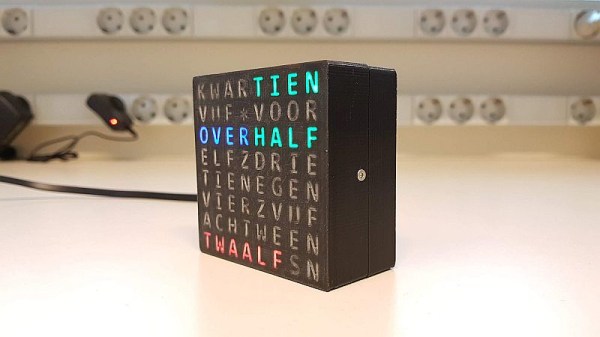
The word clock on a desk, with "tien", "over", "half" and "twaalf" lit

An Impeccably Documented Word Clock In Dutch

[Maarten Pennings] shares a word clock project – but not the regular kind. For a start, this clock is a shining demonstration of hobbyist-available 3D printing technologies, with embedded light guides for the letters printed in transparent filament, thanks to a dual-extruder printer. For a word clock, it’s surprisingly small – in fact, it uses an 8×8 addressable LED matrix, with words shown in different colors. If you’re looking to build a novel word clock, you’re all set here – [Maarten] tells all about this project’s story and provides a treasure trove of insights into designing all of its aspects!

The 8×8 limitation was initially set because he wanted to use a low-cost MAX7219 8×8 LED matrix module as a base for the clock. Thankfully, in Dutch, time can be expressed using shorter words — still, it had to be limited to 5-minute intervals. Extra effort had to be spent designing the layout — [Maarten] mentions his friend writing a solver that found a way to fit some words onto the layout diagonally. At some point, he switched from LEDs to Neopixels, and dug deep into addressable LED technology. For instance, he demonstrates Neopixel power measurements and current consumption calculations. This shows that the calculations indeed match the clock’s real consumption when measured by an external meter.

In the best of hacker traditions, all the source files are on Github — if you fancy yourself a Dutch word clock, you can build [Maarten]’s design easily! He provides extensive instructions on building this clock in the README, including a flashing and configuration tutorial, complete wiring diagrams, and a soldering guide. A manufacturing-grade amount of build information that won’t leave you guessing. He’s also added a fair number of animations, put plenty of effort into clock precision verification, and even investigated some Neopixel protocol minutiae. All in all, our hacker went all in on the capabilities while embracing the constraints. This reminds us of the similarly well-documented haptic word clock we covered just a year ago – check that one out, too!

Continue reading “An Impeccably Documented Word Clock In Dutch” →

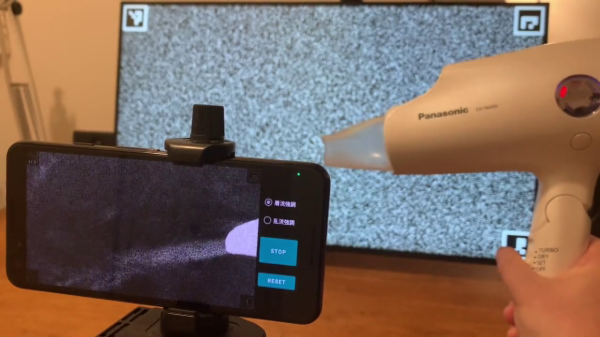
On the left side, there's a smartphone. On the right side, there's a hairdryer turned on. On the smartphone screen, you can see the working end of the hairdryer shown, as well as a jet of air coming out of that end. In the background, there's an LCD screen showing a noise pattern.

Observe Airflow Using Smartphone And Background-Oriented Schlieren

Multiple people have recently shared this exciting demonstration (nitter) with us – visualizing airflow using a smartphone, called ‘background-oriented schlieren’. On a hot summer day, you might see waves in the air – caused by air changing density as it warms up, and therefore refracting the light differently. Schlieren photography is an general set of techniques for visualizing fluid flow, but of course, it can also be applied to airflow. In this case, using some clever optical recognition tricks, this schlieren method lets you visualize flow of air using only your Android smartphone’s high resolution camera and a known-pattern printed background! Continue reading “Observe Airflow Using Smartphone And Background-Oriented Schlieren” →

Insect class-order-family-genus-species chart with drawn examples

Neural Network Identifies Insects, Outperforming Humans

There are about one million known species of insects – more than for any other group of living organisms. If you need to determine which species an insect belongs to, things get complicated quick. In fact, for distinguishing between certain kinds of species, you might need a well-trained expert in that species, and experts’ time is often better spent on something else. This is where CNNs (convolutional neural networks) come in nowadays, and this paper describes a CNN doing just as well if not better than human experts.

Continue reading “Neural Network Identifies Insects, Outperforming Humans” →