Hackaday Links Column Banner

Hackaday Links: October 18, 2020

Remember subliminal advertising? The idea was that a movie theater operator would splice a single frame showing a bucket of hot buttered popcorn into a movie, which moviegoers would see and process on a subconcious level and rush to the concession stand to buy the tub o’ petrochemical-glazed starch they suddenly craved. It may or may not work on humans, but it appears to work on cars with advanced driver assistance, which can be spoofed by “phantom street signs” flashed on electronic billboards. Security researchers at Ben Gurion University stuck an image of a stop sign into a McDonald’s ad displayed on a large LCD screen by the side of the road. That was enough to convince a Tesla Model X to put on the brakes as it passed by the sign. The phantom images were on the screen anywhere from an eighth of a second to a quarter second, so these aren’t exactly subliminal messages, but it’s still an interesting attack that bears looking into. And while we’re skeptical about the whole subliminal advertising thing in the first place, for some reason we really want a bacon cheeseburger right now.

Score one for the good guys in the battle against patent trolls. Mycroft AI, makers of open-source voice assistants, proudly announced their latest victory against what they claim are patent trolls. This appears to be one of those deals where a bunch of investors get together and buy random patents, and then claim that a company that actually built something infringes on their intellectual property. Mycroft got a letter from one such entity and decided to fight it; they’ve won two battles so far against the alleged trolls and it looks pretty good going forward. They’re not pulling their punches, either, since Mycroft is planning to go after the other parties for legal expenses and punitive damages under the State of Missouri’s patent troll legislation. Here’s hoping this sends a message to IP squatters that it may not be worth the effort and that their time and money are better spent actually creating useful things.

Good news from Mars — The Mole is finally completely buried! We’ve been following the saga of the HP³, or “Heat Flow and Physical Properties Package” aboard NASA’s Mars InSight lander for quite a while. The self-drilling “Mole”, which is essentially the guts of an impact screwdriver inside a streamlined case, has been having trouble dealing with the Martian regolith, which is simultaneously too soft to offer the friction needed to keep the penetrator in its hole, but also too hard to pierce in places where there is a “duricrust” of chemically amalgamated material below the surface. It took a lot of delicate maneuvers with the lander’s robotic arm to get the Mole back on track, and it’s clearly not out of the woods yet — it needs to get down to three meters depth or so to do the full program of science it was designed for.

If watching Martian soil experiments proceed doesn’t scratch your itch for space science, why not try running your own radio astronomy experiments? Sure, you could build your own radio telescope to do that, but you don’t even have to go that far — just log into PICTOR, the free-to-use radio telescope. It’s a 3.2-m parabolic dish antenna located near Athens, Greece that’s geared toward hydrogen line measurements of the galaxy. You can set up an observation run and have the results mailed back to you for later analysis.

Here’s a fun, quick hack for anyone who hates the constant drone of white noise coming from fans. Build Comics apparently numbers themselves among that crowd, and decided to rig up a switch to turn on their fume extractor only when the soldering iron is removed from its holder. This hack was executed on a classic old Weller soldering station, but could easily be adapted to Hakko or other irons

And finally, if you’ve never listened to a Nobel laureate give a lecture, here’s your chance. Andrea Ghez, co-winner of the 2020 Nobel Prize in physics for her work on supermassive black holes, will be giving the annual Maria Goeppert Mayer lecture at the University of Chicago. She’ll be talking about exactly what she won the Nobel for: “The Monster at the Heart of Our Galaxy”, the supermassive black hole Sagittarius A*. We suspect the talk was booked before the Nobel announcement, so in normal times the room would likely be packed. But one advantage to the age of social distancing is that everything is online, so you can tune into a livestream of the lecture on October 22.


Duality Of Light Explored By Revisiting The Double-Slit Experiment

We’ve all seen recreations of the famous double-slit experiment, which showed that light can behave both as a wave and as a particle. Or rather, it’s likely that what we’ve seen is the results of the double-slit experiment, that barcode-looking pattern of light and dark stripes, accompanied by some handwaving about classical versus quantum mechanics. But if you’ve got 20 minutes to invest, this video of the whole double-slit experiment cuts through the handwaving and opens your eyes to the quantum world.

For anyone unfamiliar with the double-slit experiment,  [Huygens Optics] actually doesn’t spend that much time explaining the background. Our explainer does a great job on the topic, but suffice it to say that when coherent light passes through two closely spaced, extremely fine openings, a characteristic pattern of alternating light and dark bands can be observed. On the one hand, this demonstrates the wave nature of light, just as waves on the ocean or sound waves interfere constructively and destructively. On the other hand, the varying intensity across the interference pattern suggests a particle nature to light.

To resolve this conundrum, [Huygens] jumps right into the experiment, which he claims can be done with simple, easily sourced equipment. This is belied a little by the fact that he used photolithography to create his slits, but it should still be possible to reproduce with slits made in more traditional ways. The most fascinating bit of this for us was the demonstration of single-photon self-interference using nothing but neutral density filters and a CCD camera. The explanation that follows of how it can be that a single photon can pass through both slits at the same time is one of the most approachable expositions on quantum mechanics we’ve ever heard.

[Huygens Optics] has done some really fascinating stuff lately, from variable profile mirrors to precision spirit levels. This one, though, really helped scratch our quantum itch.

Air Cannon Serves Up A Blast Of Ferrocerium Sparks

OK, looks like we have a new way to entertain the kids and wreak havoc in the neighborhood, if this spark-shooting ferrocerium cannon is as easy to build as it looks.

This one comes to us by well-known purveyor of eyebrow-singing projects [NightHawkInLight], whose propane torch never seems to get a break. The idea here is a large scale version of an apparently popular trick where the “flints” from lighters, which are actually rods of ferrocerium, an aptly named alloy of iron and cerium, are heated to a nearly molten state and dropped onto a hard surface. The molten alloy thence explodes in a shower of sparks, to the mirth and merriment of those in attendance.

[NightHawkInLight]’s version of the trick scales everything up. Rather than lighter flints, he uses ferrocerium rods from firestarters of the type used for camping. The rod is stuffed into a barrel formed from steel brake line which is connected to the output of a PVC air chamber. His ominpresent propane torch is attached in such a way as the flame plays upon the loaded pyrophoric plug, heating it to a molten state before the air is released from the chamber. The massive display of sparks seen in the video below is pretty impressive, but we’re getting tired of  gender reveal parties and forest fires.  We just hope he had fire extinguishers on hand.

Seriously, be careful with stuff like this. [NightHawkInLight] has a lot of experience working with these kinds of projects, from his plasma-propelled soda bottles to making synthetic rubies with an arc welder. We’re sure he wouldn’t want to see anyone get hurt.

Continue reading “Air Cannon Serves Up A Blast Of Ferrocerium Sparks”

Building This Mechanical Digital Clock Took Balls

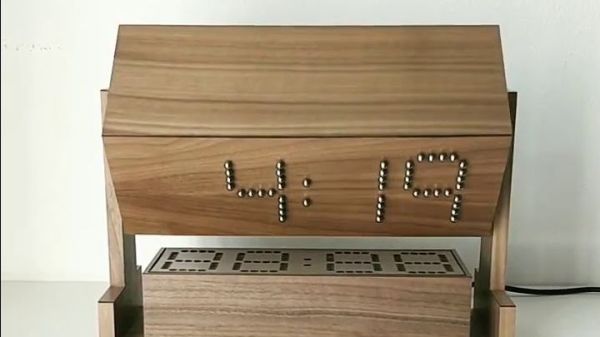
In the neverending quest for unique ways to display the time, hackers will try just about anything. We’ve seen it all, or at least we thought we had, and then up popped this purely mechanical digital clock that uses nothing but steel balls to display the time. And we absolutely love it!

Click to embiggen (you’ll be glad you did)

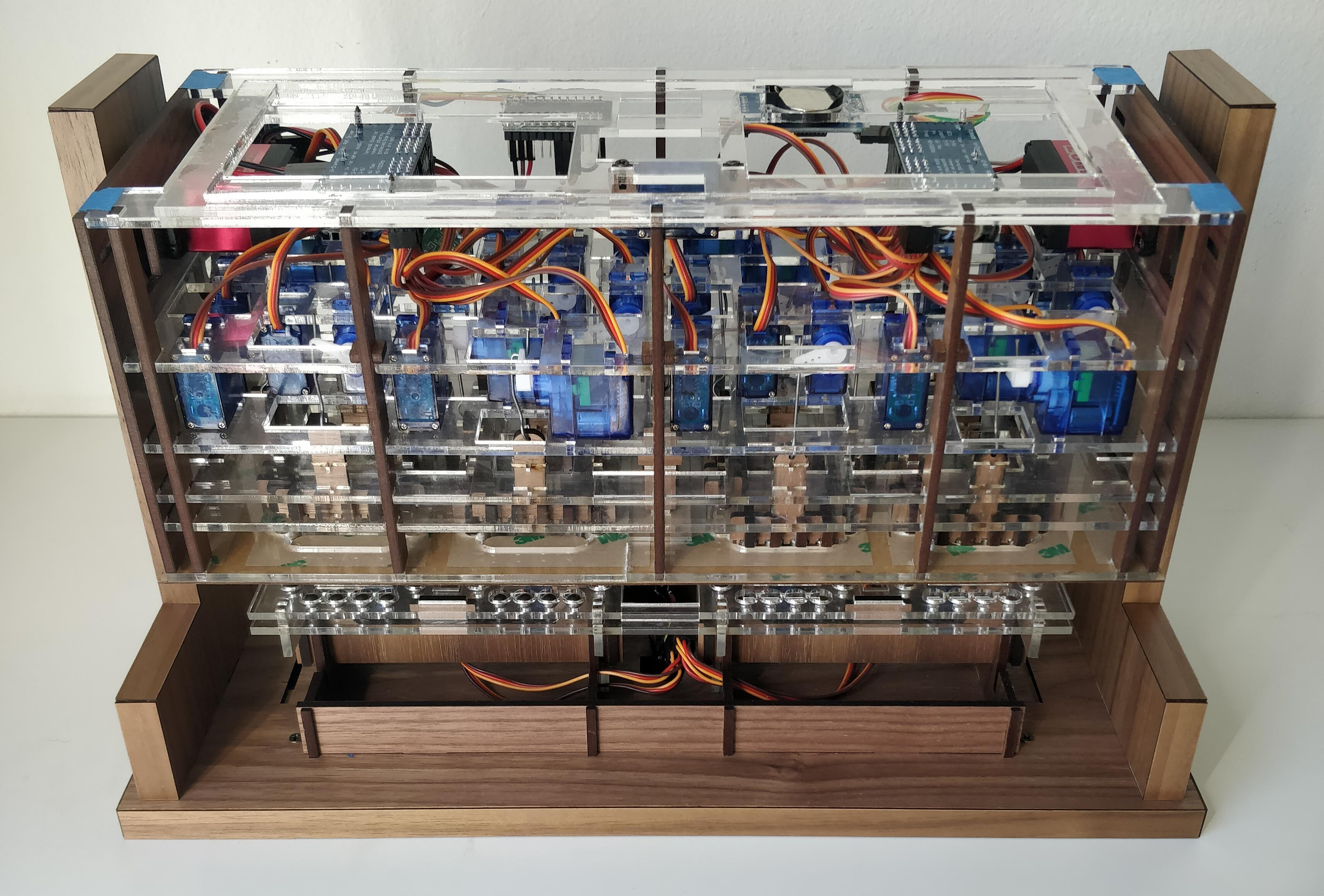
One glimpse at the still images or the brief video below shows you exactly how [Eric Nguyen] managed to pull this off. Each segment of the display is made up of four 0.25″ (6.35 mm) steel balls, picked up and held in place by magnets behind the plain wood face of the clock. But the electromechanical complexity needed to accomplish that is the impressive part of the build. Each segment requires two servos, for a whopping 28 units plus one for the colon. Add to that the two heavy-duty servos needed to tilt the head and the four needed to lift the tray holding the steel balls, and the level of complexity is way up there. And yet, [Eric] still managed to make the interior, which is packed with a laser-cut acrylic skeleton, neat and presentable, as well he might since watching the insides work is pretty satisfying.

We love the level of craftsmanship and creativity on this build, congratulations to [Eric] on making his first Arduino build so hard to top. We’ve seen other mechanical digital displays before, but this one is really a work of art.

Continue reading “Building This Mechanical Digital Clock Took Balls”

Retro Computer Trainer Gets A Raspberry Pi Refit

We know what you’re thinking: this is yet another one of those “Gut the retro gear for its cool old case and then fill it up with IoT junk” projects. Well, rest assured that extending and enhancing this 1970s computer trainer is very much an exercise in respecting the original design, and while there’s a Pi inside,  it doesn’t come close to spoiling the retro goodness.

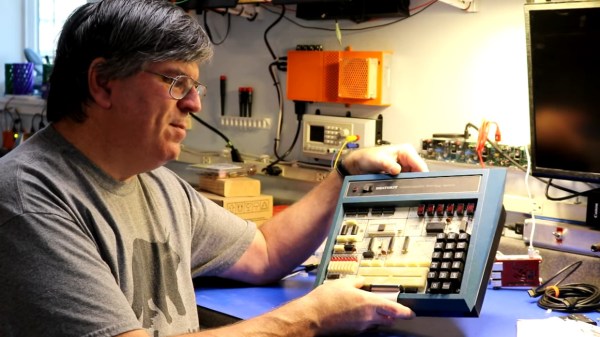
Like many of a similar vintage as [Scott M. Baker], the Heathkit catalog was perhaps only leafed through marginally less than the annual Radio Shack catalog. One particularly desirable Heathkit item was the ET-3400 microcomputer learning system, which was basically a 6800-based computer surrounded by a breadboarding area for experimentation. [Scott] got a hold of one of these, but without the optional expansion accessory that would allow it to do interesting things such as running BASIC or even supporting a serial port. So [Scott] decided to roll his own expansion board.

The expansion card that [Scott] designed is not strictly a faithful reproduction, at least in terms of the original BOM. He turned to more modern — and more readily available — components, but still managed to provide the serial port, cassette interface, and RAM/ROM expansion of the original unit. The Raspberry Pi is an optional add-on, which just allows him to connect wirelessly if he wants. The card fits into a 3D-printed case that sits below the ET-3400 and maintains the original trainer’s look and feel. The longish video below shows the build and gives a tour of the ET-3400, both before and after the mods.

It looks as though trainers like these and other artifacts from the early days of the PC revolution are getting quite collectible. Makes us wish we hadn’t thrown some things out.

Continue reading “Retro Computer Trainer Gets A Raspberry Pi Refit”

Add Creativity To Your BOM: Hack Chat

Join us on Wednesday, October 14th at noon Pacific for the Harnessing Your Creativity Hack Chat with Leo Fernekes!

You’re sitting at your bench, surrounded by the tools of the trade — meters and scopes, power supplies and hand tools, and a well-stocked parts bin. Your breadboard is ready, your fingers are itching to build, and you’ve got everything you need to get started, but — nothing happens. Something is missing, and if you’re like many of us, it’s the one thing you can’t get from eBay or Amazon: the creative spark that makes innovation happen.

Creativity is one of those things that’s difficult to describe, and is often noticed most when it’s absent. Hardware hacking requires great buckets of creativity, and it’s not always possible to count on it being there exactly when it’s called for. It would be great if you could somehow reduce creativity to practice and making it something as easy to source for every project as any other commodity.

While Leo Fernekes hasn’t exactly commoditized creativity, judging from the breadth of projects on his YouTube channel, he’s got a pretty good system for turning ideas into creations. We’ve featured a few of his builds on our pages, like a discrete transistor digital clock, the last continuity tester you’ll ever need, and his somewhat unconventional breadboarding techniques. Leo’s not afraid to fail and share the lessons learned, either.

His projects, though, aren’t the whole story here: it’s his process that we’re going to discuss. Leo joins us for this Hack Chat to poke at the creative process and see what can be done to remain rigorous and systematic in your approach but still make the process creative and flexible. Join us with your questions about finding the inspiration you need to turn parts and skills into finished projects that really innovate.

join-hack-chatOur Hack Chats are live community events in the Hackaday.io Hack Chat group messaging. This week we’ll be sitting down on Wednesday, October 14 at 12:00 PM Pacific time. If time zones baffle you as much as us, we have a handy time zone converter.

Click that speech bubble to the right, and you’ll be taken directly to the Hack Chat group on Hackaday.io. You don’t have to wait until Wednesday; join whenever you want and you can see what the community is talking about.

Continue reading “Add Creativity To Your BOM: Hack Chat”

Ask Hackaday: With Landline Use In Decline, What’s To Be Done With The Local Loop?

Walking is great exercise, but it’s good for the mind too: it gives one time to observe and to think. At least that’s what I do on my daily walks, and being me, what I usually observe and think about is the local infrastructure along my route. Recently, I was surprised to see a number of telephone company cabinets lying open next to the sidewalk. Usually when you see an open box, there’s a telephone tech right there, working on the system. But these were wide open and unattended, which I thought was unusual.

I, of course, took the opportunity to check out the contents of these pedestals in detail. Looking at the hundreds of pairs of brightly colored wire all neatly terminated and obviously installed and maintained at great expense, I was left wondering why someone would leave such a valuable asset exposed to the elements. With traditional POTS, or plain old telephone service, on the decline, the world may no longer have much use for the millions of miles of copper cable feeding back to telco central offices (COs) anymore. But there’s got to be something this once-vital infrastructure is still good for, leading me to ask: what’s to be done with the local loop?

Continue reading “Ask Hackaday: With Landline Use In Decline, What’s To Be Done With The Local Loop?”