Old Wattmeter Uses Magnetics To Do The Math

Measuring power transfer through a circuit seems a simple task. Measure the current and voltage, do a little math courtesy of [Joule] and [Ohm], and you’ve got your answer. But what if you want to design an instrument that does the math automatically? And what if you had to do this strictly electromechanically?

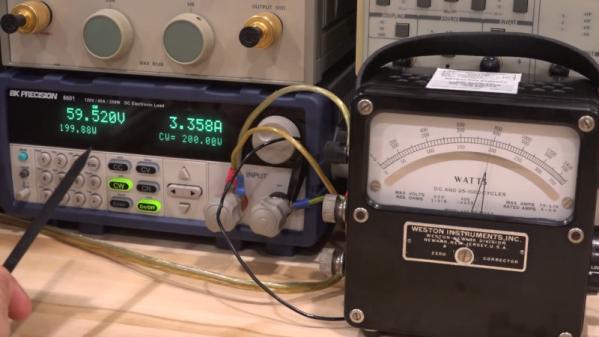
That’s the question [Shahriar] tackles in his teardown of an old lab-grade wattmeter. The video is somewhat of a departure for him, honestly; we’re used to seeing instruments come across his bench that would punch a seven-figure hole in one’s wallet if acquired new. These wattmeters are from Weston Instruments and are beautiful examples of sturdy, mid-century industrial design, and seem to have been in service until at least 2013. The heavy bakelite cases and sturdy binding posts for current and voltage inputs make it seem like the meters could laugh off a tumble to the floor.

But as [Shahriar] discovers upon teardown of a sacrificial meter, the electromechanical movement behind the instrument is quite delicate. The wattmeter uses a moving coil meter much like any other panel meter, but replaces the permanent magnet stator with a pair of coils. The voltage binding posts are connected to the fine wire of the moving coil through a series resistance, while the current is passed through the heavier windings of the stator coils. The two magnetic fields act together, multiplying the voltage by the current, and deflect a needle against a spring preload to indicate the power. It’s quite clever, and the inner workings are a joy to behold.

We just love looking inside old electronics, and moving coil meters especially. They’re great gadgets, and fun to repurpose, too.

Continue reading “Old Wattmeter Uses Magnetics To Do The Math”
Can You 3D-Print A Stator For A Brushless DC Motor?

Betteridge’s Law holds that any headline that ends in a question mark can be answered with a “No.” We’re not sure that [Mr. Betteridge] was exactly correct, though, since 3D-printed stators can work successfully for BLDC motors, for certain values of success.

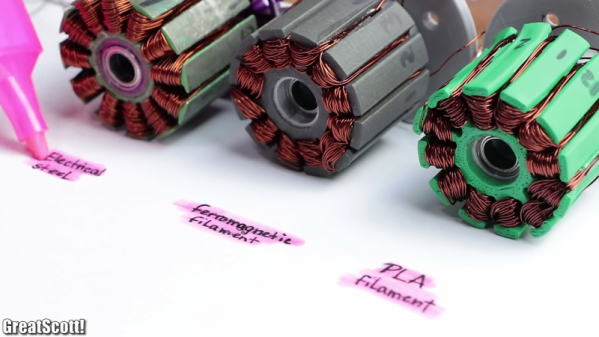
It’s not that [GreatScott!] isn’t aware that 3D-printed motors are a thing; after all, the video below mentions the giant Halbach array motor we featured some time ago. But part of advancing the state of the art is to replicate someone else’s results, so that’s essentially what [Scott!] attempted to do here. It also builds on his recent experiments with rewinding commercial BLDCs to turn them into generators. His first step is to recreate the stator of his motor as a printable part. It’s easy enough to recreate the stator’s shape, and even to print it using Proto-pasta iron-infused PLA filament. But that doesn’t come close to replicating the magnetic properties of a proper stator laminated from stamped iron pieces. Motors using the printed stators worked, but they were very low torque, refusing to turn with even minimal loading. There were thermal issues, too, which might have been mitigated by a fan.

So not a stunning success, but still an interesting experiment. And seeing the layers in the printed stators gives us an idea: perhaps a dual-extruder printer could alternate between plain PLA and the magnetic stuff, in an attempt to replicate the laminations of a standard stator. This might help limit eddy currents and manage heating a bit better. Continue reading “Can You 3D-Print A Stator For A Brushless DC Motor?”

Musical Mod Lets MRI Scanner Soothe The Frazzled Patient

Hackers love to make music with things that aren’t normally considered musical instruments. We’ve all seen floppy drive orchestras, and the musical abilities of a Tesla coil can be ear-shatteringly impressive. Those are all just for fun, though. It would be nice if there were practical applications for making music from normally non-musical devices.

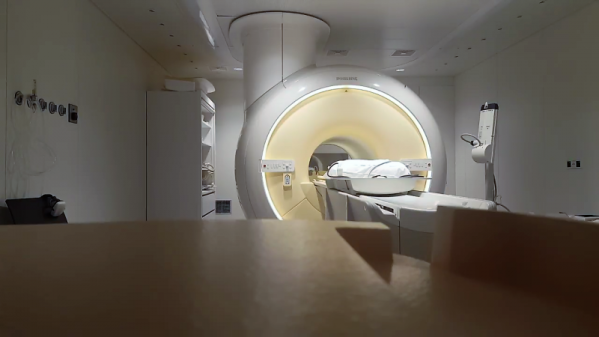
Thanks to a group of engineers at Case Western Reserve University in Cleveland, there is now: a magnetic resonance imaging machine that plays soothing music. And we don’t mean music piped into the MRI suite to distract patients from the notoriously noisy exam. The music is actually being played through the gradient coils of the MRI scanner. We covered the inner working of MRI scanners before and discussed why they’re so darn noisy. The noise basically amounts to Lorenz forces mechanically vibrating the gradient coils in the audio frequency range as the machine shapes the powerful magnetic field around the patient’s body. To turn these ear-hammering noises into music, the researchers converted an MP3 of [Yo Yo Ma] playing [Bach]’s “Cello Suite No. 1” into encoding data for the gradient coils. A low-pass filter keeps anything past 4 kHz from getting to the gradient coils, but that works fine for the cello. The video below shows the remarkable fidelity that the coils are capable of reproducing, but the most amazing fact is that the musical modification actually produces diagnostically useful scans.

Our tastes don’t generally run to classical music, but having suffered through more than one head-banging scan, a half-hour of cello music would be a more than welcome change. Here’s hoping the technique gets further refined.

Continue reading “Musical Mod Lets MRI Scanner Soothe The Frazzled Patient”

Manhattan Mystery Of Creepy Jingles And Random Noises Solved

Here’s a puzzler for you: If you’re phreaking something that’s not exactly a phone, are you still a phreak?

That question probably never crossed the minds of New Yorkers who were acoustically assaulted on the normally peaceful sidewalks of Manhattan over the summer by creepy sounds emanating from streetside WiFi kiosks. The auditory attacks caused quite a stir locally, leading to wild theories that Russian hackers were behind it all. Luckily, the mystery has been solved, and it turns out to have been part prank, part protest, and part performance art piece.

To understand the exploit, realize that New York City has removed thousands of traditional pay phones from city sidewalks recently and replaced them with LinkNYC kiosks, which are basically WiFi hotspots with giant HDTV displays built into them. For the price of being blitzed with advertisements while strolling by, anyone can make a free phone call using the built-in VOIP app. That was the key that allowed [Mark Thomas], an old-school phreak and die-hard fan of the pay telephones that these platforms supplanted, to launch his attack. It’s not exactly rocket surgery; [Mark] dials one of the dozens of conference call numbers he has set up with pre-recorded audio snippets. A one-minute delay lets him crank the speakerphone volume up to 11 and abscond. The recordings vary, but everyone seemed most creeped out by the familiar jingle of the [Mr. Softee] ice cream truck franchise, slowed down and distorted to make it sound like something from a fever dream.

Yes, it’s a minimal hack, and normally we don’t condone the misuse of public facilities, even ones as obnoxious as LinkNYC appears to be. But it does make a statement about the commercialization of the public square, and honestly, we’re glad to see something that at least approaches phreaking again. It’s a little less childish than blasting porn audio from a Target PA system, and far less dangerous than activating a public safety siren remotely.

Continue reading “Manhattan Mystery Of Creepy Jingles And Random Noises Solved”

Turn Old Pinball Parts Into A Unique Digital Clock

It’s getting ever harder to build a truly unique digital clock. From electronic displays to the flip-dots and flip-cards, everything seems to have been done to death. But this pinball scoring reel clock manages to keep the unique clock ball in play, as it were.

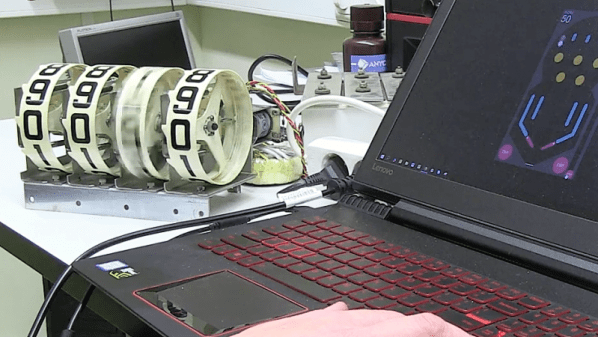
It’s not entirely clear whom to credit with this build, but the article was written by [Lucky]. Nor do they mention which pinball machine gave up its electromechanical scoring display for the build. Our guess would be a machine from the ’60s, before the era of score inflation that required more than the four digits used. And indeed, the driver for the display is designed so that a scoring unit from any pinball machine from the electromechanical era can be used. An ESP8266 keeps the time with the help of an RTC and drives the coils of the scoring unit through a bunch of MOSFETs. The video below shows that it wouldn’t make a great clock for the nightstand; thankfully, it has a user-configured quiet time to limit the not inconsiderable noise to waking hours. It also flashes the date every half hour, rings solenoid operated chimes, and as a bonus, it can be used to keep score in a pinball game built right into the software.

We like the idea of honoring the old pinball machines with clock builds like this. We’ve seen a word clock built from the back-glass of an old machine, and one that uses a four-player back to display the date and alarm time too.

Continue reading “Turn Old Pinball Parts Into A Unique Digital Clock”

Jeremy Hong: Weaponizing The Radio Spectrum

Jeremy Hong knows a secret or two about things you shouldn’t do with radio frequency (RF), but he’s not sharing.

That seems an odd foundation upon which to build one’s 2018 Hackaday Superconference talk, but it’s for good reason. Jeremy knows how to do things like build GPS and radar jammers, which are federal crimes. Even he hasn’t put his knowledge to practical use, having built only devices that never actually emitted any RF.

So what does one talk about when circumspection is the order of the day? As it turns out, quite a lot. Jeremy focused on how the military leverages the power of radio frequency jamming to turn the tables on enemies, and how civilian police forces are fielding electronic countermeasures as well. It’s interesting stuff, and Jeremy proved to be an engaging guide on a whirlwind tour into the world of electronic warfare.
Continue reading “Jeremy Hong: Weaponizing The Radio Spectrum”

Tiny Art Etched Into Silicon Wafers With Electron Beam Lithography

Looks like [Sam Zeloof] got bored on his Thanksgiving break, and things got a little weird in his garage. Of course when your garage contains a scanning electron microscope, the definition of weird can include experimenting with electron-beam lithography, resulting in tiny images etched into silicon.

You’ll probably remember [Sam] from his 2018 Hackaday Superconference talk on his DIY semiconductor fab lab, which he used to create a real integrated circuit. That chip, a PMOS dual-channel differential amp, was produced by photolithography using a modified DLP projector. Photolithography imposes limits to how small a feature can be created on silicon, based on the wavelength of light.

[Sam] is now looking into using the electron beam of his SEM as a sort of CNC laser engraver to produce much finer features. The process involves spin-coating silicon wafers with SU-8, an epoxy photoresist normally used with UV light but that also turns out to be sensitive to electron beams. He had to modify his SEM to control the X- and Y-axis deflection with a 12-bit DAC and provide a custom beam blanker. With a coated wafer in the vacuum chamber, standard laser engraving software generates the G-code to trace his test images on the resist. A very quick dip in acetone develops the exposed chip.

[Sam] says these first test images are not too dainty; the bears are about 2.5 mm high, and the line width is about 10 μm. His system is currently capable of resolving down to 100 nm, while commercial electron beam lithography can get down to 5 nm or so. He says that adding a Faraday cage to the setup might help him get there. Sounds like a project for Christmas break.

Continue reading “Tiny Art Etched Into Silicon Wafers With Electron Beam Lithography”