Why Spacecraft Of The Future Will Be Extruded

It’s been fifty years since man first landed on the Moon, but despite all the incredible advancements in technology since Armstrong made that iconic first small step, we’ve yet to reach any farther into deep space than we did during the Apollo program. The giant leap that many assumed would naturally follow the Moon landing, such as a manned flyby of Venus, never came. We’ve been stuck in low Earth orbit (LEO) ever since, with a return to deep space perpetually promised to be just a few years away.

Falcon Heavy Payload Fairing

But why? The short answer is, of course, that space travel is monstrously expensive. It’s also dangerous and complex, but those issues pale in comparison to the mind-boggling bill that would be incurred by any nation that dares to send humans more than a few hundred kilometers above the surface of the Earth. If we’re going to have any chance of getting off this rock, the cost of putting a kilogram into orbit needs to get dramatically cheaper.

Luckily, we’re finally starting to see some positive development on that front. Commercial launch providers are currently slashing the cost of putting a payload into space. In its heyday, the Space Shuttle could carry 27,500 kg (60,600 lb) to LEO, at a cost of approximately $500 million per launch. Today, SpaceX’s Falcon Heavy can put 63,800 kg (140,700 lb) into the same orbit for less than $100 million. It’s still not pocket change, but you wouldn’t be completely out of line to call it revolutionary, either.

Unfortunately there’s a catch. The rockets being produced by SpaceX and other commercial companies are relatively small. The Falcon Heavy might be able to lift more than twice the mass as the Space Shuttle, but it has considerably less internal volume. That wouldn’t be a problem if we were trying to hurl lead blocks into space, but any spacecraft designed for human occupants will by necessity be fairly large and contain a considerable amount of empty space. As an example, the largest module of the International Space Station would be too long to physically fit inside the Falcon Heavy fairing, and yet it had a mass of only 15,900 kg (35,100 lb) at liftoff.

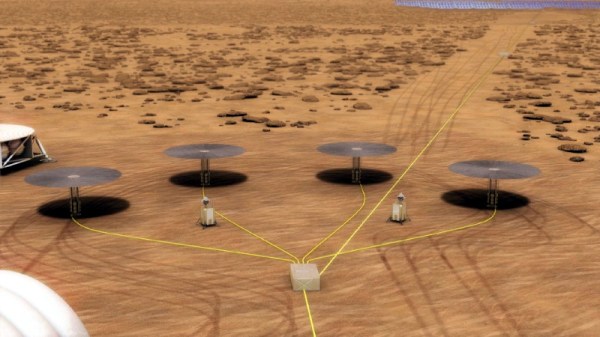
To maximize the capabilities of volume constrained boosters, there needs to be a paradigm shift in how we approach the design and construction of crewed spacecraft. Especially ones intended for long-duration missions. As it so happens, exciting research is being conducted to do exactly that. Rather than sending an assembled spacecraft into orbit, the hope is that we can eventually just send the raw materials and print it in space.

Continue reading “Why Spacecraft Of The Future Will Be Extruded”

Sniffed Transformer Puts Wired Doorbell Online

There’s certainly no shortage of “smart” gadgets out there that will provide you with a notification, or even a live audiovisual stream, whenever somebody is at your door. But as we’ve seen countless times before, not everyone is thrilled with the terms that most of these products operate under. Getting a notification on your phone when the pizza guy shows up shouldn’t require an email address, credit card number, or DNA sample.

For [Nick Touran], half the work was already done. There was already a traditional wired doorbell in his home, he just had to come up with a minimally invasive way to link it with Home Assistant. He reasoned that he could tap into the low-voltage side of the doorbell transformer and watch for the telltale fluctuations that would indicate the bell was doing its thing. The ESP8266 has an ADC to measure voltage and WiFi to connect to Home Assistant, so it seemed like the perfect bridge between old and new.

Transformer voltage before and after

Of course, as with any worthwhile project, it ended up being a bit more complicated. Wired doorbells generally operate on 16-24 VAC, and [Nick] knew if he tried to put his Wemos D1 across the line he’d release the critical Magic Smoke. What he needed was a voltage divider circuit that would take low-voltage AC and drop it to an even lower DC voltage that the microcontroller could cope with.

The simple circuit [Nick] comes up with cuts the voltage way down and removes the negative component completely. So what was originally 18.75 VAC turned into a series of 60 Hz blips at 2.4 VDC; perfect for feeding into a microcontroller ADC. With a baseline to work from, he could then write some code that would watch for variations in this signal to determine when the bell was ringing.

Or at least, that was the idea. While the setup worked well enough on the bench, its performance in the real-world left something to be desired. If his house guest had a heavy hand, it worked great. But a quick tap of the doorbell button would tend to go undetected. After investigating the issue, [Nick] found that he needed to use some software trickery to ensure the ESP8266 was able to keep up with the speedy signal. Once he was able to reliably detect short and long button presses, the rest was just a simple matter of sending an MQTT message to his automation system.

Compared to the hoops we’ve seen other hackers have to jump through to smarten up their doorbells, we think [Nick] got off fairly easy. This project is also an excellent example of how learning about circuit design and passive components can still come in handy in the Arduino Era.

Continue reading “Sniffed Transformer Puts Wired Doorbell Online”

Supercap Drink Coasters Are The Life Of The Party

You’ve probably seen multicolored flashing LEDs embedded into clear plastic cups or coasters before, they’re quite commonly used in fancy restaurants that also feature animatronic characters and a gift shop on the way out. But have you ever wondered about the logistics of maintaining such devices? When the anthropomorphic rodent shuts down for the night, you’re going to want to clean all those blinking doodads; but any opening to connect a charger or insert a battery is just a leak waiting to happen.

[Scott Clandinin] has come up with a solution to this problem that’s equal parts brilliant simplicity and unabashed overengineering. Using wireless charging and supercapacitors, he’s developing an LED coaster that can be hermetically sealed in clear resin.

With no plugs to connect or batteries to change, these coasters can be permanently encapsulated with no ill effects. Granted the supercapacitors will degrade with time and eventually won’t hold a charge for as long, but even the most conservative estimates would have these coasters still partying in a decade.

For his prototype version [Scott] has put together a simple charging base, but we imagine in a full deployment such devices could be charged with induction coils built into a bar or table. While the energy consumption could potentially be a showstopper, we’d love to see a future version that integrates a radio receiver. Then the coasters could double as pagers to let diners know their table is ready.

While this device is obviously much thicker than a traditional coaster, it looks fairly reasonable even at this early stage. We like the concentric design that puts the coil inside the PCB, and wonder if similar cutouts couldn’t be used to get the twin 15F supercapacitors and charging module hunkered down just a few millimeters more. The 2019 Hackaday Prize is all about evolving an idea into a design suitable for production, and those are the sort of incremental improvements that the judges will certainly be keeping an eye out for.

SpaceX Clips Dragon’s Wings After Investigation

When the SpaceX Dragon spacecraft reached orbit for the first time in 2010, it was a historic achievement. But to qualify for NASA’s Commercial Orbital Transportation Services (COTS) program, the capsule also needed to demonstrate that it could return safely to Earth. Its predecessor, the Space Shuttle, had wings that let it glide home and land like a plane. But in returning to the classic capsule design of earlier spacecraft, SpaceX was forced to rely on a technique not used by American spacecraft since the 1970s: parachutes and an ocean splashdown.

The Dragon’s descent under parachute, splashdown, and subsequent successful recovery paved the way for SpaceX to begin a series of resupply missions to the International Space Station that continue to this day. But not everyone at SpaceX was satisfied with their 21st century spacecraft having to perform such an anachronistic landing. At a post-mission press conference, CEO Elon Musk told those in attendance that eventually the Dragon would be able to make a pinpoint touchdown using thrusters and deployable landing gear:

The architecture that you observed today is obviously similar to what was employed in the Apollo era, but the next generation Dragon, the Crew Dragon, we’re actually going to be aiming for a propulsive landing with gear. We’ll still have the parachutes as a backup, but it’s going to be a precision landing, you could literally land on something the size of a helipad propulsively with gear, refuel, and take off again.

But just shy of a decade later, the violent explosion of the first space worthy Crew Dragon has become the final nail in the coffin for Elon’s dream of manned space capsules landing like helicopters. In truth, the future of this particular capability was already looking quite dim given NASA’s preference for a more pragmatic approach to returning their astronauts from space. But Crew Dragon design changes slated to be implemented in light of findings made during the accident report will all but completely remove the possibility of Dragon ever performing a propulsive landing.

Continue reading “SpaceX Clips Dragon’s Wings After Investigation”

Bringing Pro-Level Data Recording To RC Racing

We’re all familiar with the “Black Box” used on commercial aircraft, the flight data recorder which captures the minutia of each and every flight on the off-chance that it’s needed in the event of an accident. But even in less dire circumstances, the complete record of the aircraft’s performance versus what was commanded of it by the pilot can be used to fine tune performance or detect faults before they become serious.

As a data engineer for professional motorsports, [Jussi Luopajärvi] knows similar recorders can be just as useful for vehicles stuck here on terra firma. His entry into the 2019 Hackaday Prize, TestLogger, aims to bring that same kind of technology to the world of RC racing. The gadget allows the driver to easily record a wealth of data about the vehicle during races, giving them valuable insight into the vehicle’s performance.

So what kind of variables are there to record on a 1/8th or 1/12th scale car? Don’t be fooled by their diminutive wheelbases, the modern RC car relies on an impressive amount of technical wizardry that benefits from a close eye.

Right now, [Jussi] says TestLogger can record not only obvious elements like battery level and throttle, but also more esoteric variables such as steering input, individual drive wheel speed, angular velocity, and even g-force in three dimensions. There’s also support for a trackside IR beacon that allows TestLogger to record lap times.

All of the data is stored on TestLogger’s SD card in standard CSV files, which makes it easy for us hacker types to parse and analyze. But for those who are more interested in driving than delimiting, there’s also a very slick website that will let users upload and compare their data. This complete user experience gives TestLogger a very professional feel, and we can’t wait to see where [Jussi] takes it from here.

With powerful microcontrollers available for a song, we expect this kind of detailed data collection is only going to become more common.

Open Source Smart Display Takes The Long Way Around

Thanks to the relatively low cost of the Raspberry Pi and high resolution LCD screens, “smart displays” have become a favorite project of those looking to clear out their parts bins. Just hook the Pi up to the screen, setup some software, and you’ve got yourself a digital bulletin board for your home that can show your schedule, the weather, etc. Build it into a mirror, and you’ve got yourself at least double Internet points.

But when [John Basista] started planning his own smart display, he decided to take the path less traveled. He’s entered the resulting open source project into the 2019 Hackaday Prize, and we’re very excited to see where it goes from here. Even in these early days he’s already made some great strides, with nary a Raspberry Pi in sight.

[John] has nothing against using the Raspberry Pi for these smart displays, and indeed, it has a number of traits which make it particularly well suited to the task. But the problem for him was that it only supported HDMI, and he had his heart set on using an Embedded DisplayPort (eDP) screen. Namely the Innolux N173HCE-E31, a 17.3 inch IPS LCD designed for laptops.

He tried to find a Linux or Android compatible SBC that featured eDP, but found it to be a challenge. There were some x86 options, but didn’t want to go down that road. Eventually he settled on the Dragonboard 410c, which features a quad-core Qualcomm APQ8016E CPU running at 1.2 GHz and 1GB of RAM. This board didn’t have eDP either, but it did have Display Serial Interface (DSI), which he could convert to eDP with the Texas Instruments SN65DSI86 IC.

From there, he started developing a PCB which would hold the Dragonboard 410c and the SN65DSI86. The board also breaks out I2C and UART so he can connect it to various other sensors and gadgetry down the road, and includes all the necessary power regulation to drive everything. The whole thing fits in the palm of your hand, and judging by the renders [John] has put together, should nestle nicely into the back of the 3D printed enclosure when everything is finished.

There’s still quite a bit left to do on this project, but [John] has plenty of time to tie up the loose ends. Currently there’s little information about the software side of things, but as you can see in the video after the break, it’s now running Android which should make things relatively easy.

Continue reading “Open Source Smart Display Takes The Long Way Around”

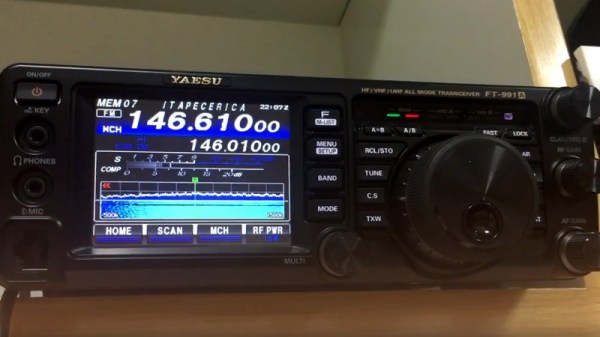
RTL-SDR: Seven Years Later

Before swearing my fealty to the Jolly Wrencher, I wrote for several other sites, creating more or less the same sort of content I do now. In fact, the topical overlap was enough that occasionally those articles would get picked up here on Hackaday. One of those articles, which graced the pages of this site a little more than seven years ago, was Getting Started with RTL-SDR. The original linked article has long since disappeared, and the site it was hosted on is now apparently dedicated to Nintendo games, but you can probably get the gist of what it was about from the title alone.

An “Old School” RTL-SDR Receiver

When I wrote that article in 2012, the RTL-SDR project and its community were still in their infancy. It took some real digging to find out which TV tuners based on the Realtek RTL2832U were supported, what adapters you needed to connect more capable antennas, and how to compile all the software necessary to get them listening outside of their advertised frequency range. It wasn’t exactly the most user-friendly experience, and when it was all said and done, you were left largely to your own devices. If you didn’t know how to create your own receivers in GNU Radio, there wasn’t a whole lot you could do other than eavesdrop on hams or tune into local FM broadcasts.

Nearly a decade later, things have changed dramatically. The RTL-SDR hardware and software has itself improved enormously, but perhaps more importantly, the success of the project has kicked off something of a revolution in the software defined radio (SDR) world. Prior to 2012, SDRs were certainly not unobtainable, but they were considerably more expensive. Back then, the most comparable device on the market would have been the FUNcube dongle, a nearly $200 USD receiver that was actually designed for receiving data from CubeSats. Anything cheaper than that was likely to be a kit, and often operated within a narrower range of frequencies.

Today, we would argue that an RTL-SDR receiver is a must-have tool. For the cost of a cheap set of screwdrivers, you can gain access to a world that not so long ago would have been all but hidden to the amateur hacker. Let’s take a closer look at a few obvious ways that everyone’s favorite low-cost SDR has helped free the RF hacking genie from its bottle in the last few years.

Continue reading “RTL-SDR: Seven Years Later”