Redefine Robots Is The Newest Hackaday Prize Challenge

Roboticists and automation enthusiasts, start your engines. This 2021 Hackaday Prize challenge is made just for you! It’s the Redefine Robots challenge and it calls for a softer, more utopian side of what tomorrow’s automated future can be.

The promise of robots has always been one of making our lives better. But so far we still don’t have a robot assistant sitting next to us ready to lend a hand. That’s where you come in! Whether it’s a physical, nuts-and-bots robot or a 1’s and 0’s software bot, create something that people can see and interact with in their day-to-day lives in ways that make sense and make us feel good about where technology is going.
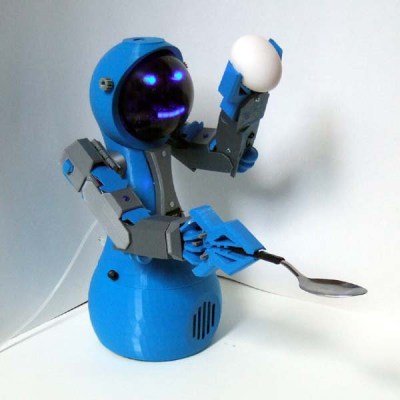
We make fun of the robot that’s been brought into the world to pass the butter, but honestly if that’s something someone needs help with, isn’t a robot a pretty good solution? That’s what [Michael Roybal] thought way back during the 2016 Hackaday Prize when he designed Zizzy the robot to zip around a tabletop, assisting people with limited mobility.

In the same year, [Mike Rigsby] was working on a little bot whose purpose was to wander around interacting with people. A robot companion (dare we say pet?) is one way to keep up interactivity for people spending long periods of time alone. Along the same lines is the EMOJO chatbot already entered in this year’s contest that seeks to deliver a digital companion onscreen.

Assistive robots aren’t the only ones to shine here. Consider some labor savers, like pick-and-place robots that help you build electronics. Does that reinvent robots? Maybe, maybe not, but getting a 3D printer to do your solder for you sure does. Think of how revolutionary robot vacuums were for people who own both hardwood floors and cats. Those bots are around humans all the time and seem normal now. What’s next automation to get this introduction into everyday life?

Ten finalists from this round will win $500 and be shuttled onto the final round judging in October for a chance at the $25,000 Hackaday Prize and four other top prizes. Start your project page on Hackaday.io and use the drop-down in the left sidebar to enter it into the 2021 Hackaday Prize.


Drone Hits Plane — And This Time It’s A Real (Police) One!

Over the years we’ve brought you many stories that follow the world of aviation as it struggles with the arrival of multirotors. We’ve seen phantom drone encounters cause panics and even shut airports, but it’s been vanishingly rare for such a story to have a basis in evidence. But here we are at last with a drone-aircraft collision story that involves a real drone. This time there’s a twist though, instead of one piloted by a multirotor enthusiast that would prompt a full-on media panic, it’s a police drone that collided with a Cesna landing at Toronto’s Buttonville airport. The York Regional Police craft was part of an operation unrelated to the airport, and its collision with the aircraft on August 10th was enough to make a significant dent in its engine cowling. The police are reported to be awaiting the result of an official investigation in the incident.

This is newsworthy in itself because despite several years and significant resources being devoted to the problem of drones hitting planes, demonstrable cases remain vanishingly rare. The machine in this case being a police one will we expect result in many fewer column inches for the event than had it been flown at the hands of a private multirotor pilot, serving only to heighten the contrast with coverage of previous events such as the Gatwick closure lacking any drone evidence.

It’s picking an easy target to lay into the Your Regional Police over this incident, but it is worth making the point that their reaction would have been disproportionately larger had the drone not been theirs. The CTV news report mentions that air traffic regulators were unaware of the drone’s presence:

NAV Canada, the country’s air navigation service provider, had not been notified about the YRP drone, Transport Canada said.

Given the evident danger to aviation caused by their actions it’s not unreasonable to demand that the officers concerned face the same penalties as would any other multirotor pilot who caused such an incident. We aren’t holding our breath though.

Header image: Raysonho @ Open Grid Scheduler / Grid Engine, CC0.

Sad clown holding melted ice cream cone

Freezing Out Ice Cream Machine Competition

We always knew that McDonald’s soft serve (you can’t really call it ice cream) machines are known to be finicky. There’s even a website that tracks where the machines are broken and, apparently, it is usually about 10% or more of them at any given time. But when we saw a news article about a judge issuing a restraining order, we knew there must be more to the story. Turns out, these $18,000 soft serve machines are in the heart of something we are very interested in: when do you own your own technology?

Cold Tech

There are apparently 13,000 or so of these machines and they are supposedly high-tech marvels, able to produce soft serve and milkshakes at the same time. However, they are also high maintenance. Cleaning the machine every two weeks (try not to think about that) involves a complete teardown. Worse, if anything breaks, you need a factory-authorized service person.

Continue reading “Freezing Out Ice Cream Machine Competition”

ESP32 Video Input Using I2S

Computer engineering student [sherwin-dc] had a rover project which required streaming video through an ESP32 to be accessed by a web server. He couldn’t find documentation for the standard camera interface of the ESP32, but even if he had it, that approach used too many I/O pins. Instead, [sherwin-dc] decided to shoe-horn a video into an I2S stream. It helped that he had access to an Altera MAX 10 FPGA to process the video signal from the camera. He did succeed, but it took a lot of experimenting to work around the limited resources of the ESP32. Ultimately [sherwin-dc] decided on QVGA resolution of 320×240 pixels, with 8 bits per pixel. This meant each frame uses just 77 KB of precious ESP32 RAM.

His design uses a 2.5 MHz SCK, which equates to about four frames per second. But he notes that with higher SCK rates in the tens of MHz, the frame rate could be significantly higher — in theory. But considering other system processing, the ESP32 can’t even keep up with four FPS. In the end, he was lucky to get 0.5 FPS throughput, but that was adequate for purposes of controlling the rover (see animated GIF below the break). That said, if you had a more powerful processor in your design, this technique might be of interest. [Sherwin-dc] notes that the standard camera drivers for the ESP32 use I2S under the hood, so the concept isn’t crazy.

We’ve covered several articles about generating video over I2S before, including this piece from back in 2019. Have you ever commandeered a protocol for “off-label” use?

Continue reading “ESP32 Video Input Using I2S”

Open-Source Insulin: Biohackers Aiming For Distributed Production

When you’ve got a diabetic in your life, there are few moments in any day that are free from thoughts about insulin. Insulin is literally the first coherent thought I have every morning, when I check my daughter’s blood glucose level while she’s still asleep, and the last thought as I turn out the lights, making sure she has enough in her insulin pump to get through the night. And in between, with the constant need to calculate dosing, adjust levels, add corrections for an unexpected snack, or just looking in the fridge and counting up the number of backup vials we have on hand, insulin is a frequent if often unwanted intruder on my thoughts.

And now, as my daughter gets older and seeks like any teenager to become more independent, new thoughts about insulin have started to crop up. Insulin is expensive, and while we have excellent insurance, that can always change in a heartbeat. But even if it does, the insulin must flow — she has no choice in the matter. And so I thought it would be instructional to take a look at how insulin is made on a commercial scale, in the context of a growing movement of biohackers who are looking to build a more distributed system of insulin production. Their goal is to make insulin affordable, and with a vested interest, I want to know if they’ve got any chance of making that goal a reality.

Continue reading “Open-Source Insulin: Biohackers Aiming For Distributed Production”

Math, Optics, And CNC Combine To Hide Secret Images In Acrylic

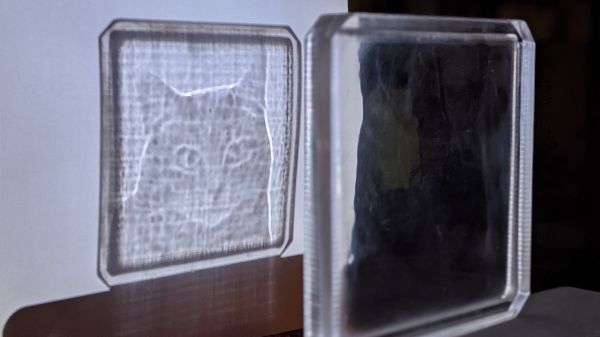
Magic mirrors, with an LCD panel hidden behind a partially reflectively mirror, are popular for a reason — they’re a good-looking way to display useful information. A “Magic Window,” however, is an entirely different thing — and from the look of it, a far cooler one.

If you’ve never seen a Magic Window before, don’t worry — it’s partially because you’re not supposed to see it. A Magic Window appears to be a clear piece of glass or plastic, one with a bit of a wave in it that causes some distortion when looking through it. But as [Matt Ferraro] explains, the distortion encodes a hidden image, visible only when light passes through the window. It looks a bit like a lithophane, but it’s projected rather than reflected, and it relies on an optical phenomenon known as caustics. If you’ve ever seen the bright and dark patches cast on the bottom of a swimming pool when sunlight hits the surface, you’ve seen caustics.

As for how to hide an image in a clear window, let’s just say it takes some doing. And some math; Snell’s Law, Fermat’s Theorem, Poisson’s Equation — all these and more are mentioned by [Matt] by way of explanation. The short story is that an image is morphed in software, normalized, and converted into a heightmap that’s used to generate a toolpath for a CNC router. The design is carved into a sheet of acrylic by the router and polished back to clarity with a succession of sandpaper grits. The wavy window is then ready to cast its hidden shadow.

Honestly, the results are amazing, and we marvel at the skills needed to pull this off. Or more correctly, that [Matt] was able to make the process simple enough for anyone to try.

Continue reading “Math, Optics, And CNC Combine To Hide Secret Images In Acrylic”

PS2 Gets The Ginger Portable Treatment

The first thing we notice about this portable PS2 is that the plastic looks like a consumer-grade shell, not a 3D printed case. It comes from [GingerOfOz], who has lots of portable conversions under his belt, so we are not surprised this looks like a genuine Sony device. When you are as experienced as he, details like plastic texture, and button selection, are solved problems, but shouldn’t be taken for granted by us mortals.

Of course, this isn’t just pretty, and if it weren’t functional, we wouldn’t be talking about it. The system plays nearly all PS2 titles from USB memory. The notable exceptions are the ones that refuse to load without a Dualshock controller. Rude. If you’re wondering if it plays games at full speed, yes. It achieves authentic speed because it uses a PS2 slim motherboard which gets cut down by a Dremel. Custom PCBs provide the rest of the hardware, like volume buttons and battery charging. There is no optical drive since they are power hogs, so your cinematic cut scenes may lag, and load times are a little longer.

Modern mobile phones are one of the most powerful gaming systems ever built, but there is something about purpose-built portable gaming hardware that just feels right. You know?

Continue reading “PS2 Gets The Ginger Portable Treatment”