Bicycle Flywheel Stores A Bit Of Energy, Not Much

Kinetic energy recovery systems have often been proposed as a useful way to improve the efficiency of on-road vehicles, and even used to great effect in motorsports for added performance. [Tom Stanton] decided to build one of his own, outfitting a simple bicycle with a flywheel system for harvesting energy. (Video, embedded below.)

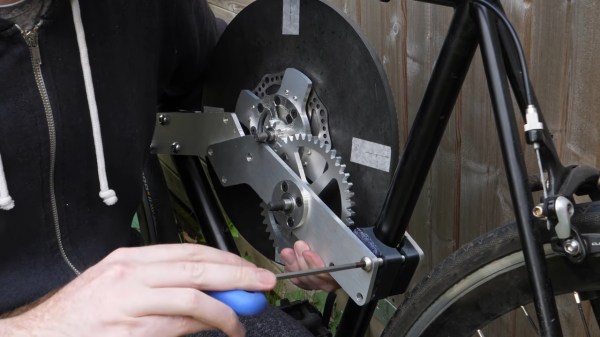
The system consists of a 300 mm steel flywheel mounted in the center of the bike’s frame. It’s connected to the rear wheel via a chain and a clutch which [Tom] assembled himself using bicycle disc brake components. The clutch is controlled by a handlebar lever, allowing the rider to slow the bike by charging the flywheel, or to charge the flywheel to maximum speed by pedalling hard with the clutch engaged.

The actual utility of the flywheel is minimal; [Tom] notes that even at its peak speed of 2200 RPM, the flywheel stores a small fraction of the energy content of a AA battery. Practical demonstration shows the flywheel is only able to deliver a small push to [Tom] when riding the bike, too.

Despite the lack of performance, it’s nonetheless an interesting project and one that demonstrates the basic principles of flywheel energy storage. The underwhelming results perhaps serve as a solid indication of why it’s not something we use particularly often, on bicycles at least. We’ve seen [Tom]’s bike experiments before, too. Video after the break.

Continue reading “Bicycle Flywheel Stores A Bit Of Energy, Not Much”

Aircraft Compass Teardown

We didn’t know what a C-2400 LP was before we saw [David’s] video below, but it turned out to be pretty interesting. The device is an aircraft compass and after replacing it, he decided to take it apart for us. Turns out, that like a nautical compass, these devices need adjustment for all the metal around them. But while a ship’s compass has huge steel balls for that purpose, the tiny and lightweight aviation compass has to be a bit more parsimonious.

The little device that stands in for a binnacle’s compensators — often called Kelvin’s balls — is almost like a mechanical watch. Tiny gears and ratchets, all in brass. Apparently, the device is pretty reliable since the date on this one is 1966.

Continue reading “Aircraft Compass Teardown”

Tiny PCB Motor Robot Is Making Its First Wobbly Moves

[Carl Bugeja] has been working on his PCB motors for more than three years now, and it doesn’t seem like he is close to running out of ideas for the project. His latest creation is a tiny Bluetooth-controlled robot built around two of these motors.

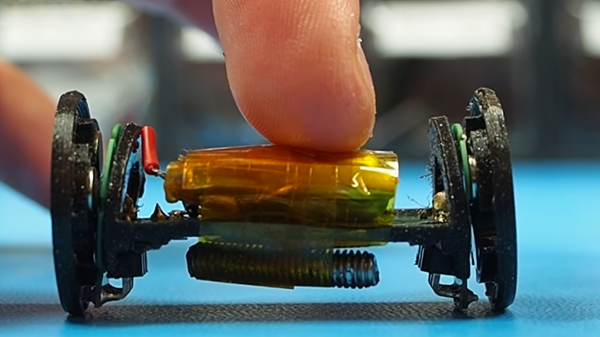
One of the main challenges of these axial flux PCB motors is their low torque output, so [Carl] had to make the robot as light as possible. The main board contains a microcontroller module with integrated Bluetooth, an IMU, regulator, and two motor drivers. The motor stator boards are soldered to the main board using 90° header pins. The frame for the body and the rotors for the motors are 3D printed. A set of four neodymium magnets and a bearing is press-fit into each rotor. The motor shafts are off-the-shelf PCB pins with one end soldered to the stator board. Power comes from a small single-cell lipo battery attached to the main board.

The robot moves, but with a jerking motion, and keeps making unintended turns. The primary cause of this seems to be the wobbly rotors, which mean that the output torque fluctuates throughout the rotation of the motor. Since there are only two points of contact to the ground, only the weight of the board and battery is preventing the central part from rotating with the motors. This doesn’t look like it’s quite enough, so [Carl] wants to experiment with using the IMU to smooth out the motion. For the next version, he’s also working on a new shaft mount, a metal rotor, and a more efficient motor design.

We look forward to seeing this in action, and also what other application [Carl] can come up with. He has already experimented with turning it into a stepper motor, a linear motor, and a tiny jigsaw motor.

Continue reading “Tiny PCB Motor Robot Is Making Its First Wobbly Moves”

Small Swedish Stores Are Miniature Oases In A National Food Desert

It all started one night in 2016 after [Robert Ilijason] dropped the last remaining jar of baby food in the house, breaking it. On the 20-minute drive to the nearest supermarket, he had an idea: what if there were small, 24-hour convenience-level grocery stores that could fill the glaring need for access to basics across the country?

Sweden has lost a few thousand smaller grocery stores in the last 25 years or so, mostly in rural areas. For many people living outside the cities, the nearest place to buy milk is several miles away, at a huge supermarket that’s either in a city, or close to it. After [Robert] built Sweden’s first 24-hour unmanned convenience store, the idea received quite a bit of media attention.

Five years and a pandemic later, the concept is still going strong. A chain of 30 of these bite-sized bodegas have popped up all over Sweden, run by a company called Lifvs. They have no staff at all, not even a cashier. Instead, shoppers unlock the door with their phones. They scan all their barcodes into an app, which provides a bill every month and is linked to both their bank account and national identity system. Beyond that, security is in the form of a single camera.

Because these tiny stores are staff-less, the prices can be kept relatively low. The only problem is that the technology is a bit of an issue for some older residents. Back in 2016, [Robert Ilijason] was trying to figure out another way for customers to unlock the door, but it doesn’t look like Lifvs has solved that problem yet.

One thing you can’t complain about with a store like this is the selection. We have to wonder if shoppers are more or less likely to encounter fasciated fruit amongst the produce.

Spell Checking Your Programming From The Linux Command Line

For most of us who didn’t do well in high school English class, spell checkers are a real game-changer. Sure, you can still swap a “to” and a “too,” but a spell checker will catch a lot of typos. But what about in your source code? You usually don’t spell check source code and even if you did, the rules are funny. After all, “my_proejct” is a perfectly fine variable name, but you probably meant “my_project.” That’s where a program called typos comes in. It aims to be a spell checker for source code that is fast enough and with a low enough false positive rate that you can run it against changed code and reject spelling problems.

Sure, if “my_proejct” is a one-time typo, the compiler or interpreter will probably catch it. But it won’t catch comments and it also won’t catch something you spell wrong consistently. For that you need something like typos.

Continue reading “Spell Checking Your Programming From The Linux Command Line”

Chainsaw Cuts More Than Timber

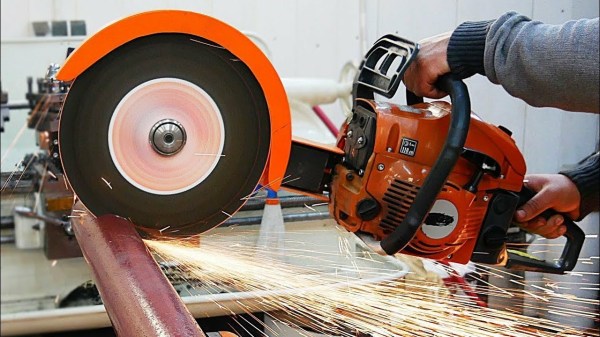
We often take electricity for granted, to the point of walking into a room during a power outage and still habitually flipping the light switch. On the other hand, there are plenty of places where electricity isn’t a given, either due to poor infrastructure or an otherwise remote location. To get common electric power tools to work in areas like these requires some ingenuity like that seen in this build which converts a chainsaw to a gas-driven grinder that can be used for cutting steel or concrete. (Video, embedded below.)

All of the parts needed for the conversion were built in the machine shop of [Workshop from scratch]. A non-cutting chain was fitted to it first to drive the cutting wheel rather than cut directly, so a new bar had to be fabricated. After that, the build shows the methods for attaching bearings and securing the entire assembly back to the gas-powered motor. Of course there is also a custom shield for the grinding wheel and also a protective housing for the chain to somewhat limit the danger of operating a device like this.

Even though some consideration was paid to safety in this build, we would like to reiterate that all the required safety gear should be worn. That being said, it’s not the first time we’ve seen a chainsaw modified to be more useful than its default timber-cutting configuration, like this build which turns a chainsaw into a metal cutting chop saw.

Continue reading “Chainsaw Cuts More Than Timber”

Retrotechtacular: The Drama Of Metal Forming

It may seem overwrought, but The Drama of Metal Forming actually is pretty dramatic.

This film is another classic of mid-century corporate communications that was typically shown in schools, which the sponsor — in this case Shell Oil — seeks to make a point about the inevitable march of progress, and succeeds mainly in showing children and young adults what lay in store for them as they entered a working world that needed strong backs more than anything.

Despite the narrator’s accent, the factories shown appear to be in England, and the work performed therein is a brutal yet beautiful ballet of carefully coordinated moves. The sheer power of the slabbing mills at the start of the film is staggering, especially when we’re told that the ingots the mill is slinging about effortlessly weigh in at 14 tons apiece. Seeing metal from the same ingots shooting through the last section of a roller mill at high speed before being rolled into coils gives one pause, too; the catastrophe that would result if that razor-sharp and red-hot metal somehow escaped the mill doesn’t bear imagining. Similarly, the wire drawing process that’s shown later even sounds dangerous, with the sound increasing in pitch to a malignant whine as the die diameter steps down and the velocity of the wire increases.

There are the usual charming anachronisms, such as the complete lack of safety gear and the wanton disregard for any of a hundred things that could instantly kill you. One thing that impressed us was the lack of hearing protection, which no doubt led to widespread hearing damage. Those were simpler times, though, and the march of progress couldn’t stop for safety gear. Continue reading “Retrotechtacular: The Drama Of Metal Forming”