A Xilinx Zynq Linux FPGA Board For Under $20? The Windfall Of Decommissioned Crypto Mining

One of the exciting trends in hardware availability is the inexorable move of FPGA boards and modules towards affordability. What was once an eye-watering price is now merely an expensive one, and no doubt in years to come will become a commodity. There’s still an affordability gap at the bottom of the market though, so spotting sub-$20 Xilinx Zynq boards on AliExpress that combine a Linux-capable ARM core and an FPGA on the same silicon is definitely something of great interest. A hackerspace community friend of mine ordered one, and yesterday it arrived in the usual anonymous package from China.

There’s a Catch, But It’s Only A Small One
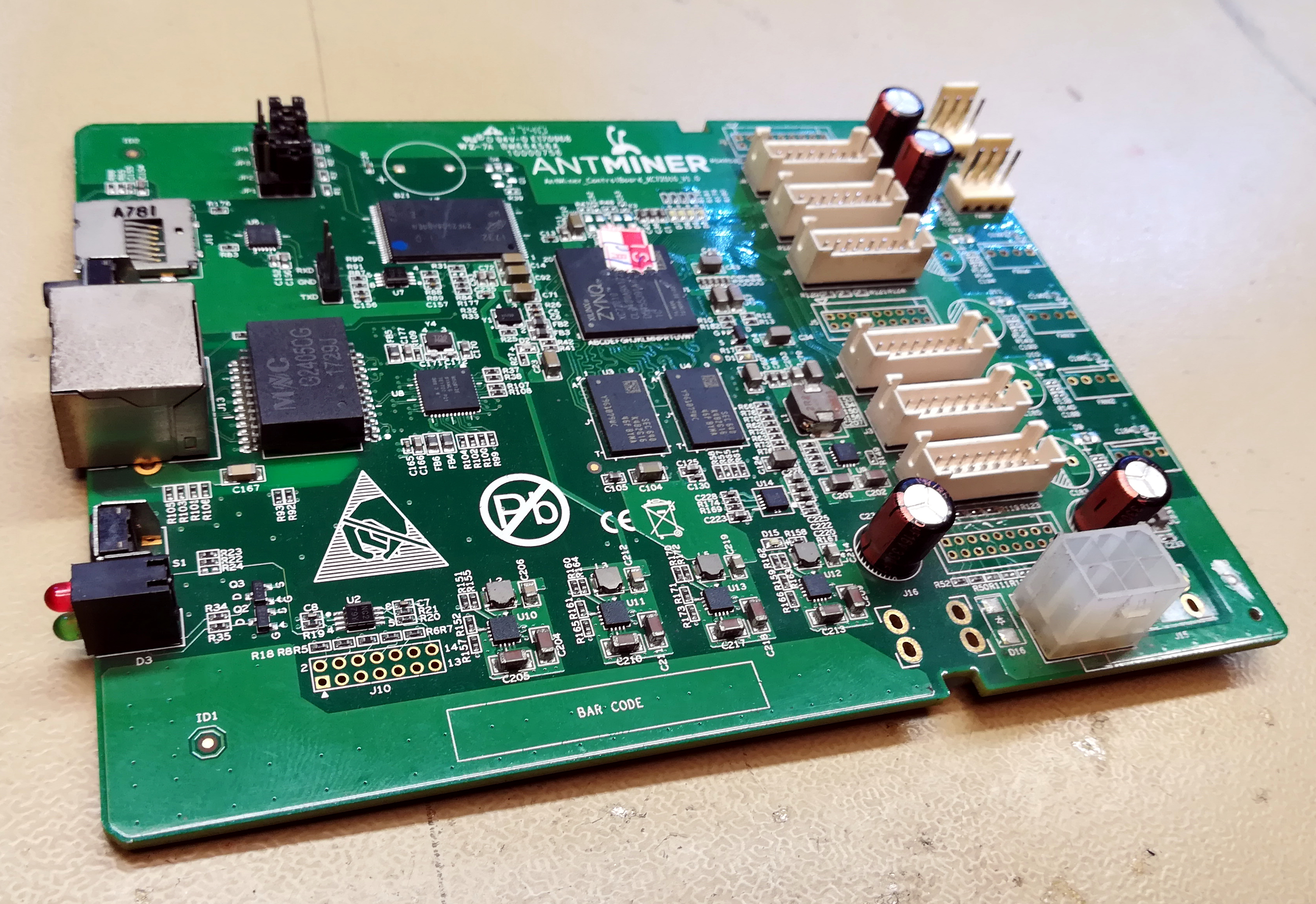
The heftier of the two boards, in all its glory.

There are two boards to be found for sale, one featuring the Zynq 7000 and the other the 7010, which the Xilinx product selector tells us both have the same ARM Cortex A9 cores and Artix-7 FPGA tech on board. The 7000 includes a single core with 23k logic cells, and there’s a dual-core with 28k on the 7010. It was the latter that my friend had ordered.

So there’s the good news, but there has to be a catch, right? True, but it’s not an insurmountable one. These aren’t new products, instead they’re the controller boards for an older generation of AntMiner cryptocurrency mining rigs. The components have 2017 date codes, so they’ve spent the last three years hooked up to a brace of ASIC or GPU boards in a mining data centre somewhere. The ever-changing pace of cryptocurrency tech means that they’re now redundant, and we’re the lucky beneficiaries via the surplus market.


Continue reading “A Xilinx Zynq Linux FPGA Board For Under $20? The Windfall Of Decommissioned Crypto Mining”

A Whimsical Touch-Free Gumball Machine For These Trying Times

It sucks that certain stuff in public is off-limits right now, like drinking fountains and coin-operated candy and gum machines — especially the fun kind where you get to watch your gumball take a twisting trip down the tower and into the collection bin. Hopefully there will be commercial contact-free machines one of these days that take NFC payments. Until then, we’ll have to make them ourselves out of cardboard and whimsy and Micro:bits.

[Brown Dog Gadgets] also used one of their Crazy Circuits Bit Boards, which is a Micro:bit-to-LEGO interface module for building circuits with conductive tape. There’s a distance sensor in the rocket’s base, and a servo to dispense the gumballs. This entire build is fantastic, but we particularly like the clever use of a LEGO Technic beam to both catch the gumball and prevent the next one from going anywhere. You can see it in action after the break.

Wave hand, receive gumball is about as simple as it gets for the end user. The three robots approach takes much more work.

Continue reading “A Whimsical Touch-Free Gumball Machine For These Trying Times”

Wireless Quad Voltmeter Brings It All Together

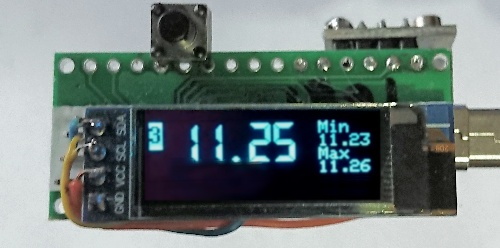
If you’re reading Hackaday, you almost certainly have a voltmeter. Matter of fact, we wouldn’t be surprised to hear you had two of them. But what if you needed to monitor four voltage levels at once? Even if you had four meters, getting them all connected and in a convenient enough place where you can see them all at once is no small feat. In that case, it sounds like the multi-channel wireless voltmeter put together by [Alun Morris] is for you.

Built as an exercise in minimalism, this project uses an array of components that most of us already have kicking around the parts bin. For each transmitter you’ll need an ATtiny microcontroller, a nRF24L01+ radio, a small rechargeable battery, and a handful of passive components. On the receiver side, there’s an OLED screen, another nRF radio module, and an Arduino Nano. You could put everything together on scraps of perfboard like [Alun] has, but if you need something a bit more robust for long-term use, this would be a great excuse to create some custom PCBs.

While the hardware itself is pretty simple, [Alun] clearly put a lot of work into the software side. The receiver’s 128 x 32 display is able to show the voltages from four transmitters at once, complete with individual indicators for battery and signal level. When you drill down to a single transmitter, the screen will also display the minimum and maximum values. With the added resolution of the full screen display, you even get a very slick faux LCD font to ogle.

Of course, there are some pretty hard limitations on such a simple system. Each transmitter can only handle positive DC voltages between 0 and 20, and depending on the quality of the components you use and environmental considerations like temperature, the accuracy may drift over time and require recalibration. Still, if you need a way to monitor multiple voltages and potentially even bring that data onto the Internet of Things, this is definitely a project to take a look at.

Continue reading “Wireless Quad Voltmeter Brings It All Together”

A Relay-Based Pseudorandom Number Generator

There are a great variety of ways to build a random number generator, and similarly many ways to generate numbers that appear random, but in a pure mathematical sense generally aren’t. [Daniel Valuch] built a Christmas decoration that does the latter, displaying the results on an attractive flashing ornament.

The build relies on a 16-bit linear feedback shift register, or LFSR. The LFSR generates a stream of numbers, with each number dependent on the previous state of the register. Thus, the numbers generated are pseudorandom, not truly random, and depend on the initial seed value of the system. [Daniel] built the shift register using relays, which create a lovely clacking sound as the register operates, and LEDs, which glow depending on the values in the register.

The result is a cute Christmas ornament that blinks in a deterministic fashion, and has a great old-school look due to the exposed copper of the PCB and the retro LED colors used. The project also serves as a great way to learn about shift registers and basic relay logic, though the latter is rarely used these days for serious purposes. We’ve covered the topic before, too. Video after the break.

Continue reading “A Relay-Based Pseudorandom Number Generator”

A PCB Diary

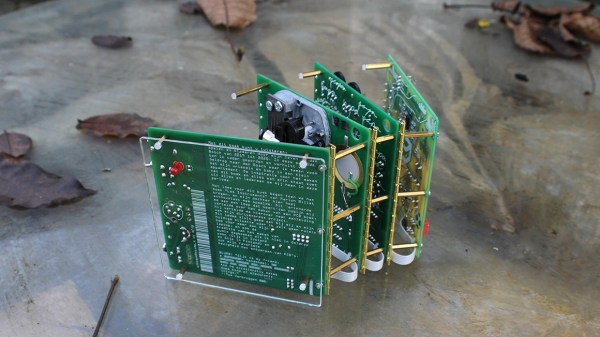
[Gijs Gieskes] has made another eye-catching PCB wonder, this time a diary built from several circuit boards which are assembled into a book, not unlike a PC/104 system. But with [Gijs]’s system you can easily open the stack-up to access single boards without disassembling the whole thing. We don’t see brass piano hinges on PCB assemblies very often, but [Gijs]’s PCB designs are anything but conventional. Hint: if you wanted to recreate this technique using more ordinary hardware, you can find hinged PCB standoffs from various suppliers.

Bicycle, soccer ball, smoke on the “No no no no no…” PCB

Apparently it’s more than a passive piece of art.  Each board has several circuits, some of which (all?) are functioning is ways not clearly described, which seems to be intentional. According to his build log, different things happen when you mix and match the inter-board ribbon cables in various ways. We are told in the instructions “to just try and see what happens”. No schematics are posted, but there is a partial description of the circuits in the manual and parts on the two-layer boards are well-labeled. Although after spot checking a few circuits board photos, we’d guess that no small number of traces, and perhaps some parts, are wild goose chases.

The project claims to be a diary for the years 2018 and 2019, but we will leave it as an exercise for the reader to interpret the messages that [Gijs] has embedded into this fascinating piece. We have written about several of his projects over the years, such as this crazy bent Casio SK-1 from all the way back in 2005. And before dismissing this “book” style of circuit board stack-up as only for artists, check out this teardown of a Soyuz clock we covered back in January.

PET 2001 Emulator On $2 Of Hardware

Since the late 60s, Moore’s law has predicted with precision that the number of semiconductors that will fit on a chip about doubles every two years. While this means more and more powerful computers, every year, it also means that old computers can be built on smaller and cheaper hardware. This project from [Bjoern] shows just how small, too, as he squeezes a PET 2001 onto the STM32 Blue Pill.

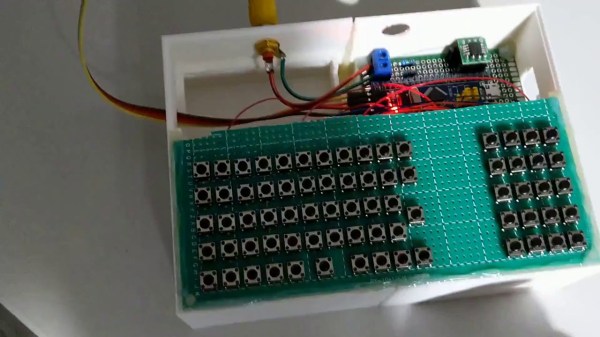
While the PET 2001 was an interesting computer built by Commodore this project wasn’t meant to be a faithful recreation, but rather to test the video output of the Blue Pill, with the PET emulation a secondary goal. It outputs a composite video signal which takes up a good bit of processing power, but the PET emulation still works, although it is slightly slow and isn’t optimized perfectly. [Bjoern] also wired up a working keyboard matrix as well although missed a few wire placements and made up for it in the software.

With his own home-brew software running on the $2 board, he has something interesting to display over his composite video output. While we can’t say we’d emulate an entire PC just to get experience with composite video, we’re happy to see someone did. If you’d like to see a more faithful recreation of this quirky piece of computing history, we’ve got that covered as well.

Continue reading “PET 2001 Emulator On $2 Of Hardware”

CentOS Is Dead, Long Live CentOS

On Tuesday, December 8th, Red Hat and CentOS announced the end of CentOS 8. To be specific, CentOS 8 will reach end of life at the end of 2021, 8 years ahead of schedule. To really understand what that means, and how we got here, it’s worth taking a trip down memory lane, and looking at how the history of Red Hat Enterprise Linux (RHEL), CentOS, and IBM are intertwined.

Continue reading “CentOS Is Dead, Long Live CentOS”