Pocket Woodwind MIDI Controller Helps You Carry A Tune

It’s easy to become obsessed with music, especially once you start playing. You want to make music everywhere you go, which is completely impractical. Don’t believe me? See how long you can get away with whistling on the subway or drumming your hands on any number of bus surfaces before your fellow passengers revolt. There’s a better way, and that way is portable USB MIDI controllers.

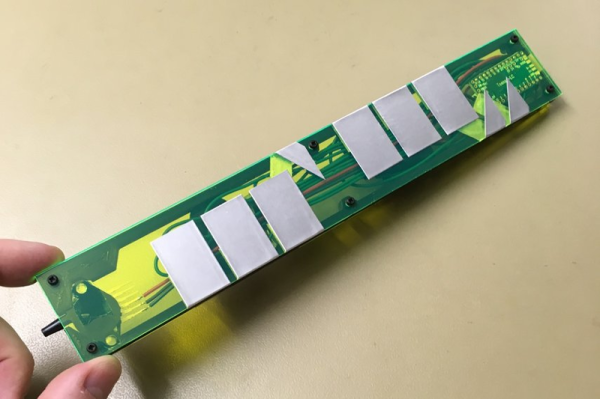
[Johan] wanted a pocket-sized woodwind MIDI controller, but all the existing ones he found were too big and bulky to carry around. With little more than a Teensy and a pressure sensor, he created TeensieWI.  It uses the built-in cap sense library to read input from the copper tape keys, generate MIDI messages, and send them over USB or DIN. Another pair of conductive pads on the back allow for octave changes. [Johan] later added a PSP joystick to do pitch bends, modulation, and glide. This is a simple build that creates a versatile instrument.

You don’t actually blow air into the mouthpiece—just let it escape from the sides of your mouth instead. That might take some getting used to if you’ve developed an embouchure. The values are determined by a pressure sensor that uses piezoresistivity to figure out how hard you’re blowing. There’s a default breath response value that can be configured in the settings.

TeensiWI should be easy to replicate or remix into any suitable chassis, though the UV-reactive acrylic looks pretty awesome. [Johan]’s documentation on IO is top-notch and includes a user guide with a fingering chart. For all you take-my-money types out there, [Johan] sells ’em ready to rock on Tindie. Check out the short demo clips after the break.

We saw a woodwind MIDI controller a few years ago that was eventually outfitted with an on-board synthesizer. Want to build a MIDI controller ? , like this beautiful build that uses hard drive platters as jog wheels.

Continue reading “Pocket Woodwind MIDI Controller Helps You Carry A Tune”

Drone License Plates: An Idea That Won’t Stave Off The Inevitable

As more and more drones hit the skies, we are beginning to encounter a modest number of problems that promise to balloon if ignored. 825,000 drones above a quarter-kilo in weight were sold in the U.S. in 2016. The question has become, how do we control all these drones?

Continue reading “Drone License Plates: An Idea That Won’t Stave Off The Inevitable”

“Hey! Don’t Lock The Door, I’m In Here!”

Those that work in front of a computer for a living spend most of the time making very little sound. Unless you’re a member of the clicky mechanical keyboard club, your working time is a low-observables time during which people can forget about you. You can make sure you’re not overlooked with this smartphone hotspot presence detector.

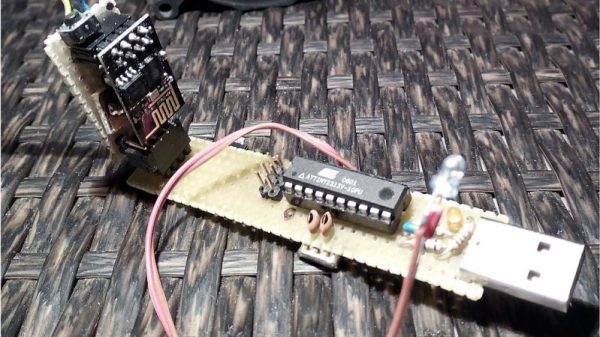
[Emilio Ficara]’s quiet work habits resulted in his housemates locking him in sometimes, to his inconvenience. PIR or microwave occupancy sensors might have worked to fix the problem, except that a few flexing fingers aren’t always enough to trigger them. Luckily, [Emilio] is also wisely distrustful of free WiFi, so his phone is always set up as a mobile hotspot, giving him the means to reliably detect his presence. An ATtiny2313 and an ESP-01 do the business of polling for the SSID of his phone and blinking a bright blue LED by his door for his housemates. It’s not perfect, of course; it could easily be spoofed by anyone else who knows his SSID. But simple works for now.

With almost everyone carrying one now, smartphone detection is a good proxy for the presence of a person. But it doesn’t work in every case, so you may want to familiarize yourself with the aforementioned PIR and microwave methods.

Shockingly, DARPA’s Brain Stimulator Might Not Be Complete Nonsense

Where does your mind jump when you hear the mention of electroshock therapy? The use of electrical current to treat various medical conditions has a long and controversial history. Our fascination with the medical applications of electricity have produced everything from the most alarming of patent medicines to life-saving devices like pacemakers and the Automatic External Defibrillator.

The oldest reference I could find is the use of the torpedo fish to allegedly cure headaches, gout, and so on in 43 CE. Incidentally, Torpedo torpedo is an awesome species name.

Dosage: Apply live fish as needed to face? Source

Much more recently, there has been interest in transcranial direct current stimulation (tDCS). In essence, it’s a technique by which you pass an electrical current (typically about 2 milliamps) between strategically positioned electrodes on your head. The precise reason to do this is a bit unclear; different journal articles have suggested improvements in cognition, learning, and/or the potential treatment of various diseases.

I think most of us here spend a lot of time studying. The idea that a simple, noninvasive device can accelerate that is very attractive. We’ve covered a few people building their own such devices.

Unfortunately, what we want to be true is irrelevant. Superficially, this looks like a DARPA-funded panacea with no clearly established mechanism of action. Various commercial products are being sold that imply (but as usual, don’t directly state) that tDCS is useful for treating pretty much everything, with ample use of ‘testimonials’.

While tDCS can be prescribed by a physician in some countries to complement a stroke rehabilitation regime, for off-label purposes you may as well just go apply a fish to your face. Let’s dig into the literature and products that are out there and see if we can find the promise hiding amidst the hype.

Continue reading “Shockingly, DARPA’s Brain Stimulator Might Not Be Complete Nonsense”

Tiny Tensor Brings Machine Deep Learning To Micros

We’ve talked about TensorFlow before — Google’s deep learning library. Crunching all that data is the province of big computers, not embedded systems, right? Not so fast. [Neil-Tan] and others have been working on uTensor, an implementation that runs on boards that support Mbed-OS 5.6 or higher.

Mbed of course is the embedded framework for ARM, and uTensor requires at least 256K of RAM on the chip and an SD card less than (that’s right; less than) 32 GB. If your board of choice doesn’t already have an SD card slot, you’ll need to add one.

Continue reading “Tiny Tensor Brings Machine Deep Learning To Micros”

Weather Station Needs Almost No Batteries

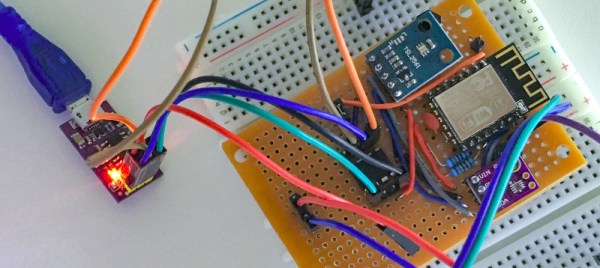
While the ESP8266 has made its way into virtually every situation where a low-cost WiFi solution is needed, it’s not known as being a low-power solution due to the amount of energy it takes to run WiFi. [Alex] took this design constraint as more of a challenge though, and with the help of an ATtiny microcontroller was able to develop a weather station using an ESP8266 that only needs new batteries every 2-4 years.

While the ESP8266 module consumes a bit of power, the ATtiny excels in low-power mode. To take advantage of this, [Alex] designed the weather station using the ATtiny to gather data every two minutes, store the data in a buffer, and upload all of it in bursts every hour using the ESP8266. This means that the power-hungry WiFi chip can stay off most of the time, drastically limiting the power demands of the station. [Alex] mostly details the setup of the ATtiny and the ESP8266 on his project page, so this could be applied anywhere that low power and network connectivity are required.

As for the weather reporting capabilities, the station is equipped to measure temperature, light, and humidity. Presumably more could be added but this might increase the power demands for the weather station as a whole. Still, changing batteries once a year instead of once every two years might be a worthwhile trade-off for anyone else attempting such an ambitious project. Other additions to the weather station that we’ve seen before might include a low-power display, too.

The VAIO WIth A Pi Inside

Raspberry Pi laptops are not an uncommon sight, as many hardware enthusiasts have shoehorned the tiny board behind LCD panels into home-made cases.

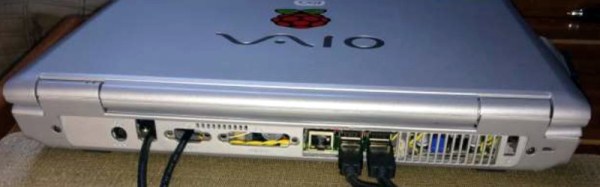
[Frank Adams] has created one of the best Pi laptops we’ve ever seen, (for which we suggest you skip straight to the PDF). He’s removed the guts from an aged Sony VAIO laptop and replaced it with the fruity computer, alongside a Teensy to handle VAIO keyboard, buttons, and LED I/O via the Pi USB port. An M.NT68676 video board interfaces the VAIO display to the Pi HDMI, and a USB to SATA cable is connected to a 240Gb solid state hard drive. The laptop’s Wi-Fi antenna is routed to the Pi via a soldered on co-axial connector, and there is also a real-time clock board. There are a few rough edges such as a USB cable that could be brought inboard, but it’s otherwise well-integrated into the case. His write-up is a very comprehensive PDF, that should serve as a good primer to anyone else considering such a laptop conversion.

The result is a laptop that looks for all the world like a commercially produced machine, yet that is also a Raspberry Pi. In a strange way, a Sony laptop is an apt homecoming for the board from Cambridge, because other than red soldermask or very early Chinese-made models, all Raspberry Pi boards are made in a Sony factory in Wales. Whatever the donor laptop though, this is definitely a step above the run-of-the-mill Pi laptops. To see its competition, take a look at this very ugly machine with a bare LCD panel, or this laser-cut sandwich laptop.